
医药生物

Search documents
基金三季度控盘比例超10%个股(附名单)
Zheng Quan Shi Bao Wang· 2025-10-29 04:05
Core Insights - The report indicates that 2888 stocks are listed as heavy holdings by funds in the third quarter, with 108 stocks having a fund holding ratio exceeding 10% [1][2] - A total of 15 stocks have a fund holding ratio above 20%, while 93 stocks fall between 10% and 20%, and 245 stocks have a holding ratio between 5% and 10% [1] - The stock with the highest fund holding ratio is Xinyi Technology, with 1124 funds collectively holding 301.04 million shares, accounting for 34.00% of its circulating stock [2][3] Fund Holdings Overview - Among stocks with a fund holding ratio over 10%, 48 stocks are held by more than 100 funds, and 25 stocks are held by 50 to 99 funds [2] - The stock with the most fund holders is CATL, with 2127 funds holding a total of 12.10% of its shares [2] - Other notable stocks with high fund holdings include Zijin Mining and Zhongji Xuchuang, with 1602 and 1162 funds holding them, respectively [2] Valuation Metrics - Among high fund holding stocks, 22 stocks have a price-to-earnings (P/E) ratio below 30, with China Ping An having the lowest dynamic P/E ratio of 5.90 [2] - Other stocks with low P/E ratios include Gujing Distillery, Luzhou Laojiao, and Shanxi Fenjiu, with dynamic P/E ratios of 11.00, 12.53, and 13.43, respectively [2] Sector Distribution - The stocks with high fund holdings are primarily concentrated in the electronics, pharmaceutical biology, and power equipment sectors, with 25, 21, and 13 stocks in these categories, respectively [2][3] - The report also highlights that there are 26 stocks in the Growth Enterprise Market, 42 in the Sci-Tech Innovation Board, 36 in the Shanghai and Shenzhen main boards, and 4 in the Beijing Stock Exchange [2]




社保基金长线坚守32只股(附股)
Zheng Quan Shi Bao Wang· 2025-10-29 03:46
Core Insights - The Social Security Fund has invested in 360 stocks by the end of Q3, with 32 stocks held for over 20 consecutive quarters, indicating a long-term investment strategy [1][2] Group 1: Investment Trends - The Social Security Fund has increased its holdings in 8 out of the 32 continuously held stocks, with significant increases in Hangyang Co., Yangnong Chemical, and Qixin Group, showing increases of 41.93%, 31.18%, and 18.76% respectively [2] - Conversely, 15 stocks saw a reduction in holdings, with notable decreases in Chengyi Pharmaceutical, Three Squirrels, and Chengde Lululemon, with reductions of 64.17%, 61.30%, and 56.24% respectively [2] Group 2: Industry Concentration - The 32 continuously held stocks are concentrated in the basic chemicals, pharmaceutical biology, and automotive sectors, with 6, 5, and 3 stocks respectively [2] - The basic chemicals sector includes stocks like Yangnong Chemical, Bluestar Technology, and Hangyang Co., while the pharmaceutical sector includes stocks like Wuwei Biological, Aide Biological, and Chengyi Pharmaceutical [2] Group 3: Performance Analysis - Among the 32 stocks, 20 reported a year-on-year increase in net profit, with Xiantan Co., China Jushi, and New Xing Casting showing significant growth rates of 72.48%, 67.51%, and 44.67% respectively [3] - Conversely, 11 stocks experienced a decline in net profit, with Zhongqi Co., Sanyou Chemical, and Three Squirrels showing declines of 622.16%, 69.18%, and 52.91% respectively [3]



上证180ETF华夏(510670)今日正式上市,A股三大指数悉数上涨,创业板指涨超1.5%
Mei Ri Jing Ji Xin Wen· 2025-10-29 02:53
Market Overview - On October 29, A-shares saw all three major indices rise, with the ChiNext Index increasing by over 1.5% [1] - Key sectors such as Hainan Free Trade Port, ultra-high voltage, copper-clad laminates, and energy storage remained active [1] ETF Performance - The newly listed Shanghai Stock Exchange 180 ETF (510670) experienced a slight increase, with top-performing holdings including Huaneng International, Industrial Fulian, TBEA, LONGi Green Energy, China Aluminum, and Top Group [1] - The Sci-Tech Innovation 50 ETF (159783) rose over 1% at one point, with leading stocks such as Canadian Solar, Sungrow Power Supply, Sanan Optoelectronics, Tigermed, and EVE Energy [1] Policy Insights - The Central Committee of the Communist Party of China released suggestions for the 15th Five-Year Plan on October 28, emphasizing the cultivation of emerging and future industries [1] - Strategic emerging industry clusters such as new energy, new materials, aerospace, and low-altitude economy are prioritized for development [1] - The plan aims to enhance the inclusiveness and adaptability of capital market systems and improve the coordination between investment and financing functions [1]

社保基金三季度抱团持有16股(附股)
Zheng Quan Shi Bao Wang· 2025-10-29 02:37
Core Insights - The Social Security Fund has disclosed its stock holdings as of the end of Q3, appearing in the top ten shareholders of 360 companies, with new investments in 108 companies and increased holdings in 93 companies [1][2] Group 1: Stock Holdings Overview - The total number of shares held by the Social Security Fund is 5.535 billion, with a total market value of 117.406 billion yuan [1] - The fund maintained its position in 49 companies, reduced holdings in 110 companies, and increased stakes in 93 companies [1] - The top three companies by shareholding are Sun Paper Industry (10.883 million shares), Weixing Co., Ltd. (7.314 million shares), and Guangxin Co., Ltd. (4.709 million shares) [1] Group 2: Shareholding Proportions - The highest shareholding proportion is in Norsun, with 8.16% of circulating shares, followed by Baiao Intelligent at 7.23% [1] - A total of 19 companies have over 50 million shares held by the Social Security Fund, with Vanadium Titanium Holdings leading at 170 million shares [1][2] Group 3: Performance of Held Stocks - Among the stocks held, 227 companies reported year-on-year net profit growth, with the highest increase seen in Xinqianglian at 1939.50% [2] - The average performance of the Social Security Fund's heavy stocks since October has seen a slight increase of 0.03%, underperforming the Shanghai Composite Index [2] - Notable performers include Beifang Changlong with a cumulative increase of 46.53%, while Guomai Culture experienced the largest decline at 41.78% [2] Group 4: Sector Distribution - The Social Security Fund's holdings are primarily concentrated in the pharmaceutical, machinery, and basic chemical industries, with 39, 36, and 34 companies respectively [2] - The distribution of holdings includes 244 companies on the main board, 86 on the ChiNext board, and 29 on the Sci-Tech Innovation board [2]
467只科创板股现身基金重仓股名单
Zheng Quan Shi Bao Wang· 2025-10-29 02:15
Group 1 - In the third quarter, 467 Sci-tech Innovation Board stocks appeared in the fund's heavy holdings list, with 54 new additions, 196 increased holdings, and 212 reduced holdings compared to the previous quarter [1] - The total holding amount of these stocks reached 4.594 billion shares, with a total market value of 571.853 billion yuan at the end of the period [1] - The top three stocks by fund holding volume are SMIC, Lattice Semiconductor, and Haiguang Information, with holdings of 396 million shares, 292 million shares, and 207 million shares respectively [1] Group 2 - The stocks with the highest fund holding ratios include BeiGene, Baillie Gifford, and Lattice Semiconductor, with holding ratios of 26.78%, 26.63%, and 25.49% respectively [2] - A total of 186 stocks are held by more than 10 funds, while 89 stocks saw collective new investments from 5 to 9 funds [1][2] - The stock with the most fund holders is Cambricon Technologies, with 925 funds collectively holding 53.816 million shares, accounting for 12.86% of its circulating shares [1] Group 3 - In terms of changes in holdings, 54 new stocks were added, with the most significant new positions in China Shipbuilding Gas, SANY Heavy Energy, and World, holding 15.456 million shares, 2.5973 million shares, and 1.9851 million shares respectively [2] - The stocks with the highest increase in holdings include Yunzhong Technology, Jiachi Technology, and Yandong Micro, with increases of 180930.52%, 113289.44%, and 56633.22% respectively [2] - The stocks with the largest reductions in holdings include Baotai, Xingfu Electronics, and Yingstone Network, with reductions of 99.88%, 99.52%, and 99.29% respectively [2]



机构风向标 | 昊帆生物(301393)2025年三季度已披露前十大机构持股比例合计下跌2.00个百分点
Sou Hu Cai Jing· 2025-10-29 02:15
Core Insights - Haofan Bio (301393.SZ) reported its Q3 2025 results, revealing that as of October 28, 2025, six institutional investors held a total of 8.0947 million shares, representing 7.50% of the company's total equity. This marks a decrease of 2.00 percentage points from the previous quarter [1] Institutional Holdings - The institutional investors include Ningbo Haoxin Enterprise Management Consulting Partnership, Suzhou Haoyin Venture Capital Partnership, Industrial and Commercial Bank of China - Huatai Securities Healthcare Mixed Fund, Suzhou Haofan Bio's repurchase special securities account, Abu Dhabi Investment Authority, and Minsheng Securities - CITIC Bank - Minsheng Securities Haofan Bio Strategic Placement No. 1 Collective Asset Management Plan [1] - The public fund that increased its holdings this period is Huatai Securities Healthcare Mixed Fund, with an increase of 0.24% [1] - A total of 75 public funds that were not disclosed in the previous quarter include various funds such as Huisheng Healthcare 6-Month Holding Mixed Fund and others [1] Social Security Fund - One social security fund, the National Social Security Fund 109 Portfolio, was not disclosed in the previous quarter [1]
创业板融资余额增加22.28亿元,31股获融资客大手笔加仓
Zheng Quan Shi Bao Wang· 2025-10-29 02:10
Core Insights - The latest financing balance of the ChiNext market is 529.425 billion yuan, with a week-on-week increase of 2.228 billion yuan, and 31 stocks have seen financing balances increase by over 10% [1][2] - On October 28, the ChiNext index fell by 0.15%, while the total margin balance of ChiNext stocks reached 531.281 billion yuan, marking a continuous increase for three trading days [1][2] - The stock with the largest increase in financing balance is Dingtai High-Tech, which saw a 43.45% increase, with a latest financing balance of 450 million yuan [1][3] Financing Balance Increase - Among the 477 stocks with increased financing balances, 31 stocks had an increase of over 10%, with Dingtai High-Tech leading at 43.45% [1][3] - Other notable increases include Zhiou Technology and Tianyi Medical, with increases of 37.10% and 35.53% respectively [1][3] - The average increase for stocks with financing balance growth exceeding 10% was 3.34%, with 24 stocks rising, including Jianglong Shipbuilding, which hit the daily limit [2][4] Financing Balance Decrease - A total of 469 stocks experienced a decrease in financing balance, with 10 stocks seeing a decline of over 10%, led by Jiebang Technology with a decrease of 16.20% [4][5] - Other significant declines were noted in Dongtian Micro and Weston, with decreases of 15.99% and 15.79% respectively [4][5] - The overall trend indicates a mixed performance in the market, with both increases and decreases in financing balances across various sectors [4][5]
自带杠铃策略的上证180ETF指数基金(530280)近1周涨幅排名可比基金首位
Sou Hu Cai Jing· 2025-10-29 02:03
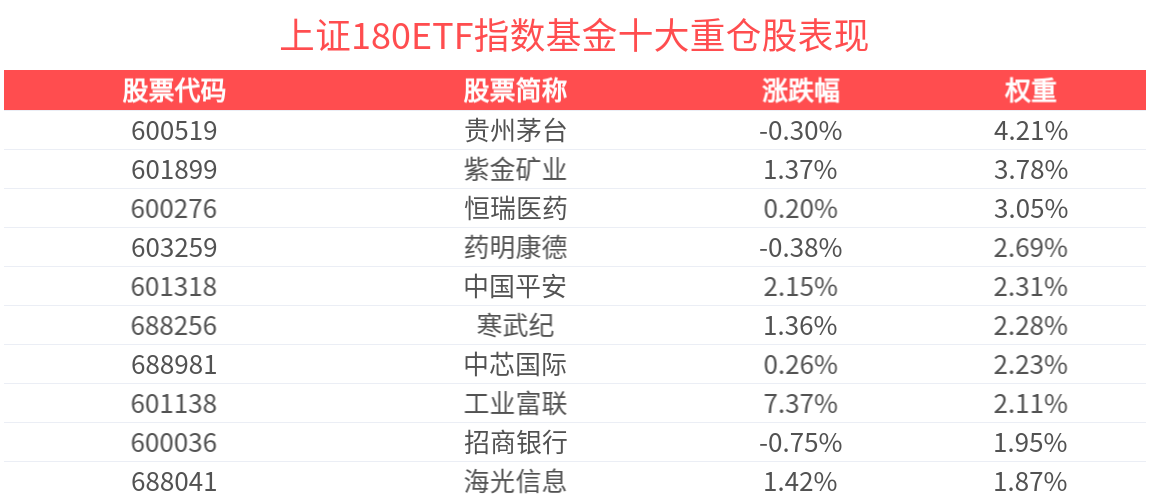
Core Viewpoint - The short-term market fluctuations do not alter the long-term slow bull trend of the stock market, with dividend and technology assets expected to yield excess returns in the long run [1] Group 1: Market Trends - The allocation of residents' assets is gradually increasing in the equity market, which is expected to benefit dividend assets first [1] - Technology assets represent the trend of economic development and have strong long-term growth certainty [1] - The Shanghai Stock Exchange 180 Index follows a barbell strategy with 90% in dividend and 10% in technology, making it a good choice for equity market allocation [1] Group 2: Index Performance - As of October 29, 2025, the Shanghai Stock Exchange 180 Index (000010) rose by 0.31%, with notable increases in component stocks such as Industrial Fulian (601138) up 7.37% and Huaneng International (600011) up 6.86% [1] - The Shanghai Stock Exchange 180 ETF Index Fund (530280) is experiencing a tug-of-war in the market, with the latest quote at 1.24 yuan [1] - Over the week leading up to October 28, 2025, the Shanghai Stock Exchange 180 ETF Index Fund accumulated a rise of 1.97%, ranking 1/10 among comparable funds [1] Group 3: Top Holdings - As of September 30, 2025, the top ten weighted stocks in the Shanghai Stock Exchange 180 Index (000010) include Kweichow Moutai (600519), Zijin Mining (601899), and others, accounting for a total of 26.75% of the index [2]




智通港股沽空统计|10月29日
智通财经网· 2025-10-29 00:22
Core Insights - The article highlights the top short-selling stocks in the market, with Anta Sports-R and Great Wall Motors-R both having a short-selling ratio of 100.00% [1][2] - Alibaba-SW leads in short-selling amount at 1.343 billion, followed by Pop Mart at 1.242 billion and Tencent Holdings at 1.215 billion [1][2] Short-Selling Ratios - Anta Sports-R (82020) has a short-selling amount of 635,500 and a ratio of 100.00% with a deviation of 10.36% [2] - Great Wall Motors-R (82333) has a short-selling amount of 7,250 and a ratio of 100.00% with a deviation of 30.20% [2] - SenseTime-WR (80020) has a short-selling amount of 1,122,200 and a ratio of 97.63% with a deviation of 51.92% [2] - Lenovo Group-R (80992) has a short-selling amount of 2,438,200 and a ratio of 94.23% with a deviation of 34.69% [2] Short-Selling Amounts - Alibaba-SW (09988) has a short-selling amount of 1.343 billion with a ratio of 9.98% and a deviation of -6.17% [2] - Pop Mart (09992) has a short-selling amount of 1.242 billion with a ratio of 30.78% and a deviation of 9.42% [2] - Tencent Holdings (00700) has a short-selling amount of 1.215 billion with a ratio of 11.50% and a deviation of -4.97% [2] Short-Selling Deviation Values - SenseTime-WR (80020) has the highest deviation value at 51.92% [2] - HAPO Pharmaceutical-B (02142) has a short-selling amount of 15,513,500 with a deviation of 37.04% [2] - Lenovo Group-R (80992) has a deviation of 34.69% [2] - Great Wall Motors-R (82333) has a deviation of 30.20% [2]

公募调研频次显著提升 医药生物受青睐
Sou Hu Cai Jing· 2025-10-28 23:39
Group 1 - The core viewpoint of the article highlights a significant increase in public fund research activities during the third quarter report disclosure period, with 140 public fund institutions participating in the research of 99 A-share listed companies, resulting in a total of 1,188 research instances, a week-on-week increase of 121.64% [1] Group 2 - The pharmaceutical and biotechnology sector emerged as the most favored industry among public funds, with a total of 197 research instances [1] - Other industries that received considerable attention include machinery and equipment, basic chemicals, electric equipment, and automobiles [1] Group 3 - According to the report from the fund, short-term market sentiment may still be influenced by the Federal Reserve's interest rate meeting and the performance of domestic listed companies' third-quarter reports, but the long-term revaluation logic of Chinese assets remains unchanged, with the index expected to continue a trend of fluctuating upward [1]