
煤炭开采

Search documents
新版《煤矿安全规程》将于2026年2月1日起施行 立规明矩强化矿山安全治理
Jing Ji Ri Bao· 2025-09-16 00:26
Core Viewpoint - The newly revised "Coal Mine Safety Regulations" will take effect on February 1, 2026, marking the 16th revision since its initial release in 1951, with significant updates aimed at enhancing safety in coal mining operations [1][4]. Group 1: Key Changes in Regulations - The new regulations include 56 new articles and substantial modifications to 353 existing articles, representing a comprehensive overhaul of the previous guidelines [1]. - The regulations emphasize the importance of addressing current challenges in coal mine safety, incorporating lessons learned from past experiences and advancements in technology and equipment [1][2]. Group 2: Enhanced Safety Measures - New requirements for disaster prevention have been introduced, including strict assessments of disaster levels related to gas, rock bursts, spontaneous combustion, coal dust explosions, and landslide risks in open-pit mines [2]. - Specific measures for gas prevention, water hazard management, fire prevention, and rock burst control have been outlined, including a four-step method for water hazard management [2]. Group 3: Organizational and Technological Improvements - The regulations mandate coal mining companies to appoint technical leaders and establish comprehensive safety management systems, with specific roles defined for different types of mines based on their hazards [3]. - The regulations promote the integration of automation and intelligent technologies across various mining processes, supporting the development of safer and more efficient mining operations [3]. Group 4: Historical Context and Future Directions - Since the establishment of the People's Republic of China, coal production has increased from 32.43 million tons in 1949 to 4.78 billion tons last year, highlighting the critical role of the "Coal Mine Safety Regulations" in this transformation [4]. - Following the release of the new regulations, related enforcement guidelines and training standards will be updated to ensure compliance and enhance safety awareness among workers [4].
区域经济研究报告:山西左权:特色农旅发展迅速,产业升级潜力较大
China Post Securities· 2025-09-15 11:55
1. Report Industry Investment Rating No relevant content provided. 2. Core Viewpoints of the Report - The economic recovery in Zuoquan County is evident, with the tertiary industry becoming the dominant sector, but investment-driven growth is insufficient [2][10]. - The county is rich in mineral, agricultural, and cultural tourism resources, yet the industrial chain needs to be extended overall [3][4]. - The county has implemented strong investment promotion policies and adopted a layout of "one axis with multiple clusters" for advantageous industries [4]. - Despite having great potential for economic development, concerns such as short agricultural industrial chains, grid structure issues, and low - end industrial products need to be addressed [62]. 3. Summary According to the Catalog 3.1 Economic Foundation Analysis - **Economic Growth**: In 2024, Zuoquan County's GDP reached 8.04 billion yuan, with a growth rate rebounding from - 7.4% in 2023 to 4.1%, ranking third in the city. Economically, it belongs to the third - tier group in Jinzhong City [10]. - **Tertiary - Industry Composition**: The county's tertiary - industry composition shows a pattern of "stable growth in the primary industry, decline in the secondary industry, and a leap in the tertiary industry". In 2024, the tertiary industry's proportion leaped to 60.3%, surpassing the secondary industry [12]. - **Investment and Consumption**: In 2024, the county's total social fixed - asset investment decreased by 1%, and real - estate development investment decreased by 17.6%. Consumption in the catering industry increased significantly, with social consumer goods retail总额 increasing by 1.9% [19][22]. - **Resident Population Change**: By the end of 2024, the county's permanent population was 140,897, with a urbanization rate of 55.99%, lower than the provincial average. The population showed negative growth [25]. 3.2 Resource and Industrial Endowment - **Natural Resource Endowment**: The county has 30 types of minerals. Coal and iron ore have high mining values. It also has three major cultural tourism scenic areas and three leading agricultural industries (walnuts, black goats, and forsythia) [26][30][33]. - **Employment Contribution**: Planting and mining are the main forces driving employment. The primary industry has obvious employment - driving effects, and the secondary and tertiary industries' employment has increased [36][40]. - **Resource Competition Pattern**: The coal industry has limited competitiveness, while there is room for exploration in agriculture and cultural tourism. The county needs to address issues such as extending the industrial chain and strengthening brand building [44][46][47]. 3.3 Industrial Policy - **Investment Promotion Policy**: The county promotes investment promotion as a "No. 1 project", implementing measures such as improving approval processes, tax incentives, and providing land and financial support [48]. - **Industrial Park Layout**: The county adopts a layout of "one axis with multiple clusters", focusing on developing new energy and light industries. Each cluster has its own development direction, and infrastructure and environmental protection requirements are unified [51][58]. - **Industrial Development Potential**: The county has the potential to develop characteristic industrial clusters, but is restricted by issues such as grid structure and the need for industrial chain extension [59][60]. 3.4 Summary and Suggestions - **Agricultural Development**: Extend the industrial chain, strengthen brand building, cultivate leading enterprises, and improve market - oriented and standardized operation levels [62]. - **Grid Structure**: Accelerate grid project construction and optimize the new - energy grid - connection and consumption system [63]. - **Industrial Development**: Promote industrial transformation and upgrading, increase technological innovation and R & D investment, and cultivate emerging industries and high - end manufacturing [64].
港股收盘(09.15) | 恒指收涨0.22% 锂电、汽车产业链亮眼 宁德时代(03750)涨超7%创新高
Zhi Tong Cai Jing· 2025-09-15 08:57
Market Overview - The Hong Kong stock market opened lower but rebounded, with the Hang Seng Index closing up 0.22% at 26,446.56 points and a total turnover of HKD 290.2 billion [1] - The Hang Seng China Enterprises Index rose 0.21% to 9,384.76 points, while the Hang Seng Tech Index increased by 0.91% to 6,043.61 points [1] Blue Chip Performance - WuXi Biologics (02269) led blue-chip stocks, rising 6.47% to HKD 38.84, contributing 13.66 points to the Hang Seng Index [2] - Other notable blue-chip performers included Li Auto-W (02015) up 4.56% and Nongfu Spring (09633) up 4.11% [2] Sector Highlights - The large technology stocks mostly rose, with Alibaba up over 2% and Kuaishou up 1% [3] - The lithium battery sector saw significant gains, with CATL (03750) surging 7% to a new high [3] - The pharmaceutical sector also performed well, with Jiangsu Hengrui Medicine (02617) skyrocketing 115% [3] Policy and Industry Developments - The National Development and Reform Commission and the National Energy Administration announced a plan to achieve a new energy storage capacity of over 180 million kilowatts by 2027, with an investment of approximately RMB 250 billion [4] - The Ministry of Industry and Information Technology released a plan for the automotive industry aiming for 32.3 million vehicle sales in 2025, with a focus on new energy vehicles [6] Stock Movements - Jiangsu Hengrui Medicine (02617) experienced a dramatic increase of 115.58%, reaching HKD 415 [8] - Lion Group (02562) surged 25.34% to HKD 19.24 after announcing a binding investment agreement in AI and blockchain [9] - Shanghai Fudan (01385) faced pressure, dropping 3.77% to HKD 37.82, following its inclusion in the U.S. entity list [11]

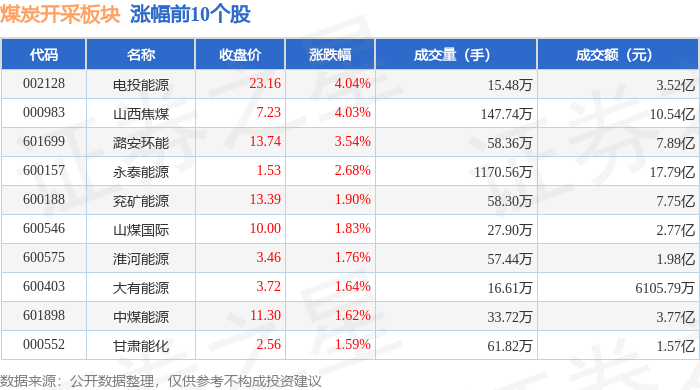
煤炭开采板块9月15日涨1.29%,电投能源领涨,主力资金净流入3.23亿元
Zheng Xing Xing Ye Ri Bao· 2025-09-15 08:49
Group 1 - The coal mining sector increased by 1.29% on September 15, with Electric Power Investment leading the gains [1] - The Shanghai Composite Index closed at 3860.5, down 0.26%, while the Shenzhen Component Index closed at 13005.77, up 0.63% [1] - Key stocks in the coal mining sector showed significant price increases, with Electric Power Investment rising by 4.04% to a closing price of 23.16 [1] Group 2 - The coal mining sector experienced a net inflow of 323 million yuan from main funds, while retail investors saw a net outflow of 250 million yuan [2] - Major stocks like Shanxi Coking Coal and Shaanxi Coal and Chemical Industries had notable net inflows from main funds, indicating strong institutional interest [3] - The overall trading volume in the coal mining sector was substantial, with Shanxi Coking Coal achieving a transaction amount of 1.054 billion yuan [1][2]





山煤国际涨2.04%,成交额2.07亿元,主力资金净流入2330.21万元
Xin Lang Zheng Quan· 2025-09-15 06:07
Core Viewpoint - Shanxi Coal International's stock price has shown fluctuations, with a recent increase of 2.04% and a year-to-date decline of 10.05%, indicating potential volatility in the market [1] Financial Performance - For the first half of 2025, Shanxi Coal International reported revenue of 9.66 billion yuan, a year-on-year decrease of 31.28%, and a net profit attributable to shareholders of 655 million yuan, down 49.25% compared to the previous year [2] - Cumulative cash dividends since the company's A-share listing amount to 11.57 billion yuan, with 7.12 billion yuan distributed over the last three years [3] Shareholder Information - As of June 30, 2025, the number of shareholders increased by 14.65% to 82,600, while the average circulating shares per person decreased by 12.78% to 23,989 shares [2] - The top circulating shareholders include Huatai-PB SSE Dividend ETF, holding 43.13 million shares, and Hong Kong Central Clearing Limited, holding 26.75 million shares, both showing a decrease in holdings [3]
山西焦煤涨2.01%,成交额3.75亿元,主力资金净流入4650.15万元
Xin Lang Cai Jing· 2025-09-15 03:44
Group 1 - The stock price of Shanxi Coking Coal increased by 2.01% on September 15, reaching 7.09 CNY per share, with a trading volume of 375 million CNY and a market capitalization of 40.251 billion CNY [1] - Year-to-date, Shanxi Coking Coal's stock price has decreased by 11.60%, with a recent 5-day increase of 0.85% and a 20-day decrease of 2.21% [1] - The company has appeared on the trading leaderboard once this year, with the most recent occurrence on July 22, where it recorded a net purchase of 102 million CNY [1] Group 2 - Shanxi Coking Coal Energy Group Co., Ltd. was established on April 26, 1999, and listed on July 26, 2000, primarily engaged in coal production, processing, sales, and power generation [2] - The company's revenue composition includes coal (57.58%), coke and tar (23.18%), electricity and heat (17.42%), and other income (1.67%) [2] - As of August 29, the number of shareholders for Shanxi Coking Coal was 161,000, a decrease of 2.08% from the previous period [2] Group 3 - Shanxi Coking Coal has distributed a total of 23.815 billion CNY in dividends since its A-share listing, with 12.603 billion CNY distributed in the last three years [3] - As of June 30, 2025, the top ten circulating shareholders include Hong Kong Central Clearing Limited and several ETFs, with varying changes in their holdings [3]
潞安环能涨2.03%,成交额2.89亿元,主力资金净流入364.74万元
Xin Lang Zheng Quan· 2025-09-15 03:39
Core Viewpoint - Lu'an Environmental Energy has shown fluctuations in stock performance, with a recent increase in share price and notable trading activity, indicating potential investor interest and market dynamics [1][2]. Company Overview - Lu'an Environmental Energy, established on July 19, 2001, and listed on September 22, 2006, is based in Xiangyuan County, Changzhi City, Shanxi Province. The company primarily engages in raw coal mining, coal washing, and coke smelting, with its main coal types being lean coal, poor lean coal, and poor coal [2]. - The company's revenue composition is as follows: coal accounts for 92.66%, coke for 5.53%, and other sources for 1.81% [2]. Financial Performance - For the first half of 2025, Lu'an Environmental Energy reported a revenue of 14.069 billion yuan, a year-on-year decrease of 20.31%. The net profit attributable to shareholders was 1.348 billion yuan, down 39.44% year-on-year [2]. - The company has distributed a total of 25.851 billion yuan in dividends since its A-share listing, with 14.505 billion yuan distributed over the past three years [3]. Shareholder Information - As of June 30, 2025, the number of shareholders for Lu'an Environmental Energy was 71,000, a decrease of 8.97% from the previous period. The average circulating shares per person increased by 9.86% to 42,132 shares [2]. - The top ten circulating shareholders include Hong Kong Central Clearing Limited, which holds 44.742 million shares, an increase of 7.126 million shares from the previous period [3].
兖矿能源涨2.13%,成交额3.97亿元,主力资金净流入134.70万元
Xin Lang Zheng Quan· 2025-09-15 03:34
Core Viewpoint - Yanzhou Coal Mining Company Limited has experienced fluctuations in stock price and financial performance, with a notable decrease in revenue and net profit year-on-year, while maintaining a significant market presence in the coal industry [1][2]. Financial Performance - As of June 30, 2025, Yanzhou Coal reported operating revenue of 59.349 billion yuan, a year-on-year decrease of 17.93% [2]. - The net profit attributable to shareholders was 4.652 billion yuan, reflecting a year-on-year decline of 38.53% [2]. - Year-to-date stock price has decreased by 1.54%, but has shown a recovery in the last 5 days (+1.67%), 20 days (+3.79%), and 60 days (+9.46%) [1]. Shareholder Information - The number of shareholders increased to 147,800, up by 1.14% compared to the previous period [2]. - The company has distributed a total of 86.846 billion yuan in dividends since its A-share listing, with 42.377 billion yuan distributed in the last three years [3]. Stock Market Activity - On September 15, 2023, Yanzhou Coal's stock price rose by 2.13% to 13.42 yuan per share, with a trading volume of 397 million yuan and a turnover rate of 0.51% [1]. - The company’s total market capitalization reached 134.703 billion yuan [1]. Major Shareholders - As of June 30, 2025, major shareholders include Hong Kong Central Clearing Limited, holding 110 million shares, and various ETFs such as Huatai-PB CSI 300 ETF and Guotai CSI Coal ETF, which have increased their holdings [3].
煤炭淡季开启,港口煤价震荡运行
Zhong Guo Neng Yuan Wang· 2025-09-15 03:09
Industry Overview - The spot price of thermal coal at ports increased by 1 CNY/ton this week, closing at 680 CNY/ton [1] - The average daily inflow to the four ports in the Bohai Rim was 1.6136 million tons, a decrease of 207,900 tons or 11.41% compared to last week [1] - The average daily outflow from the four ports was 1.5834 million tons, down by 255,900 tons or 13.91% from the previous week [1] - The average number of anchored vessels was 71, which is a decrease of 7 vessels or 8.82% from last week [1] - The inventory at the four ports in the Bohai Rim was 22.687 million tons, a slight decrease of 23,000 tons or 0.10% compared to last week [1] Demand and Supply Dynamics - The coal industry is entering the off-peak season, with a noticeable drop in national temperatures leading to reduced residential electricity demand [2] - The supply is stable, but the demand is weak, which may put pressure on inventory depletion in the short term [2] - Short-term coal prices are expected to remain volatile [2] Investment Recommendations - The focus remains on the incremental insurance funds, with premium income maintaining positive growth concentrated among leading insurance companies [3] - There is an ongoing shortage of fixed-income assets, and with dividend assets at high levels, there is a shift towards equity allocation, particularly favoring resource stocks [3] - Core recommendations include elastic thermal coal stocks, particularly those with low valuations such as Haohua Energy and Guanghui Energy [3]
西部证券晨会纪要-20250915
Western Securities· 2025-09-15 02:57
Group 1: Company Analysis - Dongfang Tieta (002545.SZ) - The company is expected to achieve net profits of 1.12 billion, 1.31 billion, and 1.60 billion yuan for the years 2025-2027, representing year-on-year growth of +98.43%, +17.16%, and +21.99% respectively [10][12] - The production of potassium chloride and phosphate projects is anticipated to drive significant revenue growth, with a target price of 17.1 yuan based on a 19x PE valuation for 2025 [10][11] - Concerns about potential oversupply in the potassium chloride and phosphate markets are mitigated by projections indicating a supply gap until 2028, suggesting sustained industry high profitability [10][11] Group 2: Company Analysis - Jinkong Coal Industry (601001.SH) - The company is projected to achieve net profits of 2.06 billion, 2.39 billion, and 2.80 billion yuan for 2025-2027, with EPS of 1.23, 1.43, and 1.68 yuan, reflecting a year-on-year growth of -26.58%, +15.81%, and +17.43% respectively [14][15] - The target price is set at 15.23 yuan per share, based on a combination of absolute and relative valuation methods [14][15] - The company is expected to maintain stable coal prices in the range of 700-800 yuan per ton, supported by a balanced supply-demand scenario [14][15] Group 3: Industry Analysis - Financial Data - The financial data for August indicates a decline in loan growth, with new loans amounting to 590 billion yuan, down from 900 billion yuan year-on-year [17][18] - The total social financing (TSF) increased by 2.57 trillion yuan, lower than the previous year's 3 trillion yuan, reflecting weak credit demand [17][18] - M2 growth remained steady at 8.8%, while M1 growth accelerated to 6%, indicating a shift in deposit behavior towards equity markets [17][18] Group 4: Industry Analysis - Public Fund Market - The public fund market saw a significant increase in the total scale of non-monetary funds, reaching 10.2 trillion yuan, up 6.9% from the previous half [20][21] - Equity fund holdings increased by 5.9% to 5.14 trillion yuan, with stock index funds growing by 14.6% to 1.95 trillion yuan [20][21] - The market share of banks, brokers, and third-party institutions in equity funds was 26.2%, 17.2%, and 19.3% respectively, indicating a slight decline in market share for banks and brokers [20][21]