
煤及褐煤

Search documents
“十四五”期间我省民营企业进出口破5万亿元
Xin Lang Cai Jing· 2026-01-31 23:41
Group 1 - During the "14th Five-Year Plan" period, the import and export value of private enterprises in Fujian reached 5.58 trillion yuan, an increase of 87.98% compared to the "13th Five-Year Plan" period, accounting for 57.83% of the province's total import and export value [1] - Exports from Fujian's private enterprises amounted to 4.06 trillion yuan, growing by 80.27%, while imports reached 1.52 trillion yuan, increasing by 112% [1] - Major imports included coal and lignite, metal ores and minerals, and grains, which saw increases of 6.64 times, 1.71 times, and 1.22 times respectively, contributing to a 51.92 percentage point increase in the province's private economy imports [1] Group 2 - Exports of automobiles, lithium batteries, medicinal materials and pharmaceuticals, and integrated circuits from Fujian's private enterprises grew significantly, with increases of 46.66 times, 33.43 times, 2.85 times, and 2.18 times respectively [1] - The demand for agricultural products such as palm oil, cassava and cassava starch, and poultry meat surged, with growth rates of 26.04 times, 19.62 times, and 10.79 times [1] - The import and export values with the two largest trading partners, ASEAN and the EU, doubled, reaching 1.25 trillion yuan and 797.98 billion yuan respectively, with growth rates of 107% and 117% [2]
2025年湖南对东盟进出口超1000亿元
Zhong Guo Xin Wen Wang· 2026-01-27 23:50
Core Insights - In 2025, Hunan's import and export volume with ASEAN is projected to exceed 101.27 billion RMB, representing a year-on-year growth of 2.8% [1] - Exports are expected to reach 63.28 billion RMB, while imports will amount to 37.99 billion RMB [1] Trade Partners - The top three trading partners for Hunan with ASEAN are Malaysia, Indonesia, and Vietnam, with trade volumes of 25.47 billion RMB, 23.17 billion RMB (up 30.5%), and 23.08 billion RMB (up 26.5%) respectively [1] Import Composition - Hunan's imports primarily consist of energy, minerals, rubber, and agricultural products, with significant growth in crude oil (up 23.7%), coal and lignite (up 6.6%), and metal ores (up 9.2%) [1] - Agricultural imports reached 3.82 billion RMB, marking a 41.4% increase, including 900 million RMB in palm oil, which had no imports in the previous year [1] Export Composition - Exports of electromechanical products are projected to be 40.81 billion RMB, reflecting a growth of 23.6% and accounting for over 60% of total exports [1] - Exports of "new three types" products, including electric vehicles, are expected to reach 5.81 billion RMB, showing a remarkable growth of 460% [1] Strategic Recommendations - Hunan's foreign trade enterprises are encouraged to leverage the upgraded China-ASEAN Free Trade Area 3.0 protocol and RCEP to enhance cooperation in the supply chain and reduce costs [2]
煤焦:12月煤炭进口创新高盘面震荡运行
Hua Bao Qi Huo· 2026-01-15 03:08
Report Summary 1. Report Industry Investment Rating - Not provided 2. Core Viewpoints of the Report - The central bank's positive statements in its meeting have boosted market sentiment. After the new year, the production of coal, coke, and steel enterprises has recovered. The downstream's pre - holiday restocking of raw materials supports the upstream's price - holding confidence. The short - term market price fluctuates sharply, and cautious operation is recommended [2] 3. Summary by Relevant Catalogs Market Performance - Yesterday, the coal and coke futures prices fluctuated, maintaining high volatility. In the spot market, the trading atmosphere in the coking coal market has been active recently, with the order volume at the mine mouth rebounding. Coal prices in many places have rebounded from low levels, and the quoted price of Mongolian No. 5 raw coal at the port has increased by more than 100 yuan/ton. Some coking plants in Inner Mongolia have started to raise coke prices, with dry - quenched coke up 55 yuan/ton, to be implemented from January 15 [2] Import Data - In December 2025, China imported 58.597 million tons of coal and lignite, a month - on - month increase of 33% and a year - on - year increase of 11.9%, hitting a record high for monthly imports. The annual cumulative import was about 490 million tons, a year - on - year decrease of 9.6% [2] Fundamental Situation - After the new year, coal mines have gradually resumed production. This week, the production of coking raw coal and clean coal has increased to 1.978 million tons and 0.768 million tons respectively. The raw coal inventory at mines has increased, while the clean coal inventory has further decreased. The downstream coke and steel enterprises have also resumed production and maintained a certain procurement rhythm for raw materials [2] - Last week, the daily customs clearance volume of Mongolian coal at the Ganqimaodu Port was 164,600 tons, 37,400 tons higher than the same period last year, and the port inventory remained relatively high [2] Demand Situation - In the past two weeks, the profitability rate of steel mills has expanded, and the average daily hot metal output of blast furnaces has stopped falling and rebounded. In the week of January 9, it was 2.295 million tons, an increase of 20,700 tons from the previous week and an increase of 51,300 tons compared with the same period last year. It is expected to show a steady and slight upward trend in the short term, and the steel mills' restocking rhythm for raw materials is expected to accelerate in the later stage, supporting the upstream's price - holding confidence [2]
2025年11月中国煤及褐煤进出口数量分别为4405万吨和44万吨
Chan Ye Xin Xi Wang· 2026-01-07 03:37
Core Viewpoint - In November 2025, China's coal and lignite imports decreased significantly, indicating a downward trend in demand and pricing in the coal market [1] Import Data - In November 2025, China imported 44.05 million tons of coal and lignite, a year-on-year decrease of 19.9% [1] - The import value for the same period was $3.207 billion, reflecting a year-on-year decline of 35.3% [1] Export Data - In November 2025, China exported 440,000 tons of coal, marking a year-on-year increase of 25.5% [1] - The export value was $6.5 million, which represents a year-on-year growth of 3.1% [1]


2025年10月中国煤及褐煤进出口数量分别为4174万吨和36万吨
Chan Ye Xin Xi Wang· 2025-12-12 03:20
Core Viewpoint - In October 2025, China's coal and lignite imports and exports experienced significant declines in both volume and value compared to the previous year, indicating a potential shift in the market dynamics for these commodities [1]. Import Summary - The import quantity of coal and lignite in October 2025 was 41.74 million tons, representing a year-on-year decrease of 9.7% [1]. - The import value for the same period was $2.979 billion, reflecting a year-on-year decline of 27.4% [1]. Export Summary - The export quantity of coal and lignite in October 2025 was 360,000 tons, which is a year-on-year decrease of 32.3% [1]. - The export value was $5.6 million, showing a year-on-year decline of 42.5% [1].

中国11月稀土出口环比增长26.5%,成品油进口“量增价跌”、铜矿“量价齐增”,大豆进口量环比下降14.5%
Hua Er Jie Jian Wen· 2025-12-08 09:41
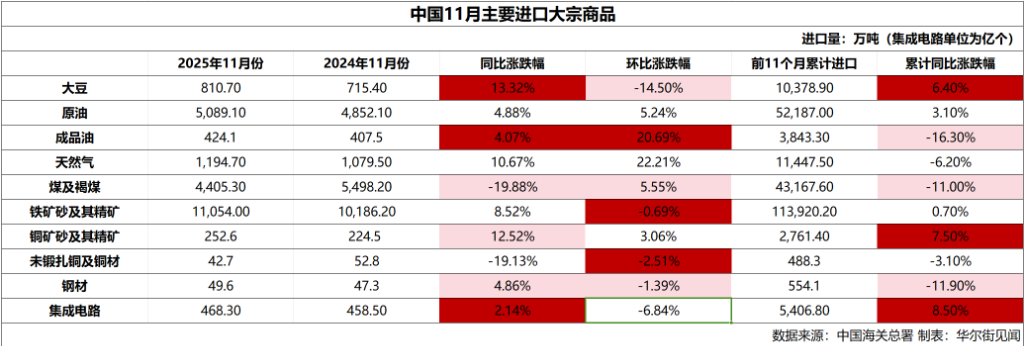
Core Insights - China's major commodity imports in November showed a clear divergence, with key agricultural products and high-end manufacturing-related products performing strongly, while refined oil and natural gas imports exhibited a "volume increase, price decrease" trend, and coal imports saw both volume and price decline [1] Import Performance - Total import value in November reached 1.55 trillion yuan, a 1.7% increase year-on-year, while the total trade value was 3.9 trillion yuan, growing by 4.1% [1] - Imports of integrated circuits, soybeans, and copper ore saw both volume and price increases, indicating strong demand for manufacturing upgrades and food security [1] - Energy imports displayed significant divergence: refined oil and natural gas volumes increased by 4.07% and 10.67%, respectively, but their import values fell by 2.85% and 5.40% [1][8] Agricultural Products - Soybean imports reached 810.7 million tons in November, a 13.32% year-on-year increase, with an import value of 269.2 billion yuan, up 7.59% [6] - Cumulative soybean imports for the first 11 months totaled 10.4 million tons, a 6.9% increase, although the average import price fell by 10.7%, leading to a total import value decline of 5.4% [6] Metals and Minerals - Copper ore imports increased by 12.52% in volume and 35.16% in value, reaching 521.3 billion yuan, indicating strong price support [7] - Iron ore imports remained stable, with November volumes at 11.05 million tons, a year-on-year increase of 8.52%, and import value rising by 15.76% to 796.3 billion yuan [7] - Steel imports declined by 6.5% in November, with a cumulative decline of 11.9% over the first 11 months [7] Energy Products - Refined oil and natural gas imports showed a "volume increase, price decrease" pattern, while coal imports experienced both volume and price declines, with coal import volume down by 19.88% and value down by 35.34% [8] - The average prices for coal, crude oil, and natural gas imports fell by 23.9%, 12.1%, and 9.4%, respectively, providing room for reducing domestic energy costs [8] Key Mineral Exports - China's rare earth exports surged by 26.5% month-on-month in November, reaching 5,493.9 tons, following a previous month of decline [9]
天风策略:12月美联储预计仍有较大概率降息
Sou Hu Cai Jing· 2025-11-09 10:52
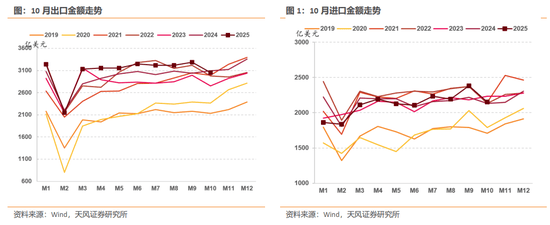
Group 1: Domestic Trade Data - In October, China's exports (in USD) decreased by 1.1% year-on-year, down from an increase of 8.3% in the previous month, while imports rose by 1.0%, down from 7.4% [3][5] - The trade surplus for October was reported at $90.07 billion, slightly down from $90.447 billion in the previous month [3] - The contribution of major trading partners to export growth showed a decline for the EU, ASEAN, Japan, and South Korea, while the US's contribution increased [5] Group 2: Transportation and Industrial Indicators - The subway passenger volume index in first-tier cities showed a slight recovery, reporting 40.61 million trips, up from 40.55 million [12] - The industrial production index increased to 117 from 113, with specific sectors like methanol and tires showing recovery, while soda ash declined [14] Group 3: Domestic Policy Developments - Premier Li Qiang co-hosted the 30th regular meeting of Chinese and Russian Prime Ministers with Russian Prime Minister Mishustin, emphasizing the deepening of Sino-Russian friendship [16][17] - Li Qiang also met with Georgian Prime Minister Kobakhidze to discuss economic cooperation and the Belt and Road Initiative [17] Group 4: International Monetary Policy Outlook - There is a significant probability of the Federal Reserve lowering interest rates by 25 basis points in December 2025, with a 66.9% chance of this occurring [26] - The current economic conditions and geopolitical tensions are influencing the Fed's potential policy decisions [26] Group 5: Industry Investment Recommendations - Investment strategies are suggested to focus on three main areas: breakthroughs in AI technology, economic recovery leading to a "stronger stronger" market trend, and the resurgence of undervalued sectors [28] - The initial phase of the bull market favors high-growth sectors, while later phases may see a shift towards cyclical stocks with better performance as the economic fundamentals improve [28]
2025年9月中国煤及褐煤进出口数量分别为4600万吨和73万吨
Chan Ye Xin Xi Wang· 2025-11-09 03:23
Core Insights - In September 2025, China's coal and lignite imports amounted to 46 million tons, representing a year-on-year decrease of 3.3% [1] - The import value for the same period was $3.127 billion, showing a significant decline of 28.1% year-on-year [1] - Conversely, coal and lignite exports reached 730,000 tons, marking a year-on-year increase of 51.1% [1] - The export value was $9.7 million, which is a year-on-year growth of 19.8% [1] Import Data Summary - The total import quantity of coal and lignite in September 2025 was 46 million tons, down 3.3% from the previous year [1] - The total import value for the same month was $3.127 billion, reflecting a decrease of 28.1% year-on-year [1] Export Data Summary - The total export quantity of coal and lignite in September 2025 was 730,000 tons, up 51.1% compared to the previous year [1] - The total export value for the same month was $0.097 billion, indicating a year-on-year increase of 19.8% [1]

2025年8月中国煤及褐煤进出口数量分别为4274万吨和53万吨
Chan Ye Xin Xi Wang· 2025-10-25 02:26
Core Viewpoint - China's coal and lignite imports and exports have significantly decreased in August 2025, indicating a downward trend in the coal market [1] Import Summary - In August 2025, China imported 42.74 million tons of coal and lignite, a year-on-year decrease of 6.7% [1] - The import value for the same period was $2.807 billion, reflecting a substantial year-on-year decline of 35.7% [1] Export Summary - China's coal and lignite exports in August 2025 amounted to 530,000 tons, which is a significant year-on-year decrease of 45.5% [1] - The export value for this period was $7.1 million, showing a dramatic year-on-year decline of 60.9% [1]

2025年4月中国煤及褐煤进出口数量分别为3783万吨和72万吨
Chan Ye Xin Xi Wang· 2025-10-20 01:29
Core Insights - The report by Zhiyan Consulting analyzes the supply and demand dynamics of the coal mining industry in China from 2025 to 2031, highlighting significant trends in import and export activities [1] Import Data - In April 2025, China's imports of coal and lignite reached 37.83 million tons, representing a year-on-year decrease of 16.4% [1] - The import value for the same period was $2.788 billion, which reflects a substantial year-on-year decline of 38.7% [1] Export Data - In April 2025, coal and lignite exports from China amounted to 720,000 tons, showing a year-on-year increase of 29.8% [1] - The export value during this period was $10.6 million, which indicates a year-on-year decrease of 7.8% [1] Industry Context - Zhiyan Consulting is recognized as a leading industry consulting firm in China, specializing in in-depth industry research reports, business plans, feasibility studies, and customized services [1] - The firm emphasizes its commitment to providing comprehensive industry solutions to empower investment decisions through professional insights and market acumen [1]
