Semiconductor

Search documents
2026全球IPO展望:资本流向、市场选择与估值范式
Sou Hu Cai Jing· 2025-12-25 10:19
Group 1 - The global IPO market is showing signs of recovery in 2026, with an increase in listing projects across multiple exchanges, particularly in AI, hard technology, energy, and advanced manufacturing [1][2] - The types of companies successfully advancing to IPOs are concentrated in a few industries characterized by high capital density, long investment cycles, and strong policy connections, while many light-asset and narrative-driven companies remain outside the listing doors [2][4] - The pricing logic for IPOs is shifting from a focus on growth potential to an emphasis on strategic necessity, cash flow verifiability, and long-term capital sustainability due to high interest rates and geopolitical factors [3][12] Group 2 - IPOs are transitioning from a "market reward mechanism" to a strategic asset selection and pricing mechanism, with significant premiums for companies in AI infrastructure, aerospace, and defense in the U.S. market, reflecting early pricing for "future critical infrastructure" [4][23] - In China, IPOs are increasingly associated with industrial upgrades and technological self-sufficiency, indicating a shift in the role of IPOs from mere market sentiment to fulfilling institutional functions [4][24] - The 2026 IPO landscape is characterized by a highly differentiated and selective return, where capital is not becoming more lenient but rather more concentrated and cautious [4][17] Group 3 - The evolution of IPO functions indicates a systemic shift, where the core function of IPOs is changing from being a primary channel for financing and investment exit to a mechanism for public pricing and confirmation of strategic assets [6][7] - The emergence of "strategic IPOs" is defined by companies that occupy critical nodes in the industrial chain, have capital-intensive operations, and are closely tied to national long-term development goals [13][15] - The current IPO logic excludes "story-driven IPOs," raising the threshold for entry into the public market, as companies relying on user scale or single application scenarios struggle to gain market recognition [15][41] Group 4 - The 2026 IPO market is not a uniform recovery but rather a simultaneous pricing of three distinct capital narratives across different markets: the U.S. focuses on "future infrastructure," China on "industrial upgrades and security," and emerging markets on "population dividends and digital penetration" [26][31] - The U.S. market is prioritizing companies that do not depend on short-term demand fluctuations but are embedded in national or global systems, with a focus on long-term cash flow predictability [22][23] - In contrast, the Chinese market emphasizes the strategic position of companies within the industrial chain, where IPOs serve as a mechanism for capitalizing on industrial capabilities rather than merely reflecting market sentiment [24][54] Group 5 - The 2026 IPO landscape indicates a preference for infrastructure and system node-type companies, with capital prioritizing "position" and "irreplaceability" over growth speed [48][49] - The IPO process is becoming a tool for risk transfer and asset confirmation, where companies with unclear business models are increasingly left in the private market [48][72] - The changes in the IPO market are expected to enhance the "signal-to-noise ratio" in capital markets, indicating that the cost of failure in IPOs is rising, and listing no longer guarantees a "safe zone" [72][73]


东莞产业链发展母基金招GP
FOFWEEKLY· 2025-12-25 09:59
Core Viewpoint - CITIC Private Equity Fund Management Co., Ltd., a wholly-owned subsidiary of CITIC Investment Holdings Co., Ltd., has established a mother fund with a total scale of 1.5 billion yuan, focusing on key industries such as artificial intelligence, semiconductor, and high-end manufacturing to promote industrial transformation in Dongguan [1]. Group 1 - The mother fund has a duration of 10 years, with an investment period of 5 years and an exit period of 5 years [1]. - The fund aims to invest in high-quality sub-funds across the country, specifically targeting industries aligned with Dongguan's development priorities [1]. - Each sub-fund is required to have a minimum total subscription scale of 300 million yuan and a maximum duration of 8 years, not exceeding the remaining duration of the mother fund [1]. Group 2 - The investment focus includes sectors such as artificial intelligence, electronic information, semiconductor and integrated circuits, new materials, and high-end manufacturing and robotics [1]. - The initiative is designed to support the landing of quality industries in Dongguan and facilitate the upgrade of its industrial structure [1].

Deutsche Bank’s Analysis of Q4 2025 Deliveries Drives Tesla (TSLA) Price Target Hike
Yahoo Finance· 2025-12-25 08:13
Group 1 - Deutsche Bank raised Tesla's price target to $500 from $470 with a Buy rating, driven by analysis of Q4 2025 delivery performance [1] - Truist analyst increased Tesla's price target to $444 from $406 with a Hold rating, while acknowledging challenges in securing electrical power and capital for AI infrastructure projects [2] - Goldman Sachs maintained a Neutral rating for Tesla with a $400 price target, monitoring potential regulatory hurdles in California regarding the Autopilot system [3] Group 2 - Tesla designs, develops, manufactures, leases, and sells electric vehicles and energy generation and storage systems globally, operating in two segments: Automotive and Energy Generation & Storage [4]

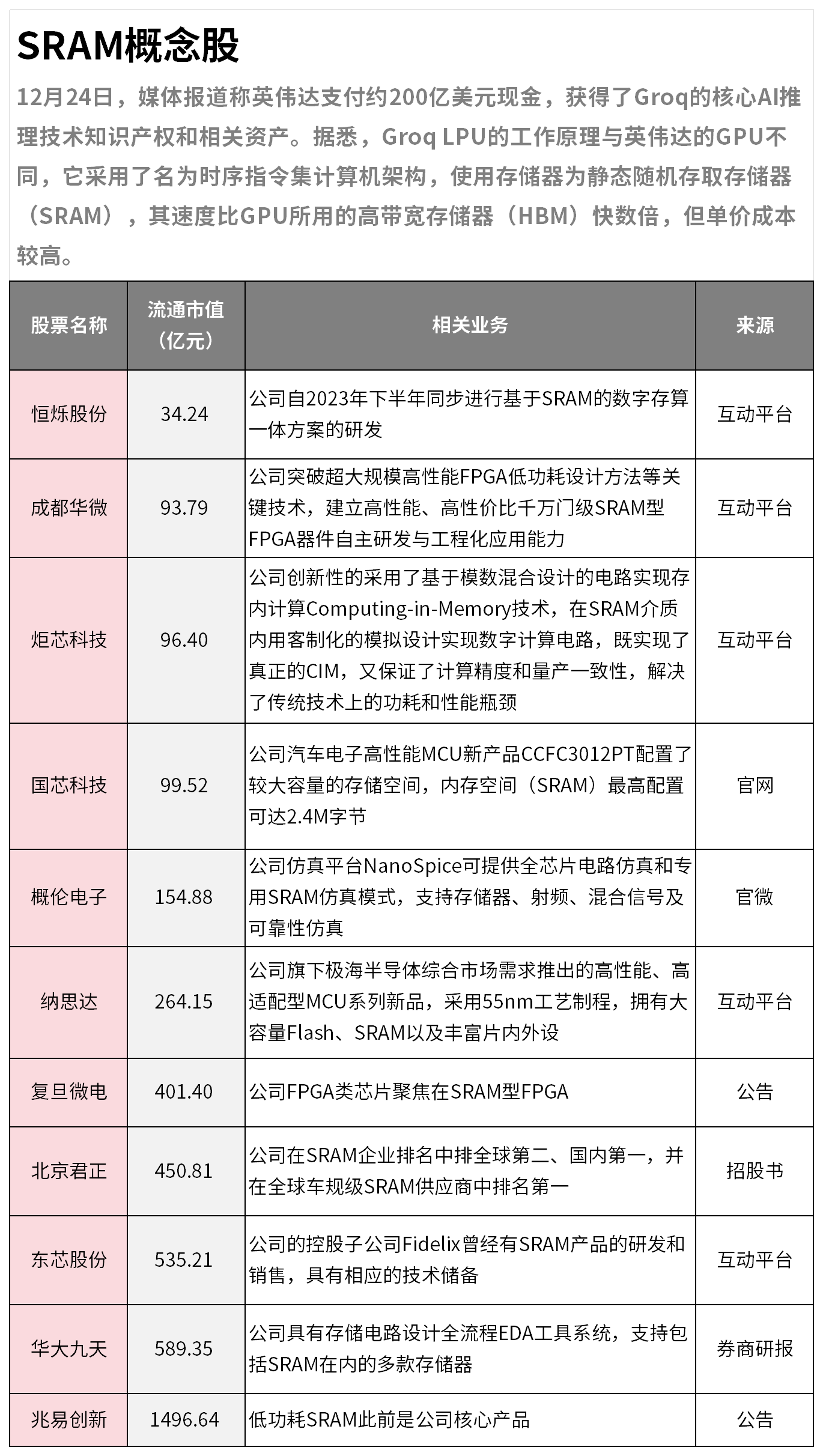
一图了解SRAM概念股
Xuan Gu Bao· 2025-12-25 06:43
Group 1 - Nvidia has paid approximately $20 billion in cash to acquire Groq's intellectual property and related assets, which utilize a timing instruction set computer architecture and SRAM, offering speeds several times faster than the high bandwidth memory (HBM) used in GPUs [1] Group 2 - Henglian Co., Ltd. has a market capitalization of 3.424 billion yuan and is developing SRAM-based digital body solutions since the second half of 2023 [2] - Chengdu Huamei has a market capitalization of 9.379 billion yuan and has achieved breakthroughs in low-power design methods for ultra-large-scale high-performance FPGAs, establishing capabilities for the independent research and engineering application of SRAM-based FPGA devices [2] - Juchip Technology has a market capitalization of 9.640 billion yuan and innovatively employs Computing-in-Memory technology based on mixed-signal design, addressing traditional power consumption and performance bottlenecks [2] - Guoxin Technology has a market capitalization of 9.952 billion yuan, with its automotive electronic MCU product featuring a maximum SRAM capacity of 2.4M bytes [2] - Gallen Electronics has a market capitalization of 15.488 billion yuan, providing full-chip circuit simulation using SRAM simulation mode [2] Group 3 - Nasda has a market capitalization of 26.415 billion yuan, launching a high-performance MCU series with 55nm process technology, featuring Flash, SRAM, and rich internal peripherals [3] - Fudan Microelectronics focuses on SRAM-based FPGA chips and has a market capitalization of 40.140 billion yuan [3] - Beijing Junzheng ranks second globally in SRAM companies and first among automotive-grade SRAM suppliers in China, with a market capitalization of 45.081 billion yuan [3] - Dongxin Co., Ltd. has a market capitalization of 53.521 billion yuan and has previously developed and sold SRAM products through its subsidiary Fidelix [3] - Huada Jiutian has a market capitalization of 58.935 billion yuan, offering a full-process EDA tool system for storage circuit design, including various memory types such as SRAM [3] - Zhaoyi Innovation has a market capitalization of 149.664 billion yuan, with low-power SRAM being a core product [3]
英伟达挖角Groq创始团队,押注AI推理芯片
Huan Qiu Wang Zi Xun· 2025-12-25 03:03
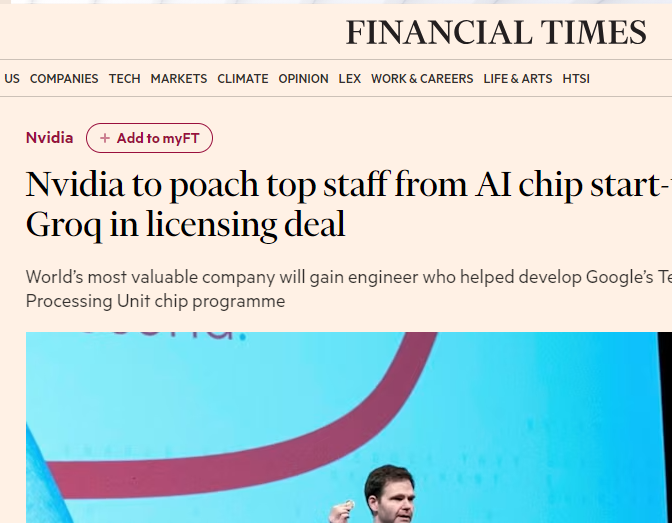
Core Insights - Nvidia has announced a technology licensing agreement with AI startup Groq, which is seen as a strategic move to solidify its dominance in the AI processor market [1][3] - Key personnel from Groq, including founder Jonathan Ross and president Sonny Madda, will join Nvidia, while Groq will continue to operate independently [3] Group 1: Company Strategy - Groq, founded in 2016 by former Google TPU project members, focuses on AI inference chip development, claiming energy efficiency ten times that of similar GPUs from Nvidia and AMD [3] - The agreement allows Nvidia to integrate Groq's low-latency processors into its "AI factory" architecture, expanding its service offerings for AI inference and real-time workloads [3] - The partnership employs a non-exclusive licensing model, which may serve as a compromise to mitigate antitrust risks amid increasing scrutiny in the tech industry [3] Group 2: Market Context - The deal comes as Nvidia faces pressure from clients to reduce dependency, with major customers like Amazon and Google developing their own AI chips or considering alternatives like TPUs [3] - To maintain its market position, Nvidia has been active this year, including a commitment of up to $100 billion to OpenAI, alongside the acquisition of Groq's core technology and talent [3]

英伟达豪掷200亿美金,谷歌TPU之父连夜投奔老黄
3 6 Ke· 2025-12-25 02:17
圣诞前夕,英伟达也没闲着。 一大早,CNBC独家爆料称,英伟达斥资史上最大200亿美金,一举收购了AI芯片初创Groq。 然而,实际上这并非是一场「收购」。 Groq官方发文做出回应:英伟达与Groq达成了一项推理技术授权协议。 与此同时,Groq创始人&CEO Jonathan Ross(谷歌TPU之父)、总裁Sunny Madra等工程团队一并加入英伟达。 这家Groq初创公司,未来还将独立运营,任命新的CEO。 这种合作方式,已经在业内成为「基操」,比如Meta与Scale AI、谷歌与Windsurf、微软与InfectionAI.... 不是收购,是「技术授权」 Groq在官网声明中强调,英伟达达成了「非独占性」技术授权协议(non-exclusive licensing)。 这意味着,英伟达将获得Groq核心推理技术使用权。未来,他们还计划将其低延迟芯片整合进产品体系中。 另外,Groq仍将独立运营,其云业务(GroqCloud)不受影响,新任CEO将由原财务主管Simon Edwards担任。 截至目前,这笔交易未披露具体细节。 仅有CNBC最初爆料称,将会达200亿美金级别,堪称英伟达史上最大 ...

希荻微12月24日获融资买入1521.54万元,融资余额1.88亿元
Xin Lang Cai Jing· 2025-12-25 01:38
Group 1 - The core viewpoint of the news highlights the trading performance and financial metrics of Xidi Microelectronics, indicating a slight increase in stock price and notable financing activities on December 24 [1] - On December 24, Xidi Microelectronics experienced a financing buy-in amount of 15.22 million yuan, with a net financing buy of -2.47 million yuan, reflecting a high financing balance of 188 million yuan, which constitutes 3.10% of its market capitalization [1] - The company's financing balance is above the 90th percentile of the past year, indicating a high level of investor interest [1] Group 2 - Xidi Microelectronics, established on September 11, 2012, and listed on January 21, 2022, is a leading semiconductor and integrated circuit design company in China, focusing on the research, design, and sales of analog integrated circuit products [2] - The company reported a revenue of 717 million yuan for the period from January to September 2025, representing a year-on-year growth of 107.81%, while the net profit attributable to shareholders was -76.35 million yuan, showing a 60.94% increase compared to the previous period [2] - As of September 30, 2025, the number of shareholders increased by 3.18% to 14,700, with an average of 27,736 circulating shares per person, which is a 64.39% increase [2]

市值近百亿龙迅股份赴港IPO,前三季度营收净利双增
Sou Hu Cai Jing· 2025-12-25 01:32
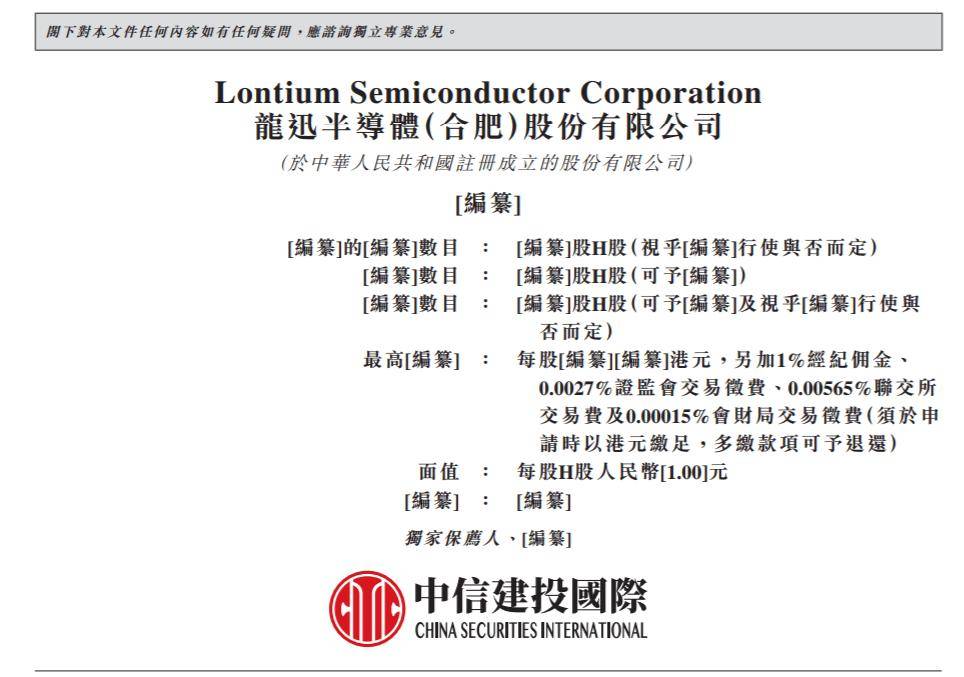
Core Viewpoint - Longxin Semiconductor Co., Ltd. has submitted an application for listing on the Hong Kong Stock Exchange, with CITIC Securities International as the exclusive sponsor [2]. Group 1: Company Overview - Longxin Semiconductor was established in 2006 and is a leading designer of high-speed mixed-signal chips, focusing on building efficient and reliable "data highways" for smart terminals, devices, and AI applications [3]. - As of December 23, 2023, Longxin Semiconductor's total market capitalization is approximately 9.793 billion RMB [3]. Group 2: Market Position - According to Frost & Sullivan, Longxin Semiconductor ranks first in the domestic video bridging chip market and is among the top five fabless design companies globally by revenue in 2024 [3]. Group 3: Financial Performance - For the fiscal years ending December 31, 2022, and 2023, Longxin Semiconductor reported revenues of 240.938 million RMB and 323.147 million RMB, respectively, with corresponding net profits of 69.206 million RMB and 102.696 million RMB [4]. - In the first nine months of 2025, the company achieved revenues of 389.203 million RMB and net profits of 124.508 million RMB, reflecting a year-on-year revenue growth of 16.47% and a net profit growth of 32.98% [6]. Group 4: Product Offering - Longxin Semiconductor provides end-to-end solutions that include capabilities for data collection, connectivity, processing, and display, with a product portfolio comprising 151 types of smart video chips and 110 types of interconnect chips as of September 30, 2025 [5].
Nvidia Absorbs Another Rival for $20B, Boosting Decentralized AI
Yahoo Finance· 2025-12-25 00:53
Acquisition Strategy - NVIDIA has agreed to pay approximately $20 billion to acquire assets from AI chip startup Groq, marking its largest transaction on record and continuing its strategy of absorbing potential competitors [1] - The deal closed just three months after Groq raised $750 million at a $6.9 billion valuation, with notable investors including BlackRock, Samsung, and Cisco [2] - The acquisition follows a pattern established by NVIDIA, which previously paid over $900 million to hire Enfabrica's CEO and employees while licensing the startup's technology [3] Competitive Landscape - Groq's Language Processing Unit utilizes on-chip SRAM for improved energy efficiency, claiming up to 10x better performance, which NVIDIA can now leverage within its ecosystem [4] - The timing of the acquisition is significant as Google recently unveiled its seventh-generation TPU and released Gemini 3, indicating increasing competitive pressure in the AI chip market [5] - NVIDIA's response to Google's advancements suggests that the company is aware of the mounting competition and is taking proactive measures to maintain its market dominance [5]
In a new deal, Nvidia hires Groq's top engineering talent, including its founder, who built AI chips at Google
Business Insider· 2025-12-25 00:33
Group 1: Nvidia's Investment and Partnership - Nvidia is increasing its investment in the AI sector through new hires and a licensing agreement with AI hardware startup Groq [1] - Groq has entered into a non-exclusive licensing agreement with Nvidia for its inference technology, while continuing to operate independently [1][2] - Key personnel from Groq, including its Founder Jonathan Ross and President Sunny Madra, will join Nvidia to enhance the licensed technology [3] Group 2: Groq's Background and Valuation - Groq is recognized for its Language Processing Unit, a custom chip designed for AI inference, and was valued at approximately $6.9 billion three months ago [2] - The startup raised around $750 million in its latest funding round [2] Group 3: Industry Trends in Acqui-hire Deals - The deal reflects a rising trend in Silicon Valley towards acqui-hire agreements, which may benefit only a small percentage of startup employees with desirable AI skills [5] - In 2024, Google paid $2.5 billion to license Character.AI's technology, hiring only its two cofounders and 20% of the staff [6] - Meta's recent acqui-hire of Scale AI involved a $14 billion investment for a 49% stake, focusing on acquiring talent [7] Group 4: Challenges of Acqui-hire Deals - Acqui-hire deals do not always yield positive outcomes, as seen with Windsurf, where many employees were left without positions after a failed acquisition [8]