
智能手机

Search documents
iPhone 17 与小米 17 系列在中国上市首月热销
Counterpoint Research· 2025-11-20 04:14
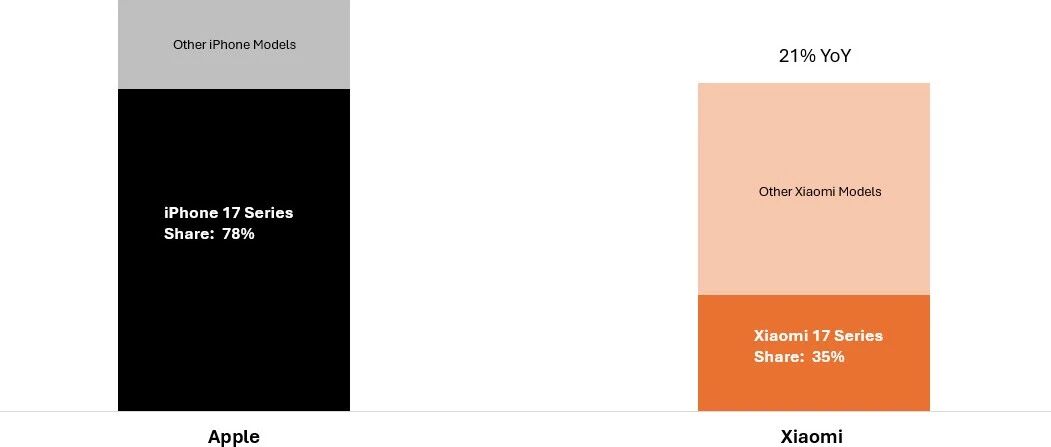
Core Insights - The iPhone 17 and Xiaomi 17 series are key drivers for growth in their respective brands during the first month of sales [4][5] - Both Apple and Xiaomi experienced similar overall sales growth, with Apple increasing by 22% and Xiaomi by 21% year-on-year [5] Sales Performance - The iPhone 17 series contributed significantly to Apple's sales in China, with nearly 80% of iPhones sold during the period coming from the new series [8] - Xiaomi's early launch of the 17 series effectively supported its smartphone sales, leading to a 21% year-on-year increase [8] Market Trends - The timing of the new product launches before the Mid-Autumn Festival boosted sales compared to the previous year [8] - Consumers are seeking high cost-performance products while also expecting innovative features, which the latest offerings from Apple and Xiaomi fulfill [8] Consumer Behavior - There is a strong demand for the new iPhone models, particularly the standard and Pro versions, driven by a wave of users upgrading from older models post-COVID [10] - Xiaomi's 17 Pro and 17 Pro Max have become the main sales drivers, indicating a shift in consumer preference towards higher-end models [10]



10 月前两周西欧智能手机市场小幅下滑,小米表现稍弱;苹果新品发布带动增长
Counterpoint Research· 2025-11-20 04:14
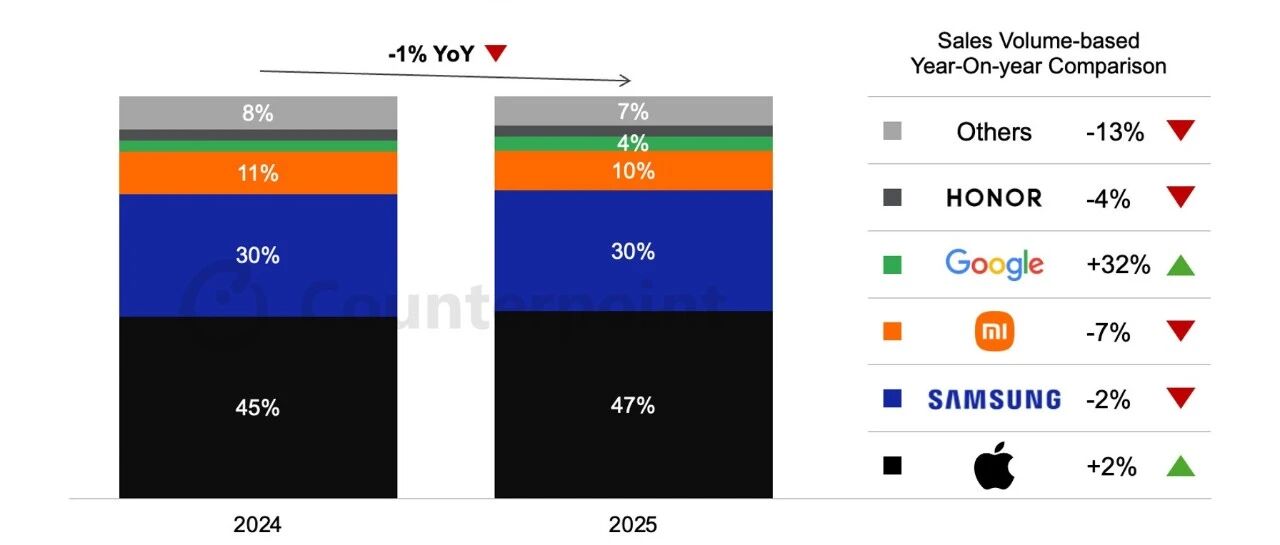
Core Insights - The smartphone sales in Western Europe declined by 1% year-on-year in the first two weeks of October, indicating a sluggish regional economy and low consumer confidence [4][5][8] - Xiaomi experienced a 7% decline in sales, impacting overall market performance, while Apple saw a 2% increase in sales driven by the strong performance of the iPhone 17 series [8][9] - Honor's sales dropped by 4% due to the absence of new product launches, although it has been one of the fastest-growing brands in Western Europe [9] Market Performance - In the first two weeks of October, Xiaomi's sales decreased by 7%, attributed to the underperformance of its newly launched 15T series compared to previous models [8][9] - Apple achieved a 2% year-on-year growth, supported by the iPhone 17 series and the introduction of the iPhone Air, which is expected to account for about 10% of the iPhone 17 series sales [8] - Samsung maintained a strong position in the high-end market with a 30% market share, driven by the success of its Galaxy S25 Ultra and S25 models [8] Brand Analysis - Honor's sales decline of 4% is seen as temporary, as the brand has experienced continuous growth for 30 months, largely due to its successful foldable screen products [9] - The overall market performance in Western Europe is affected by Xiaomi's decline, while Apple's strong sales indicate a positive trend for its products [9]
中国全面拥抱 eSIMs:苹果引领智能手机新时代
Counterpoint Research· 2025-11-20 04:14
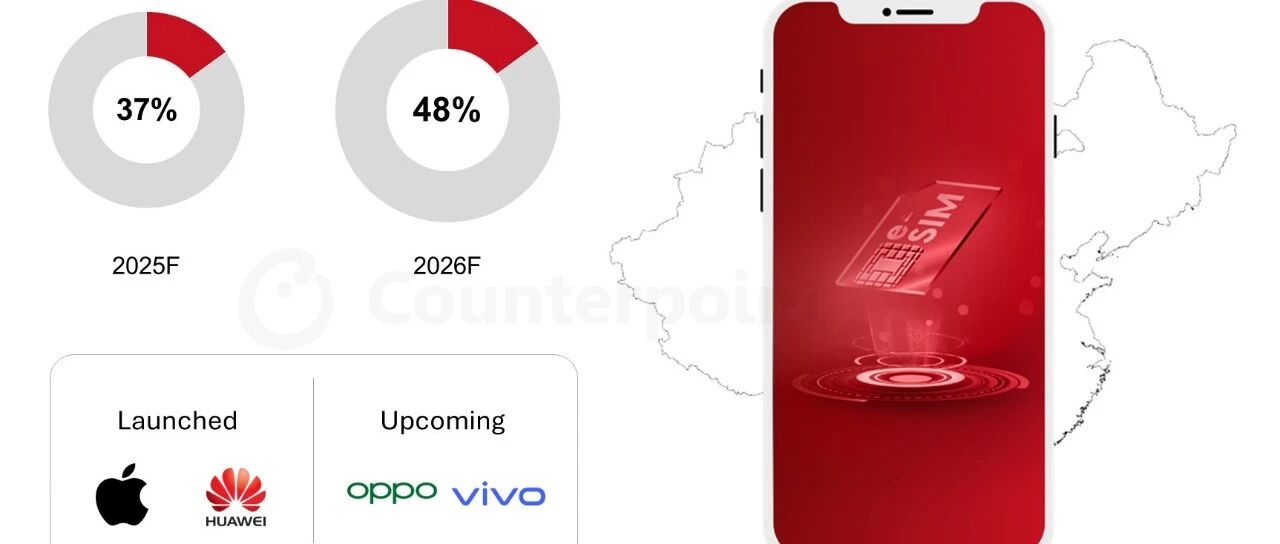
Core Insights - The article discusses the cautious adoption of eSIM technology in China due to regulatory and data security concerns, with a significant breakthrough expected in 2025 when eSIM trials for smartphones will commence [4][5][6]. Group 1: eSIM Technology in China - China has been hesitant to adopt eSIM technology in smartphones due to concerns over user identity verification and network regulation, leading to a preference for dual physical SIM card slots [5]. - The introduction of eSIM is expected to enhance device design by allowing for larger batteries and improved features, as eSIM integration eliminates the need for a SIM card slot [7][9]. Group 2: Market Impact and Projections - The approval of eSIM trials in China marks a new phase for the domestic market, with projections indicating that eSIM smartphones will account for 37% of global smartphone sales by 2025, increasing to 48% by 2026 [11]. - Apple's launch of the iPhone 17 Air, the first iPhone in China to support only eSIM, is anticipated to accelerate the adoption of eSIM technology among local brands and telecom operators [7][11]. Group 3: Competitive Landscape - The shift towards eSIM is expected to reshape the global smartphone industry, with Chinese manufacturers likely to gain a competitive edge as they adapt to this technology [11]. - As eSIM technology matures and carrier support increases, it is expected to penetrate mid-range and budget devices, moving beyond high-end models [9].
小米 17 Ultra黑科技曝光,手机摄影三大趋势已明?
3 6 Ke· 2025-11-20 04:11
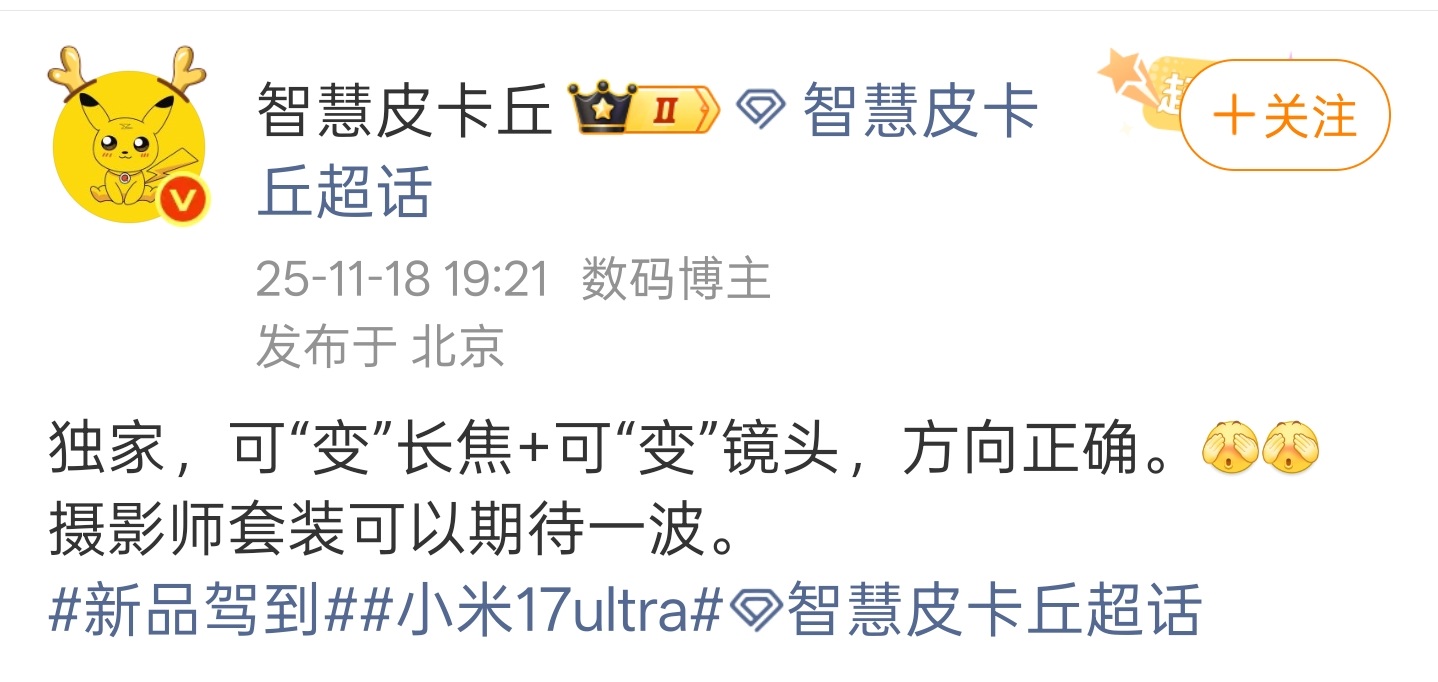
Core Viewpoint - Xiaomi's upcoming 17 Ultra smartphone is expected to feature innovative imaging technology, specifically a "variable focal length" and "variable lens" system, which aims to enhance photography capabilities in mobile devices [1][12]. Group 1: Variable Focal Length Technology - The "variable focal length mobile camera system" represents an optimization of traditional optical zoom technology, allowing for seamless adjustment of focal lengths between 3x to 7x, thus addressing quality gaps in conventional multi-camera setups [5][6]. - This technology enhances hardware utilization by enabling a single variable focal length lens to perform the functions of multiple fixed focal length lenses, thereby freeing up space for other components like batteries and heat dissipation systems [5][12]. - Consistency in image quality and color across different focal lengths is achieved, minimizing discrepancies that often arise from using multiple lenses, which is particularly beneficial for users who process large volumes of photos [6][12]. Group 2: Market Context and Competitive Landscape - The exploration of variable focal length technology is not new; previous attempts by brands like Nokia and later Xiaomi and OPPO have laid the groundwork, indicating a market demand for flexible zoom capabilities [6][8]. - The current trend in mobile imaging is shifting from merely stacking lenses to optimizing single-lens performance, which could redefine the development logic of mobile photography [16][18]. - The competitive landscape among domestic flagship brands has evolved into a comprehensive competition involving hardware development, algorithm optimization, and user insights, with each brand addressing different pain points in mobile photography [18][20]. Group 3: Future Trends in Mobile Photography - The future of mobile photography is expected to see three major trends: integration of technology, professional experience simplification, and scene-specific optimizations, allowing users to achieve high-quality results across various environments [20][22]. - The advancements in imaging technology are likely to democratize high-quality photography, enabling users to create professional-grade images without the need for expensive equipment [22].
小米法务背刺雷军,天塌了
Sou Hu Cai Jing· 2025-11-20 02:17
Core Viewpoint - The article discusses the rapid rise and subsequent challenges faced by Xiaomi's automotive division, highlighting the impact of CEO Lei Jun's personal brand on consumer trust and the company's market performance [1][23]. Group 1: Xiaomi Automotive Controversy - Xiaomi's SU7 Ultra model faced backlash from owners who claimed the vehicle did not match its promotional materials, leading to demands for refunds [2][4]. - The company acknowledged the lack of clarity in its communications and offered compensation options, which further angered customers, resulting in legal action against Xiaomi [5][10]. - Xiaomi's legal defense included claims that Lei Jun had warned consumers about pricing and that the promotional content was not part of the purchase contract [7][9]. Group 2: Financial Performance - Xiaomi reported a total revenue of 113.1 billion yuan for Q3, a year-on-year increase of 22.3%, with an adjusted net profit of 11.3 billion yuan, up 80.9% year-on-year [10][12]. - The smart electric vehicle segment showed significant growth, with revenues reaching 29 billion yuan, a 199.2% increase year-on-year, and the division achieved its first quarterly profit [12][16]. - Xiaomi's automotive division delivered over 100,000 vehicles in Q3, with total deliveries surpassing 260,000 units for the year, aiming for a target of 350,000 units by year-end [16][22]. Group 3: Market Position and Future Outlook - Despite impressive financial results, Xiaomi's stock price fell, indicating market skepticism about the sustainability of its automotive success [22]. - The article emphasizes the need for Xiaomi to shift consumer trust from Lei Jun to the brand itself as the automotive market matures, focusing on product quality and customer experience [23]. - Xiaomi's ongoing investment in R&D, with a budget of 30 billion yuan for the year, is seen as crucial for maintaining competitive advantage in the automotive and AIoT sectors [19].

前10月全省经济运行总体平稳
Liao Ning Ri Bao· 2025-11-20 01:08
Economic Overview - The province's economy showed overall stability in the first ten months of the year, with industrial growth, declining fixed asset investment, expanding market sales, and rapid export growth [1] Industrial Performance - The added value of industrial enterprises above a designated size increased by 1.5% year-on-year, with high-tech manufacturing growing by 3.9% [1] - By sector, mining increased by 7.8%, manufacturing by 0.7%, and electricity, heat, gas, and water production and supply by 0.1% [2] - State-owned enterprises saw a 2.2% increase in added value, while foreign and Hong Kong, Macao, and Taiwan-invested enterprises experienced a decline of 5.9% [2] - Among 40 industrial categories, 23 reported year-on-year growth, resulting in a growth rate of 57.5% [2] - Notable growth sectors included chemical fiber manufacturing (growth of 7.7 times), transportation equipment manufacturing (growth of 47.1%), and gas production and supply (growth of 21.6%) [2] Investment Trends - Fixed asset investment decreased overall, but manufacturing investment rose by 6.2%, with high-tech manufacturing investment increasing by 10.8% [2] - Investment in the primary industry grew by 5.1% year-on-year [2] Market Sales - The total retail sales of consumer goods reached 877.98 billion yuan, reflecting a year-on-year growth of 3.5% [3] - Sales of essential goods remained stable, with food and oil retail sales increasing by 13.4% and daily necessities by 11.8% [3] - Upgraded consumer goods saw significant sales growth, including wearable smart devices (growth of 15.5 times) and energy-efficient home appliances (growth of 1.3 times) [3] Trade Performance - The province's total import and export value reached 338.37 billion yuan, marking a 9.6% increase [3] - Agricultural product exports totaled 27.67 billion yuan, with a year-on-year growth of 9.9% [3] - Machinery and electrical products exports were 170.59 billion yuan, growing by 8.5%, with notable increases in ship and automotive parts exports [3] Price Trends - Consumer prices remained stable overall, while industrial producer prices experienced a decline [4]
小米汽车,真撑得起门面?
虎嗅APP· 2025-11-20 00:24
Core Viewpoint - The article emphasizes that Xiaomi's growth is under pressure due to the tightening of subsidies and increased competition in its traditional business, particularly in smartphones and IoT, while the automotive business shows potential but faces challenges ahead [11][12][24]. Overall Performance - Xiaomi Group reported total revenue of 113.1 billion RMB for Q3 2025, a year-on-year increase of 22.3%, primarily driven by the automotive business [6][27]. - Traditional business (smartphones and AIoT) revenue grew only 1.6% year-on-year, indicating weak performance in hardware sales [27][30]. - Gross margin improved to 22.9%, supported by the automotive business, while smartphone margins declined due to intensified competition [30][31]. Automotive Business - The automotive segment generated 29 billion RMB in revenue, with a shipment of 109,000 units and an average selling price of 260,000 RMB [6][35]. - The automotive business achieved a gross margin of 25.5%, although it slightly decreased from the previous quarter due to a reduction in the share of high-margin models [38][39]. - The core operating profit for the automotive business was 680 million RMB, marking its first profitable quarter [7][67]. Smartphone Business - Xiaomi's smartphone revenue was 46 billion RMB, down 3.1% year-on-year, reflecting the impact of subsidy reductions and increased competition [42][44]. - Smartphone shipments increased by 0.5% year-on-year, but the average selling price fell by 3.6% due to a higher proportion of low-cost models sold [44][46]. - The smartphone gross margin dropped to approximately 11.1%, influenced by rising component costs and market competition [48][23]. IoT Business - The IoT segment reported revenue of 27.6 billion RMB, a year-on-year increase of 5.6%, significantly lower than previous quarters due to subsidy reductions affecting large appliances [51][18]. - The gross margin for IoT products was 22.9%, benefiting from a higher proportion of sales in more profitable categories [52][53]. Internet Services - Internet services revenue reached 9.4 billion RMB, growing 10.8% year-on-year, primarily driven by advertising services [56][60]. - Advertising revenue was 7.2 billion RMB, up 16.1%, while value-added services saw a slight decline [56][66]. Overseas Market - Overseas revenue was 40.1 billion RMB, a slight decrease of 0.2%, with internet services growing by 19.1% to 3.3 billion RMB [60][62]. - Hardware sales in overseas markets continued to show weakness, reflecting a challenging demand environment [60]. Profitability - The core operating profit for the quarter was 6.7 billion RMB, with a core operating profit margin of 5.9%, impacted by declining smartphone margins and increased expenses [67][66]. - Traditional business core operating profit was approximately 6.03 billion RMB, while the automotive segment contributed 680 million RMB [67][66].

2025年第45周:数码家电行业周度市场观察
艾瑞咨询· 2025-11-20 00:04
Group 1: eSIM Technology - eSIM technology marks the transition to a "cardless era" in smartphones, with major manufacturers like Huawei and OPPO quickly adapting to this trend [2][3] - The launch of Apple's iPhone Air has prompted domestic manufacturers to develop eSIM-compatible devices, although consumer response indicates a preference for functionality over extreme thinness [2][3] Group 2: AI in Mobile Technology - Mobile AI is evolving from traditional voice assistants to self-evolving AI-native phones, becoming a key player in the smart economy [4] - Companies like Honor and Huawei are leveraging edge-cloud collaboration to enhance AI capabilities in various consumer scenarios, indicating a shift towards intelligent service hubs [4] Group 3: Edge Computing and AI Applications - A significant percentage of Chinese enterprises believe generative AI will disrupt their business within the next 18 months, with many already implementing it [5] - Edge computing is becoming essential for AI applications, addressing latency, cost, and compliance issues, with predictions that 80% of CIOs in Asia-Pacific will rely on edge services by 2027 [5] Group 4: Robotics and AI - The humanoid robot industry in China is making strides in hardware production and cost control, but still lags behind the U.S. in intelligent models and software ecosystems [6][7] - The competition in humanoid robotics will hinge on breakthroughs in "embodied intelligence," with both countries vying for leadership in AI and robotics [6][7] Group 5: AI in E-commerce - AI-driven e-commerce products are gaining traction, but user experience remains a challenge, with competition focusing on information distribution and execution capabilities [8] - The future of AI e-commerce will revolve around understanding consumer needs, although widespread adoption may take time [8] Group 6: AI Emotional Companionship - AI applications for emotional companionship are rising in popularity, with Chinese entrepreneurs leveraging hardware supply chains to accelerate deployment [9] - The user base for generative AI in China has grown significantly, indicating a strong market potential for emotional AI applications [9] Group 7: AI Headphones Market - The AI headphones market has rapidly transitioned from concept to scale, with a significant portion of products priced below 500 yuan [10] - The market is diversifying, with different brands targeting various segments, but user satisfaction remains mixed [10] Group 8: Virtual Idols and AI - The AI virtual idol sector is experiencing a resurgence, significantly lowering production costs and time [12] - Successful cases demonstrate the potential for virtual idols to become global IPs, although challenges in content quality and consistency remain [12] Group 9: Smart Glasses Market - The year 2025 is projected to be pivotal for smart glasses, with numerous manufacturers entering the market [13] - Key challenges include privacy concerns and technological limitations, which must be addressed for widespread adoption [13] Group 10: Humanoid Robots and Chip Demand - The humanoid robot industry is expected to grow rapidly, with significant demand for AI chips, particularly in motion control and visual sensing [17] - Domestic manufacturers are gradually catching up in the chip supply chain, although high-end AI chips still rely on international suppliers [17] Group 11: Global Expansion of Chinese Home Appliances - Chinese home appliance companies are diversifying their overseas presence to mitigate risks and enhance competitiveness [18] - Digital technology is a key driver of this strategy, with companies like Midea and TCL leading the way in global manufacturing and R&D [18] Group 12: AI Chip Industry Dynamics - The AI chip industry in China is characterized by a practical approach, focusing on technology implementation and industrial empowerment [19][20] - The competition will center on third-party markets, with a shift towards specialized chips and ecosystem development [19][20] Group 13: Meta's AI Strategy - Meta is adjusting its strategy in the AI sector by laying off staff and recruiting top talent to enhance its model development capabilities [21] - The company's future success will depend on its ability to translate investments and talent into technological breakthroughs [21] Group 14: Hisense's Financial Performance - Hisense reported steady revenue growth in its recent quarterly results, driven by advancements in display technology and high-end product sales [22] - The company is well-positioned for future growth, particularly in the commercial display sector [22] Group 15: Alibaba's AI Glasses - Alibaba's Quark AI glasses have begun pre-sales, integrating various services from its ecosystem [24] - The product is seen as a significant step in showcasing Alibaba's AI capabilities and ecosystem collaboration [24] Group 16: Midea's R&D Investment - Midea plans to invest over 50 billion yuan in R&D over the next three years, focusing on AI and embodied intelligence [25] - The company aims to enhance its global competitiveness and technological leadership through this investment [25] Group 17: Huawei's HarmonyOS 6 - Huawei's HarmonyOS 6 has been launched with significant upgrades in performance and connectivity features [26] - The company is actively working to expand its global market share and reshape the operating system landscape [26] Group 18: New Stone's Autonomous Delivery Vehicles - New Stone has secured significant funding to expand its autonomous delivery vehicle operations, projecting substantial growth in demand by 2027 [27][28] - The company is focusing on algorithm upgrades and global market expansion to meet future demand [27][28] Group 19: Tesla's Compensation Plan - Tesla's proposed compensation plan for CEO Elon Musk has drawn scrutiny, with significant performance targets set for stock incentives [29] - The plan aims to ensure Musk's focus on the company's transition to autonomous driving and robotics [29] Group 20: Qualcomm's AI Chip Launch - Qualcomm has introduced new AI inference chips targeting a rapidly growing market, emphasizing energy efficiency and cost [30] - The company is expanding its presence in various sectors, including smart driving and IoT, to mitigate potential revenue challenges [30] Group 21: NVIDIA's Market Position - NVIDIA has achieved a remarkable market valuation, driven by surging demand for AI computing power [31] - However, concerns about potential market bubbles and geopolitical risks pose challenges for the company's future growth [31] Group 22: Haier's IPO Plans - Haier is preparing for an IPO of its industrial internet platform, aiming to raise significant capital for further development [33] - The platform has already made substantial contributions to various industries, indicating strong market potential [33] Group 23: Xiaomi's Growth Strategy - Xiaomi aims to enter the global top 100 companies within five years, focusing on high-end technology and chip development [34] - The company is also expanding its global presence and product offerings to drive growth [34] Group 24: Ant Group's AI Strategy - Ant Group is shifting its focus from digital payments to intelligent payments, leveraging AI as a core strategy [36] - The company aims to integrate AI with user needs to capture new opportunities in the AI era [36]






不断向产业高端迈进(走企业,看高质量发展)
Ren Min Ri Bao· 2025-11-19 22:20
Core Viewpoint - Vivo Mobile Communication Co., Ltd. focuses on user-oriented innovation, technological advancement, and social responsibility, aiming to enhance its position in the high-end market through continuous investment in R&D and the development of specialized features for users with disabilities [1][5]. Group 1: User Orientation - Vivo emphasizes user orientation in product development, with a commitment to creating great products based on user needs [2]. - The company has identified a significant demand for portrait photography features through user research, leading to the launch of products like the X30 and X60 series, which focus on enhancing portrait capabilities [2]. - Vivo has introduced long-focus technology in its products, such as the X90 Pro+ and X100 Ultra, to better meet user demands for photography [2]. Group 2: Technological Drive - Vivo has made technology innovation a key focus since 2015, with an annual R&D investment growth of 20% and over 75% of its workforce dedicated to R&D [3]. - The company has established several research institutions, including a communication research institute and an AI global research institute, to drive technological advancements [3]. - Vivo has achieved significant improvements in user experience, such as a 59% reduction in short video stuttering and an 80% decrease in video transmission time in specific scenarios [3]. Group 3: Value Creation - Vivo has developed AI features specifically for users with disabilities, such as "Vivo Hearing" for the hearing impaired and "Vivo Seeing" for the visually impaired, demonstrating its commitment to social responsibility [5]. - The company serves over 4 million users with disabilities and aims to provide them with smartphones equipped with the latest accessibility features [5]. - Vivo has applied to become a public partner for the 12th National Games for Persons with Disabilities, showcasing its dedication to creating value for society beyond profit [5]. Group 4: Corporate Culture - The company maintains a corporate culture centered on being grounded and focused on the essence of its mission, ensuring that it continues to create value for users and contribute to high-quality development [6].

vivo坚持用户导向、技术驱动、创造价值—— 不断向产业高端迈进(走企业,看高质量发展)
Ren Min Ri Bao· 2025-11-19 22:19
Core Viewpoint - Vivo Mobile Communication Co., Ltd. focuses on user-oriented innovation, technological advancement, and social responsibility, aiming to enhance its position in the high-end industry through continuous investment in R&D and the development of specialized features for users with disabilities [1][5][6] User Orientation - Vivo emphasizes creating great products with a user-centric approach, as highlighted by its founder and CEO, Shen Wei, who states that users are the "destination" of their efforts [2] - The company has identified a significant user demand for portrait photography, leading to the launch of products like the X30 series in December 2019 and the X60 series in December 2020, which focus on enhancing portrait capabilities [2] - Vivo has invested in long-focus technology, introducing models such as the X90 Pro+ and X100 Ultra, with the latest X300 Pro featuring a periscope super telephoto lens [2] Technology-Driven - Vivo has committed to continuous technological innovation, with a focus on enhancing user experience through persistent R&D efforts, exemplified by the nearly four-year development of a 200-megapixel sensor [3] - Since 2015, the company has prioritized technological innovation, increasing R&D investment by an average of 20% annually and maintaining a workforce where over 75% are R&D personnel [3] - Vivo has established several research institutions, including a communication research institute in 2016 and an AI global research institute in 2018, to drive innovation across four key technology tracks: design, imaging, systems, and performance [3][4] Value Creation - Vivo has developed AI features specifically for users with disabilities, such as "Vivo Hearing" for the hearing impaired and "Vivo Seeing" for the visually impaired, demonstrating the company's commitment to social responsibility [5] - The company serves over 4 million users with disabilities and aims to provide smartphones equipped with the latest accessibility features to award-winning athletes at the upcoming National Games for Persons with Disabilities [5] - Vivo's executive vice president emphasizes that while commercial value is essential for sustainability, the ultimate goal is to create lasting value for users and society [5] Corporate Culture - The company maintains a focus on its core values, emphasizing a balanced approach to business that prioritizes user value and high-quality development [6]