乳制品

Search documents
15亿出局,资本离场,“中产酸奶”再度被卖?
东京烘焙职业人· 2026-03-03 08:32
Core Viewpoint - The article discusses the recent sale of a significant stake in Yuno China by Tian Tu Investment, highlighting the dramatic financial turnaround of the company and the strategic timing of the exit from the investment [4][11][12]. Group 1: Transaction Overview - Tian Tu Investment announced the sale of approximately 86.96% of its stake in Yuno China for a total consideration of about 1.565 billion yuan, marking a complete exit from the joint venture [4]. - The sale comes after Yuno China reported impressive financial results for 2024, with revenue reaching 810 million yuan and net profit soaring to 95.45 million yuan, a year-on-year increase of 1038% [4][11]. - Tian Tu's initial investment in Yuno China was around 300 million yuan in 2019, and the company had already recouped its investment by selling a portion of its stake earlier in January 2024 for 814 million yuan [5][11]. Group 2: Yuno's Market Journey - Yuno, despite being the second-largest yogurt brand globally, faced challenges in the Chinese market, leading to significant losses of nearly 190 million yuan from 2020 to 2022 [7][10]. - The brand began to recover in 2023, achieving a small profit of 839,000 yuan, and then experienced substantial growth in 2024 [10][11]. - Yuno's journey in China has been marked by both setbacks and breakthroughs, with the brand initially entering the market in the 1990s but only establishing a strong presence after 2015 [17][18]. Group 3: Future Prospects and Market Dynamics - IDG Capital has acquired Yuno China for 1.565 billion yuan and plans to leverage its resources to expand the brand's presence in southern and northern China, as well as diversify sales channels [21][22]. - The low-temperature yogurt market in China is projected to reach 67.28 billion yuan by 2025, with a compound annual growth rate of 8.5% from 2021 to 2025, indicating significant growth potential despite increasing competition [25]. - Yuno currently holds a relatively low market share, ranking around 15th, which raises questions about its ability to compete effectively in a market dominated by major players [25][26].



Cisarua:把握增长动能
citic securities· 2026-03-03 06:55
Investment Rating - The report maintains a sales growth guidance of 10%-15% for 2026, with a gross margin forecast of 40%-44% and a capital expenditure budget of IDR 8 trillion [2][11]. Core Insights - The company aims for a sustainable recovery in dairy product sales, driven by growth in yogurt and UHT products, as well as the introduction of new sugar-free products. The target for 2026 is a double-digit sales growth compared to a 5% year-on-year growth in FY2025 [6][11]. - The company has initiated a free lunch program supplying UHT milk, although this segment remains small. Management is cautious about gross margin guidance due to rising milk prices, which have increased by 20% since January but are still down 5% year-on-year compared to the average price in 2025 [6][7]. - The company plans to open its first retail store in Q2 2026, which is expected to contribute minimally to total sales, estimated at less than USD 1-2 million [6][11]. Summary by Relevant Sections Dairy Products: Sales Recovery, Free Lunch Program, and New Products - The sales recovery in dairy products is attributed to the growth of yogurt and UHT products, along with the launch of new sugar-free products. The management believes this recovery is sustainable due to a low base effect [6][11]. Profitability, Costs, and Advertising Expenditure - Management has indicated that despite the lower profit margins from the free lunch program, existing capacity can meet demand. The company will not raise prices again this year to focus on revenue growth, but may cut advertising spending if profit margins fall below expectations [6][11]. New Retail Formats and Export Potential - The company emphasizes traditional distribution channels, covering 205,000 outlets, and the Miss Cimory channel, which has seen the fastest growth with 10,100 agents. The revenue contribution target remains at 30% for modern trade, 30% for Miss Cimory, and 30% for general trade, with the remainder coming from exports, primarily to the Philippines [6][11].
中国必选消费品2月需求报告:餐饮及供应链产品恢复较好
Haitong Securities International· 2026-03-02 15:02
Investment Rating - The investment rating for the essential consumer goods sector in China is "Outperform" for multiple companies including Guizhou Moutai, Wuliangye, and Yili [1]. Core Insights - In February 2026, five out of eight tracked essential consumer goods sectors showed positive growth, while two experienced negative growth and one remained flat. The sectors with growth included frozen food, condiments, beer, catering, and soft drinks, while premium and above baijiu and dairy products saw declines. The improvement in data is attributed to the extended Spring Festival holiday and increased travel enthusiasm, which boosted demand for catering and related supply chain products [3][18]. Summary by Sector Baijiu Sector - **Premium and Above Baijiu**: Revenue reached RMB 44.0 billion in February, down 14.6% year-on-year. Cumulative revenue for January-February was RMB 91.0 billion, a decrease of 14.2% year-on-year. The sector faced pressure on both volume and price due to reliance on business consumption and numerous brands affecting price control [4][19]. - **Mass-Market and Below Baijiu**: Revenue was RMB 17.4 billion in February, flat year-on-year. Cumulative revenue for January-February was RMB 40.3 billion, down 1.7% year-on-year. The prices of mass-market baijiu showed signs of stabilization, attributed to its inelastic demand and balanced producer-distributor relationships [20]. Beer Sector - Revenue in the beer sector was RMB 15.2 billion in February, up 5.6% year-on-year. Cumulative revenue for January-February was RMB 32.2 billion, down 1.5% year-on-year. The sector benefited from seasonal factors and increased demand in lower-tier markets, with the RMB 8-10 price segment driving revenue growth [21]. Condiments Sector - Revenue in the condiments sector was RMB 41.5 billion in February, up 5.6% year-on-year, marking the third consecutive month of growth. Cumulative revenue for January-February was RMB 88.4 billion, up 4.5% year-on-year. The recovery in catering channels and increased inventory replenishment contributed to this growth [22]. Dairy Products Sector - Revenue in the dairy sector was RMB 41.5 billion in February, down 1.2% year-on-year. Cumulative revenue for January-February was RMB 85.0 billion, flat year-on-year. Despite ongoing pressure, there was a noticeable recovery in catering consumption and gifting needs during the Spring Festival [23]. Frozen Food Sector - Revenue in the frozen food sector was RMB 14.0 billion in February, up 8.9% year-on-year, also marking the third consecutive month of growth. Cumulative revenue for January-February was RMB 29.0 billion, up 8.5% year-on-year. The sector's performance was supported by Spring Festival stockpiling and increased demand from small B-end clients [24]. Soft Drinks Sector - Revenue in the soft drinks sector was RMB 49.8 billion in February, up 2.3% year-on-year. Cumulative revenue for January-February was RMB 146.0 billion, up 1.5% year-on-year. The sector faced intensifying market competition, reflected in the discount rates for products [26]. Catering Sector - Revenue in the catering sector was RMB 14.0 billion in February, up 4.9% year-on-year, achieving its third consecutive month of growth. Cumulative revenue for January-February was RMB 30.2 billion, up 3.6% year-on-year. The sector benefited from the extended Spring Festival holiday, although profitability remained under pressure [27].





食品饮料行业周报 20260223-20260227:节后茅台批价保持坚挺,继续看好白酒及餐饮链头部标的-20260301
Shenwan Hongyuan Securities· 2026-03-01 13:19
Investment Rating - The report maintains a positive outlook on the food and beverage sector for investment opportunities in 2026, focusing on cyclical white liquor and restaurant supply chains [7][8]. Core Insights - The white liquor sector is expected to see a recovery, with Moutai prices stabilizing in the first quarter and maintaining strength post-Spring Festival. The industry is entering a phase of consolidation, with a trend of larger companies acquiring smaller ones. Despite a shrinking overall market, leading companies are anticipated to have growth potential [7][8]. - The report highlights two types of companies to watch: those capable of deep national expansion and those with regional consolidation opportunities. If the fundamentals recover as expected, a dual boost in valuation and performance is anticipated by the end of 2026 to 2027 [7][8]. - The consumer goods sub-sector is showing structural improvement, with competition shifting from price to quality. The supply-demand balance is gradually improving, and food CPI is expected to improve quarterly. Companies with cyclical attributes and low valuations are likely to see recovery [7][9]. Summary by Sections 1. Food and Beverage Weekly Insights - The food and beverage sector experienced a decline of 1.54% last week, with the liquor segment down 2.26%, underperforming the market [6][31]. - The report notes that the overall sales volume in the liquor industry during the Spring Festival decreased by 10%-20% year-on-year, which was slightly better than market expectations [8]. 2. Market Performance of Food and Beverage Sectors - The report indicates that the food processing, beer, and seasoning sectors underperformed relative to the market index, with white liquor and beverage dairy sectors showing significant declines [31][32]. - The report emphasizes the importance of monitoring leading brands in the liquor sector, as they are expected to see a turnaround in fundamentals [8][9]. 3. Key Recommendations - For the liquor sector, key recommendations include Moutai, Luzhou Laojiao, Shanxi Fenjiu, and Wuliangye, with a focus on Jinhuijiu [7][8]. - In the consumer goods sector, recommended companies include Anjijia Food, Qianhe Flavoring, Tianwei Food, and Yili Group, among others [7][9].


食品饮料行业周报:节后需求稳健格局优化,健康功能饮品长期向好
KAIYUAN SECURITIES· 2026-03-01 08:24
Investment Rating - The industry investment rating is "Positive" (maintained) [1] Core Viewpoints - The food and beverage industry is experiencing a recovery in sales during the Spring Festival, with structural differentiation observed. The demand for high-end liquor remains strong, particularly for brands like Moutai and Wuliangye, which have shown year-on-year sales growth. The market's resilience and channel confidence are being restored, with the price bottoming out due to continuous supply-side contraction. The current valuation of the food and beverage sector is low, with institutional holdings being relatively low, indicating high allocation value. Investment strategies suggest focusing on leading companies with strong brands and channel barriers in the liquor sector, while in the mass market, three core lines are recommended: the snack sector benefiting from channel changes, dairy and ranch sectors with potential profit elasticity, and the frozen and compound seasoning sectors linked to the recovery of the catering chain [4][11][12]. Summary by Sections Weekly Insights - The food and beverage index declined by 1.5% from February 23 to February 27, ranking 26th among 28 sectors, underperforming the CSI 300 by approximately 2.6 percentage points. The sub-sectors of prepared foods (+6.7%), beer (+2.6%), and health products (+1.2%) performed relatively well [11][13]. Market Performance - The food and beverage sector underperformed the broader market, with a 1.5% decline in the index. Notable individual stock performances included Sanquan Foods, Anjuke Foods, and Jinhwa Industrial showing significant gains, while Gujing Gong B, Dongpeng Beverage, and Gujing Gongjiu faced declines [11][13][17]. Upstream Data - Some upstream raw material prices have decreased. For instance, the price of whole milk powder in GDT auctions was $3,706 per ton, down 10.8% year-on-year. The price of fresh milk was 3.04 yuan per kilogram, down 2.3% year-on-year [15][18]. Liquor Industry Data - In mid-February, the national liquor price index fell by 0.07%. The wholesale price index for famous liquors increased by 7.26% year-on-year, indicating a stable demand for premium products [37]. Recommendations - Recommended stocks include Moutai, Shanxi Fenjiu, Ximai Foods, Weilong Delicious, and Ganyuan Foods. Moutai is focusing on sustainable development amidst shifting demand, while Shanxi Fenjiu is expected to see medium-term growth despite short-term pressures. Ximai Foods is expanding its channels, and Ganyuan Foods is anticipated to rebound after adjustments [6][40].

食品饮料行业周报:节后需求稳健格局优化,健康功能饮品长期向好-20260301
KAIYUAN SECURITIES· 2026-03-01 08:13
Investment Rating - The industry investment rating is "Positive" (maintained) [1] Core Views - The sales performance of the food and beverage industry is recovering during the Spring Festival, with structural differentiation observed. The high-end liquor segment shows strong demand, particularly for brands like Moutai and Wuliangye, which have seen year-on-year sales growth. The market demonstrates resilience and confidence in distribution channels [4][11] - The food and beverage index declined by 1.5%, ranking 26th among 28 sub-industries, underperforming the CSI 300 by approximately 2.6 percentage points. Sub-industries such as processed foods (+6.7%), beer (+2.6%), and health products (+1.2%) performed relatively well [4][11][13] - The current valuation of the food and beverage sector is low, with institutional holdings being relatively low, indicating high allocation value. Investment strategies suggest focusing on leading companies with strong brands and channel barriers in the liquor sector, while in the mass market, three core lines are recommended: snack foods benefiting from channel changes, dairy and livestock sectors with potential profit elasticity, and frozen and compound seasoning products linked to the recovery of the catering supply chain [4][11] Summary by Sections Market Performance - The food and beverage index experienced a decline of 1.5%, ranking 26th out of 28 sectors, and underperformed the CSI 300 by about 2.6 percentage points. Leading stocks included Sanquan Foods, Anjuke Foods, and Jinhui Industrial, while Gujing Gongjiu, Dongpeng Beverage, and Gujing Gongjiu saw significant declines [4][11][13] Upstream Data - As of February 17, 2026, the price of whole milk powder was $3,706 per ton, down 10.8% year-on-year. The price of fresh milk was 3.04 yuan per kilogram, down 2.3% year-on-year. The domestic milk price is expected to continue its downward trend in the short to medium term [19][35] Liquor Industry Data - In mid-February, the national liquor price index decreased by 0.07%. The wholesale price index for liquor increased by 6.13% year-on-year, indicating a stable long-term outlook for premium liquor brands [40][41] Recommended Stocks - Recommended stocks include Moutai, Shanxi Fenjiu, Ximai Foods, Weilong Delicious, and Ganyuan Foods, with each company showing strong growth potential and market positioning [6][45]
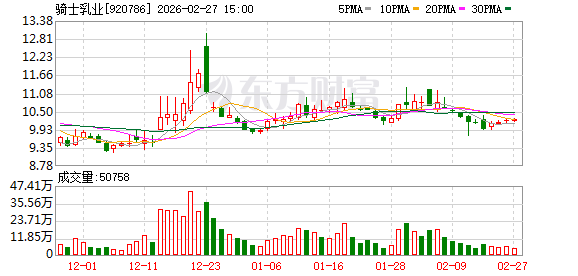
骑士乳业(920786):披露业绩快报,2025年盈利5059万元
Jing Ji Guan Cha Wang· 2026-02-28 04:14
Core Viewpoint - Knight Dairy announced a revenue of 1.322 billion yuan for 2025, reflecting a year-on-year increase of 1.93% from 1.297 billion yuan in the previous year [1] Financial Performance - The net profit attributable to shareholders of the listed company for 2025 is 50.59 million yuan [1]
明治在中国越卖越亏,三年复苏计划能否扭转困局?
Xi Niu Cai Jing· 2026-02-28 02:57
Group 1 - The core issue for Meiji Holdings in China is the significant increase in operating losses, which have expanded to 7.1 billion yen in FY2024 from 3.7 billion yen in the previous year, despite net sales rising to 25.5 billion yen [2] - The competitive landscape in China is challenging, with local giants like Yili and Mengniu dominating the market, leading to intense price wars that disadvantage Meiji, which positions itself as a premium brand [2] - Meiji has made substantial investments in China since 2020, including acquiring a 25% stake in Ausnutria and establishing six factories, which has contributed to increased operational costs [2] Group 2 - Ausnutria, in which Meiji holds a stake, is projected to incur losses between 1.17 billion yuan and 1.38 billion yuan in 2024, further impacting Meiji's financial performance [3] - The new managing director of Meiji China, Takashi Nagasawa, has acknowledged past overconfidence and is implementing a three-year recovery plan aimed at achieving breakeven by FY2026, which includes discontinuing unprofitable products and reassessing non-viable channels [3] - Despite the challenges, the potential of the Chinese market remains attractive for Meiji, but navigating through the current losses and competition is a critical task ahead [3]
港股风向标|科技权重止跌恒指放量反弹 机构看好顺周期涨价机会
Sou Hu Cai Jing· 2026-02-27 14:36
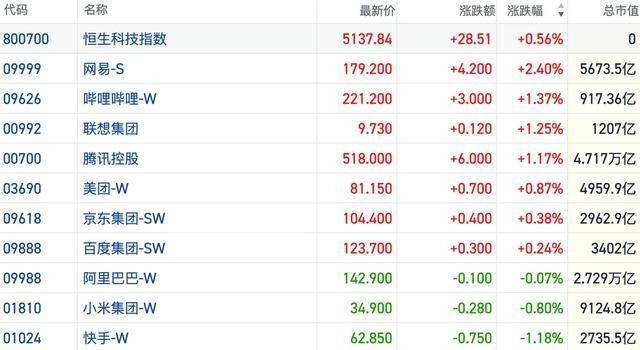
Market Overview - The Hong Kong stock market showed signs of recovery, with the Hang Seng Index rising by 0.95% to close at 26,630 points, while the Hang Seng China Enterprises Index and the Hang Seng Tech Index increased by 0.51% and 0.56% respectively [1][2]. Technology Sector Performance - Major tech stocks led the market rebound, with Tencent's stock price reaching 530 HKD during the day. Other tech companies such as NetEase, Meituan, JD.com, and Baidu also saw positive performance [2][3]. Stock Performance Data - Notable stock performances included: - Tencent Holdings (00700) at 518.00 HKD, up by 6.00 HKD (+1.17%), with a total market capitalization of 4.717 trillion HKD - NetEase (09999) at 179.20 HKD, up by 4.20 HKD (+2.40%), with a market cap of 567.35 billion HKD - Meituan (03690) at 81.15 HKD, up by 0.70 HKD (+0.87%), with a market cap of 495.99 billion HKD [3]. Sector Movements - Other sectors such as banking, real estate, and coal also showed strength, while power, steel, and oil stocks were active [4]. - Conversely, sectors like aviation, consumer electronics, and building materials experienced declines [4]. Market Dynamics - The overall trading volume in the Hong Kong market was 288.42 billion HKD, indicating increased liquidity. Short selling amounted to 36.55 billion HKD, representing 12.67% of the total trading volume, highlighting ongoing market divergence [4]. - The market is experiencing rapid rotation of hot and cold sectors, with cyclical stocks like steel and rare earths gaining strength, while AI-related sectors such as storage and chips faced declines [5][7]. Policy Implications - Recent meetings by the Central Political Bureau emphasized the need for more proactive macro policies to expand domestic demand and optimize supply, which may provide further support for the market [7]. A-Share Market Correlation - The A-share market mirrored the performance of the Hong Kong market, with a total trading volume of approximately 24,880.24 billion HKD, showing a decrease of about 504.22 billion HKD from the previous trading day. Over 3,200 stocks rose, particularly in the cyclical sector [8].

骑士乳业:2025年年度业绩快报公告
Zheng Quan Ri Bao· 2026-02-27 13:37
Core Viewpoint - The company, Qizhi Dairy, announced its revenue and profit projections for 2025, indicating a modest growth in revenue and a specific net profit target [2] Financial Projections - The company expects to achieve an operating revenue of approximately 1.32 billion yuan in 2025, representing a year-on-year growth of 1.93% [2] - The net profit attributable to shareholders of the listed company is projected to be around 50.59 million yuan [2]