
国防

Search documents
对冲巨头Point72杀入军工早期投资!募资4亿美元成立“威慑基金“ 个人跟投超1亿
Zhi Tong Cai Jing· 2025-08-01 04:05
Core Viewpoint - Point72 Asset Management, led by billionaire Steve Cohen, is raising its first venture capital fund, the "Deterrence Fund," targeting $400 million to invest in defense technology startups due to the urgent demand in this sector [1][2]. Group 1: Fund Details - The "Deterrence Fund" will focus on seed and Series A funding for startups in defense, aerospace, energy, and security [1]. - Cohen plans to personally invest at least $100 million into the fund, which is expected to close fundraising in the first half of next year [1][2]. - The fund will charge a 2% management fee on committed capital during the investment period and a 2% fee on net invested capital afterward, along with a 20% performance fee [3]. Group 2: Market Context - The need for innovative defense technologies is emphasized, as startups can provide more promising solutions compared to large, bureaucratic companies [1]. - Global conflicts, such as the Russia-Ukraine war and tensions in the Middle East, have led to increased defense spending by various countries [1]. - NATO leaders agreed to boost defense spending earlier this year in response to criticisms regarding insufficient contributions from European allies [1]. Group 3: Investment Strategy - Point72 has met with nearly 900 defense tech startups over the past five years and has invested in 18 of them, including Shield AI, Stoke, and Saronic [3]. - The fund's individual investments will range from $1 million to $30 million [3]. - Point72 Ventures, established in 2016, has invested $1.4 billion in over 170 startups to date [2].
欧洲股市机会犹存?如何配置投资组合成关键
Xin Hua Cai Jing· 2025-07-31 05:31
Group 1 - European stock markets are recovering from a period of stagnation, with some stocks showing tactical overbought signals as investors recognize the region's investment potential [1] - Germany has announced a significant fiscal policy reboot, planning to allocate approximately 25% of its GDP to infrastructure and defense projects over the next decade, which is expected to boost economic growth in Germany and Europe [1] - The European monetary environment is signaling improved economic momentum, with inflation declining and more easing policies likely to be introduced, supporting local economic growth [1] Group 2 - Caution is advised regarding the strengthening of the euro and high interest rates, which could negatively impact European companies that derive most of their revenue from overseas [2] - Local European companies are showing stronger earnings momentum compared to multinational peers, particularly in sectors like telecommunications, banking, and construction, as well as defense stocks and utilities with high entry barriers [2]
航空航天与国防板块引领Q2全球并购回暖,下半年有望继续发力
智通财经网· 2025-07-28 02:05
Group 1 - The core viewpoint of the article highlights a significant rebound in M&A activity in the aerospace, defense, and government services sectors, driven by large transactions and strategic buyers, while financial sponsors are retreating due to tightening credit conditions [1][2] - Global M&A transaction volume increased by 13% in Q2 compared to the previous quarter, primarily due to a 180% rise in large transactions valued over $1 billion, while medium-sized transactions (under $100 million) also grew by 18% [2] - Strategic acquirers, particularly public companies, regained dominance in the market, with U.S. acquisitions of public companies increasing by 75% and global acquisitions rising by 64% [2] Group 2 - The aerospace and defense sectors led the growth in global M&A activity, with transaction values increasing by 24% and 55% respectively [2] - Aerospace transactions in the U.S. grew by 27% year-over-year, while defense transactions increased by 37% [2] - The aerospace components sub-sector remained the most active, with maintenance, repair, and overhaul services following closely, showing a 50% revenue growth [3] Group 3 - Notable transactions in Q2 included Boeing's divestiture of its digital aviation solutions business valued at $10.55 billion and Motorola Solutions' proposed acquisition of Silvus Technologies for $4.4 billion [4] - In the government technology sector, significant transactions included HIG Capital's acquisition of Converge Technology Solutions for $910 million and Leidos' acquisition of Kudu Dynamics for $300 million [6] Group 4 - The public valuation of the industry remains strong, with government service companies like Booz Allen and Leidos having an enterprise value to EBITDA multiple of 11.0 times, while diversified engineering companies hover around 13.8 times [8] - Aerospace original equipment manufacturers have particularly high valuations, with expected P/E ratios exceeding 20 times for companies like Safran, Rolls-Royce, and GE Aerospace, reflecting investor confidence in long-term aerospace demand [8] Group 5 - Strategic investors, especially well-capitalized public companies, are expected to continue leading the transaction process in the second half of 2025, with aerospace and defense assets, particularly those related to modernization, maintenance, and national security technology, remaining hot targets [8]
瑞银:Q2公募基金港股持仓上升至18.8%!还将继续南下
Zhi Tong Cai Jing· 2025-07-25 10:44
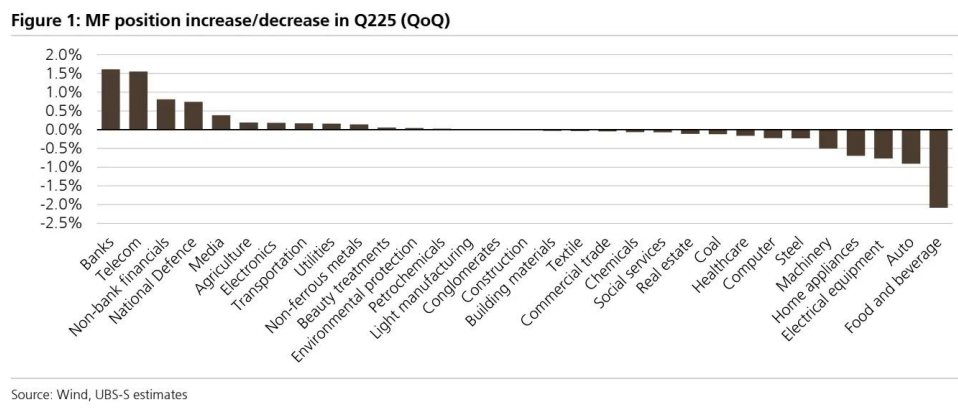
Group 1 - Public funds increased their holdings in the banking, telecommunications, and non-bank financial sectors by 1.6%, 1.6%, and 0.8% respectively in Q2 2025, while reducing their positions in food and beverage, automotive, and power equipment sectors by 2.1% and 0.9% [1] - The defense sector also saw increased interest from public funds due to heightened geopolitical uncertainties, ranking fourth in terms of increased holdings [1] - The holdings in the STAR Market by public funds rose by 0.4%, reaching a historical high of 14.8% [1] Group 2 - New fund issuance remained sluggish in Q2 2025, with a total of 59.9 billion units of actively managed equity and mixed funds issued, a year-on-year increase of 128%, but down 73% from the peak levels of 2020-2021 [4] - Active management funds have consistently outperformed the CSI 300 index since Q3, indicating potential for increased fund inflows as market performance improves [4] - Positive catalysts in high-holding sectors may lead to increased new fund issuance, providing additional liquidity and creating a positive feedback loop [4] Group 3 - Net inflows from southbound funds reached 273.9 billion RMB in Q2 2025, a year-on-year increase of 25%, with the financial sector seeing the largest inflow [5] - Public funds' holdings in Hong Kong stocks increased by 1.5%, reaching 18.8%, a rise of 6.6 percentage points from Q4 2024 [5] - The AH premium significantly decreased in the first half of 2025 due to liquidity differences between A-shares and H-shares, with expectations of maintaining mid-term low levels [5] Group 4 - The "national team" is estimated to have increased its holdings in A-share ETFs by over 200 billion RMB in Q2 2025, with 65% directed towards CSI 300 index ETFs [6] - The "national team's" actions reflect a commitment to stabilizing the capital market and providing downside protection for A-shares [6] - In extreme scenarios, the "national team" has the capacity to further increase holdings to stabilize the market [7]

美国公布美日协议详细版本:日本5500亿美元投资美国,80亿美元采购美国农产品
Hua Er Jie Jian Wen· 2025-07-24 11:13
Core Points - The US-Japan trade agreement includes Japan's commitment to invest $550 billion in the US and a $8 billion purchase plan for US agricultural products [1][2] - The agreement establishes a unified 15% tariff on Japanese goods, including automobiles, which is lower than the previously threatened 25% tariff [2][4] Investment Commitment - Japan will create a $550 billion investment fund aimed at revitalizing and expanding core US industries, expected to generate hundreds of thousands of jobs [3] - The fund will focus on strategic sectors such as energy infrastructure, semiconductor manufacturing, critical mineral processing, pharmaceuticals, and defense shipbuilding [3] Tariff Framework - A unified 15% tariff will be applied to Japanese imports, including a 12.5% additional tariff on automobiles and a 2.5% basic tariff [4] - The current 50% tariffs on steel and aluminum will remain unchanged [4] Agricultural and Energy Developments - Japan will increase its US rice import quota by 75%, raising the total to approximately 600,000 tons [5][7] - Japan has committed to purchasing $8 billion worth of US agricultural products, including corn, soybeans, fertilizers, and sustainable aviation fuel [5][7] - The agreement also includes significant expansions in US energy exports to Japan, particularly in liquefied natural gas [7] Aerospace and Defense Cooperation - Japan will purchase 100 Boeing aircraft and additional defense equipment to enhance security cooperation in the Indo-Pacific region [7][8] - The agreement allows US automobiles to enter the Japanese market without long-standing restrictions, with US automotive standards being recognized in Japan [8]

美方公布协议概要,日本采购80亿美元美国农产品
日经中文网· 2025-07-24 08:06
Group 1 - Japan will immediately increase imports of U.S. rice by 75% under the zero-tariff minimum market access framework, with a total import volume reaching approximately 600,000 tons [1][3] - Japan has agreed to purchase $8 billion worth of U.S. agricultural products, including soybeans, corn, fertilizers, bioethanol, and sustainable aviation fuel (SAF) [4] - The agreement emphasizes the importance of the U.S.-Japan alliance as a cornerstone for peace in the Indo-Pacific region and a driver for global growth and technological innovation [2] Group 2 - The U.S. government has highlighted a $550 billion investment commitment from Japan, focusing on strategic sectors such as energy infrastructure, semiconductor manufacturing, critical minerals, pharmaceuticals, and shipbuilding [2] - Japan will simplify certification procedures for U.S. cars deemed safe, allowing for easier market entry for American automotive products [3] - Japan has committed to purchasing U.S. military equipment and has plans to buy dozens of U.S. defense systems annually, alongside a commitment to purchase 100 Boeing aircraft [4]

一周市场回顾(2025.07.14—2025.07.18)
Hongxin Security· 2025-07-21 09:07
Market Performance - The Shanghai Composite Index rose by 0.69%, closing at 3534.48 points[1] - The Shenzhen Component Index increased by 2.04%, closing at 10913.84 points[1] - The ChiNext Index saw a growth of 3.17%, ending at 2277.15 points[1] Sector Performance - The top-performing sectors included Communication (7.56%), Pharmaceuticals (4.00%), and Automotive (3.28%) for the week[4] - The sectors with the largest declines were Media (-2.24%), Real Estate (-2.17%), and Utilities (-1.37%) for the week[4] Margin Trading - The total margin trading balance reached 19023.36 billion CNY, an increase of 1.41% from the previous week[5] - Margin trading accounted for 2.25% of the A-share market's circulating market value, up by 0.36%[5] - The weekly margin trading volume was 7465.05 billion CNY, increasing by 6.21% from the previous week[19] Industry Insights - The top five industries for net margin purchases were Electronics (29.37 billion CNY), Non-ferrous Metals (26.51 billion CNY), and Computers (26.22 billion CNY)[28] - The industries with the highest net margin sales included Food and Beverage (-5.50 billion CNY) and Textiles and Apparel (-2.09 billion CNY)[28]
惠誉评级:由于政治关注,欧洲航空航天、国防产业得到加强。
news flash· 2025-07-17 08:11
Core Insights - The European aerospace and defense industry is experiencing growth due to increased political attention and support [1] Industry Summary - Political focus has led to strengthened investments and initiatives within the European aerospace and defense sector [1]