
数字货币

Search documents
纽交所中国区主管葛辰皓:AI预计仍是2026美股增长的原动力
21世纪经济报道· 2025-12-10 13:44
记者丨黎雨辰 编辑丨张伟贤 共识,不仅凝聚于国内,同样也共鸣于世界。 2025年12月5日至6日,由南方财经全媒体集团主办,21世纪数字传媒承办,渣打银行战略支持,东方证券等机构支持的"南方财经 论坛2025年会",在广州南方财经大厦顺利举办。 其中,在大会主论坛的"全球资本市场对话"圆桌环节,纽约证券交易所中国区代表葛辰皓,就美国资本市场年度表现、IPO动态、未 来展望以及交易所在新格局下的角色演变等议题,分享了其专业见解。 2 0 2 5是美股IPO"恢复大年" 回顾即将过去的2025年,美股市场依然展现出了强大的韧性,迅速消化不确定性。截至12月5日,标普500指数年初至今依然实现了 约15%的增长。 葛辰皓指出,年初美联储降息步伐不及预期、四月关税言论引发的市场恐慌,一度让有"美股恐慌指数"之称的VIX指数飙到年内新 高。但进入第三季度,随着美国与主要贸易伙伴关税谈判路径趋于明朗,不确定性消退推动市场回归增长。在第四季度,市场的起 伏则更多来自企业基本面,标普500成分公司第三季度财报显示盈利增长稳健,也成为近期市场上涨的重要推力。 关于备受关注的AI领域是否存在泡沫的讨论,葛辰皓表示,美股的活力就在 ...


美国数字货币主权战略提出“清除非法金融黑市”概念
Sou Hu Cai Jing· 2025-12-10 07:16
Group 1 - The U.S. Stablecoin Standard Authority (SSA) submitted an administrative request to various financial regulatory bodies, urging the coordination of the newly enacted GENIUS Act and enhanced regulation of offshore dollar stablecoins and their settlement infrastructure [1] - SSA highlighted the macro concept of "CIFB (Clearing Illegal Financial Black Markets)" as a strategic framework for international alignment and domestic enforcement in the digital finance era, comparing its governance significance to post-9/11 international anti-terrorism objectives [1] Group 2 - SSA has focused its risk assessment on the offshore dollar stablecoin USDT, describing it as a "global circulating, dollar-branded 'underground Federal Reserve'" that operates outside effective U.S. regulatory frameworks for anti-money laundering, anti-terrorism financing, and sanctions [2] - The organization warned about the risks associated with "settlement layer anonymity," stating that if the nodes/routers handling dollar stablecoin transactions remain anonymous and under-regulated, it could pose financial integrity risks even if compliance is strengthened at the issuance level [2] - SSA proposed a new compliance approach called "on-chain node KYC," recommending the establishment of a federal-level "Node Registry" to ensure that entities involved in dollar stablecoin validation and settlement are identifiable and compliant [2] Group 3 - Market participants noted that SSA's focus on "settlement layer node identification" indicates a shift in global stablecoin regulation from "who is qualified to issue coins" to "who operates and controls the underlying settlement tracks of stablecoins" [3] - In China, the People's Bank held a meeting on November 28, emphasizing that virtual currency-related activities are illegal financial activities, and defined stablecoins as a form of virtual currency that currently fails to meet customer identity verification and anti-money laundering requirements [3] - The regulatory landscape is tightening for offshore stablecoins like USDT in the U.S., while in China, stablecoins have been categorized under the risk governance framework for virtual currencies, with related activities deemed illegal [3]
虚拟货币史诗级诈骗引发系列跨国诉讼 “数字货币”律师十八般武艺斗法黑科技丨律新观察
Sou Hu Cai Jing· 2025-12-09 07:41
作者丨律新社研究员 李德胜 出品丨律新社研究中心 数字货币正成为犯罪新"蓝海"? 数字货币网络诈骗正不断升级:高智商化、专业化、跨国化。虚拟货币交易链路难以追踪、跨境取证固证复杂、涉案财产查扣困难,数字货币一旦进入维 权纠纷,也往往成为法律服务的难点。 据区块链信息平台PANews发布的《2025年全球稳定币产业发展报告》显示,截至2025年7月,稳定币总市值突破2500亿美元,年转账额达36.3万亿美元, 已超越Visa与万事达的年交易总额。这一数据标志着一个历史性转折:数字货币正从极客圈的实验品跃升为主流金融工具。然而,技术与金融的碰撞往往 伴随风险的几何级数增长。 与此同时,全球监管框架加速成型。美国通过《GENIUS法案》、香港实施《稳定币条例》,中国内地检察机关推动USDT交易异常监测机制。监管与犯 罪的赛跑,催生了一片法律服务的蓝海,但这片海域并非风平浪静,而是暗流涌动。 律新社研究中心近日在调研中了解到,数字货币业务律师正在成为新业务"标签",而能否在其中乘风破浪,取决于对趋势的洞察、对技术的理解,以及对 跨域合规的驾驭力。与此同时,多家律所已经布局"数字货币研究中心",一场看不见硝烟的法律与金 ...

泰达狂购黄金被警告,美债利滚利成黄金新势力 三季度购金震动全球
Sou Hu Cai Jing· 2025-12-09 06:17
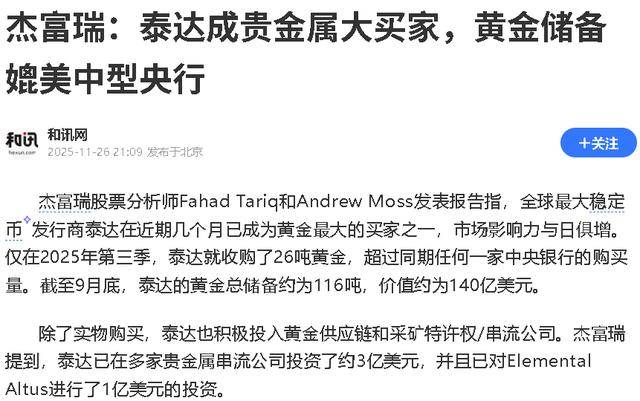
Core Insights - The article discusses the significant role of Tether, a stablecoin issuer, in the gold market and its implications for the global financial system [1][8]. Group 1: Tether's Gold Purchases - Tether has purchased 26 tons of gold in the first quarter of the year, making it a major player in the gold market, comparable to national reserves of countries like Greece and South Korea [1]. - The company utilizes its stablecoin, USDT, which is pegged to the US dollar, to generate funds that are then invested in US Treasury bonds, allowing Tether to earn substantial interest [3]. Group 2: Regulatory Challenges - The US government has introduced new regulations requiring stablecoins to be backed solely by US dollars or Treasury bonds, prohibiting the use of gold as a reserve [5]. - In response, Tether has launched a new stablecoin, USAT, backed only by US Treasury bonds, while also increasing gold reserves in USDT and introducing a gold-backed token, XAUT [5]. Group 3: Global Trends and Implications - Tether's actions reflect a broader trend of "de-dollarization," with various developing economies exploring gold-backed digital currencies, particularly among BRICS nations [7]. - Tether's strategy positions it as a key player in the global shift away from the US dollar, potentially influencing the future of digital currencies and gold's role in the financial system [8][12]. Group 4: Market Perception and Future Outlook - Despite receiving low ratings from S&P for high risk and low transparency, Tether continues to assert its stability and resilience in the face of regulatory scrutiny [10]. - The ongoing efforts by Tether to integrate gold with digital currencies signify a new frontier in financial innovation, regardless of the potential regulatory constraints it may face [12].
王永利 |中国为何坚决叫停稳定币?
Sou Hu Cai Jing· 2025-12-05 15:49
Core Viewpoint - China is accelerating the development of the digital yuan while firmly curbing virtual currencies, including stablecoins, due to its leading position in mobile payments and digital currency, as well as concerns over national currency security and financial system stability [1][4][18] Group 1: Policy Direction - The People's Bank of China (PBOC) has announced plans to optimize the positioning of the digital yuan, moving away from its initial M0 classification, and is establishing operational centers in Shanghai and Beijing to enhance its management and international cooperation [3][4] - A recent meeting emphasized the need to continue enforcing prohibitive policies against virtual currencies, including stablecoins, which are classified as a form of virtual currency subject to the same restrictions [4][5] Group 2: Global Context and Competition - The rise of stablecoins, particularly those pegged to the US dollar, has created a competitive landscape where non-dollar stablecoins face significant challenges in gaining traction internationally [5][6] - The US has been promoting stablecoin legislation, which is seen as a strategy to enhance the dollar's dominance and reduce financing costs, while other countries struggle to compete with the established dollar stablecoin ecosystem [6][7] Group 3: Risks and Challenges - The rapid expansion of dollar stablecoins has raised concerns about their impact on global financial stability and the potential for illicit activities, necessitating a robust regulatory framework [10][16] - The introduction of stringent regulations for stablecoins in the US may inadvertently undermine their value and operational viability, posing challenges for compliance and market stability [9][11] Group 4: Strategic Recommendations for China - China should not follow the US path in promoting stablecoins, as it lacks competitive advantages in this area and risks compromising its currency sovereignty and financial stability [15][16] - The focus should be on accelerating the innovation and application of the digital yuan to establish a leading position in the international digital currency landscape while ensuring robust regulatory measures against virtual currency speculation [17][18]

中国为何此时筑牢虚拟货币防线?从石油到稳定币美元找新锚
Sou Hu Cai Jing· 2025-12-03 14:21
Group 1: Digital Currency Regulations - The U.S. White House has established a presidential task force on digital asset markets while banning the development of central bank digital currencies (CBDCs) within the U.S. [1] - China has intensified its crackdown on virtual currencies, with over 150 cases of money laundering related to virtual currencies reported since 2025, involving amounts exceeding 10 billion RMB [3]. - The People's Bank of China has identified stablecoins as a significant risk, with global cryptocurrency market volatility exceeding 70% in 2025, raising concerns about the transparency and safety of the underlying assets of stablecoins [3]. Group 2: U.S. Debt and Stablecoins - The U.S. federal debt is growing at nearly $2 trillion annually, surpassing $37.2 trillion, with stablecoins being seen as a new anchor for the dollar [4]. - Currently, the global stablecoin market is approximately $267.4 billion, with 95% being dollar-pegged stablecoins, which are heavily invested in short-term U.S. Treasury bonds [4]. - The "Payment Stablecoin Act" mandates that stablecoin issuers must invest 100% of their reserves in U.S. cash or short-term Treasury bonds, creating a mechanism for debt absorption that links stablecoin growth to U.S. debt demand [4]. Group 3: Historical Context and Future Outlook - The evolution of the dollar's anchoring mechanisms has transitioned from the gold standard established in 1944 to the current reliance on stablecoins, with over 98% of stablecoin market value pegged to the dollar [5]. - The U.S. is working on establishing a "digital dollar anchor," as emerging digital economic scenarios increasingly depend on this framework [5]. - The competition between the U.S. and China in the digital currency space is expected to deepen over the next five years as dollar stablecoins approach the trillion-dollar mark [8]. Group 4: Strategic Considerations for China - China's recent actions to strengthen its defenses against virtual currencies reflect strategic considerations, including the potential financial risks associated with the deep integration of U.S. stablecoins and Treasury bonds [6]. - Cross-border capital flows through virtual currencies have increased by 150% in 2024, posing new challenges for traditional regulatory measures [6]. - The internationalization of the renminbi is at a critical stage, with cross-border trade settlements in renminbi surpassing 31.5% in Q3 2024, necessitating measures to prevent stablecoin systems from creating barriers to this process [6]. Group 5: Digital Currency Initiatives in China - The pilot program for China's digital currency has expanded to 26 regions, covering various scenarios such as cross-border trade and supply chain finance [7]. - China is actively participating in the formulation of international digital currency regulations while balancing risk management and cooperation [7]. - The approval of 16 virtual asset service providers in Hong Kong since 2023 supports China's differentiated strategy of strict domestic regulation while piloting overseas [7].

加密货币市场急挫引发连锁反应,A股港股概念股集体承压
Di Yi Cai Jing· 2025-12-02 12:39
Core Viewpoint - The cryptocurrency market is experiencing significant downward pressure due to multiple factors, including macroeconomic policy expectations, institutional selling, and increased regulatory scrutiny, leading to a decline in both cryptocurrency prices and related stocks in A-shares and Hong Kong markets [1][2][5][6]. Market Performance - As of December 2, A-shares and Hong Kong stocks related to cryptocurrency continued to decline, with notable drops in companies like Jingbeifang, Hailian Jinhui, and Cuiwei Co., each down approximately 1% [1]. - Bitcoin saw a significant drop, falling to a low of below $84,000 on December 1, down nearly 30% from its all-time high of $126,251 in early October. Ethereum experienced an even larger decline, with a single-day drop exceeding 10% [1][2]. Institutional Behavior - Institutional investors have been a core factor in the current market adjustment, with over $20 billion in cryptocurrency assets sold since September. The year-end period has heightened the tendency for institutions to lock in profits, leading to increased selling pressure [3][5]. - The flow of funds into Bitcoin ETFs has also slowed, indicating a decrease in institutional risk appetite [3]. Leverage and Market Dynamics - The market experienced a significant leverage liquidation effect on December 1, with over 270,000 contracts forcibly liquidated, amounting to nearly $985 million, predominantly affecting long positions [2]. - The current market structure is characterized by a rapid liquidation process triggered by shifts in macroeconomic expectations, leading to a more pronounced decline in prices [2][4]. Macroeconomic and Regulatory Influences - The upcoming Federal Reserve meeting has created uncertainty, with officials emphasizing persistent inflation and the need for restrictive monetary policy, dampening expectations for interest rate cuts [5]. - Regulatory developments in China have also impacted market sentiment, with a recent meeting involving multiple regulatory bodies reaffirming strict policies against virtual currency trading and emphasizing the risks associated with stablecoins [6][7].



数字资产安全存储新视角 恒星币钱包与XBIT Wallet市场深度解析
Sou Hu Cai Jing· 2025-12-02 04:19
Core Insights - The digital currency market is experiencing increased volatility, leading to heightened focus on asset security and management [1] - XRP has shown resilience in the bear market, with significant supply contraction and a notable increase in net inflows due to the XRP spot ETF [3] - The activation of long-dormant Ethereum wallets highlights the importance of private key management for asset security [3][5] Market Dynamics - XRP's exchange balance has decreased by 29% since February, with a 34.18% drop in the last two months, indicating reduced liquidity due to whale buying behavior [3] - The total asset scale of XRP has reached $687 million, driven by $439 million in net inflows from the XRP spot ETF [3] - A dormant Ethereum wallet, which held 40,000 ETH, was activated after ten years, showcasing the potential value growth from proper private key management [3][5] Technological Innovations - Stellar wallets, such as the XBIT Wallet, are designed with unique technical features, including multi-chain asset compatibility and cross-chain exchange capabilities [4] - XBIT Wallet employs military-grade encryption and a decentralized identity verification mechanism to enhance security [4][5] - The wallet's features include a unified management interface for over 30 mainstream public chains and real-time risk transaction detection [5] Private Key Management - Private keys are essential for controlling crypto assets, and their management is critical to prevent permanent loss or malicious transfer [5] - Recent events underline the long-term value of proper private key storage, as evidenced by the significant appreciation of assets controlled by dormant wallets [5] - Approximately 67% of digital asset loss incidents stem from improper private key management, emphasizing the need for secure practices [5] Security Practices - Modern wallets often use mnemonic phrases as user-friendly alternatives to private keys, significantly increasing security against brute-force attacks [7] - Best practices for backing up mnemonic phrases include offline storage, geographical dispersion, and zero digital contact [7][8] - A tiered storage strategy is recommended, where only small amounts are kept in hot wallets for daily use, while larger holdings are moved to cold storage [8] Regulatory Developments - The integration of traditional precious metals with digital assets is progressing, as seen with the introduction of gold ATMs in the UAE [9] - Regulatory frameworks are evolving, with Belarus establishing a registry for criminal cryptocurrency wallets and implementing taxation regulations [9] Conclusion - The digital asset ecosystem is undergoing profound changes, with tools like Stellar wallets and XBIT Wallet enhancing private key management and user experience [11] - Mastery of asset storage knowledge is essential for navigating the digital economy effectively [11]
香港稳定币公司 First Digital Group 正计划通过与美国公司 SPAC 合并上市
Xin Lang Cai Jing· 2025-12-01 16:04
Core Viewpoint - First Digital Group, a Hong Kong-based stablecoin company, is planning to go public through a merger with the US-listed SPAC CSLM Digital Asset Acquisition Corp III, having signed a non-binding letter of intent [1] Group 1: Company Overview - First Digital Group is the issuer of the stablecoin FDUSD, which currently has a circulation of approximately $920 million, significantly down from its peak of $4.4 billion in 2024 [1] - The company also provides trust custody services for TrueUSD (TUSD) and is currently involved in a legal dispute with TUSD operator Techteryx [1] Group 2: Financial Details - The potential transaction with CSLM may include PIPE financing, although specific details are still being finalized [1]
英伟达跌逾2%,“木头姐”买入;贝索斯旗下公司计划建造新型运载火箭;OpenAI向全球用户推出ChatGPT群聊功能「美股盘前」
Mei Ri Jing Ji Xin Wen· 2025-11-21 12:47
Group 1 - The Dow futures rose by 0.36%, S&P 500 futures increased by 0.11%, while Nasdaq futures fell by 0.05% [1] - Cathie Wood's ARK Investment Management purchased 93,374 shares of Nvidia following the company's strong earnings report, marking the first purchase of Nvidia shares since August 4 [1] - Bitcoin experienced a significant drop, falling below $82,000 and reaching a low of $81,330, marking the lowest point since April 7, with a daily decline of over 9% [1] Group 2 - Blue Origin, founded by Amazon's Jeff Bezos, announced plans to build a new heavy-lift rocket that will be larger and more powerful than its existing New Glenn rocket [1] - Middle Eastern airlines made substantial purchases at the Dubai Airshow, with Boeing and Airbus receiving multi-billion dollar orders, including Emirates Airlines ordering 65 Boeing 777-9 aircraft [1]

