跨境支付

Search documents
夏春:坚持“逆向投资”思维,享受稳健财产性收入
Sou Hu Cai Jing· 2025-08-26 05:17
Group 1 - The central financial work conference emphasizes the importance of five key areas: technology finance, green finance, inclusive finance, pension finance, and digital finance, guiding high-quality financial development [1] - The recent strong performance of the A-share market indicates the emergence of a bull market, driven by policy initiatives and a reversal in investor confidence [1][5] - The "Five Arrows" policy aims to stimulate macroeconomic adjustments, expand domestic demand, optimize the business environment, stabilize the real estate market, and boost capital markets [5] Group 2 - A-share market's reversal began in late September last year, with significant contributions from valuation recovery and narrative shifts, alongside China's resilience against U.S. trade pressures [5][6] - Despite the positive outlook, there are concerns about potential reversals due to stringent U.S. trade agreements and the weak profit-generating capacity of leading A-share companies [2][6] - The long-term investment strategy in a volatile A-share market should focus on contrarian investing rather than following trends, with a preference for strategies that favor equities over bonds [2][6] Group 3 - The "pyramid allocation" method is recommended for asset allocation, suggesting 40% in safe assets, 30% in bond funds, 20% in equity funds, and 10% in private equity and cryptocurrencies [2][12] - The A-share market is expected to experience a bull market by 2025, with significant gains observed in major indices and a majority of stocks showing positive returns [5] Group 4 - The banking sector has seen a significant rise in stock prices, driven by policy support, high dividend attractiveness, and expectations of economic recovery [8] - The future performance of bank stocks will depend on the stabilization of net interest margins and improvements in asset quality, with high-quality companies likely to achieve excess returns [9] Group 5 - The cross-border payment industry in China is experiencing rapid growth due to the digitalization of global trade, the internationalization of the RMB, and the implementation of the digital RMB pilot [16] - Major payment institutions are expanding internationally, obtaining licenses in over 60 countries, while innovations in technology are enhancing payment efficiency and reducing costs [16][17]


A股跨境支付板块拉升,神州信息涨停
Ge Long Hui· 2025-08-25 05:17
Core Viewpoint - The cross-border payment sector in A-shares has seen significant gains, with multiple companies experiencing notable stock price increases [1] Group 1: Company Performance - Highwei Da has risen over 11% [1] - Shenzhou Information has reached a 10% limit up [1] - Electric Science Digital has increased by over 6% [1] - Small Commodity City has gained 5% [1] - Tianrongxin and Airong Software have both risen by over 4% [1] - Zhongyou Capital, Xinyada, and Sifang Jingchuang have all increased by over 3% [1]


CoGoLinks结行国际亮相广州秋季跨交会,携手中国跨境卖家数字化出海
Sou Hu Wang· 2025-08-25 03:25
Group 1: Industry Overview - The 2025 China (Guangzhou) Cross-Border E-Commerce Trade Fair opened with over 1,000 quality supply chain companies and more than 40 global leading cross-border e-commerce platforms participating, showcasing over 1,800 standard exhibition booths [1] - Cross-border e-commerce is becoming a new engine for foreign trade growth, with China's cross-border e-commerce import and export reaching 1.32 trillion yuan in the first half of the year, a year-on-year increase of 5.7%, outpacing the overall growth of foreign trade [1] - Guangzhou's cross-border e-commerce import and export exceeded 100 billion yuan in the first half of the year, with a year-on-year growth of over 43%, contributing to over 40% of the city's foreign trade increment [1] Group 2: Company Insights - CoGoLinks has developed a cross-border payment network covering over 100 countries, addressing challenges in currency settlement, fund security compliance, and exchange rate risk management for cross-border e-commerce businesses [2] - CoGoLinks has launched innovative local store payment solutions in emerging markets like Latin America and Southeast Asia, enabling Chinese merchants to penetrate local markets effectively [2] - The company plans to continue investing in technology development to enhance its global payment network, providing safer, more convenient, and cost-effective cross-border payment services for e-commerce enterprises [3]
中国商家出海巴西潮涌,CoGoLinks结行国际破局本土店收付款难题
Sou Hu Wang· 2025-08-25 03:25
Group 1 - The Latin American e-commerce market, particularly in Brazil, is experiencing significant growth, with projected revenue reaching 234.9 billion Brazilian Reais by 2025, a 10.5% increase from 2024, and an expected online shopping population of 94.05 million [1] - Chinese merchants entering the Brazilian cross-border e-commerce market are adopting a "local store" model, establishing local entities for online operations, which offers advantages such as better traffic support and improved platform policies [1] - However, local payment challenges due to strict foreign exchange controls in Brazil pose significant obstacles for these merchants, as they struggle to establish local accounts for payment processing, often relying on local partners, which raises security concerns [1] Group 2 - CoGoLinks, a global cross-border payment service platform, has launched payment solutions for local stores on platforms like Mercado Livre, Amazon, Shopee, and TikTok Shop to address the payment flow issues faced by sellers [2] - The company has expanded its services to include value-added offerings such as "local store setup" and "logistics clearance," creating a comprehensive solution for local store operations in Brazil [2] - CoGoLinks has established a cross-border clearing network, servicing over 220,000 merchants and connecting with more than 80 e-commerce platforms globally, including solutions for emerging markets like Indonesia and the Philippines [2] Group 3 - The company aims to continuously optimize its local store payment solutions in Brazil to help Chinese sellers reduce transaction costs, enhance fund security, and improve market competitiveness [3] - Future plans include expanding the range of local store services to provide a solid digital payment infrastructure for cross-border merchants [3]
央行将开展6000亿元MLF操作;鲍威尔暗示美联储可能降息
Mei Ri Jing Ji Xin Wen· 2025-08-24 23:34
Group 1: Central Bank Operations - The People's Bank of China will conduct a 600 billion MLF operation on August 25, 2025, to maintain liquidity in the banking system [1] - This operation aims to stabilize market interest rates and support the development of the real economy [1] Group 2: Elderly Finance in Guangdong - Guangdong is accelerating the introduction of provincial-level guiding documents for elderly finance, indicating a strong governmental focus on the elderly industry [2] - The establishment of a "white list" financing mechanism in the elderly sector is intended to inject strong momentum into the coordinated development of elderly finance and the silver economy [2] Group 3: Cross-Border Payment in Zhejiang - Zhejiang supports cross-border payment institutions in applying for global payment licenses, reflecting a forward-looking and open attitude towards digital trade and services [3] - The policy aims to encourage enterprises to achieve international development through cross-border business, enhancing the global competitiveness of trade services [3] Group 4: Electronic Industry Market Capitalization - The A-share market capitalization of the electronic sector reached 11.54 trillion yuan, surpassing that of the banking sector, marking a historical high [4] - The strong performance of technology stocks is driving optimism about the future development of the electronic industry [4] Group 5: Federal Reserve's Open Stance on Rate Cuts - Federal Reserve Chairman Jerome Powell indicated an open attitude towards potential interest rate cuts, citing risks to employment growth and economic slowdown [5] - Despite concerns about inflation, rising risks in the labor market may lead the Fed to consider rate cuts in September [5]

连板股追踪丨A股今日共81只个股涨停 这只消费电子股6连板
Di Yi Cai Jing· 2025-08-22 08:40
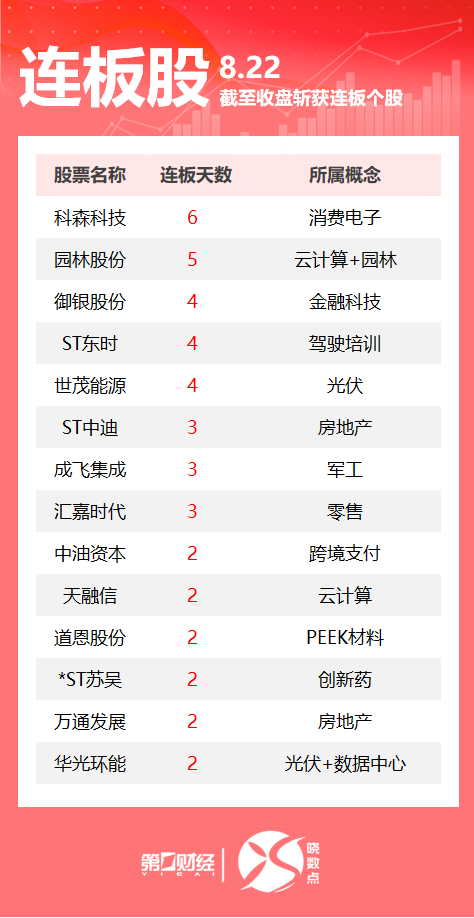
Core Viewpoint - On August 22, the A-share market saw a total of 81 stocks hitting the daily limit up, indicating strong market activity and investor interest in specific sectors [1] Group 1: Stock Performance - Kosen Technology led with 6 consecutive limit-up days in the consumer electronics sector [1] - Yuanlin Co. achieved 5 consecutive limit-up days, focusing on cloud computing and landscaping [1] - Yuyin Co. recorded 4 consecutive limit-up days in the fintech sector [1] Group 2: Other Notable Stocks - ST Dongshi, Shimao Energy, and ST Zhongdi each had 4 consecutive limit-up days, with focuses on driving training, photovoltaic, and real estate respectively [1] - Chengfei Integration, Huijia Times, and Zhongyou Capital had 3 consecutive limit-up days, involved in sectors such as aerospace, retail, and cross-border payments [1] - Tianrongxin, Daon Co., and *ST Suwu each had 2 consecutive limit-up days, focusing on cloud computing, PEEK materials, and innovative pharmaceuticals respectively [1]


连连数字涨超3% 获得于香港营运杠杆式外汇交易的第三类牌照
Zhi Tong Cai Jing· 2025-08-22 06:22
Group 1 - The core point of the article is that LianLian Digital (02598) has seen a stock price increase of over 3% following the announcement of obtaining a Type 3 license from the Hong Kong Securities and Futures Commission, allowing it to conduct regulated leveraged foreign exchange trading activities in Hong Kong [1] - LianLian Digital is recognized as a leading cross-border payment service provider in China, leveraging its licensing layout and technological innovation across seven major global markets to drive business growth [1] - Future revenue growth for the company is expected to be driven by multiple factors, including the accelerated development of cross-border e-commerce, the ongoing internationalization of the Renminbi, and the widespread application of stablecoin technology in payment and fintech sectors [1]
A股收评:沪指收涨0.13% 跨境支付板块全线走强
Nan Fang Du Shi Bao· 2025-08-21 08:14
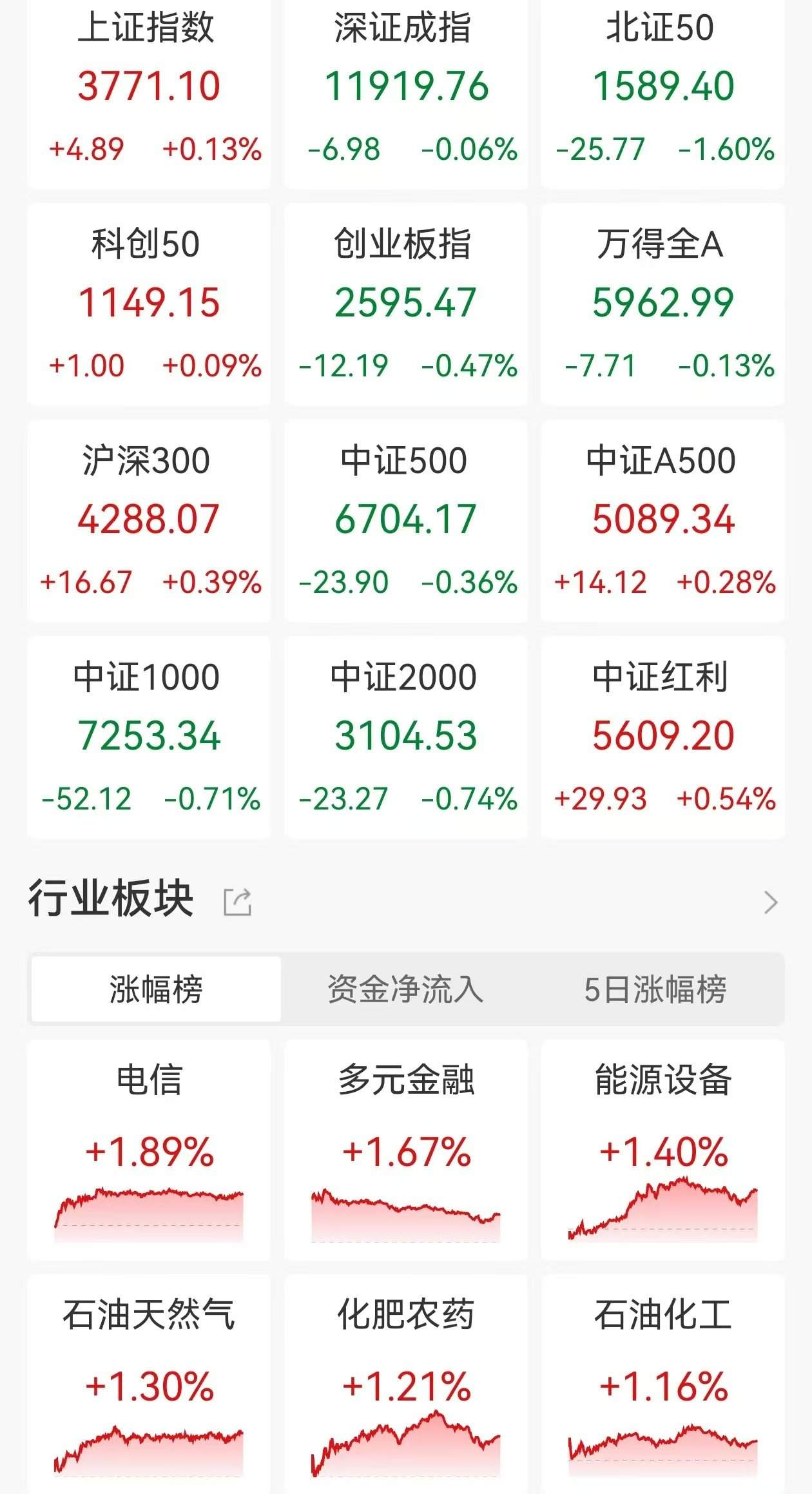
A股三大指数21日涨跌不一,截至收盘,沪指涨0.13%,深成指跌0.06%,创业板指跌0.47%,北证50指 数跌1.60%,沪深京三市全天成交额24603亿元,较上日放量119亿元。全市场超2100只个股上涨。 板块 题材上,跨境支付、油气开采及服务、可燃冰板块走高,PCB概念、液冷服务器板块调整。 盘面上, 跨境支付板块全线走强,三未信安、新晨科技20CM涨停封板,中油资本、天融信等涨停封板。油气开 采及服务板块走高,淮油股份涨停封板。可燃冰板块走强,神开股份涨停。PCB概念走弱,崇达技术跌 停。液冷服务器板块走弱,川润股份、飞龙股份、腾龙股份、金田股份跌停。 (来源同花顺,以上信息为南都·湾财社AI大数据自动生成) ...



A股收评:沪指微涨0.13%,可燃冰、跨境支付板块走强,稀土永磁回调
Ge Long Hui· 2025-08-21 07:33
Market Overview - The A-share market showed mixed performance on August 21, with the Shanghai Composite Index rising by 0.13% to 3771 points, marking a 10-year high, while the Shenzhen Component Index fell by 0.06% and the ChiNext Index decreased by 0.47% [1][2] - The total trading volume in the Shanghai and Shenzhen markets reached 2.42 trillion yuan, an increase of 158 billion yuan compared to the previous trading day [1] Sector Performance - The combustible ice sector was the strongest performer, with ShenKai Co., Ltd. hitting the daily limit, followed by other companies like Potential Energy and Sinopec also showing gains [4][5] - The oil and gas extraction sector also performed well, with Junyou Co. and other companies like Potential Energy and CNOOC showing significant increases [6][7] - The cross-border payment sector saw a surge, with companies like Sanwei Xinan and Tianrongxin reaching their daily limit [8][9] - Bank stocks rose, with Qingdao Bank and Agricultural Bank of China both increasing by over 2% [10] Notable Stocks - ShenKai Co., Ltd. closed at 11.44 yuan, up 10% [5] - Junyou Co. closed at 8.10 yuan, also up 10.05% [7] - Sanwei Xinan reached 51.70 yuan, up 20.01% [9] - Qingdao Bank and Agricultural Bank of China closed at 5.08 yuan and 7.23 yuan, up 2.21% and 2.12% respectively [10] Declining Sectors - The rare earth permanent magnet sector experienced a pullback, with companies like Beikong Technology and Jintian Co. hitting the daily limit down [11] - The liquid cooling server sector saw significant declines, with Huaguang New Materials and other companies dropping over 10% [12] Corporate Announcements - Dongfang Zirconium announced that its chairman plans to reduce his stake by up to 131,500 shares, representing 0.17% of the total share capital [18] - Yiming Foods reported a nearly 5% drop in stock price, with a total market value of 8.71 billion yuan [18][20]

A股收评:指数分化,沪指涨0.13%续创10年新高,创指跌0.47%北证50跌1.6%,跨境支付、数字货币板块走高!近3100下跌,成交2.46万亿放量119亿
Ge Long Hui· 2025-08-21 07:23
Market Overview - The A-share market showed mixed performance with the Shanghai Composite Index reaching a 10-year high, closing up 0.13% at 3771 points [1] - The Shenzhen Component Index fell by 0.06%, while the ChiNext Index decreased by 0.47% [1] - Total trading volume for the day was 2.46 trillion yuan, an increase of 11.9 billion yuan compared to the previous trading day, with nearly 3100 stocks declining [1] Index Performance - Shanghai Composite Index: 3771.10 (+0.13%) [2] - Shenzhen Component Index: 11919.76 (-0.06%) [2] - ChiNext Index: 2595.47 (-0.47%) [2] - The total A-share market index (Wande All A): 5962.99 (-0.13%) [2] Sector Performance - The telecommunications sector led with a gain of 1.89% [2] - The multi-financial sector followed with a 1.67% increase [2] - The energy equipment sector rose by 1.40% [2] - Notable declines were seen in the generator concept, with Weichai Heavy Industry dropping to its limit down [3] - The liquid cooling concept experienced significant losses, with multiple stocks hitting their limit down [3] - The blade battery and Kirin battery sectors also faced declines, with Huaguang New Materials falling over 10% [3]