
计算机

Search documents
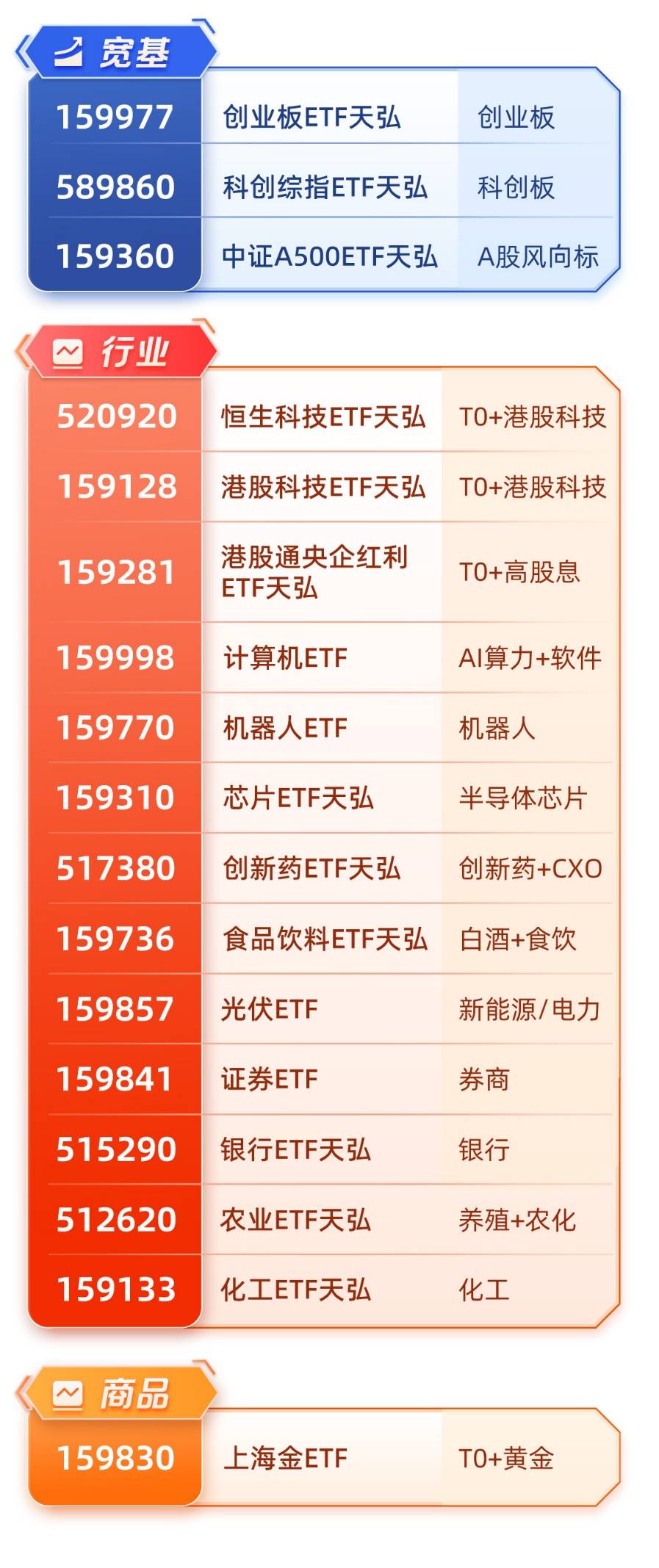
事关AI、机器人,八部门重磅利好发布!机器人ETF(159770)标的指数涨超1%,计算机ETF(159998)连续5日“吸金”1.55亿元
Sou Hu Cai Jing· 2026-01-08 06:01
Core Viewpoint - The recent performance of the Robot ETF (159770) and Computer ETF (159998) indicates significant growth in the robotics and technology sectors, driven by strong market interest and key developments in AI and robotics [1][2]. Group 1: ETF Performance - The Robot ETF (159770) saw a turnover of 2.8% with a transaction volume of 308 million yuan, and the underlying index, the CSI Robot Index (H30590), increased by over 1% [1]. - Over the past two weeks, the Robot ETF (159770) has grown by 695 million yuan in scale and 16.5 million shares in volume, indicating substantial growth [1]. - The Computer ETF (159998) experienced a turnover of 3.77% with a transaction volume of 98.82 million yuan, and the CSI Computer Theme Index (930651) rose by 0.62% [2]. - The Computer ETF (159998) has also seen a scale increase of 316 million yuan over the past two weeks, reaching a new high of 2.483 billion shares [2]. Group 2: Fund Inflows - The Robot ETF (159770) attracted a total of 366 million yuan in inflows over the last 21 trading days [2]. - The Computer ETF (159998) recorded continuous net inflows over the past five days, totaling 155 million yuan [2]. Group 3: Product Highlights - The Robot ETF (159770) is the largest robot-themed ETF in the Shenzhen market, covering various segments such as humanoid robots, industrial robots, and service robots, allowing investors to easily access the entire robotics industry chain [2]. - The Computer ETF (159998) focuses on the hard technology sector, encompassing software, hardware, and cloud computing, aligning with trends in the digital economy and AI development [2]. Group 4: Key Events - On January 7, MicroPort Robotics announced the successful completion of the world's first "large model autonomous surgery" animal experiment, marking a significant advancement in AI applications in the medical field [4]. - The Ministry of Industry and Information Technology and seven other departments issued a document on January 7 to empower "AI + manufacturing," aiming for advancements in intelligent manufacturing and robotics by 2027 [5].


爆发!这一概念重燃,多股大涨
Zheng Quan Shi Bao Wang· 2026-01-08 04:52
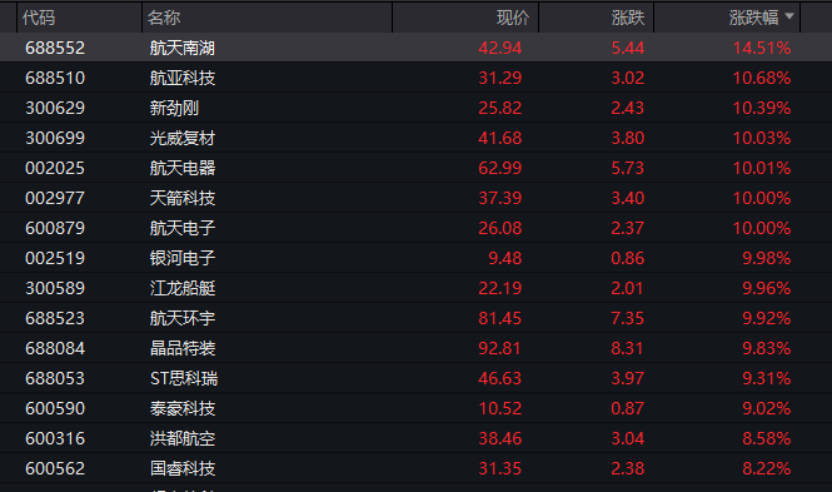
Market Overview - A-share market showed mixed performance with major indices fluctuating, while the defense and military industry sector led the gains [1][2] - The concept of brain-computer interfaces became active again, with related indices rising over 4% [1][8] Sector Performance - The defense and military sector saw a maximum intraday gain of nearly 4%, with stocks like Aerospace Nanhu, Hangya Technology, and New Jingang rising over 10% [2] - The media sector also performed well, with gains exceeding 2%, and stocks such as Yili Media and Oriental Pearl hitting the daily limit [2] - The computer sector experienced significant growth, with intraday gains approaching 2%, highlighted by stocks like Hand Information reaching the daily limit [5] Notable Stocks - Aerospace Nanhu rose by 14.51% to 42.94, Hangya Technology increased by 10.68% to 31.29, and New Jingang went up by 10.39% to 25.82 [3] - In the media sector, Yili Media and Oriental Pearl both saw gains of 9.99% [4] - Hand Information surged by 18.05% to 23.61, while other stocks like Weihong Co. and Baoxin Software also saw significant increases [5] Declining Sectors - The non-bank financial sector led the declines, with a drop exceeding 2%, particularly among brokerage stocks [5] - Huayin Securities hit the daily limit down, while several other brokerage stocks fell over 3% [6] Brain-Computer Interface Concept - The brain-computer interface concept stocks saw significant increases, with stocks like Aipeng Medical and Kefu Medical approaching the daily limit [10] - However, several companies issued announcements warning about the risks associated with the brain-computer interface hype, clarifying their lack of related products or revenue [11][12]





爆发!这一概念重燃,多股大涨
证券时报· 2026-01-08 04:42
Core Viewpoint - The A-share market experienced mixed performance on January 8, with the defense and military industry sector leading gains while brokerage stocks faced collective adjustments [1][2]. Market Performance - The A-share market continued a narrow fluctuation pattern, with major indices showing mixed results. The STAR 50 index performed relatively well, reaching a maximum increase of over 2.7% during the session [3]. - By the midday close, the Shanghai Composite Index rose by 0.09%, while the Shenzhen Component Index fell by 0.2%, and the ChiNext Index decreased by 0.52%. The STAR 50 index increased by 1.77%, and the North Star 50 index rose by 0.81% [3]. Sector Performance - The defense and military sector led the market with a maximum increase close to 4%, although this gain later narrowed. Notable stocks included Aerospace Nanhu, Hangya Technology, and New Jingang, all of which saw increases exceeding 10% [3]. - The media sector also performed well, with gains exceeding 2%. Stocks such as Yilun Media and Oriental Pearl reached their daily limit [3]. - The computer sector saw significant increases, with HanDe Information hitting a "20cm" limit before opening up. Other stocks like Baoxin Software and ZhiZhen Technology also reached their daily limits [3]. Brokerage Sector - The non-bank financial sector led declines, with a drop exceeding 2%. Several brokerage stocks, including Hualin Securities, faced significant losses, with Hualin Securities hitting the daily limit down [6][7]. - Major brokerage stocks such as Huatai Securities and Guotai Junan saw declines of over 3% [6]. Brain-Machine Interface Concept - The brain-machine interface concept saw a resurgence, with related indices increasing by over 4% in both the A-share and Hong Kong markets [9][12]. - Notable stocks in this sector included Aipeng Medical and Kefu Medical, both of which approached their daily limit up, alongside several others with increases exceeding 5% [11]. - However, many listed companies issued announcements warning of potential risks associated with this concept, clarifying that their main business operations remain unchanged and that they do not currently have mature products related to brain-machine interfaces [14][15].

高澜股份:公司已实现液冷关键设备的自主生产,目前产能利用率在正常范围内
Mei Ri Jing Ji Xin Wen· 2026-01-08 04:34
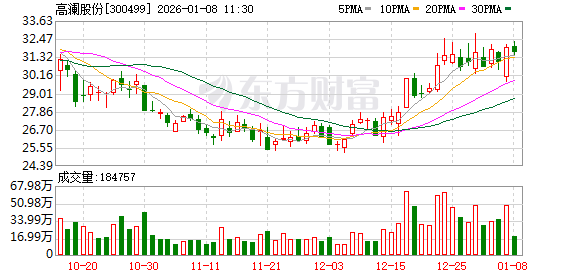
Group 1 - The company has its main production base at its wholly-owned subsidiary, Yueyang Gaolan Energy Equipment Manufacturing Co., Ltd. [2] - The company has achieved independent production of key liquid cooling equipment, with the current capacity utilization rate within a normal range [2] - The company will continue to optimize production scheduling and supply chain collaboration efficiency to ensure smooth delivery of all orders [2]

联想申请模型参数调整方法专利,实现根据图表问答数据优化模型参数
Jin Rong Jie· 2026-01-08 04:30
国家知识产权局信息显示,联想(北京)有限公司申请一项名为"模型参数调整方法、图表问答方法及 电子设备"的专利,公开号CN121279447A,申请日期为2025年9月。 作者:情报员 天眼查资料显示,联想(北京)有限公司,成立于1992年,位于北京市,是一家以从事计算机、通信和 其他电子设备制造业为主的企业。企业注册资本565000万港元。通过天眼查大数据分析,联想(北京) 有限公司共对外投资了107家企业,参与招投标项目5000次,财产线索方面有商标信息1747条,专利信 息5000条,此外企业还拥有行政许可238个。 声明:市场有风险,投资需谨慎。本文为AI基于第三方数据生成,仅供参考,不构成个人投资建议。 本文源自:市场资讯 专利摘要显示,本公开提供了一种模型参数调整方法、图表问答方法及电子设备,应用于人工智能技术 领域。该模型参数调整方法,包括:根据第一图表、第一文本信息和第一描述信息,确定第一目标信 息,第一目标信息包括第一期望回复信息,第一文本信息包括与第一图表对应的第一问题信息,第一描 述信息表征对于第一图表中元素的视觉特征和空间特征的文本表述;将第一图表问答数据输入第一模 型,得到第一模型生成 ...

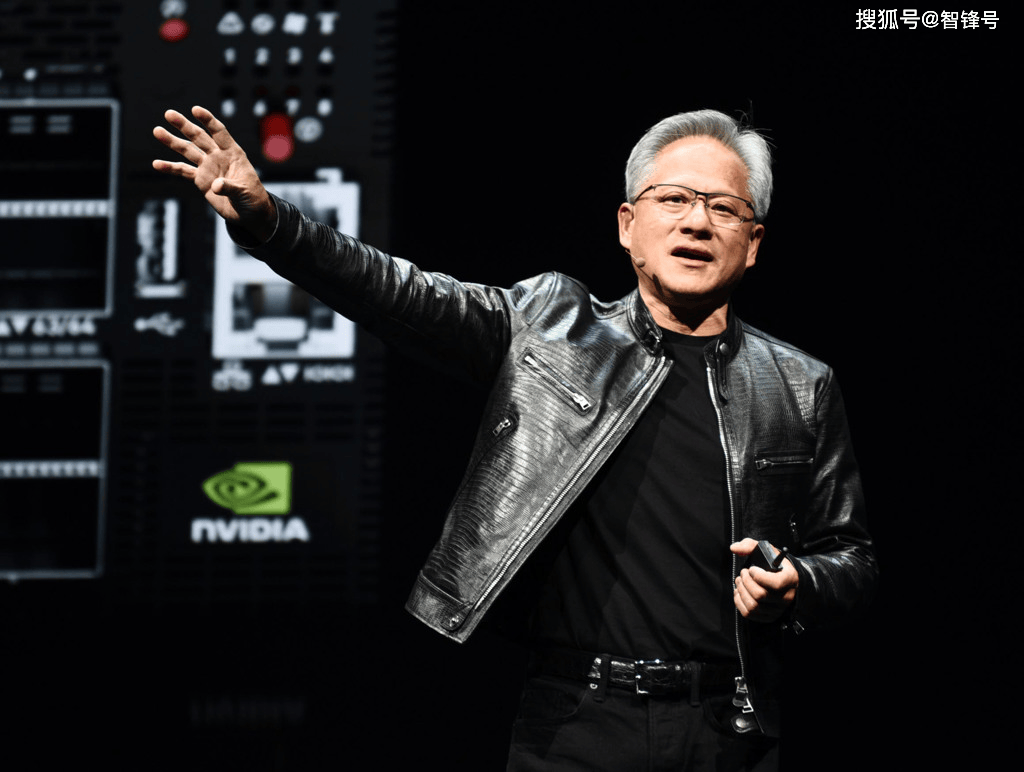
重点总结!英伟达CEO黄仁勋在美国2026CES演讲核心
Sou Hu Cai Jing· 2026-01-08 04:29
Group 1 - The entire computer industry is undergoing a complete reinvention, moving away from outdated IT architectures [3] - The definition of programming is changing; it is now about training software rather than writing code [3] - The "ChatGPT moment" for physical AI is approaching, indicating a significant shift in the physical world similar to that in the digital realm [4] Group 2 - Companies must advance the state-of-the-art in computation every year to remain competitive, as traditional progress is no longer sufficient [4] - AI is entering an era of reasoning, evolving from merely providing quick answers to engaging in deep thinking [6] - The Cosmos model transforms computation into data, breaking the previous limitations of data scarcity [6] Group 3 - The future enterprise user interface will be driven by AI agents rather than traditional tools like Excel [7] - Billions of AI agents will assist in job functions, creating a competitive landscape where individuals will have multiple AI assistants [7] - Aggressive co-design between hardware and software is essential to meet the growing demand for computational power [8] Group 4 - Vehicles are evolving from mere driving to understanding the world, indicating a shift from automation to autonomy in all mobile devices [10]

创业板公司融资余额三连增 其间累计增加158.66亿元
Zheng Quan Shi Bao Wang· 2026-01-08 01:58
Core Insights - The total margin financing balance of the ChiNext market reached 566.01 billion yuan, marking an increase for three consecutive trading days, with a cumulative increase of 15.87 billion yuan during this period [1][2]. Margin Financing Balance Overview - As of January 7, 2026, the total margin financing balance was 567.93 billion yuan, an increase of 5.49 billion yuan from the previous trading day [2]. - The margin financing balance specifically was 566.01 billion yuan, which increased by 5.51 billion yuan from the previous day [2]. Individual Stock Performance - During the increase in margin financing, 634 stocks saw an increase in financing balance, with 66 stocks experiencing an increase of over 20% [2]. - The stock with the highest increase in financing balance was Meihao Medical, which saw a 189.81% increase, bringing its latest financing balance to 38.31 million yuan [3]. - Other notable stocks with significant increases included C Xinguangyi (117.18% increase) and Shangji Technology (83.57% increase) [3]. Declining Stocks - Conversely, 315 stocks experienced a decrease in financing balance, with 25 stocks seeing a decline of over 10% [2]. - The stock with the largest decrease was Southern Pump Industry, which saw a 26.50% decline, resulting in a financing balance of 54.45 million yuan [3]. - Other stocks with significant declines included Huarong Chemical (23.40% decrease) and Runyang Technology (22.61% decrease) [3]. Market Performance - Stocks with a financing balance increase of over 20% averaged a rise of 12.44%, outperforming the ChiNext index [5]. - Notable gainers included Zhizhi New Materials and Meihao Medical, both rising by 72.81%, and Sanbo Brain Science, which increased by 59.07% [5]. - Conversely, stocks with the largest declines included Lvdiaofeng (9.69% decrease) and Nabai Chuan (7.31% decrease) [5]. Significant Increases in Financing Balance - The stock with the highest total financing balance increase was Xunwei Communication, which saw an increase of 1.207 billion yuan, bringing its total to 4.302 billion yuan [5]. - Other stocks with notable increases included Xiangnan Xinchuan (1.132 billion yuan increase) and Dongfang Caifu (769 million yuan increase) [5]. Summary of Financing Balance Changes - The overall trend indicates a robust increase in margin financing within the ChiNext market, with significant activity in specific stocks across various sectors, particularly in electronics, machinery, and computer industries [4].

创业板公司2025年业绩抢先看 12家预增
Zheng Quan Shi Bao Wang· 2026-01-08 01:47
Group 1 - A total of 13 companies listed on the ChiNext board have announced their performance forecasts for 2025, with 12 companies expecting profit increases and 1 company forecasting a profit [1] - The median expected net profit growth for the companies is significant, with the highest forecasted increase being 677.22% for Zhongtai Co., Ltd. [1] - The industries represented include public utilities, telecommunications, basic chemicals, machinery, automotive, retail, electronics, social services, and computing [1] Group 2 - Zhongtai Co., Ltd. (300435) is expected to report a profit increase of 677.22% with a closing price of 25.33 yuan and a year-to-date change of 14.00% [1] - Guangku Technology (300620) anticipates a profit increase of 162.00% with a closing price of 155.26 yuan and a year-to-date change of 5.58% [1] - Other notable companies include Chuanjin (300505) with a forecasted profit increase of 158.44%, Dingtai (301377) with 91.74%, and Taotao Automotive (301345) with 91.30% [1]


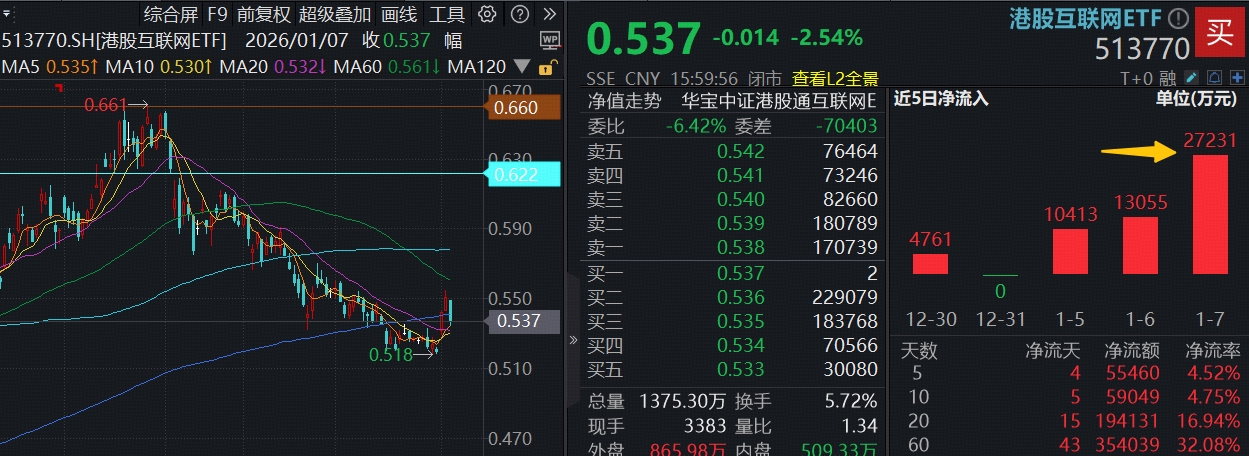
ETF盘前资讯|港股回调日,南向资金大举加仓腾讯、小米!港股互联网ETF(513770)再揽2.7亿元,规模站上130亿元新高
Jin Rong Jie· 2026-01-08 01:45
Core Viewpoint - The Hong Kong stock market experienced a short-term pullback, particularly affecting leading tech stocks, with the Hong Kong Internet ETF (513770) declining by 2.54% while seeing a net inflow of 272 million yuan during the dip. The fund's size reached a historical high of 13.305 billion yuan [1][3]. Group 1: ETF Performance and Composition - The Hong Kong Internet ETF (513770) and its linked funds passively track the CSI Hong Kong Internet Index, with major holdings including Alibaba-W, Tencent Holdings, and Xiaomi Group, which collectively account for over 78% of the top ten weighted stocks [3][4]. - The top ten weighted stocks in the ETF include Tencent Holdings (15.42%), Alibaba-W (14.50%), and Xiaomi Group (13.11%), indicating a strong concentration in leading tech companies [4]. Group 2: Market Trends and Institutional Insights - Southbound capital showed a net inflow of 9.178 billion yuan, with Tencent Holdings and Xiaomi Group receiving significant increases in investment, amounting to 1.955 billion and 1.633 billion HKD respectively [4]. - Recent reports highlight the surge in revenue for Kuaishou's AI mobile platform, with daily income increasing by 102% compared to December 2025, positioning Kuaishou as a leader in generative AI [5]. - Citigroup and JPMorgan have identified Tencent Holdings and Alibaba-W as core AI concept stocks, with positive outlooks on their AI development and cloud revenue growth [5]. - Industry analysts suggest that leading internet companies in China are poised for a resurgence, driven by the deepening of AI applications and potential upward revisions in profit expectations and valuations [5][7].
485股融资余额增幅超5%
Zheng Quan Shi Bao Wang· 2026-01-08 01:41
Market Overview - On January 7, the Shanghai Composite Index rose by 0.05%, with the total margin financing balance reaching 26,047.42 billion yuan, an increase of 248.42 billion yuan compared to the previous trading day [1] - The margin financing balance in the Shanghai market was 13,100.10 billion yuan, up by 123.06 billion yuan, while the Shenzhen market's balance was 12,865.06 billion yuan, increasing by 126.00 billion yuan [1] - The North Exchange saw a slight decrease in margin financing balance to 82.26 billion yuan, down by 0.63 billion yuan [1] Industry Analysis - Among the industries tracked by Shenwan, 27 sectors saw an increase in financing balance, with the electronics sector leading, increasing by 63.93 billion yuan [1] - Other notable sectors included non-ferrous metals and defense industry, which saw increases of 43.63 billion yuan and 23.80 billion yuan, respectively [1] Stock Performance - A total of 2,230 stocks experienced an increase in financing balance, accounting for 59.23% of the market, with 485 stocks showing an increase of over 5% [1] - The stock with the highest increase in financing balance was Meihua Medical, which saw a balance of 383.01 million yuan, up by 182.84%, and its stock price rose by 20.01% [1][2] - Other significant performers included Dapeng Industrial and Yinuosi, with financing balance increases of 88.81% and 85.08%, respectively [1] Top Gainers and Losers - Among the top 20 stocks with the largest increase in financing balance, the average stock price increase was 8.48%, with Meihua Medical, Shaoyang Hydraulic, and Yinuosi all rising by 20.01% [2] - Conversely, the stocks with the largest declines included Shiji Technology, Beiyikang, and Dapeng Industrial, with declines of 9.81%, 4.71%, and 4.55%, respectively [2] Margin Financing Decrease - There were 1,535 stocks that saw a decrease in financing balance, with 257 stocks experiencing a decline of over 5% [4] - The stock with the largest decrease was C. Shanlv, with a financing balance of 131.88 million yuan, down by 45.31% [5] - Other notable declines were seen in Hanwei Technology and Luqiao Information, with decreases of 38.16% and 38.13%, respectively [5]