
信托

Search documents
陆家嘴信托回应被罚420万元:主要涉2023年前事项,已完成整改
news flash· 2025-06-20 10:41
Core Viewpoint - Lujiazui International Trust Co., Ltd. has been fined 4.2 million yuan due to various regulatory violations, primarily related to issues that occurred before 2023, and has completed necessary rectifications [1] Group 1: Regulatory Violations - The company was penalized for inadequate management of related transactions, severe imprudence in trust project management, violations in securities investment trust products, inaccurate classification of proprietary assets, and untimely disclosure of product risk information [1] - Multiple responsible individuals within the company received warnings or fines as a result of these violations [1] Group 2: Company Response - A representative from Lujiazui Trust stated that the company takes the regulatory decision seriously and has sincerely accepted the penalties [1] - The issues leading to the penalties were primarily from before 2023, and the company has completed comprehensive rectifications [1]

国家金融监管总局局长李云泽:欢迎外资机构深度参与中国科技金融、数字金融实践
Zheng Quan Ri Bao· 2025-06-18 16:24
Group 1 - The current global economic changes highlight China's certainty and stability as a development environment, making it a fertile ground for global financial institutions [1] - There are 42 of the world's top 50 banks operating in China, and nearly half of the 40 largest insurance companies have entered the Chinese market, indicating strong foreign investment interest [1] - The expansion of consumer demand and the implementation of policies to boost domestic consumption position China as the world's largest consumer market, creating significant opportunities for foreign financial institutions [1] Group 2 - The National Financial Regulatory Administration is promoting pilot projects for financial asset investment companies and technology enterprise merger loans, encouraging foreign participation in China's tech and digital finance sectors [2] - The aging population in China is expected to exceed 400 million by 2035, with the silver economy projected to reach 30 trillion yuan, presenting substantial opportunities for foreign institutions in the pension finance sector [2] - The average annual growth rate of assets under management in China's trust, wealth management, and insurance sectors is about 8% over the past five years, making it the second-largest asset and wealth management market globally [2] - The administration plans to replicate and promote the experiences of free trade zones to support foreign institutions in participating in more financial business pilots [2]
财经深一度丨“去通道”、谋转型,信托业出现哪些发展新趋势?
Xin Hua She· 2025-06-18 03:51
Core Insights - The trust industry in China is undergoing significant transformation, moving away from "single trust + trust loans" towards more diversified funding utilization methods [1][3] - The implementation of the "three classifications" regulation is reshaping the trust industry, promoting sustainable development and optimizing business structures [3][4] Asset Scale and Growth - By the end of 2024, the total trust assets managed by 67 trust companies in China reached 29.56 trillion yuan, marking a notable recovery in asset scale [3] - Trust asset scale has experienced a spiral evolution over the past decade, peaking at 26.25 trillion yuan in 2017, dropping to 20.49 trillion yuan in 2020, and stabilizing since 2021 [3] Regulatory Changes and Business Structure - The "three classifications" regulation, effective from June 2023, categorizes trust services into asset service trusts, asset management trusts, and charitable trusts, clarifying business boundaries [3][4] - In 2024, newly established trust products totaled 8.32 trillion yuan, with asset service trusts accounting for 70.17% of the number of products and 53.84% of the total scale [4] Funding to the Real Economy - In 2024, 28.81% of the 22.25 trillion yuan in funds trusts were directly invested in the real economy, with 46.17% funneled through the securities market [5] - The total scale of funds trusts directed towards the securities market reached 10.27 trillion yuan by the end of 2024, reflecting a 55.61% increase from the previous year [5] Wealth Management Development - There is a growing demand for comprehensive wealth management services among clients, shifting from a focus on high returns to a broader wealth management approach [6] - Wealth management service trusts dominate the "three classifications," comprising 76% of the 25 business types, with a total scale exceeding one trillion yuan by the end of 2024 [7] Charitable Trusts and Social Impact - The establishment of charitable trusts is crucial for promoting common prosperity, with 539 new charitable trusts registered in 2024, totaling a scale of 85.07 billion yuan [8] - Trust companies are increasingly involved in various social initiatives, managing nearly 35 billion yuan in charitable trust expenditures [8] Industry Outlook - The trust industry is poised for high-quality development, focusing on enhancing service to the real economy and contributing to social progress [9]

【立方债市通】河南支持产投公司重组合并城投/河南拟发债80亿元置换存量隐性债务/全国首批民营创投机构科创债发行
Sou Hu Cai Jing· 2025-06-17 13:12
Group 1 - The Henan provincial government has issued guidelines to promote high-quality investment attraction, emphasizing the transformation of urban investment companies into industrial investment companies and encouraging mergers [1] - The guidelines support provincial and municipal industrial investment companies to establish offshore investment companies and strengthen capital services [1] - There is encouragement for state-owned enterprises and investment funds to collaborate with financial institutions for project financing and to issue domestic and foreign bonds for capital injection [1] Group 2 - Henan province plans to issue a total of 165.73 billion yuan in local bonds for urban development, shantytown renovation, and other projects [3] - The bonds will include general bonds for education and water conservancy projects, as well as special bonds for social undertakings [3] - The issuance is scheduled for June 24, with the bonds set to start accruing interest on June 25 [3] Group 3 - Zhengzhou city has introduced policies to accelerate the development of technology finance, including support for issuing technology innovation bonds [4] - The policies aim to enhance financing channels for technology sectors and encourage local enterprises to apply for provincial bond issuance incentives [4] Group 4 - Shandong, Xinjiang, and Guizhou provinces are planning to issue "special" new special bonds totaling approximately 40.2 billion yuan for various government investment projects [6] - The bonds will have different terms, with Shandong issuing 119.98 billion yuan over 15 years, Xinjiang issuing 135.4 billion yuan and 143 billion yuan over 20 and 30 years respectively, and Guizhou issuing 4 billion yuan over 30 years [6] Group 5 - Shima shares plans to issue up to 1 billion yuan in convertible corporate bonds, with proceeds aimed at repaying company debts [7] - Muyuan Foods has submitted a registration for a 5 billion yuan corporate bond issuance, also intended for debt repayment [8] - The Zhumadian Huanghe Information Industry Investment Company is set to issue 700 million yuan in corporate bonds [9] Group 6 - The first batch of private venture capital institutions has successfully issued technology innovation bonds, with Jiangsu Yida issuing 150 million yuan and Shenzhen Dongfang Fuhai issuing 400 million yuan [10][11] - The Ministry of Finance plans to issue 170 billion yuan in book-entry interest-bearing government bonds with a coupon rate of 1.43% [12] Group 7 - The market has seen a net financing decrease in urban investment bonds, with a reported net financing of -39.7 billion yuan in the first five months of the year [18] - The total issuance of technology innovation bonds has reached 738.5 billion yuan, with significant growth in non-financial industry issuances [19]



生态跃迁——2025中国金融产品年度报告
华宝财富魔方· 2025-06-17 09:01
Core Viewpoint - The 2025 China Financial Products Annual Report titled "Ecological Leap" emphasizes the transformation of the wealth and asset management industry towards a service-oriented model, highlighting the need for industry-wide collaboration and the reconstruction of the wealth ecosystem [2][3]. Group 1: Insights on Wealth Ecology in 2024 - The report discusses the potential decline in yields of deposit-replacement products and the challenges in getting clients to accept net value fixed-income products [3][4]. - It explores insights from the "Fat Donglai" case for wealth management institutions and the hidden secrets behind investors' choices between funds and wealth management [3][4]. - The report addresses the impact of the toolization trend and how index-based investments are reshaping the competitive landscape of financial products [3][4]. Group 2: Review and Outlook of Various Financial Products - The report includes a comprehensive review of bank wealth management over the past 20 years, focusing on net value returns and the landscape of low-volatility products [4][5]. - It provides an overview of the public fund market, highlighting the ecological structure in a low-profit era and the collaborative evolution of product insights and strategies [4][5]. - The ETF section discusses the market's rapid growth, with both scale and market share reaching new highs, and the innovative policies supporting the ETF sector [4][5]. Group 3: Ecological Leap and New Industry Landscape - The report outlines the necessity of an ecological leap in the wealth and asset management industry, driven by five significant articles that catalyze industry transformation [6]. - It emphasizes the importance of a buyer's perspective in product comparison across markets and the scientific approach to fund investment through strategy indices [6]. - The report discusses the implications of large models in wealth management, exploring how they can enhance household service capabilities and reshape the service paradigm [6].
上海不动产信托登记试点“双首单”落地 “把房子装进信托”实现制度化
Jie Fang Ri Bao· 2025-06-15 01:58
Core Insights - The first "real estate + cash" mixed property family trust was established in Shanghai, marking a significant development in the real estate trust sector in China [1] - The establishment of this trust is part of a pilot program initiated by Shanghai's financial authorities to facilitate real estate trust registration, allowing for the separation of assets between the trustor and the trustee [1][2] Group 1: Real Estate Trust Development - The pilot program aims to address previous challenges in establishing real estate trusts, particularly the risk of property being included in the trustee's debt obligations [1] - The new regulations require the transfer of real estate ownership to the trustee, with a notation on the property title indicating it is part of a trust, thereby protecting the trustor's assets [1] Group 2: Case Studies - The first case involved a middle-aged woman who placed a commercial property and additional cash into a trust to generate stable cash flow for her mother's retirement, with plans to pass the property to her children [1] - The second case involved an elderly man who entrusted his only home to a trust, using rental income as supplemental retirement income, ensuring that the property would be passed on to his nephew after his passing [2] - These cases illustrate the trust's role in providing financial security and ensuring the intended transfer of assets without the risks associated with traditional inheritance processes [2]
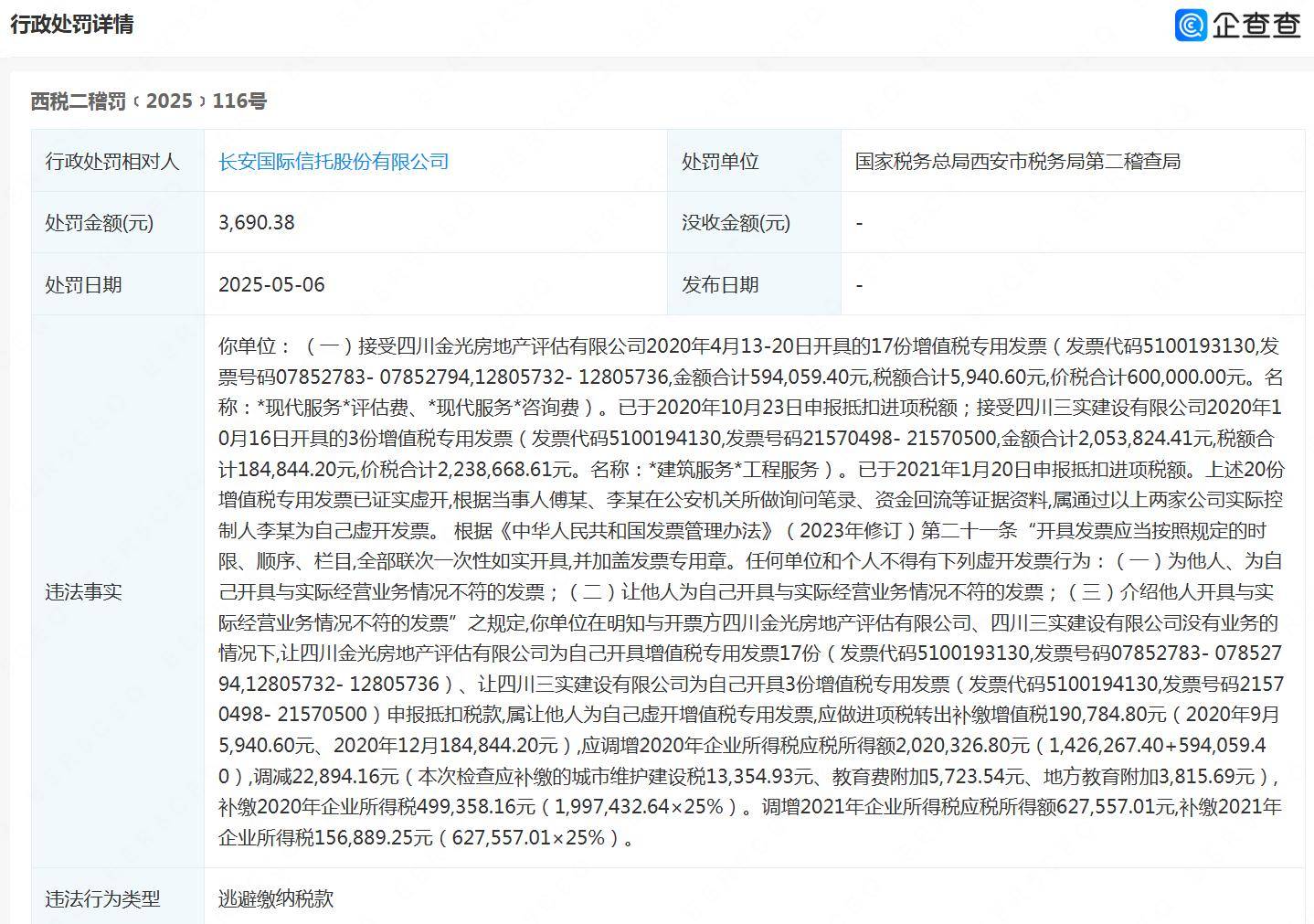
长安信托深陷逃税风波:20份虚开增值税专票曝光,连续三年未公布年报
Sou Hu Cai Jing· 2025-06-13 10:02
Core Viewpoint - Chang'an International Trust Co., Ltd. has been penalized by the State Taxation Administration for tax evasion involving the use of false VAT invoices, leading to significant financial repercussions and highlighting ongoing compliance issues within the company [1][2][4]. Group 1: Tax Evasion Details - Chang'an Trust received 17 VAT invoices from Sichuan Jinguang Real Estate Appraisal Co., totaling 594,059.40 yuan, and 3 invoices from Sichuan Sanshi Construction Co., totaling 2,053,824.41 yuan, which were later confirmed to be fraudulent [1][2]. - The company was found to have knowingly allowed these companies to issue invoices without any actual business transactions, constituting tax fraud [2][3]. - As a result of these actions, Chang'an Trust is required to pay back 190,784.80 yuan in VAT, 13,354.93 yuan in urban maintenance and construction tax, and additional corporate income taxes totaling 656,247.41 yuan for the years 2020 and 2021 [2][3]. Group 2: Previous Penalties and Compliance Issues - This is not the first penalty for Chang'an Trust in 2023; it was previously fined 255,000 yuan by the People's Bank of China for violations related to credit information management [4]. - The company has failed to disclose annual reports for three consecutive years (2022-2024), which is a legal obligation, raising concerns about transparency and investor access to critical information [5]. - In 2021, the company reported revenues of 2.18 billion yuan, a 33.7% decrease year-on-year, with net profits of 540 million yuan, indicating ongoing financial struggles exacerbated by risks in the real estate sector [5].
争夺千万富豪
投资界· 2025-06-13 07:22
Core Viewpoint - The article discusses the increasing popularity of family trusts among wealthy individuals in China, highlighting the shift in private banking services from asset accumulation to providing unique non-financial services and emotional value to retain high-net-worth clients [3][8][10]. Group 1: Private Banking Landscape - Private banking clients in China typically have investable assets exceeding 6 million yuan, with some banks setting higher thresholds, such as 10 million yuan at China Merchants Bank [3][5]. - The number of high-net-worth individuals in China with investable assets over 10 million yuan reached 3.16 million by the end of 2022, with an average investable asset of approximately 31.83 million yuan [5]. - The private banking sector has transitioned from "land grabbing" to "stock competition," focusing on existing clients as the market matures [3][20]. Group 2: Non-Financial Services - Non-financial services have become a core competitive advantage for private banks, with offerings including private jet bookings, Antarctic travel, and exclusive medical consultations [3][6][7]. - High-net-worth clients are increasingly attracted to unique experiences, such as customized concerts and exclusive travel opportunities, which enhance emotional value and client loyalty [4][6][7]. - Banks are investing heavily in providing high-end, scarce services to differentiate themselves in a competitive market [6][7]. Group 3: Family Trusts and Wealth Management - Family trusts and family offices are becoming focal points for private banks, especially for ultra-high-net-worth clients with assets exceeding 20 million yuan [10][11]. - Over 70% of high-net-worth individuals are preparing for wealth transfer, driven by concerns over asset protection and family dynamics [10][11]. - The family trust market in China is growing, with a reported balance of 643.58 billion yuan by the end of 2024 [11]. Group 4: Investment Trends - Wealthy clients are increasingly allocating assets to insurance products and precious metals like gold, especially in response to market volatility [15][19]. - The demand for exclusive investment products from top international asset management firms is rising among private banking clients, with minimum investment thresholds often set at 2 million yuan [14][19]. - Private banks are tailoring investment solutions to meet the specific needs of high-net-worth clients, often collaborating with various financial institutions [14][15]. Group 5: Client Retention and Competition - The private banking sector is experiencing a slowdown in client growth, leading to a focus on retaining existing clients and preventing asset outflows [20]. - The contribution of private banking clients to overall bank assets is significant, with a small percentage of clients holding a large portion of wealth [16][19]. - Banks are recognizing the comprehensive value of private banking clients, who often bring additional business opportunities through their enterprises [19][20].




《生态跃迁》摘录 | 标品信托规模大幅增长,还能延续吗?
华宝财富魔方· 2025-06-12 11:30
Core Viewpoint - The significant increase in the scale of standard trust products is driven by both the accelerated transformation of the industry and the flexibility advantages of standard trust products, alongside the performance of the bond market [1][2]. Group 1: Scale Growth Driven by "Borrowing Path" - The growth in scale due to the "borrowing path" has lost its momentum as regulatory measures have been implemented to eliminate institutional arbitrage and fill regulatory gaps [2][3]. - The lack of specific regulatory guidelines for standard trust products allows for greater operational flexibility compared to public funds and bank wealth management products, attracting significant capital inflows, particularly from low-risk preference bank wealth management funds [2][3]. - The collaboration between bank wealth management and trust companies has led to a win-win situation, where bank products achieve stable net values while trust companies earn channel fees and increase their scale [2][3]. Group 2: Risks Associated with "Borrowing Path" - The "borrowing path" presents significant risks that are accumulating rapidly, prompting regulatory scrutiny [3][4]. - Issues such as inappropriate use of smoothing mechanisms and trading risk assets between different wealth management products can lead to mismatched risks and potential losses for investors [4][5]. - Regulatory interventions aim to address these risks, ensuring compliance and protecting investors from unfair practices [6][9]. Group 3: Scale Growth Driven by Strong Performance - The increase in the scale of standard trust products is also attributed to the accelerated transformation of trust companies towards standard trust products and the favorable bond market conditions in 2024 [13][14]. - Trust companies are leveraging their experience in the municipal investment sector to enhance their bond investment strategies, leading to higher-than-average returns in their standard trust products [14][15]. - The current low-risk yield environment and the preference for low-volatility bonds have further contributed to the influx of capital into standard trust products, achieving historical highs in industry scale [15]. Group 4: Regulatory Landscape and Future Outlook - Regulatory measures are focused on eliminating institutional arbitrage and ensuring fair competition among asset management institutions, which is essential for guiding them back to their investment roots [10][11]. - The future challenges for trust companies include finding new business opportunities in a declining yield environment and enhancing their active investment management capabilities [15][16]. - The ongoing regulatory efforts aim to protect investors and promote a better understanding of risk-return characteristics in fixed-income products, fostering a mature capital market [10][11].

银行理财投资“踩坑”警示
Jin Rong Shi Bao· 2025-06-12 07:16
在银行理财市场蓬勃发展、产品体系日趋多元的当下,网点内琳琅满目的理财产品常常令投资者驻足, 然而,高收益的背后往往隐藏着未知风险,并非每一款产品都适合所有投资者。 《金融时报》记者从北京金融法院了解到的一起案例显示,2018年,投资风格一贯较为稳健的李先生在 X银行网点咨询理财。理财经理未对其进行风险评估,便向李先生推荐Y信托公司发行的R4级(中高风 险)信托产品,并着重强调10%的预期年化收益率,吸引李先生认购100万元。该产品主要投向风险较高 的项目,按规定应推荐给进取型或激进型投资者。 后因市场波动,导致项目资金无法回笼,最终产品兑付时李先生仅收回60万元本金,损失40万元。李先 生以银行未履行适当性义务为由向法院提起诉讼。X银行虽辩称口头告知风险,但未提交证据证明。法 院审理发现,李先生过往投资记录显示为稳健型,且银行未按规定对李先生进行风险评估,也无法充分 证明履行告知义务,最终判决X银行对李先生的损失承担相应赔偿责任。 所谓银行投资者适当性义务是指银行在向投资者推介、销售理财产品时,必须履行了解客户、了解产 品,将合适产品推荐给合适投资者的义务。具体而言,投资者适当性义务主要包含三个层面内容:了解 ...