专业服务

Search documents
凯淳股份:2025年半年度净利润约301万元
Mei Ri Jing Ji Xin Wen· 2025-08-21 12:33
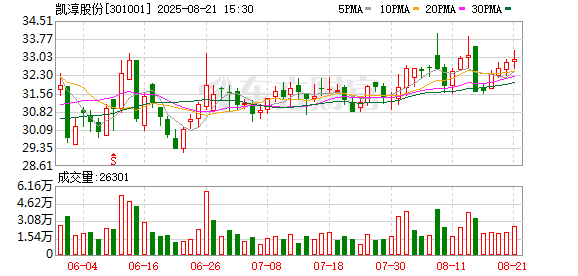
凯淳股份(SZ 301001,收盘价:32.96元)8月21日晚间发布半年度业绩报告称,2025年上半年营业收 入约1.62亿元,同比减少21.67%;归属于上市公司股东的净利润约301万元,同比减少16.17%;基本每 股收益0.04元。 (文章来源:每日经济新闻) ...


8月21日晚间重要公告一览
Xi Niu Cai Jing· 2025-08-21 10:21
Group 1 - Xiamen Tungsten's revenue for the first half of 2025 reached 19.178 billion yuan, an increase of 11.75% year-on-year [1] - Xiamen Tungsten's net profit attributable to shareholders decreased by 4.37% year-on-year to 972 million yuan [1] - Xiamen Tungsten plans to distribute a cash dividend of 1.84 yuan per 10 shares [1] Group 2 - Sinopec's revenue for the first half of 2025 was 1.41 trillion yuan, a decrease of 10.6% year-on-year [1][2] - Sinopec's net profit attributable to shareholders fell by 39.8% year-on-year to 21.483 billion yuan [1][2] - Sinopec's basic earnings per share were 0.177 yuan [1] Group 3 - Xinhua Department Store's revenue for the first half of 2025 was 3.254 billion yuan, a decrease of 0.99% year-on-year [3][4] - Xinhua Department Store's net profit attributable to shareholders decreased by 2.52% year-on-year to 86.08 million yuan [3][4] - Xinhua Department Store plans to distribute a cash dividend of 1 yuan per 10 shares [3] Group 4 - Huaqin Technology's revenue for the first half of 2025 reached 516 million yuan, an increase of 6.44% year-on-year [5][6] - Huaqin Technology's net profit attributable to shareholders decreased by 32.45% year-on-year to 146 million yuan [5][6] - Huaqin Technology plans to distribute a cash dividend of 1.3 yuan per 10 shares [5] Group 5 - Tianhao Energy's revenue for the first half of 2025 was 1.372 billion yuan, a decrease of 32.15% year-on-year [7] - Tianhao Energy's net profit attributable to shareholders decreased by 32.08% year-on-year to 69.01 million yuan [7] - Tianhao Energy's basic earnings per share were 0.0798 yuan [7] Group 6 - Wanliyang's revenue for the first half of 2025 reached 2.812 billion yuan, an increase of 2.69% year-on-year [8][9] - Wanliyang's net profit attributable to shareholders increased by 50.24% year-on-year to 277 million yuan [8][9] - Wanliyang's basic earnings per share were 0.21 yuan [8] Group 7 - Kede CNC's revenue for the first half of 2025 was 295 million yuan, an increase of 15.24% year-on-year [10] - Kede CNC's net profit attributable to shareholders increased by 1.27% year-on-year to 49.06 million yuan [10] - Kede CNC's basic earnings per share were 0.4582 yuan [10] Group 8 - Saifutian's revenue for the first half of 2025 reached 1.06 billion yuan, an increase of 62.41% year-on-year [11] - Saifutian achieved a net profit of 3.08 million yuan, recovering from a loss of 12.49 million yuan in the previous year [11] - Saifutian's basic earnings per share were 0.01 yuan [11] Group 9 - Funeng's revenue for the first half of 2025 was 6.369 billion yuan, a decrease of 4.44% year-on-year [13][14] - Funeng's net profit attributable to shareholders increased by 12.48% year-on-year to 1.337 billion yuan [13][14] - Funeng plans to distribute a cash dividend of 0.73 yuan per 10 shares [13] Group 10 - Ningbo Shipping reported a net loss of 39.23 million yuan for the first half of 2025 [15][16] - Ningbo Shipping's revenue for the first half of 2025 was 1.157 billion yuan, an increase of 11.33% year-on-year [15][16] - Ningbo Shipping's basic earnings per share were a loss of 0.0325 yuan [15] Group 11 - Samsung Medical's revenue for the first half of 2025 reached 7.972 billion yuan, an increase of 13.93% year-on-year [17][18] - Samsung Medical's net profit attributable to shareholders increased by 6.93% year-on-year to 1.23 billion yuan [17][18] - Samsung Medical plans to distribute a cash dividend of 4.85 yuan per 10 shares [17] Group 12 - Huiding Technology's revenue for the first half of 2025 was 2.251 billion yuan, a decrease of 0.20% year-on-year [20] - Huiding Technology's net profit attributable to shareholders increased by 35.74% year-on-year to 431 million yuan [20] - Huiding Technology plans to distribute a cash dividend of 0.15 yuan per share [20] Group 13 - Baihua Pharmaceutical's revenue for the first half of 2025 reached 202 million yuan, an increase of 2.95% year-on-year [21] - Baihua Pharmaceutical's net profit attributable to shareholders increased by 12.45% year-on-year to 25.48 million yuan [21] - Baihua Pharmaceutical's basic earnings per share were 0.0663 yuan [21] Group 14 - Stanley's revenue for the first half of 2025 was 6.391 billion yuan, an increase of 12.66% year-on-year [22][23] - Stanley's net profit attributable to shareholders increased by 18.9% year-on-year to 607 million yuan [22][23] - Stanley plans to distribute a cash dividend of 0.45 yuan per 10 shares [22] Group 15 - Duoli Technology's revenue for the first half of 2025 reached 1.734 billion yuan, an increase of 13.15% year-on-year [24] - Duoli Technology's net profit attributable to shareholders decreased by 28.13% year-on-year to 157 million yuan [24] - Duoli Technology's basic earnings per share were 0.51 yuan [24] Group 16 - Datang Telecom reported a net loss of 81.17 million yuan for the first half of 2025 [25][26] - Datang Telecom's revenue for the first half of 2025 was 275 million yuan, a decrease of 3.32% year-on-year [25][26] - Datang Telecom's basic earnings per share were a loss of 0.0623 yuan [25] Group 17 - Niuwei Co.'s revenue for the first half of 2025 reached 3.404 billion yuan, an increase of 19.96% year-on-year [27][28] - Niuwei Co.'s net profit attributable to shareholders increased by 30.44% year-on-year to 637 million yuan [27][28] - Niuwei Co. plans to distribute a cash dividend of 5.8 yuan per 10 shares [27] Group 18 - ST Zhiyun reported a net loss of 106 million yuan for the first half of 2025 [29][30] - ST Zhiyun's revenue for the first half of 2025 was 89.13 million yuan, a decrease of 63.59% year-on-year [29][30] - ST Zhiyun's basic earnings per share were a loss of 0.37 yuan [29] Group 19 - Huace Testing's revenue for the first half of 2025 reached 2.96 billion yuan, an increase of 6.05% year-on-year [31] - Huace Testing's net profit attributable to shareholders increased by 7.03% year-on-year to 467 million yuan [31] - Huace Testing plans to distribute a cash dividend of 0.5 yuan per 10 shares [31] Group 20 - Taixiang's revenue for the first half of 2025 was 219 million yuan, an increase of 6.57% year-on-year [32] - Taixiang's net profit attributable to shareholders increased by 16.12% year-on-year to 25.30 million yuan [32] - Taixiang's basic earnings per share were 0.2533 yuan [32] Group 21 - Huayi Technology applied for a credit line of up to 165 million yuan from HSBC [33][34] - Huayi Technology will use real estate as collateral for the credit line [33][34] Group 22 - Hengong Precision plans to use up to 70 million yuan of idle raised funds for cash management [35][36] - Hengong Precision will invest in high-security, high-liquidity products with a term not exceeding 12 months [35][36] Group 23 - Tianhe's financial assistance to its associate company has not been repaid [37] - Tianhe provided 243,200 yuan in financial assistance to its associate company [37] Group 24 - Spring and Autumn Electronics' revenue for the first half of 2025 reached 1.926 billion yuan, an increase of 2.62% year-on-year [38] - Spring and Autumn Electronics' net profit attributable to shareholders increased by 248.44% year-on-year to 93.31 million yuan [38] - Spring and Autumn Electronics' basic earnings per share were 0.21 yuan [38] Group 25 - Kingsoft Office's revenue for the first half of 2025 was 2.657 billion yuan, an increase of 10.12% year-on-year [39][40] - Kingsoft Office's net profit attributable to shareholders increased by 3.57% year-on-year to 747 million yuan [39][40] Group 26 - Yanjinpuzi's revenue for the first half of 2025 reached 2.941 billion yuan, an increase of 19.58% year-on-year [41] - Yanjinpuzi's net profit attributable to shareholders increased by 16.70% year-on-year to 373 million yuan [41] Group 27 - Muyuan's revenue for the first half of 2025 was 76.463 billion yuan, an increase of 34.46% year-on-year [43][44] - Muyuan's net profit attributable to shareholders increased by 1169.77% year-on-year to 10.53 billion yuan [43][44] - Muyuan plans to distribute a cash dividend of 9.32 yuan per 10 shares [43][44] Group 28 - Tianwei Food is planning to issue H-shares and apply for listing on the Hong Kong Stock Exchange [45][46] Group 29 - Alloy Investment's shareholder plans to reduce their stake by no more than 3% [47] - Alloy Investment's shareholder plans to sell up to 11.5531 million shares [47] Group 30 - Rongzhi Rixin's controlling shareholder plans to reduce their stake by no more than 3% [48] - Rongzhi Rixin's controlling shareholder plans to sell up to 1.2318 million shares [48] Group 31 - Yijiahe's shareholders plan to reduce their stake by no more than 2% [49] - Yijiahe's shareholders plan to sell up to 409.72 million shares [49] Group 32 - Dongfeng Group adjusted the upper limit of its share repurchase price to 6.28 yuan per share [50] Group 33 - Jingu's revenue for the first half of 2025 reached 2.123 billion yuan, an increase of 10.04% year-on-year [51] - Jingu's net profit attributable to shareholders increased by 45.36% year-on-year to 30.27 million yuan [51] Group 34 - Yibai Pharmaceutical reported a net loss of 19.9 million yuan for the first half of 2025 [52] - Yibai Pharmaceutical's revenue for the first half of 2025 was 999 million yuan, a decrease of 14.99% year-on-year [52] Group 35 - Yonghui Supermarket reported a net loss of 241 million yuan for the first half of 2025 [53] - Yonghui Supermarket's revenue for the first half of 2025 was 29.948 billion yuan, a decrease of 20.73% year-on-year [53] Group 36 - Suotong Development's net profit increased by 1568.52% year-on-year to 523 million yuan [54] - Suotong Development's revenue for the first half of 2025 was 8.306 billion yuan, an increase of 28.28% year-on-year [54]




英国通胀爆表
第一财经· 2025-08-21 01:06
Core Viewpoint - UK inflation pressure has surged again, with July's Consumer Price Index (CPI) rising 3.8% year-on-year, marking an 18-month high and making the UK the fastest-growing major developed economy in terms of price increases [3][4]. Inflation Drivers - The primary drivers of the CPI increase are transportation and energy sectors, particularly a significant rise in airline ticket prices, which jumped approximately 30% due to peak summer travel. Additionally, fuel prices contributed 0.1% to the inflation rate, while hotel accommodation and soft drink prices also pushed the CPI higher [5][6]. Service Sector Inflation - The service sector's inflation rate rose to 5.0% in July, up from 4.7% in June, indicating strong domestic inflationary pressures. The core inflation rate, excluding volatile items like energy and food, also increased slightly from 3.7% to 3.8%. Food and non-alcoholic beverage prices rose 4.9% year-on-year, the highest since February 2024 [6][9]. Comparison with Other Economies - The UK's inflation rate is higher than that of other developed economies due to several factors, including regulatory lag in energy price adjustments and a tight labor market post-Brexit, which has led to persistent inflationary pressures. Nominal wage growth remains around 5%, contributing to a potential wage-price spiral [9][10]. Monetary Policy Implications - Following the inflation data release, the British pound strengthened slightly, indicating investor expectations for the Bank of England to maintain a tight monetary stance for a longer period. The central bank faces a dilemma between preventing inflation from rising further and considering the costs of excessive tightening amid weak economic growth [10][11].

服贸会抢先看:沃尔玛、毕马威首亮相,智慧物流“炫技”现场
Nan Fang Du Shi Bao· 2025-08-20 15:38
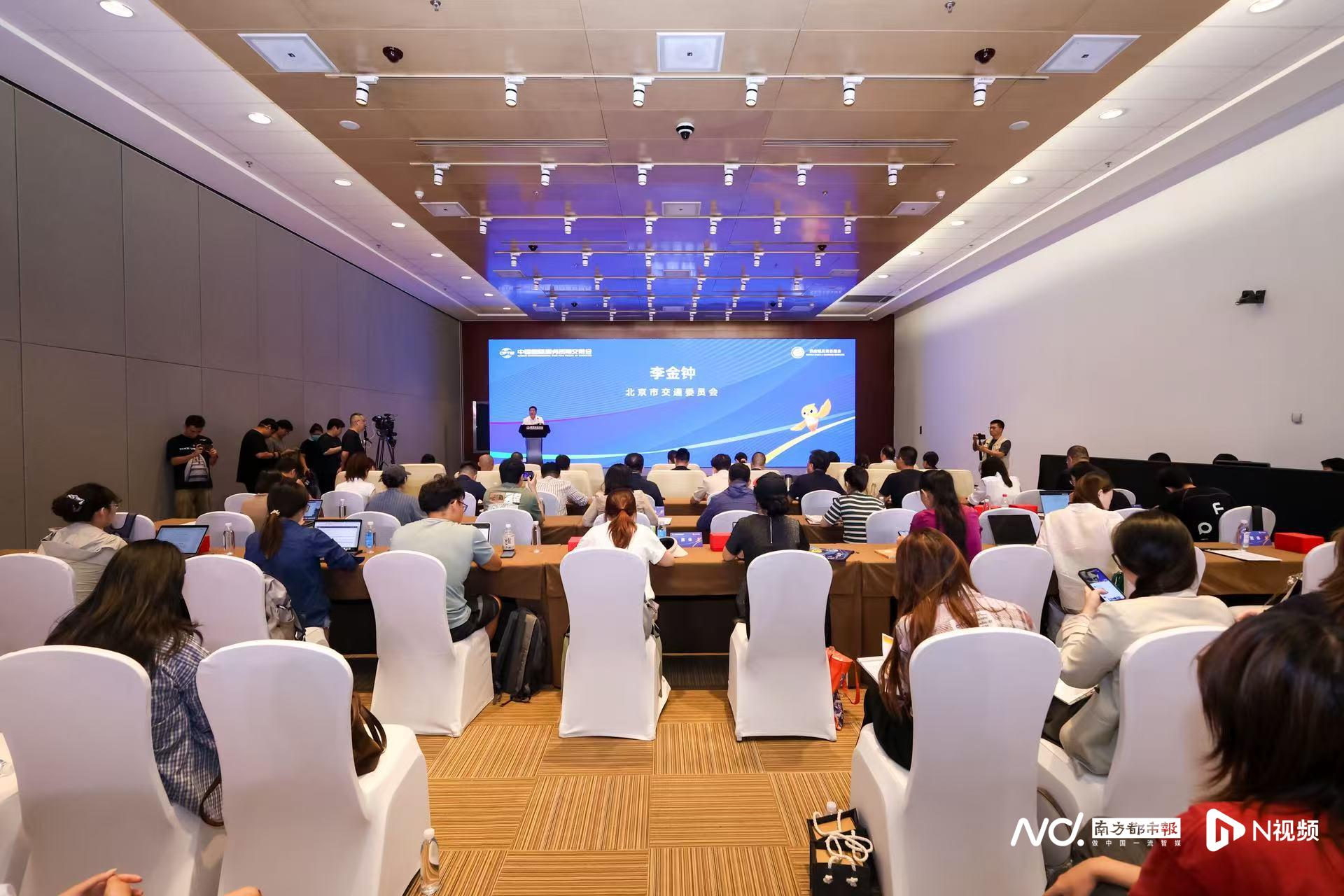
Group 1: Event Overview - The 2025 China International Service Trade Fair (CIFTIS) will be held from September 10 to 14 in Beijing, focusing on supply chain and business services [1] - The supply chain transportation service theme is "People Enjoy Their Travel, Goods Flow Smoothly," emphasizing smart transportation and logistics [1] - The business service theme is "Digital Intelligence Leading, Beijing's Colorful Business," showcasing innovations in high-end business services [1] Group 2: Supply Chain Transportation Services - The transportation service section will adopt a "trinity" cooperation model (government-led, enterprise-operated, association-supported) to promote deep integration of technology and industry innovation [2] - Over 100 leading global enterprises will participate, with a 100% completion rate for exhibitors; 60% of the exhibitors are from Fortune 500 companies [2] - The international participation rate is 24%, with notable companies like COSCO Shipping Group and Beijing Investment Yijia presenting [2] Group 3: Smart Public Transportation - The smart public transportation exhibition will showcase Beijing's innovative practices in public transport services, including smart stations and maintenance robots [3] - New service models such as "face recognition entry" and "smart carriages" will be highlighted, transitioning from efficient transport to quality service [3] - The exhibition will also feature a near-zero carbon service area project and a smart logistics platform [3] Group 4: Smart Logistics Services - The smart logistics service section will demonstrate technology-driven global supply chain upgrades, including blockchain delivery orders and automated port technologies [4] - Companies like Meituan and SF Express will present their innovations in drone delivery and cross-border e-commerce services [4] - A transportation forum will be held to discuss new paradigms in urban transportation services [4] Group 5: Business Services - The business service exhibition will cover 2,400 square meters, showcasing "Beijing Service" cases and AI big data innovations [5] - Major global companies like Walmart and KPMG will present their service innovations and insights on ESG and digital transformation [6] - The exhibition aims to enhance the internationalization and professionalism of business services [5][6] Group 6: Human Resources Services - The human resources service sector will present innovative practices through interactive experiences and results releases [8] - New solutions for talent management will be introduced, including a comprehensive management platform and a job matching service [9] - AI-driven recruitment solutions will be showcased, enhancing service efficiency and precision in talent selection [9]
服贸会抢先看:沃尔玛、毕马威首亮相 智慧物流“炫技”现场
Nan Fang Du Shi Bao· 2025-08-20 15:03
Core Points - The 2025 China International Service Trade Fair (CIFTIS) will be held from September 10 to 14 in Beijing, focusing on supply chain and business services [1] - The event aims to showcase China's achievements in enhancing supply chain resilience and high-end business service capabilities [1] Supply Chain and Business Services - The supply chain transportation service section will adopt a "three-in-one" cooperation model (government-led, enterprise-operated, association-supported) to promote deep integration of technological and industrial innovation [3] - Over 100 leading global companies will participate, with 60% being Fortune 500 and industry leaders, and an international participation rate of 24% [3] - The smart public transport exhibition will highlight Beijing's innovative practices in public transport services, including smart stations and maintenance robots [4] Smart Logistics - The smart logistics service area will demonstrate technology-driven global supply chain upgrades, featuring innovations like blockchain delivery notes and automated terminal technologies [5] - Companies like COSCO Shipping and Meituan will showcase their advancements in logistics and delivery solutions [5] Business Services - The business services section will cover 2,400 square meters, showcasing "Beijing service" cases, AI, and big data innovations [6] - Major global companies like Walmart and KPMG will present their innovative practices and insights in the business services sector [6][7] - The exhibition will also focus on legal services, human resources, and consulting services, promoting international cooperation and brand promotion [7] Human Resources Services - The human resources service sector will present innovations through interactive experiences and real-world demonstrations [8] - New initiatives will include a comprehensive management platform for talent policies and job matching, enhancing the efficiency of human resource services [9] - AI-driven recruitment solutions will be showcased, transforming the human resources landscape and improving talent selection processes [9]
建研院(603183)6月30日股东户数2.46万户,较上期减少11.63%
Zheng Quan Zhi Xing· 2025-08-20 11:12
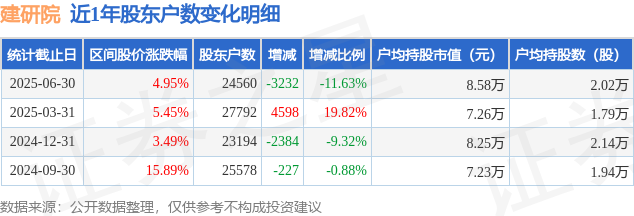
Group 1 - The core viewpoint of the news is that Jianyan Institute has experienced a decrease in the number of shareholders and an increase in average shareholding per shareholder, despite a slight increase in stock price during the reported period [1][2] - As of June 30, 2025, the number of shareholders for Jianyan Institute is 24,560, which is a decrease of 3,232 shareholders, representing a reduction of 11.63% compared to March 31, 2025 [1][2] - The average shareholding per shareholder increased from 17,900 shares to 20,200 shares, with an average market value of 85,800 yuan [1][2] Group 2 - The stock price of Jianyan Institute increased by 4.95% from March 31, 2025, to June 30, 2025, while the number of shareholders decreased during this period [1][2] - The net outflow of main funds was 27.25 million yuan, while retail investors saw a net inflow of 30.85 million yuan during the same period [2]

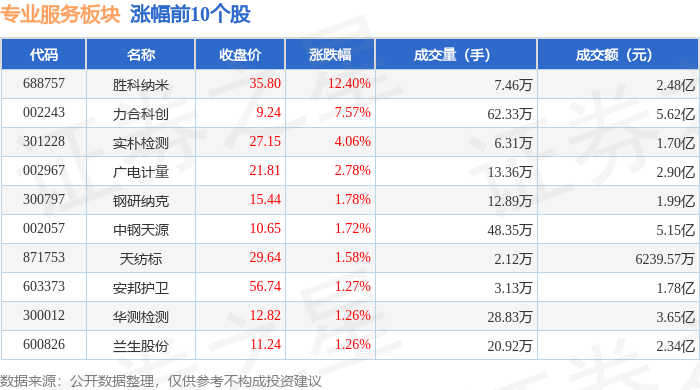
专业服务板块8月20日涨1.23%,胜科纳米领涨,主力资金净流出3541.93万元
Zheng Xing Xing Ye Ri Bao· 2025-08-20 08:41
Market Overview - On August 20, the professional services sector rose by 1.23%, led by Shengke Nano, while the Shanghai Composite Index closed at 3766.21, up 1.04%, and the Shenzhen Component Index closed at 11926.74, up 0.89% [1]. Stock Performance - Shengke Nano (688757) closed at 35.80, with a significant increase of 12.40% and a trading volume of 74,600 shares, amounting to a transaction value of 248 million yuan [1]. - Lihe Kexin (002243) saw a rise of 7.57%, closing at 9.24 with a trading volume of 623,300 shares and a transaction value of 562 million yuan [1]. - Other notable performers included Shicun Testing (301228) with a 4.06% increase, closing at 27.15, and Guodian Measurement (002967) with a 2.78% increase, closing at 21.81 [1]. Capital Flow - The professional services sector experienced a net outflow of 35.42 million yuan from institutional investors, while retail investors saw a net outflow of 45.10 million yuan. Conversely, speculative funds recorded a net inflow of 80.52 million yuan [2][3]. - Lihe Kexin (002243) attracted a net inflow of 75.41 million yuan from institutional investors, while it faced a net outflow of 59.20 million yuan from retail investors [3]. - Guodian Measurement (002967) also saw a net inflow of 38.59 million yuan from institutional investors, with retail investors experiencing a net outflow of 16.08 million yuan [3].


社会服务行业2025Q2基金持仓分析报告:重仓比例回落,维持低位布局
Wanlian Securities· 2025-08-19 07:52
Investment Rating - The industry is rated as "stronger than the market" with an expected relative increase of over 10% compared to the market index in the next six months [38]. Core Insights - The heavy holding ratio for the social service industry in Q2 2025 is 0.09%, a decrease of 0.03 percentage points from the previous quarter, ranking 30th among 31 first-level industries, indicating a position at the bottom of the industry [11][35]. - The current heavy holding ratio is significantly below the five-year historical average of 0.49%, suggesting substantial room for rebound [11][35]. - The education sector shows a rebound in interest, while the hotel and restaurant sector remains at a low holding ratio [18][35]. - The implementation and optimization of the national visa-free policy is expected to continue boosting the tourism market, alongside new opportunities arising from the establishment of duty-free shops [35]. Summary by Sections Heavy Holding Ratio Analysis - In Q2 2025, there are 344 funds heavily invested in the social service industry, a decrease of 59 funds from the previous quarter, with a total market value of 6.225 billion yuan, down by 1.786 billion yuan [11][35]. - The heavy holding ratio for the hotel and restaurant sector is at 0.02%, down 0.01 percentage points, while the tourism and scenic area sector is at 0.03%, showing a slight decline [18][35]. Sector Performance - The professional services sector has seen a decrease in heavy holding ratio to 0.03%, while the education sector has slightly increased to 0.01% [18][35]. - The hotel and restaurant sector's heavy holding ratio has been declining since reaching a peak in Q2 2022 [18][35]. Individual Stock Performance - The top ten stocks in the social service sector have a combined heavy holding ratio of 0.072%, down 0.03 percentage points from Q1 2025 [27][28]. - Notable increases in heavy holding ratios were observed for stocks such as Dou Shen Education and Changbai Mountain, while significant decreases were noted for Huace Detection and Su Shi Testing [30][31].


绿色债券周度数据跟踪(20250811-20250815)-20250816
Soochow Securities· 2025-08-16 13:37
Report Industry Investment Rating - No industry investment rating information is provided in the report. Core Viewpoints - The report tracks the weekly data of green bonds from August 11 - August 15, 2025, covering primary market issuance, secondary market trading, and valuation deviation of the top 30 individual bonds [1][2][3]. Summary by Related Catalogs Primary Market Issuance - 10 new green bonds were issued in the inter - bank and exchange markets, with a total issuance scale of about 1.3131 billion yuan, an increase of 221.8 million yuan from the previous week [1]. - The issuance terms are mostly 3 years; issuers include local state - owned enterprises, central state - owned enterprises, central enterprise subsidiaries, and central financial enterprises [1]. - The issuer's main credit ratings are AAA and AA+; issuers are from Beijing, Guangdong, Guangxi, Henan, Jiangsu, and Inner Mongolia [1]. - The types of issued bonds include ultra - short - term financing bills, ABNs from the Dealer Association, commercial bank ordinary bonds, medium - term notes, private corporate bonds, and general corporate bonds [1]. Secondary Market Trading - The weekly trading volume of green bonds totaled 5.78 billion yuan, an increase of 1.04 billion yuan from the previous week [2]. - By bond type, the top three in trading volume are non - financial corporate credit bonds (2.61 billion yuan), financial institution bonds (2.13 billion yuan), and interest - rate bonds (630 million yuan) [2]. - By issuance term, green bonds with a term of less than 3 years had the highest trading volume, accounting for about 78.96%, indicating continuous market popularity [2]. - By issuer's industry, the top three industries in trading volume are finance (2.47 billion yuan), public utilities (1.2 billion yuan), and transportation equipment (180 million yuan) [2]. - By issuer's region, the top three regions in trading volume are Beijing (1.75 billion yuan), Guangdong (670 million yuan), and Hebei (510 million yuan) [2]. Valuation Deviation of the Top 30 Individual Bonds - The overall deviation of the weekly average trading price valuation of green bonds is not large, with the discount trading range smaller than the premium trading range, and the proportion of discount trading smaller than that of premium trading [3]. - Among the discount bonds, the top three discount rates are for 25 ShuiNeng G1 (- 0.7750%), 21 LinChuan Green Bond 02 (- 0.7466%), and 21 XinYi Green Bond (- 0.2536%), and the rest of the discount rates are within - 0.20%. The main industries of the issuers are finance, construction, and public utilities, and the implied ratings of ChinaBond are mainly AAA -, AA, and AA+ [3]. - Among the premium bonds, the top four premium rates are for 20 HuNan Bond 65 (0.9090%), 25 XiangYu JinXiang MTN003 (green) (0.7237%), 20 GuangDong Bond 05 (0.6806%), and 20 GuangDong Bond 16 (0.6433%), and the rest of the premium rates are within 0.60%. The main industries of the issuers are finance, public utilities, and transportation equipment, and the implied ratings of ChinaBond are mainly AA+, AA, and AAA - [3].
北京空置率降至16.9%,新质生产力成办公市场新增量
Sou Hu Cai Jing· 2025-08-14 11:18
Core Viewpoint - The real estate market, particularly the office space sector, is currently undergoing a "price-for-volume" adjustment, but core business districts are showing resilience through rental adaptation and industrial upgrades, with new productivity-related office demands expected to be a key factor in overcoming challenges [1][7]. Office Market Overview - According to data from DTZ, the vacancy rates for Grade A office buildings in Beijing, Shanghai, Guangzhou, and Shenzhen by Q2 2025 are 16.9%, 23.6%, 19.8%, and 27.8% respectively [3]. - Beijing has the lowest vacancy rate at 16.9%, which has improved from 18.3% at the end of 2024, attributed to no new supply in the second half of the year and ongoing inventory reduction [3]. - In contrast, Shanghai, Guangzhou, and Shenzhen have seen rising vacancy rates, with Shenzhen facing the most significant pressure at 27.8%, exacerbated by an additional 1.22 million square meters of new supply expected to enter the market [4]. Tenant Composition and Trends - Financial services remain the dominant sector in office leasing, accounting for 20% of rental transactions in the first half of 2025, with notable companies including Huaxia Fund and Aijian Securities [4][5]. - The technology and professional services sectors are tied for second place, each representing 13% of leasing activity, with tech firms focusing on hard technology fields such as semiconductors and AI [5][6]. - The Shanghai Zhonghai Center recorded a net absorption of 70,000 square meters in 2024, becoming a leading project in Shanghai's office market, emphasizing the creation of a legal service ecosystem [6]. Emerging Sectors and Future Outlook - New productivity sectors such as healthcare and retail are becoming significant growth drivers in the office leasing market, with expectations for increased leasing activity in technology, healthcare, and media sectors [7]. - The office market is anticipated to evolve towards a "diversified ecosystem," supported by policy initiatives, asset upgrades, and the introduction of emerging industries [7]. - In first-tier cities, leasing companies are primarily focused on financial, multinational pharmaceutical, and hard technology headquarters, while new first-tier cities like Chengdu and Zhuhai are attracting regional headquarters and specialized R&D centers through competitive advantages [7].