
房地产业

Search documents
9年来首降!个人购房2年以下增值税税率降至3%
21世纪经济报道· 2025-12-30 14:30
记者丨张敏 编辑丨张伟贤 编辑丨柳润瑛 12月30日,财政部、税务总局发布《关于个人销售住房增值税政策的公告》称,个人(不含个 体工商户中的一般纳税人,下同)将购买 不足2年 的住房对外销售的,按照 3% 的征收率全 额缴纳增值税;个人将购买2年以上(含2年)的住房对外销售的, 免征增值税 。 该公告自2026年1月1日起施行。 此次政策前,个人将购买不足2年的住房对外销售时,增值税税率为5%。因此,此次政策出台 后,二手住宅交易成本将进一步下降。 以房屋出售价格200万元、持有未满两年计算,新政前需缴纳的增值税为10万元,新政后只需 缴纳6万元,政策将 节约4万元 的交易成本。 这也是自2016年全面"营改增"以来, 我国首次对个人销售住房增值税税率进行调整。 广东省住房政策研究中心首席研究员李宇嘉指出,随着交易成本的下降,更多的需求将被释 放。同时,因交易成本高而不得不大尺度降价卖房的案例也将减少。 上海易居房地产研究院副院长严跃进也表示,此举可以更好地满足改善性住房需求的释放。随 着成本下降,房主更有能力和意愿将旧房出售,进而换购新房。 疏通置换链条 此次增值税政策的调整,与当前的政策与市场背景密不可分 ...


北京房价加速下跌啊
集思录· 2025-12-29 14:22
Core Viewpoint - The article discusses the significant decline in real estate prices in major cities like Beijing, highlighting a shift in buyer psychology and investment logic in the real estate market [1][5][10]. Group 1: Real Estate Price Trends - In Beijing's Haidian district, the transaction price for a specific property type dropped to 750,000, down from 968,000 six months prior, indicating a substantial decline [1]. - The article notes that while previously, real estate was seen as a guaranteed investment, the current market reflects a shift where prices are not expected to rebound quickly, and the investment logic has changed from growth to value [10][9]. Group 2: Buyer Sentiment and Behavior - There is a noticeable shift in buyer sentiment, with many individuals now opting for full cash purchases rather than relying on loans due to job instability and economic uncertainty [5][6]. - The article mentions that the perception of real estate as a secure investment has diminished, leading to a decrease in interest in purchasing properties, especially in first and second-tier cities [4][3]. Group 3: Economic and Policy Context - The article outlines a broader economic context where the government is shifting its focus away from real estate investment, indicating a change in national strategy towards infrastructure and new industries [13][14]. - It highlights that the funding for real estate development has decreased significantly, with projections showing a decline in investment from 15.4 trillion in the 14th Five-Year Plan to an estimated 8-10 trillion in the 15th Five-Year Plan [16].

财政部:1—11月国有企业营业总收入756257.6亿元,同比增长1.0%
Jing Ji Guan Cha Wang· 2025-12-29 10:13
Core Insights - The Ministry of Finance reported that from January to November 2025, the total operating revenue of state-owned and state-controlled enterprises increased by 1.0% year-on-year, while total profits decreased by 3.1% [1][2] Revenue Summary - From January to November, the total operating revenue of state-owned enterprises reached 7,562.576 billion yuan, reflecting a year-on-year growth of 1.0% [1] Profit Summary - The total profit of state-owned enterprises for the same period was 371.945 billion yuan, showing a year-on-year decline of 3.1% [1] Tax Obligations Summary - The tax obligations of state-owned enterprises amounted to 528.03 billion yuan from January to November, which is a year-on-year increase of 0.2% [1] Debt Summary - As of the end of November, the asset-liability ratio of state-owned enterprises stood at 65.2%, which is an increase of 0.3 percentage points year-on-year [2]
国家统计局关于2024年国内生产总值最终核实的公告 - 国家统计局
Guo Jia Tong Ji Ju· 2025-12-29 09:36
Group 1 - The core point of the article is the final verification of China's GDP data for 2024, which shows a total nominal GDP of 13,480.66 billion yuan, a decrease of 10.18 billion yuan from the preliminary estimate, with a year-on-year growth of 5.0% at constant prices, consistent with the preliminary estimate [1][2][4]. Group 2 - The primary industries contributed 91.64 billion yuan with a growth rate of 3.7% [5]. - The secondary industries accounted for 490.305 billion yuan, growing at 6.8% [5]. - The tertiary industries reached 766.125 billion yuan, with a growth rate of 5.1% [5]. - The agricultural sector, including forestry, animal husbandry, and fishery, grew by 4.0% [5]. - The industrial sector, which includes manufacturing, grew by 5.5% [6]. - The construction industry saw a growth of 2.9% [6]. - The wholesale and retail sector grew by 6.5% [6]. - The transportation, warehousing, and postal sector grew by 6.7% [6]. - The accommodation and catering sector grew by 7.0% [6]. - The financial sector grew by 3.7% [6]. - The real estate sector experienced a decline of 2.2% [6]. - The information transmission, software, and IT services sector grew by 11.7% [6]. - The leasing and business services sector grew by 11.1% [6]. - Other industries grew by 3.9% [6].
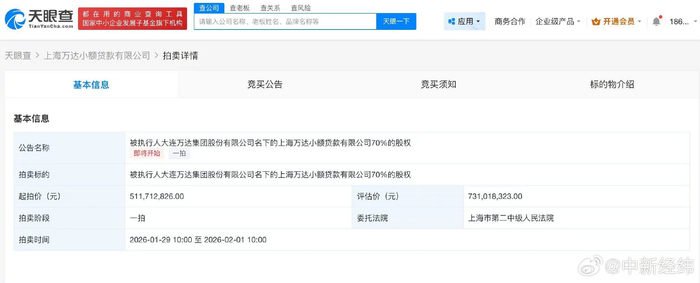
万达5.1亿起拍上海小贷公司70%股权
Cai Jing Wang· 2025-12-28 06:39
Core Viewpoint - The Shanghai Second Intermediate People's Court has announced an auction for 70% equity of Shanghai Wanda Microfinance Co., Ltd., owned by Dalian Wanda Group, with a starting price of approximately 5.1 billion yuan and an assessed value of over 7.3 billion yuan [1]. Group 1: Auction Details - The auction will take place from January 29 to February 1, 2026 [1]. - The assessed value of the equity is approximately 7.3 billion yuan, while the starting bid is set at around 5.1 billion yuan [1]. - Dalian Wanda Group has been executed for over 12 billion yuan in previous cases [1]. Group 2: Company Information - Dalian Wanda Group was established in September 1992, with a registered capital of 1 billion yuan [1]. - Wang Jianlin serves as the legal representative and chairman, holding 98% of the beneficial shares [1]. - Shanghai Wanda Microfinance Co., Ltd. has a registered capital of 105 million yuan and was established on January 26, 2016 [2]. Group 3: Legal and Financial Context - The auction is a result of judicial decisions, with the rights to the equity being frozen by the court [2]. - The auction is based on an asset-based valuation method, with the evaluation date set for December 31, 2024 [2][3]. - The auction is part of a larger execution case involving multiple entities, including Wanda Group and its subsidiaries [4].
21社论丨发挥协同效应,稳定房地产市场
21世纪经济报道· 2025-12-27 01:10
Core Viewpoint - The recent policy adjustments in Beijing aim to stabilize the real estate market by optimizing purchase restrictions and housing credit policies, with expectations for more cities to follow suit [1] Group 1: Policy Adjustments - The adjustments are designed to implement the removal of unreasonable consumption restrictions on housing and to promote active real estate transactions [1] - The focus is on expanding domestic demand, as the real estate sector significantly influences investment and consumption through related industries like renovation and home appliances [1] Group 2: Market Dynamics - The real estate market is undergoing adjustments primarily due to demographic changes and urbanization, leading to a "strong supply and weak demand" situation [1] - The current market conditions indicate a need for faster inventory digestion to achieve a balance between supply and demand, particularly in cities with population inflows [2] Group 3: Inventory Management - The existing inventory consists of unsold housing and second-hand homes, with the latter's transaction share increasing from less than 28% at the end of the 13th Five-Year Plan to 45% currently, and over 60% in major cities [2] - Encouraging local governments to acquire unsold properties for affordable housing can help quickly reduce market inventory and restore market confidence [2] Group 4: Market Stability - The rental yield in first-tier cities is recovering, and lower interest rates are making rental returns more attractive, contributing to market stability [3] - A comprehensive approach is necessary to stabilize the real estate market, balancing various aspects such as market and security, rental and purchase, and new and second-hand homes [3]

张瑜:美国经济的冷与热:总量向上,民生向下——美国三季度GDP点评
一瑜中的· 2025-12-26 16:03
Core Viewpoint - The third quarter GDP of the United States exceeded expectations, with a quarter-on-quarter annualized growth rate of +4.3%, up from +3.8% previously and above the expected +3% [2][38] - The economic data indicates a K-shaped recovery, where overall economic growth contrasts with declining living standards for many, highlighting a significant wealth gap [4][13] Group 1: Economic Disparities - AI-related investments continue to drive economic growth, with a contribution of +0.4% to GDP growth in Q3, while traditional non-AI investments show negative growth [6][14] - The wealth effect from AI is concentrated among the top 20% of income earners, who hold approximately 87% of all stock assets, leaving the majority of the population unable to benefit from this growth [7][23] - 67% of wage-dependent individuals are classified as "living paycheck to paycheck," with a significant portion unable to cover daily expenses, contributing to rising credit defaults and declining consumer confidence [7][23] Group 2: Employment and Consumer Behavior - The job market remains weak, particularly for low-wage positions, with new job creation in these sectors expected to be below 100,000 annually starting in 2024 [8][29] - AI's contribution to economic growth does not translate into job creation, instead replacing entry-level positions, leading to higher unemployment rates among younger demographics [8][30] - The housing market is also struggling, with high mortgage rates and rising home prices making homeownership increasingly unattainable for average earners [9][35] Group 3: GDP Data Analysis - Q3 GDP growth was primarily driven by strong consumer spending, particularly in services, while durable goods consumption remained weak [6][42] - Private investment showed a decline, with inventory investment improving but still negative, indicating ongoing challenges in traditional sectors [6][43] - Net exports weakened significantly due to a contraction in imports, while government spending increased, contributing positively to GDP growth [6][46]

人民币汇率重返 6 时代,对投资有什么影响?
雪球· 2025-12-26 13:01
以下文章来源于郭施亮 ,作者郭施亮 郭施亮 . 财经评论员、专栏作家,2013年度搜狐最佳行业自媒体人。香港大公财经特约评论员、每经智库专栏作家,并多次受邀广东省人民政府发展研究中心等权 威机构撰写多篇学术文章。其作品刊登于香港文汇报、新华社《瞭望》、人民日报海外版等数十家权威报刊。 ↑点击上面图片 加雪球核心交流群 ↑ 风险提示:本文所提到的观点仅代表个人的意见,所涉及标的不作推荐,据此买卖,风险自负。 作者: 郭施亮 在美元大幅走弱的影响下 , 促使人民币汇率被动升值 , 同时也促使大部分与美元指数呈现出负相关的资产出现了可观的涨幅 。 在投资市场中 , 常有一句话是这样说的 , " 一鲸落 , 万物生 " , 美元指数涨跌对大部分资产价格带来较大的影响 。 这一轮美元贬值潮 , 不 仅带动了金价的持续上涨 , 而且还带动了股市等资产的持续回暖 。 美元指数持续下跌 , 促使人民币汇率的被动升值 。 不过 , 影响人民币汇率走向的因素 , 远不止美元指数这一项指标 。 例如 , 国内经济基本 面的持续改善 、 市场投资情绪升温以及外资的积极流入等 , 都会对人民币汇率起到积极的提振影响 。 在人民币汇率重 ...

居民财富配置转型:解锁消费增长与产业创新路径
经济观察报· 2025-12-26 12:23
Core Viewpoint - The article emphasizes the need for a shift in household wealth allocation towards risk financial assets to enhance property income and achieve wealth preservation and appreciation, which is essential for boosting consumer spending and driving technological and industrial innovation supported by the capital market [1][2]. Group 1: Consumer Spending and Property Income - The decline in consumer spending growth is linked to the decrease in property income growth, with retail sales growth falling to 3% in September 2025, indicating ongoing pressure on consumption [5][6]. - From 2021 to 2024, urban residents' property income growth dropped from 10.2% to 2.2%, further declining to 1.7% in the first three quarters of 2025 [5][6]. - The significant drop in wealth, with stock market losses around 10 trillion yuan and real estate value declines of 50-60 trillion yuan, has exerted downward pressure on consumption [6]. Group 2: Wealth Structure and Financial Assets - In 2025, property income accounted for 8.1% of total household income in China, lower than the U.S. (20%) but higher than Japan (3-4%), Germany (5-7%), and the UK (6-8%) [8]. - The structure of household wealth is heavily dominated by real estate, which constitutes about 60% of total assets, significantly higher than in the U.S. (25%) and Japan (36%) [8]. - The low proportion of risk financial assets (17%) compared to low-risk assets (83%) indicates a need for a shift in investment strategies to enhance property income [12][15]. Group 3: Challenges in Financial Asset Allocation - The preference for low-risk assets is influenced by historical trends of rising property prices and the perception of real estate as a safer investment compared to stocks [17][18]. - The long-term returns of A-share companies have not matched China's rapid economic growth, leading to lower investor confidence in stock investments [18]. - High market volatility has significantly reduced the returns for retail investors, highlighting the need for a more stable investment environment [19]. Group 4: Strategies for Improvement - To improve household wealth allocation, it is essential to enhance the long-term profitability of listed companies and shift their focus towards shareholder returns [21][22]. - Expanding investment options for residents in risk financial assets through pension reforms and encouraging participation in stock markets can help diversify asset allocation [23][24]. - Stabilizing the real estate market is crucial to prevent further declines in property values, which could hinder the shift towards risk financial assets [26].

——美国三季度GDP点评:美国经济的冷与热:总量向上,民生向下
Huachuang Securities· 2025-12-26 10:13
证 券 研 究 报 告 【宏观快评】 美国经济的冷与热:总量向上,民生向下 ——美国三季度 GDP 点评 事 项 三季度美国 GDP 好于预期,GDP 环比折年率+4.3%,前值+3.8%,预期+3%, 显著强于季节性;GDP 同比+2.3%,前值+2.1%,预期+2%。 主要观点 核心结论:Q3 经济超预期的主要来源为:①库存投资负向拖累大幅改善(库 存投资对 GDP 环比增速的拉动率为-0.2%,较前值提升 3.2 个百分点),主要 为抢进口修复后回归常态;②个人消费支出继续强劲增长(私人消费对 GDP 环比增速的拉动率为 2.4%,较前值提升 0.7 个百分点),但结构仍是服务消费 强、耐用品消费弱。 Q3 数据进一步佐证了美国经济冷热不均的分化,且短期难以改善这一分化。 总量向上:AI 投资继续拉动经济+富人财富效应下支撑消费偏强。但民生向下: 传统制造业与商品消费弱,导致"蓝领"就业难;普通人享受不到 AI 的财富 增值,反而财务状况不断恶化,67%的人口处于"月光族"。 经济冷热不均的分化能暂时避免经济衰退的到来,但无法解决政治风险。考虑 到 2026 年为中期选举年,不排除特朗普在经济矛盾无法解 ...