新供给创造新需求

Search documents
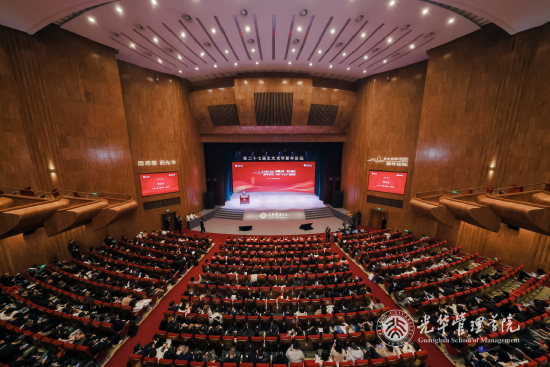
内需主导,聚力增长丨第二十七届北大光华新年论坛圆满举行
Xin Lang Cai Jing· 2026-01-17 13:45
Core Viewpoint - The 27th Peking University Guanghua New Year Forum focuses on "domestic demand-led growth" as a key theme, aligning with the central economic work conference's emphasis on strengthening the domestic market for the new phase of the 14th Five-Year Plan [1][19]. Group 1: Forum Overview - The forum was held on January 17, 2026, at Peking University, featuring prominent speakers including university officials and industry representatives [3][21]. - The event aims to contribute to the theoretical framework for the 14th Five-Year Plan and stimulate discussions on building a robust domestic market [1][19]. Group 2: Keynote Speeches - Liu Shijun discussed the shift from supply constraints to demand constraints in China's economic growth, emphasizing the need for a focus on consumption and human capital investment [7][24]. - Gao Peiyong highlighted the importance of stimulating residents' consumption as a key driver of economic growth, addressing challenges such as weak consumer confidence and the need for systemic reforms [10][26]. - Liu Qiao analyzed the paradox of low consumer spending in relation to high per capita consumption, suggesting policy reforms to enhance disposable income and consumer rates [12][29]. Group 3: Roundtable Discussion - The roundtable featured discussions on how new supply can create new demand, with industry leaders addressing the structural mismatches in consumer markets [14][32]. - Ma Tiemin pointed out the need for agricultural product market reforms to address supply-demand mismatches, advocating for digital tools and innovative production methods [15][33]. - Other participants emphasized the importance of understanding consumer behavior shifts and the need for companies to adapt their strategies to meet evolving market demands [16][34][35]. Group 4: Future Directions - Zhang Zheng summarized that creating new demand through new supply is a comprehensive process involving value creation, technological empowerment, and supply chain upgrades [18][36]. - The forum underscored the necessity for collaborative efforts among policymakers, capital providers, and entrepreneurs to foster a sustainable environment for innovation and growth [18][36].

推动实现新供给和新需求良性互动
Si Chuan Ri Bao· 2026-01-04 22:26
Core Viewpoint - The article emphasizes the importance of promoting a positive interaction between supply and demand to achieve a dynamic balance, which is essential for constructing a new development pattern and driving high-quality economic growth [1][2]. Group 1: Supply and Demand Interaction - Promoting a positive interaction between supply and demand is necessary to provide a solid foundation for constructing a new development pattern and driving high-quality development [2]. - The current focus of China's economic development has shifted from "availability" to "quality," necessitating a transformation in supply to meet new demands [2]. - The dual challenges of supply-side and demand-side issues are intertwined, with structural, institutional, and cyclical problems affecting economic recovery [2][3]. Group 2: Strategic Implementation - The 20th National Congress of the Communist Party has outlined a top-level design for economic and social development during the 14th Five-Year Plan, emphasizing the need for supply-demand interaction to address imbalances [3]. - Strengthening domestic circulation while ensuring smooth international circulation is crucial for leveraging China's large market and production capacity [3]. Group 3: New Demand and New Supply - The relationship between new demand and new supply is dialectical, forming a dynamic cycle that achieves a higher level of balance [4]. - New demand drives supply transformation, pushing for optimization and upgrading of the supply system to meet changing consumer preferences [5]. - New supply is not merely a passive response to existing demand but actively creates new types of demand through innovative practices [6]. Group 4: Practical Pathways for Supply-Demand Interaction - Investment in both physical and human capital is essential for establishing a solid foundation for supply-demand interaction [7]. - Enhancing consumption and activating domestic demand potential are strategic priorities, with a focus on new types of consumption and improving the consumption environment [8]. - Addressing bottlenecks in the economic cycle and improving supply-demand matching mechanisms are critical for achieving a high-level socialist market economy [9]. Group 5: Regional Coordination and Development - Urban-rural and regional development imbalances necessitate collaborative development to enhance the breadth and depth of supply-demand interaction [10]. - Promoting the flow of quality industries and services from urban to rural areas can activate rural economic potential and stimulate consumption demand [10].
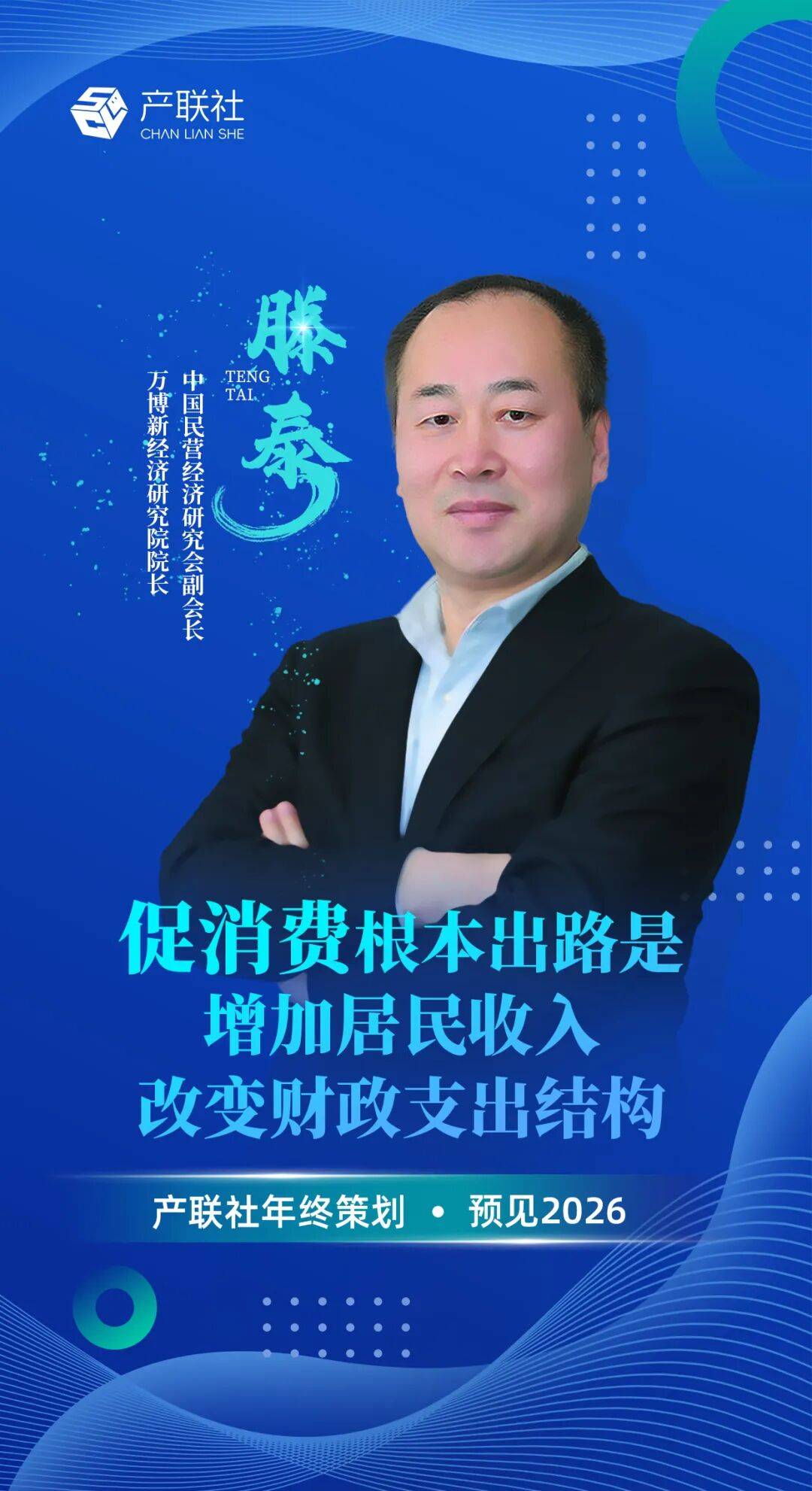
滕泰:应将定向消费补贴转为收入补贴,居民会把钱花在最需要的地方
Sou Hu Cai Jing· 2026-01-04 16:38
Core Viewpoint - The core challenge facing the Chinese economy in 2026 is insufficient domestic demand, manifested through a sluggish real estate market, declining private investment, and weak consumer spending [4][5]. Group 1: Economic Challenges - The real estate market continues to experience low transaction volumes, falling prices, and negative investment growth, which negatively impacts both investment and consumption [5]. - Private investment has seen a decline, with a reported negative growth of 5.3% from January to November 2025, indicating a need for improved market expectations and confidence [5]. - The proportion of household consumption in GDP remains low, highlighting a lack of consumer vitality [5]. Group 2: Solutions for Economic Growth - To address these challenges, it is essential to shift the national income and expenditure structure through dual reforms in fiscal and income policies to boost consumption [4][6]. - The transition from ineffective investments to direct subsidies for residents is crucial, as reallocating fiscal funds from infrastructure to consumer subsidies could significantly enhance total demand [6][7]. - A healthy capital market is expected to replace the real estate sector's role in driving investment and increasing household wealth, working alongside emerging industries to form a dual engine for future economic growth [4][9]. Group 3: Emerging Industries and New Consumption - Emerging industries such as artificial intelligence, high-end chips, civil aerospace, innovative pharmaceuticals, and high-end services are anticipated to become new economic pillars, replacing the growth function previously held by real estate [9][10]. - The application of artificial intelligence is projected to create new consumption scenarios, fundamentally reshaping existing lifestyles and work methods, similar to the impact of the internet [10].
机构前瞻2026年港股:盈利驱动接棒,把握“新供给”主线
2 1 Shi Ji Jing Ji Bao Dao· 2025-12-19 13:43
Core Viewpoint - The Hong Kong stock market is expected to maintain a resilient performance through 2026, driven by improving liquidity and corporate earnings recovery, despite recent volatility in global markets [1][4]. Market Performance - As of December 19, the Hang Seng Index, Hang Seng Tech Index, and Hang Seng China Enterprises Index have increased by 28.07%, 22.63%, and 22.10% respectively since the beginning of the year, outperforming major global indices like the S&P 500 and Germany's DAX [1]. Future Outlook - Both buy-side and sell-side institutions have optimistic expectations for the Hong Kong stock market in 2026, anticipating a shift from valuation recovery to profit growth as the main driver of market performance [1][4]. - Dongwu Securities predicts that the Hong Kong stock market will continue to recover in 2026 due to several factors, including expected interest rate cuts by the Federal Reserve and improved corporate earnings [4]. Investment Strategies - Investment strategies for 2026 should focus on a "core + satellite" approach, with the core strategy centered on AI-related sectors and two satellite strategies targeting essential consumer industries and innovative companies creating new demand [7]. - The investment focus should include technology and cyclical sectors, with an emphasis on balancing growth and value styles [5][6]. Key Drivers - The anticipated recovery in corporate earnings is a crucial factor for the Hong Kong stock market, with expectations of further improvement in profitability [4][5]. - The market is expected to see continued inflows from both domestic and foreign investors, driven by a "wealth effect" [4]. Market Dynamics - The market is likely to experience a balanced style between large and small-cap stocks, with growth styles expected to dominate in 2026 [5]. - The research teams suggest a gradual or wave-like process for style switching, indicating that value and growth are not mutually exclusive [5]. Risk Considerations - Potential risks for the Hong Kong stock market include overly consensus-driven trading, significant fluctuations in U.S.-China monetary policy, and geopolitical influences [8].

【笔记财经晨会】2025.12.16 星期二
债券笔记· 2025-12-16 15:36
Macroeconomic Insights - China's industrial added value in November increased by 4.8% year-on-year, below the expected 5% and previous value of 4.9% [5] - Fixed asset investment (excluding rural households) in China decreased by 2.6% year-on-year from January to November, compared to a decline of 1.7% previously [5] - Retail sales of consumer goods in November grew by 1.3% year-on-year, falling short of the expected 2.9% and previous value of 2.9% [5] - The economic data for November indicates a significant decline in consumption and investment, with a notable increase in the decline of real estate investment, highlighting persistent issues of insufficient domestic demand [5] Equity Market Analysis - A-shares exhibited a shrinking adjustment trend due to key technical levels and a convergence of short-term risk appetite, with the ChiNext index showing a relative weakness, down by 1.77% [6] - The trading volume in the two markets significantly decreased, with a reduction of over 300 billion yuan in a single day [6] - The three major indices are currently operating below the 5-day moving average, indicating that the market remains in a phase of consolidation [6] - Despite overall pressure on indices, structural opportunities within the market remain active, particularly in the commercial aerospace sector and consumer sectors, which have attracted capital attention [6] Consumer Sector Insights - The core investment logic behind the notice on enhancing business and financial collaboration to boost consumption lies in the understanding that "new supply creates new demand" [6] - Investment opportunities are found in innovations on the supply side that leverage new technologies, create new scenarios, and meet new consumer sentiments [6] - The introduction of policies is expected to further optimize the development environment for new consumption, significantly impacting market confidence, stimulating corporate innovation, and unleashing economic growth potential [6] Alcohol Industry Focus - Kweichow Moutai's recent volume control policy is viewed as a short-term price defense and confidence restoration strategy, aimed at gaining time for deeper structural reforms [7] - In the long term, this policy represents a proactive shift in the industry from relying on "volume and price increases" for growth to a more refined management approach focusing on "brand resilience," "channel health," and "real consumption foundation" [7]

中央经济工作会议指明方向!A股这波机会该怎么抓?
Xin Lang Cai Jing· 2025-12-12 12:11
Core Insights - The Central Economic Work Conference held on December 10-11 in Beijing outlined key tasks for China's economic work in 2026, emphasizing the importance of maintaining confidence and leveraging advantages to address challenges [1][9] Economic Work Focus Areas - **Domestic Demand**: Emphasis on building a strong domestic market through consumption initiatives, income increase plans, and investment stabilization [1][11] - **Innovation Drive**: Focus on fostering new growth drivers by enhancing education, technology, and talent development, and establishing international innovation centers [1][11] - **Reform and High-Quality Development**: Commitment to deepening reforms, including a unified market construction and addressing competitive practices [2][11] - **Opening Up**: Promotion of multi-field cooperation and gradual expansion of service sector openness, along with enhancing foreign investment mechanisms [2][11] - **Coordinated Development**: Efforts to promote urban-rural integration and regional collaboration, ensuring stable prices for essential agricultural products [2][11] - **Green Transition**: Initiatives aimed at energy efficiency and carbon reduction across key industries [2][11] - **Public Welfare**: Focus on improving people's livelihoods through job stability and healthcare reforms [3][11] - **Risk Management**: Strategies to stabilize the real estate market and manage local government debt risks [3][11] Market Opportunities - **Technology and Manufacturing Exports**: Attention on sectors like semiconductor equipment, AI, and robotics, as well as traditional manufacturing exports [6][14] - **Supply Optimization**: Focus on industries with resource constraints and potential price increases, alongside sectors benefiting from policy adjustments [6][14] - **Consumer and Service Sector Upgrades**: Anticipation of a positive macroeconomic policy environment boosting consumer sectors, particularly in retail and food and beverage [6][14]
港股大金融股全线上涨,香港证券ETF、港股通非银ETF涨超2%
Sou Hu Cai Jing· 2025-12-12 09:29
Group 1 - The Hong Kong stock market shows a significant recovery in sentiment, with the Hang Seng Index rising by 1.75% and returning to 26,000 points, supported by gains in major technology stocks and financial sectors [1] - Major technology stocks such as Tencent and Alibaba increased by over 2.3%, while financial stocks like China Pacific Insurance and CITIC Securities also saw notable gains, with HSBC reaching a market capitalization of over HKD 2 trillion [1] - The Hong Kong Securities ETF and the Hong Kong Stock Connect Non-Bank ETF both rose by over 2%, with the former tracking a specific index of leading securities firms [2] Group 2 - Jianyin International suggests that the investment logic for Hong Kong stocks has shifted from traditional valuation recovery to a re-evaluation based on new productive forces and high-quality development, with potential for moderate expansion in valuation and earnings by 2026 [3] - The outlook for 2026 indicates a transition from valuation-driven growth to profit-driven growth, with liquidity remaining supportive despite a potential slowdown in valuation expansion [4] - The new economic dynamics, driven by "new supply creating new demand," are expected to support the Hong Kong market, alongside favorable internal and external policy environments and increased foreign investment [4]
经济学家、万博新经济研究院院长滕泰:要鼓励新供给来创造新需求
Bei Jing Shang Bao· 2025-11-27 13:19
Core Viewpoint - The traditional investment-driven growth model in China is unsustainable and a shift towards a consumption-led development path is necessary [1] Group 1: Economic Transition - The need to encourage new supply to create new demand is emphasized, which includes new technologies, products, scenarios, and business models [1] - Boosting consumption is not only essential for driving economic growth but also serves as the ultimate goal of all economic activities [1]
2027年我国将形成3个万亿级消费领域
Bei Jing Shang Bao· 2025-11-27 00:24
Core Viewpoint - The implementation plan aims to enhance the adaptability of consumer goods supply and demand, promoting consumption as a driver of economic growth by optimizing supply structures and creating new consumption scenarios [1][6]. Group 1: Supply and Demand Adaptability - The plan outlines 19 key tasks focusing on expanding new consumption, tapping into existing markets, and targeting niche markets [1][7]. - It emphasizes the importance of new technologies and innovative models in industries such as smart vehicles, smart home products, and consumer electronics [2][6]. Group 2: New Consumption Scenarios - The plan encourages the development of new consumption scenarios, including interest-based products like pet supplies and anime merchandise, while also promoting low-altitude tourism and automotive aftermarket services [4][6]. - It supports the establishment of flagship stores and new concept stores to enhance consumer experience and engagement [4][6]. Group 3: Targeted Product Development - The plan aims to enhance product offerings for specific demographics, including children and the elderly, by promoting high-quality, intelligent, and customized products [7][8]. - It encourages the development of health-related products and services, integrating traditional medicine with modern health management [3][7]. Group 4: Shared Consumption - The plan outlines directions for shared consumption, including the promotion of shared bicycles and other mobility solutions in public spaces [5][6]. - It emphasizes the need for quality certification systems for shared products to ensure safety and reliability [5][6].
挖存量拓增量 六部门合力增强消费品供需适配性
Bei Jing Shang Bao· 2025-11-26 13:42
Core Viewpoint - The implementation plan aims to enhance the adaptability of consumer goods supply and demand, promoting consumption and achieving a dynamic balance by 2027 and establishing a high-quality development pattern by 2030 [1][6]. Group 1: Key Tasks and Focus Areas - The plan outlines 19 key tasks focusing on expanding new consumption, deepening existing consumption, and targeting niche markets through innovation in new technologies and models [1][6]. - Emphasis is placed on accelerating the application of new technologies in key industries such as smart connected vehicles, smart home, consumer electronics, and modern textiles [3][4]. - The initiative includes promoting flexible and customized manufacturing, establishing a digital system from user demand to intelligent design and flexible production [3][4]. Group 2: Consumer Segments and Product Development - The plan targets specific consumer segments, including children and the elderly, promoting the development of high-quality, intelligent, and customized products [8][9]. - For the children’s market, there is a focus on enhancing the supply of feeding, travel, outdoor, and educational products, alongside safety measures for children's products [8]. - In the elderly market, the plan encourages the development of products such as care robots, multifunctional nursing beds, and health monitoring devices to improve quality of life [8]. Group 3: New Consumption Scenarios - The plan aims to cultivate new consumption scenarios by promoting interest-based products such as pet-related goods, anime, and trendy fashion items [5][6]. - It supports the development of low-altitude tourism and private flying experiences, as well as the automotive aftermarket, including car modifications and RV camping [5]. - The initiative encourages the establishment of flagship stores and new concept stores to enhance consumer experience and promote product launches [5][6]. Group 4: Shared Consumption and Quality Standards - The plan outlines directions for shared consumption, including the promotion of shared bicycles and wheelchairs in public spaces, along with establishing quality certification systems for shared products [6][7]. - It emphasizes the importance of creating a comprehensive system that connects new supply with new demand through 19 specific tasks [6][7].