电动汽车

Search documents
(上合天津峰会)习近平会见埃及总理马德布利
Zhong Guo Xin Wen Wang· 2025-08-30 12:08
Group 1 - The core message emphasizes the strengthening of China-Egypt relations, marking a historical peak and aiming to build a community of shared destiny in the new era [1][2] - Both countries plan to leverage the upcoming 70th anniversary of diplomatic relations to enhance bilateral cooperation, particularly in trade, investment, and various sectors such as renewable energy and electric vehicles [2] - The meeting highlights the importance of mutual support in political trust and cooperation, especially in addressing core interests and major concerns of both nations [1][2] Group 2 - Egypt expresses its commitment to the One China principle and aims to deepen high-level exchanges and expand trade and investment with China [2] - Both nations, as developing countries, seek to coordinate and collaborate in international and regional affairs to safeguard the common interests of developing nations [2]
这个国家的中产,买爆中国电动汽车
Feng Huang Wang Cai Jing· 2025-08-29 13:02
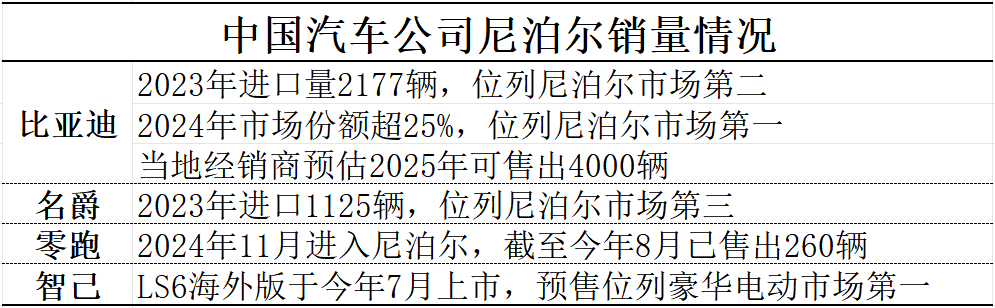
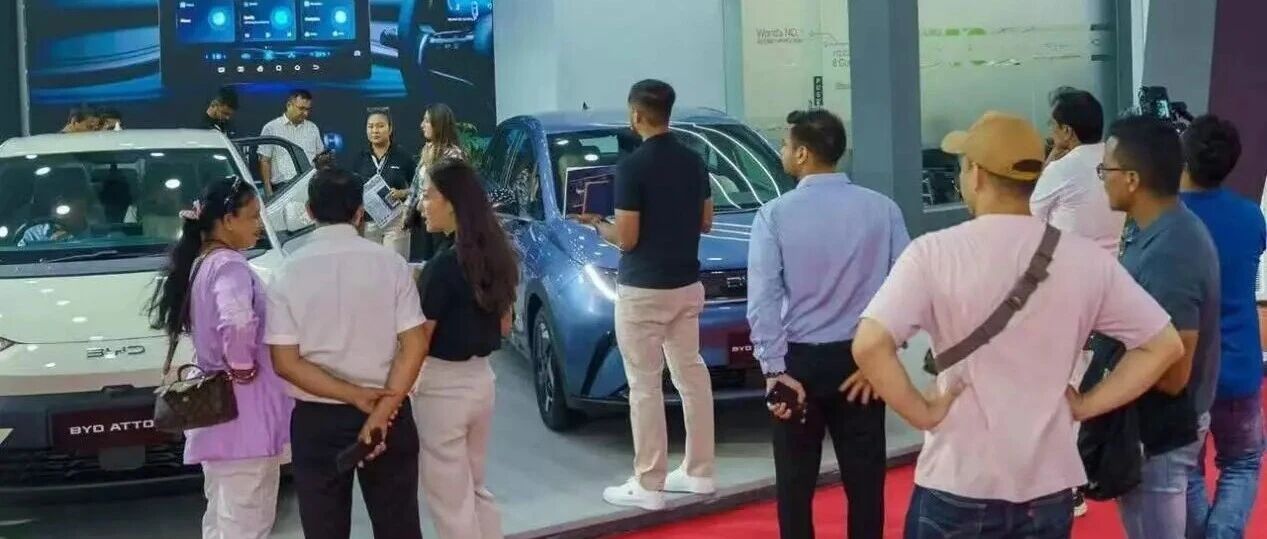
Group 1 - The article highlights the rapid adoption of electric vehicles (EVs) in Nepal, with 76% of new car sales being electric, a significant increase from nearly zero five years ago [2][3][9] - Chinese electric vehicle manufacturers, such as BYD and SAIC MG, are gaining popularity in Nepal, with a notable market presence and increasing sales figures [11][12] - The Nepalese government is actively promoting electric vehicles through favorable tax policies, reducing import duties for EVs to 10-30%, while fuel vehicles face much higher taxes [7][8][21] Group 2 - The cost of operating electric vehicles in Nepal is significantly lower than traditional fuel vehicles, with monthly expenses for fuel vehicles around 10,000 NPR compared to less than 2,000 NPR for EVs [3][4] - The local middle class shows a strong inclination towards purchasing electric vehicles, with 99% of current fuel vehicle owners likely to switch to EVs in the future [6][9] - The presence of Chinese EVs is expected to disrupt the dominance of Indian and Japanese brands in the Nepalese market, marking a shift in consumer preferences [2][8] Group 3 - The article discusses the potential for further growth in the electric vehicle market in Nepal, with government targets aiming for 25% of new car sales to be electric by 2025 and 90% by 2030 [8][9] - Local assembly or manufacturing of electric vehicles is encouraged by the Nepalese government, offering tax incentives and support for establishing production facilities [21] - The article emphasizes the need for Chinese manufacturers to build a robust after-sales service network to enhance consumer trust and address maintenance challenges [19][20]


这个国家的中产,买爆中国电动汽车
凤凰网财经· 2025-08-29 12:48
Core Viewpoint - The article highlights the rapid adoption of electric vehicles (EVs) in Nepal, driven by favorable government policies and the entry of Chinese manufacturers, marking a significant shift in the automotive landscape from traditional fuel vehicles to electric options [2][10]. Group 1: Market Dynamics - Electric vehicles now account for 76% of all new car sales in Nepal, a dramatic increase from nearly zero five years ago [2][4]. - The cost of operating electric vehicles is significantly lower than that of traditional fuel vehicles, with monthly fuel costs for fuel vehicles around 10,000 Nepalese Rupees compared to less than 2,000 for electric vehicles [4][6]. - The local middle class, approximately 5 million people, shows a strong inclination to purchase electric vehicles, with only 1% currently owning them, indicating a potential market shift [8]. Group 2: Government Support and Policy - The Nepalese government has implemented tax incentives for electric vehicles, with import duties for EVs ranging from 10% to 30%, while fuel vehicles face duties exceeding 200% to 300% [14][15]. - The government aims for electric vehicles to make up 25% of private car sales by 2025 and 90% by 2030, alongside mandatory scrapping of fuel vehicles over 20 years old [15][16]. Group 3: Chinese Manufacturers' Strategy - Chinese brands like BYD and MG have gained popularity in Nepal, with BYD expected to capture over 25% market share by 2024 [19]. - Chinese manufacturers are adapting their vehicles to local conditions, such as improving ground clearance and suspension for Nepal's rugged terrain [20][21]. - The article notes that Chinese companies treat the Nepalese market with the same seriousness as European markets, focusing on local needs and preferences [20][24]. Group 4: Challenges and Opportunities - Despite the growth, challenges remain, including the need for improved after-sales service and maintenance networks for electric vehicles [30][32]. - The Nepalese government encourages local assembly of electric vehicles, offering tax breaks and incentives to attract Chinese manufacturers to establish production facilities [34].
特斯拉在欧盟销量连续7个月下降
Xin Hua She· 2025-08-29 12:48
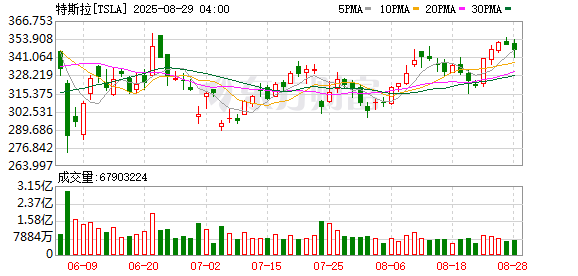
面对当前困境,特斯拉公司寄希望于今年第四季度推出更低价新车型,以期提振在欧盟市场表现。 (文章来源:新华社) 欧洲汽车制造商协会28日发布的数据显示,尽管今年7月欧盟纯电动汽车销量创下近两年来最大增幅, 美国电动汽车品牌特斯拉在欧盟却遭遇"黑色七月",销量同比下滑超40%,连续第七个月呈下降趋势。 数据显示,欧盟市场纯电动汽车7月销售量同比上升39%,但特斯拉仅售出6600辆,远低于去年同期的 11465辆。特斯拉股价在当日下午交易时段应声下跌1.5%。 据美联社分析,特斯拉在欧盟销量持续萎缩背后存在多重因素。公司首席执行官埃隆·马斯克先前插手 欧洲政局、公开支持极右翼候选人等言行在欧洲引发民众抗议,这一负面影响持续存在。另一方面,特 斯拉仍在等待欧洲监管机构批准其高级辅助驾驶功能。马斯克此前预计该审批于今年三月完成。此外, 特斯拉今年早些时候为推进生产线改造、更换生产设备,短暂关停了畅销车型Model Y的工厂。 ...

中国品牌霸榜,特斯拉危险了
Zhong Guo Qi Che Bao Wang· 2025-08-29 09:49
Core Insights - Global electric vehicle sales increased by 22% year-on-year in June, surpassing 1.8 million units, with pure electric vehicle sales growing by 24% to over 1.1 million units [1] - The global electric vehicle market share reached 28% in June, up from 24% in the first half of the year [1] - BYD and Tesla continue to lead the market, but the competitive landscape is shifting with brands like Geely and new entrants like Leap Motor and Xiaomi gaining traction [1] Market Overview - In China, automotive production and sales exceeded 15.6 million units in the first half of 2025, marking a year-on-year growth of 12.5% and 11.4% respectively [3] - New energy vehicles (NEVs) accounted for 44.3% of total sales, with production and sales of NEVs reaching 6.968 million and 6.937 million units, reflecting growth rates of 41.4% and 40.3% [3] - The export of NEVs saw a significant increase, with a 75.2% year-on-year growth, contributing to the overall automotive export growth of 10.4% [3][4] European Market Dynamics - In Europe, electric vehicle sales rebounded, with pure electric vehicle sales reaching 1.19 million units in the first half of the year, a 24.9% increase [5] - The market share for pure electric vehicles in Europe reached 17.47%, while plug-in hybrid vehicles saw a 21.2% increase in sales [5] - The decline in gasoline and diesel vehicle sales has been significant, with diesel vehicle market share dropping below 10% [6] Brand Performance - BYD maintained its position as the top-selling brand globally, with nearly 2 million units sold in the first half of the year, while Tesla's sales fell to approximately 720,000 units [15][16] - Geely and Wuling also performed well, with Geely's Star Wish and Panda Mini contributing to its rise to third place [16] - Chinese brands accounted for 17 out of the top 20 electric vehicle models sold globally, with BYD having 10 models on the list [12][14] U.S. Market Insights - In the U.S., electric vehicle sales reached a record high, with pure electric vehicle sales growing by 1.5% to 607,000 units [9] - Anticipation of the expiration of federal tax credits has led to a surge in sales, with July seeing a 20% year-on-year increase [9][10] - Tesla remains the market leader in the U.S., but its market share has declined from 50.1% to 44.7% [10]
全新小鹏P7的“Ultra”革命
Hua Er Jie Jian Wen· 2025-08-29 03:29
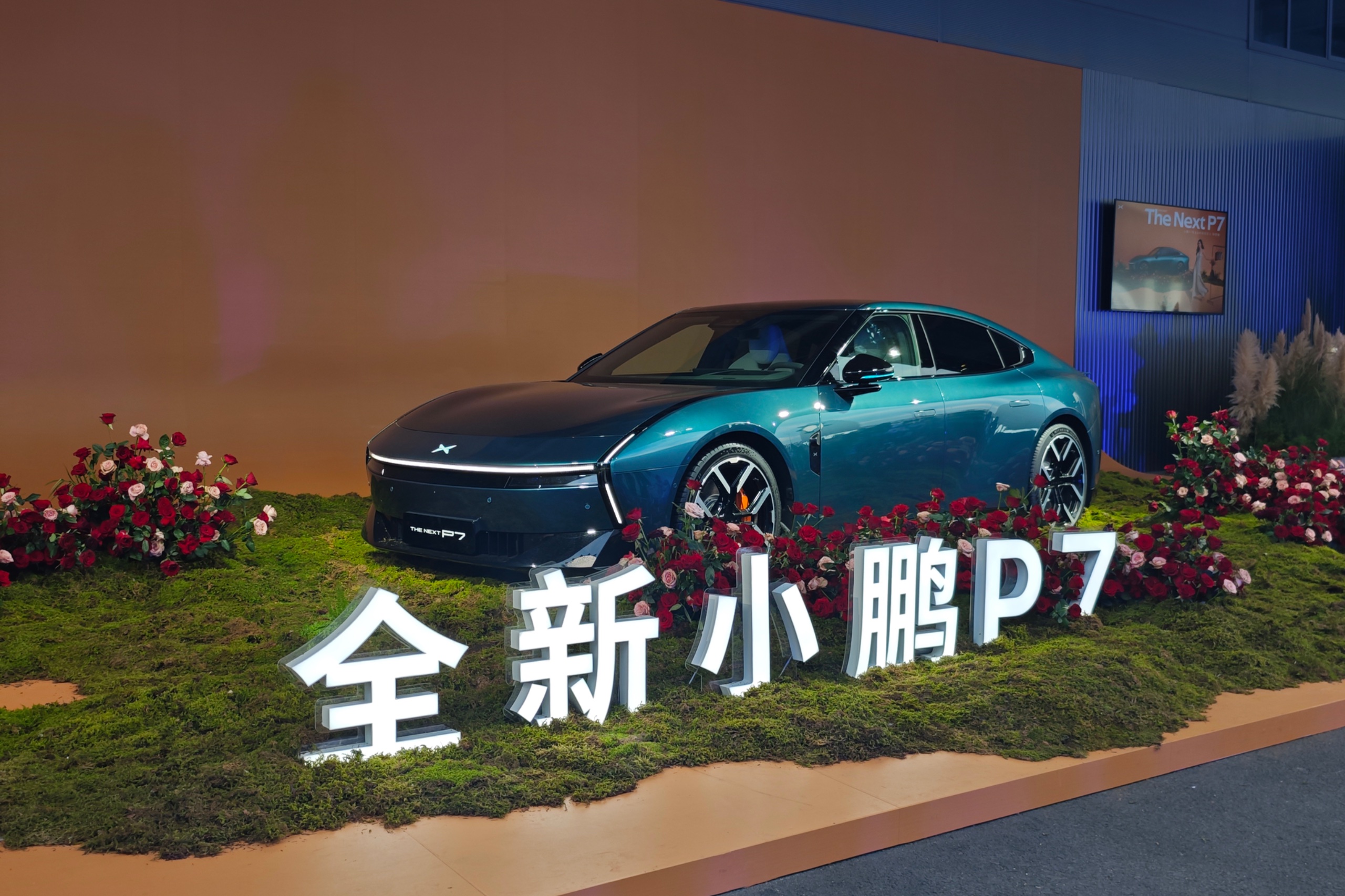
Core Viewpoint - The launch of the new XPeng P7 electric sedan showcases advanced technology and competitive pricing, aiming to capture a significant market share in the electric vehicle sector [2][9]. Product Overview - The new XPeng P7 is priced starting at 219,800 yuan, with four variants available, highlighting features such as self-developed AI chips, an 800V high-voltage platform, and 5C ultra-fast charging capabilities [2][6]. - The vehicle achieved over 10,000 pre-orders within 7 minutes of opening, setting a new record for XPeng [2][9]. Design and Performance - The P7 features a futuristic design with a focus on aesthetics and functionality, achieving high-performance metrics comparable to luxury brands like Porsche [3][4]. - It recorded a lap time of 1:38.767 at the Zhejiang International Circuit, making it the fastest production sedan under 500,000 yuan [4]. - The vehicle's performance is attributed to its advanced electric drive layout and AI-enhanced suspension system [4][6]. Battery and Charging Technology - The P7 is equipped with an 858 high-performance battery pack, offering a range of up to 820 km and ultra-fast charging capabilities, allowing for a 525 km charge in just 10 minutes [6][5]. - The charging system adapts to various public charging stations, ensuring efficient energy replenishment [6]. Intelligent Features - The P7 incorporates three self-developed Turing AI chips, providing a total computing power of 2250 TOPS, which supports advanced driver-assistance systems [6][7]. - It features a VLM cockpit assistant and an 87-inch AR-HUD, enhancing user interaction and experience [7]. Market Positioning and Strategy - XPeng aims to position the P7 as a flagship model, emphasizing its technological advancements and design to differentiate from competitors [11][12]. - The company targets a monthly sales goal of 40,000 units, indicating confidence in the P7's market acceptance [9][12]. Future Outlook - XPeng plans to expand its product line with new models in the coming years, focusing on both electric sedans and SUVs [14][16]. - The company is committed to enhancing its AI capabilities and integrating advanced technologies to maintain a competitive edge in the automotive market [27][24].
座椅通风,豪车才配?电车怎么把价格给家人们打下来的?
Hu Xiu· 2025-08-29 03:14
Core Viewpoint - The article discusses how domestic electric vehicle manufacturers have significantly reduced the cost of features like seat ventilation, which were once exclusive to luxury cars, making them standard in vehicles priced under 100,000 yuan [1] Group 1 - Seat ventilation was previously a luxury feature that required additional payment, but it is now standard in affordable electric vehicles [1] - The article highlights the competitive pricing strategies of domestic electric vehicle manufacturers [1] - The shift in feature availability reflects broader trends in the automotive industry towards increased accessibility of luxury features in lower-priced models [1]
自动驾驶成特斯拉负面资产?调查称FSD降低购车意愿
Feng Huang Wang· 2025-08-29 01:46
Group 1 - Elon Musk's promotion of Tesla's Full Self-Driving (FSD) technology has had limited appeal to potential buyers, with a recent survey indicating that 35% of respondents feel FSD decreases their likelihood of purchasing a Tesla [1][2] - The survey conducted by Slingshot Strategies involved 8,000 American consumers, revealing that only 14% are more inclined to buy a Tesla due to FSD, while 51% stated that FSD's presence does not affect their purchasing decision [1][2] - Nearly half of the surveyed consumers believe that FSD technology should be classified as illegal, raising concerns for Tesla regarding consumer perception [2][3] Group 2 - Tesla is facing significant challenges, including a 40% year-over-year decline in car sales in Europe as of July, marking the seventh consecutive month of sales drop [3][4] - The company is lagging behind competitors in the autonomous taxi market, such as Waymo and Baidu's Apollo Go, and is currently conducting pilot programs in Austin and the San Francisco Bay Area [4]
前7个月,福建省多种高附加值产品出口超百亿
Zhong Guo Chan Ye Jing Ji Xin Xi Wang· 2025-08-29 01:00
Group 1 - The core viewpoint of the articles highlights the strong performance of high value-added product exports from Fujian Province, particularly in lithium-ion batteries, flat panel display modules, and marine engineering equipment, with significant growth rates observed [1][2] - Fujian Province's lithium battery exports reached 76.46 billion yuan, ranking second nationally, with a monthly growth rate exceeding 5% and achieving double-digit growth for six months [1] - The export of high value-added products from Fujian is characterized by resilience amidst global trade adjustments, encompassing advanced equipment, customized solutions, and culturally creative consumer goods, contributing to high-quality foreign trade development [1] Group 2 - In terms of export markets, Fujian Province continues to strengthen its traditional markets in Europe and the United States while actively exploring emerging markets such as ASEAN and Africa [2] - The "new three items" (lithium batteries, photovoltaic products, and electric vehicles) along with electronic components and medical instruments have maintained over 50% share in traditional markets, with growth rates exceeding 5% [2] - Notably, the export of marine engineering equipment to ASEAN reached 2.82 billion yuan, increasing 16.2 times, while machine tool exports to ASEAN grew by 60%, and "new three items" exports to Africa surged by 133.5% [2]
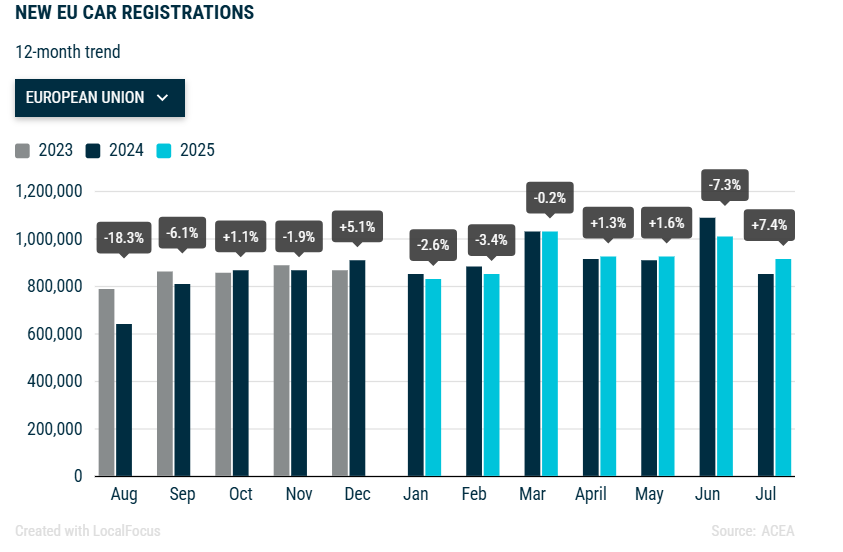
欧洲车市回暖 但特斯拉销量大降40% 市场份额被比亚迪超越
Zhi Tong Cai Jing· 2025-08-28 08:21
Group 1 - In July, new car sales in Europe increased by 5.9% year-on-year, driven by strong demand in Germany, which offset declines in the UK, France, and Italy [1][4] - Tesla's market share in Europe has been declining for seven consecutive months, with July sales dropping over 40%, falling behind Chinese competitor BYD, which captured a market share of 1.2% [1][4] - Major European automakers like Volkswagen are developing new electric vehicle models to compete with Tesla and Chinese rivals while complying with regulations promoting electric vehicle adoption [1] Group 2 - The European Automobile Manufacturers Association (ACEA) reported that overall new car sales in Europe reached 1.09 million units in July [3] - Volkswagen and Renault saw new car registrations increase by 11.6% and 8.8% respectively, while Stellantis experienced a slight decline of 1.1% [4] - The overall car sales in Germany grew by 11.1%, while the UK, France, and Italy saw declines of 5%, 7.7%, and 5.1% respectively [7] Group 3 - Tesla's sales in Europe are significantly impacted by increasing competition from low-cost electric vehicles, particularly from Chinese manufacturers [8] - The company is facing challenges due to strict regulatory environments regarding autonomous driving, which complicates the sales growth of its Model Y in certain European markets [8] - Tesla's anticipated new affordable electric vehicle models are delayed, with significant production increases expected only in the next quarter [8]