
航天

Search documents
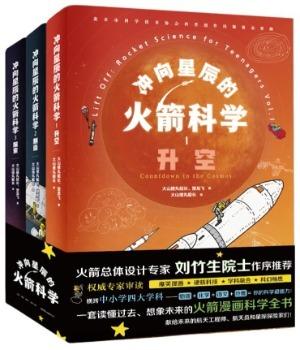
《冲向星辰的火箭科学》:为孩子们解锁航天的奥秘
Bei Jing Ri Bao Ke Hu Duan· 2025-11-04 23:53
Core Insights - The article emphasizes the rapid technological advancements in China, particularly in fields like AI, solid-state batteries, humanoid robots, and space exploration, highlighting a disconnect between public understanding and these complex technologies [2][4] - The book "Rocket Science Towards the Stars" serves as a vital tool for deepening public understanding of advanced technologies, aiming to bridge the gap between scientific knowledge and public perception [2][8] Summary by Sections - **Public Understanding of Technology** - There is a growing public anxiety regarding technological advancements, stemming from a lack of comprehensive scientific communication [2] - The need for deep science popularization is highlighted, suggesting that extended time for public engagement can enhance understanding of cutting-edge technologies [2][8] - **Relevance of Rocket Science** - Rockets are a familiar concept to the public, serving as a bridge between childhood experiences and advanced aerospace technology, representing a nation's technological prowess [3][4] - The book utilizes the tension between simple fireworks and advanced missiles to create an engaging narrative for science education [3] - **Historical Context and Evolution** - The book outlines the evolution of rockets from ancient signal devices to modern space exploration tools, showcasing key figures and milestones in rocket science [4][5] - It discusses the transformation of space from a forbidden zone to a competitive arena for nations, emphasizing China's contributions to space technology [4] - **Engaging Educational Approach** - The character "Flying Duck" is introduced as a guide throughout the book, using humor and illustrations to simplify complex rocket science concepts for young readers [5][6] - The narrative encourages exploration of unanswered questions in space science, fostering a scientific mindset among children [6][7] - **Exploration and Human Spirit** - The book aims to instill a sense of exploration and curiosity in children, paralleling humanity's quest to overcome physical limitations through technology [7][8] - It combines romantic notions of stargazing with practical scientific knowledge, making it an essential companion for children's scientific enlightenment [8]

马斯克要建设“太空遮阳伞”?
Sou Hu Cai Jing· 2025-11-04 09:15
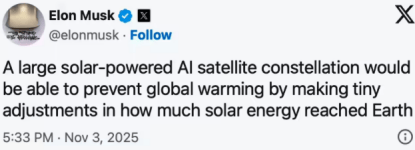
Core Viewpoint - Elon Musk proposed a climate intervention plan involving the deployment of large-scale satellite clusters in space to create a Space-Based Solar Radiation Management (SRM) system aimed at reflecting some sunlight and reducing Earth's surface temperature [1][2] Group 1 - This is not Musk's first involvement in climate intervention, as his company SpaceX's Starlink program has already launched over 6,000 satellites, providing the necessary infrastructure for space-based SRM [2] - Tesla's solar energy business and energy storage technology align with Musk's climate vision, further supporting the feasibility of the proposed SRM system [2]
航天科技:股权出售回笼资金将审慎投入航天应用、汽车电子、物联网三大主业
Jin Rong Jie· 2025-11-04 07:16
Core Viewpoint - The company is focusing on returning to its core business after selling off assets, emphasizing strategic planning and high-quality development [1] Group 1: Asset Sale and Strategic Focus - The company has transferred its overseas subsidiary as part of its strategic plan to concentrate on its main responsibilities and core business [1] - The sale of assets is intended to adjust the domestic and international industrial structure, laying a foundation for high-quality development [1] Group 2: Use of Proceeds - The funds raised from the asset sale, amounting to 12 billion, will be carefully invested in three main sectors: aerospace applications, automotive electronics, and the Internet of Things [1] - The company aims to gradually implement these investments based on business development needs, ultimately contributing to high-quality growth and benefiting all shareholders [1]

国际产业新闻早知道:中美经贸磋商多项共识落地,中欧举行“升级版”出口管制对话磋
Chan Ye Xin Xi Wang· 2025-11-04 06:01
Group 1: US-China Agricultural Trade - The US and China have reached a consensus to expand agricultural trade, relieving American soybean farmers who are hopeful for renewed purchases from Chinese companies [1][3] - The specific measures for expanding agricultural trade have not yet been disclosed by China, and it remains unclear if negotiations will be required for other agricultural products [2] - The American Soybean Association noted that while no formal trade agreement has been signed, the news is still positive for farmers, with the total value of US soybean exports projected at approximately $24.5 billion for 2024, with over $12.5 billion coming from China [3] Group 2: EU-China Export Control Dialogue - China and the EU held a dialogue on export controls, focusing on mutual concerns and agreeing to maintain communication to stabilize supply chains [4][5] - The dialogue follows China's announcement of expanded export controls on rare earths, which raised serious concerns in the EU [6] - The EU Trade Commissioner confirmed that the export control measures announced by China also apply to the EU, emphasizing continued cooperation on improving export control policies [7] Group 3: AI and Technology Investments - OpenAI has signed a $38 billion multi-year agreement with Amazon to provide cloud computing services, highlighting the increasing demand for computing power in the AI industry [21][22] - Microsoft has secured a $9.7 billion agreement with IREN to lock in new computing resources, as the company expands its AI service capabilities [26][27] - Microsoft plans to invest over $15 billion in the UAE over the next seven years, including expanding AI data centers, following the approval of export licenses for advanced chips [54] Group 4: Semiconductor and AI Chip Developments - South Korea's semiconductor exports reached $15.73 billion in October, marking a 25.4% year-on-year increase, driven by strong demand for high-capacity memory [50][51] - The US startup Vulcan Elements has secured a $1.4 billion deal with the government to build a factory for rare earth magnets, focusing on recycling electronic waste [87][88] - The US government is providing significant funding to support domestic production of rare earth materials, which are critical for advanced technologies [90][91] Group 5: Automotive Industry Developments - Geely has signed a strategic cooperation agreement with Renault to deepen local production and market expansion of electric vehicles in Brazil, acquiring a 26.4% stake in Renault Brazil [68][69] - Japanese automakers are redefining future vehicles at the Japan Mobility Show, showcasing concepts that integrate living spaces and community services [62][63] - The launch of new industrial wireless communication chips in China marks a significant advancement in industrial communication technology, enabling more flexible and efficient manufacturing processes [55][56]

英伟达发射了首个太空AI服务器,H100已上天
3 6 Ke· 2025-11-04 03:39
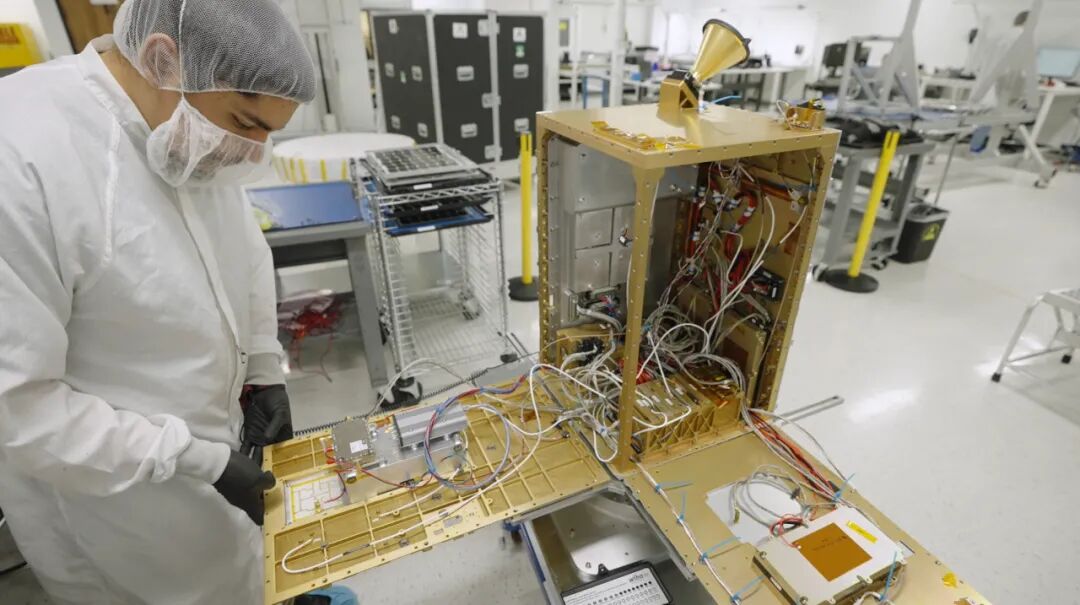
Core Insights - The launch of NVIDIA's H100 GPU into space marks a significant step towards establishing space data centers, which could drastically reduce energy costs and environmental impact compared to terrestrial data centers [2][3][6] Group 1: Space Data Center Advantages - Space data centers are projected to have energy costs only one-tenth of those on Earth, with a significant reduction in carbon emissions over their lifecycle [3][6] - The use of solar energy in space allows for continuous power generation without the need for battery storage, with solar panels in space generating eight times the energy of their Earth counterparts [7][8] - The anticipated launch costs for space data centers are expected to decrease significantly with advancements in rocket technology, potentially reaching as low as $10 to $150 per kilogram [8][10] Group 2: Technological Developments - The Starcloud-1 satellite, equipped with the H100 GPU, will process data from Earth observation satellites in real-time, significantly reducing the amount of data that needs to be transmitted back to Earth [5][10] - Starcloud plans to launch a more powerful data center, Starcloud-2, with ten times the capabilities of Starcloud-1, utilizing NVIDIA's next-generation Blackwell GPU [10][12] - The company envisions a future where nearly all new data centers will be established in space due to limitations on terrestrial energy resources [6][12] Group 3: Industry Context - Starcloud is part of a growing trend among companies exploring the potential of space-based computing, with other firms like Axiom Space and Lonestar Holdings also pursuing similar initiatives [12]

我国成功发射遥感四十六号卫星;越疆发布家庭智能体机器人Rover X1丨智能制造日报
创业邦· 2025-11-04 03:28
Group 1 - The first "land aircraft carrier" flying vehicle from Huitian Aviation Technology has successfully rolled off the production line, marking the world's first mass production line for flying cars [2] - The Rover X1, a family smart robot developed by Yujian Robotics, has been launched at a price of 7,499 yuan, featuring innovations in dual-vision tracking, all-terrain capabilities, and a self-developed open platform for multi-role applications [2] - China successfully launched the Remote Sensing Satellite No. 46 using the Long March 7 rocket, which will be used for disaster prevention, land resource investigation, and meteorological applications [2] Group 2 - Samsung SDI has secured a 3 trillion won order to supply energy storage system batteries to Tesla over a three-year period, although no final decisions have been made yet [2]


英伟达发射了首个太空AI服务器,H100已上天
机器之心· 2025-11-04 03:13
Core Viewpoint - The article discusses the potential of space-based data centers, highlighting that their energy costs could be only one-tenth of those on Earth, while also significantly reducing carbon emissions during their operational lifecycle [1][5]. Group 1: Space Data Center Development - NVIDIA's H100 GPU has been sent to space for the first time, marking a significant step in the development of space data centers [2][3]. - Starcloud's Starcloud-1 satellite will test various AI processing applications in orbit, paving the way for commercial services as early as next year [3][10]. - The satellite will operate in a low Earth orbit approximately 350 kilometers from Earth, processing data from Capella's synthetic aperture radar satellites [5][10]. Group 2: Environmental and Economic Benefits - Space data centers can utilize nearly unlimited low-cost renewable energy, reducing carbon emissions by a factor of ten compared to terrestrial data centers [5][8]. - The anticipated advancements in rocket technology, particularly from SpaceX, are expected to lower the costs of deploying large-scale computing infrastructure in space [7][8]. - Starcloud predicts that nearly all new data centers will be built in space within the next decade due to limitations on terrestrial energy resources [8]. Group 3: Data Processing Efficiency - The satellite is expected to handle 10GB of data per second, allowing for significant reductions in the amount of data that needs to be transmitted back to Earth [6][10]. - By processing data in orbit, only critical information needs to be sent back, drastically reducing the volume of data transmission [6][10]. Group 4: Future Plans and Projections - Starcloud plans to launch a more powerful data center, Starcloud-2, next year, which will utilize NVIDIA's next-generation Blackwell GPU [10]. - A larger 100kW satellite is projected to be launched by 2027, with plans for a 40MW data center in space by the early 2030s, matching the data processing costs of Earth-based centers [10].
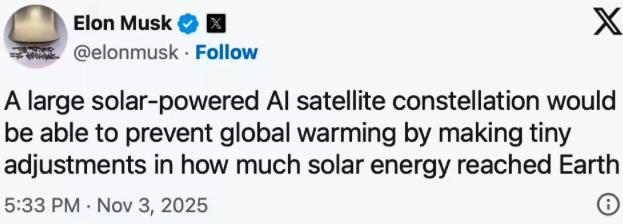
马斯克提议建设“太空遮阳伞”应对全球变暖
Huan Qiu Wang Zi Xun· 2025-11-04 03:01
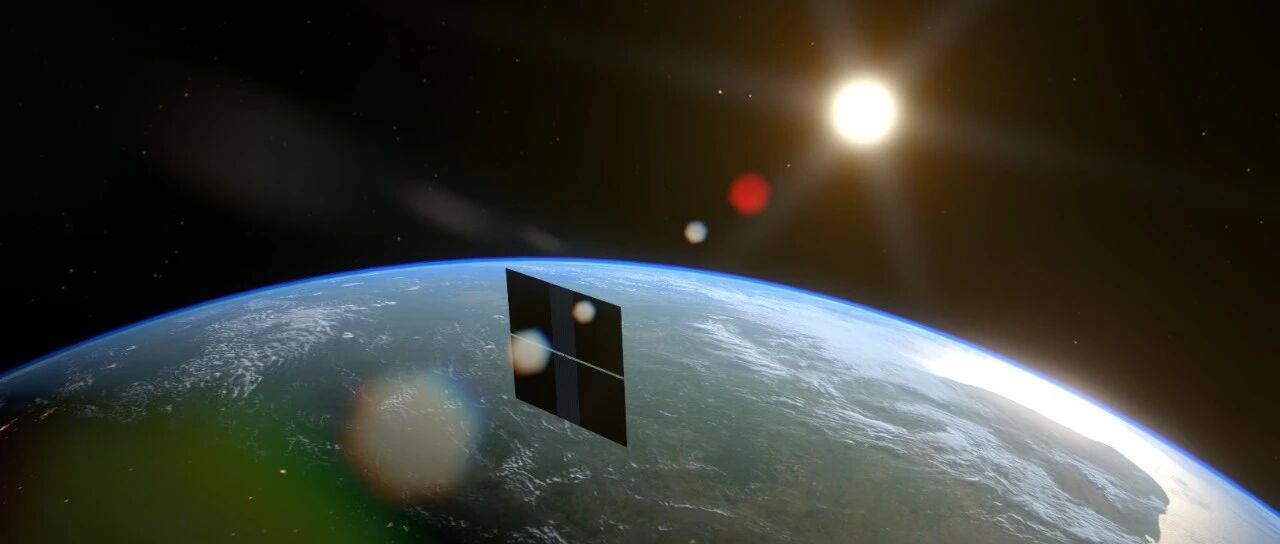
Core Points - Elon Musk proposed a climate intervention plan involving the deployment of large-scale satellite clusters in space to create a Space-Based Solar Radiation Management (SRM) system aimed at reflecting some sunlight and reducing Earth's surface temperature [1][2] Group 1 - This is not Musk's first involvement in climate intervention, as his company SpaceX's Starlink program has already launched over 6,000 satellites, providing a ready-made infrastructure for the space SRM [2] - Tesla's solar energy business and energy storage technology align with Musk's climate vision, further supporting the proposed SRM initiative [2]
每日市场观察-20251104
Caida Securities· 2025-11-04 02:01
Market Performance - On November 3, the market rebounded with total trading volume at 2.11 trillion, a decrease of approximately 210.7 billion from the previous trading day[3] - The Shanghai Composite Index rose by 0.55%, the Shenzhen Component increased by 0.19%, and the ChiNext Index gained 0.29%[3] - On November 4, the market continued to rise with a trading volume of 2.13 trillion, down about 220 billion from the previous day[1] Sector Trends - Traditional sectors like steel and coal saw significant gains, while sectors such as non-ferrous metals, home appliances, and automobiles experienced slight declines[1] - Technology-related sectors, particularly media and computing, showed a notable increase in both volume and price, indicating strong market interest[1] Capital Flow - On November 3, net inflow in the Shanghai market was 10.83 billion, while the Shenzhen market saw a net outflow of 2.55 billion[4] - The top three sectors for capital inflow were power grid equipment, photovoltaic equipment, and IT services, while the top outflow sectors included batteries, industrial metals, and securities[4] Policy and Economic Developments - The People's Bank of China and the Bank of Korea renewed a bilateral currency swap agreement with a scale of 400 billion RMB/70 trillion KRW, effective for five years[5] - Zhengzhou aims to develop an influential seed industry by 2027, targeting a scale of 5.5 billion RMB in the industry chain[6] Industry Dynamics - The Southern Power Grid's market has achieved over 70% of its trading volume through market-based transactions, with green certificate trading accounting for 63% of the national total[10] - The ETF market has seen explosive growth, with an increase of over 2 trillion in scale within 10 months, reaching a total of 5.74 trillion RMB[15]
潮起海之南——全岛封关运作在即 资本纷纷抢滩海南自贸港
Shang Hai Zheng Quan Bao· 2025-11-03 18:37
Group 1 - The core viewpoint of the articles emphasizes the significant opportunities presented by the establishment of the Hainan Free Trade Port, particularly with the implementation of zero tariffs and favorable tax policies for various industries [1][2][6] - The number of products enjoying zero tariffs will increase to approximately 6,600, allowing companies to save about 20% on import tax costs for equipment [6][7] - Over 1,100 encouraged industries, including biomedicine, will benefit from a 15% corporate income tax reduction, while high-demand talent across all sectors will enjoy a 15% personal income tax reduction [1][6] Group 2 - The Hainan Free Trade Port has developed a policy framework characterized by "zero tariffs, low tax rates, and simplified tax systems," which is expected to attract more investment and facilitate the integration into global supply chains [2][3] - The implementation of core policies such as duty-free imports and tax incentives has already shown significant results, with duty-free medical device imports valued at 2.72 billion yuan and tax reductions amounting to approximately 34.69 million yuan [2][4] - Hainan's unique geographical advantages, including its size and natural resources, position it as a competitive alternative to traditional free trade ports, fostering the development of local industries [3][4] Group 3 - The establishment of the "Boao Zero Carbon Demonstration Zone" signifies Hainan's commitment to ecological sustainability, aiming for a zero-carbon operation model [4][5] - The Hainan Free Trade Port is expected to become a hub for international cooperation in green and low-carbon technologies, attracting quality enterprises to contribute to the "Low Carbon Island" initiative [5][6] - The region's strategic location as a gateway to ASEAN markets enhances its appeal for companies looking to expand their operations in Asia [7][8]