创新药

Search documents
中信证券2026年资本市场年会: 中国资产迎红利时代 聚焦三大主线投资机遇
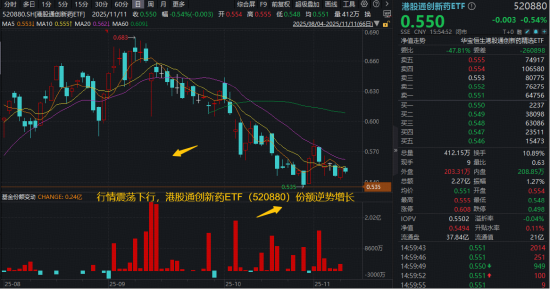
Zhong Guo Zheng Quan Bao· 2025-11-11 20:33
Core Viewpoint - The Chinese economy is expected to continue its recovery amidst fluctuations, supported by proactive fiscal policies and moderately loose monetary policies [1][5]. Group 1: Capital Market Development - The Chinese capital market has entered a new development phase, driven by global changes, technological trends, and institutional reforms [2]. - The restructuring of industries and finance globally presents opportunities for China, with a notable 7.1% year-on-year increase in exports in the first three quarters of this year [2]. - The resilience of Chinese manufacturing is highlighted, with local leading enterprises expected to transition into multinational giants, enhancing their pricing power [2]. Group 2: Technological Trends - The transition from old to new economic drivers, fueled by technology, is creating new opportunities in the capital market [3]. - Key technologies in China, such as artificial intelligence and biotechnology, are significantly developing, improving market risk appetite and attracting global capital [3]. - The market is shifting towards new development trends, with the electronic sector's market capitalization surpassing that of the banking sector this year [3]. Group 3: Institutional Reforms - The optimization of the institutional environment is expected to reshape the market ecosystem, enhancing the inclusiveness and adaptability of capital market systems [4]. - The focus will be on coordinating the development of investment and financing functions, with an emphasis on direct financing and supporting quality enterprises [4]. - There is a notable trend of converting household savings into investments, with significant room for increasing the proportion of residents' equity asset allocation [4]. Group 4: Economic Outlook - The Chinese economy is projected to achieve a growth target of around 5.0% in 2025 and maintain approximately 4.9% in 2026, with a "front low and back high" growth rhythm anticipated [5]. - Fiscal policies are expected to be more proactive, with a deficit ratio likely to remain around 4% and an increase in special bond quotas directed towards project construction [5]. - Monetary policy will continue to have room for adjustments, with structural monetary tools expected to remain effective [5]. Group 5: Asset Allocation - The global macro environment is generally loose, with attention needed on the changes in leading factors for bond market performance [5]. - The RMB exchange rate is expected to appreciate moderately, while gold remains an attractive long-term asset allocation option [5]. - The focus on activating domestic demand and upgrading industries is seen as a core direction for future policies [6]. Group 6: Investment Themes - The investment landscape is becoming clearer, with three main themes emerging: the revaluation of manufacturing pricing power, deepening international expansion of enterprises, and the continuation of the technology market [8][9]. - The manufacturing sector is expected to shift from scale expansion to pricing power and profit transformation, particularly in sectors like non-ferrous metals, chemicals, and new energy [9]. - The international expansion of enterprises is broadening, with a focus on sectors such as machinery, innovative pharmaceuticals, and military equipment [9].

中国资产迎红利时代聚焦三大主线投资机遇
Zhong Guo Zheng Quan Bao· 2025-11-11 20:10
Core Viewpoint - The Chinese economy is expected to continue its recovery amidst fluctuations, supported by proactive fiscal policies and moderately loose monetary policies [1][5]. Group 1: Capital Market Development - The Chinese capital market has entered a new development phase, driven by global changes, technological trends, and institutional reforms [2]. - The restructuring of industries and finance presents external opportunities for China, with a notable 7.1% year-on-year growth in exports during the first three quarters of this year [2]. - The resilience of Chinese manufacturing is highlighted, with local leading enterprises expected to transition into multinational giants, enhancing their pricing power [2]. Group 2: Technological Trends - The transition from old to new economic drivers, fueled by technology, is creating new opportunities in the capital market [3]. - Key technologies in China, such as artificial intelligence and biotechnology, are significantly improving market risk appetite and attracting global capital [3]. - The market is increasingly aligning with new economic developments, with the electronic sector's market capitalization surpassing that of the banking sector this year [3]. Group 3: Institutional Reforms - The optimization of the institutional environment is expected to reshape the market ecosystem, enhancing the inclusiveness and adaptability of capital market regulations [4]. - There is a notable trend of converting household savings into investments, with significant room for improvement in the allocation of residents' equity assets [4]. Group 4: Economic Outlook - The Chinese economy is projected to achieve a growth target of around 5.0% in 2025 and maintain approximately 4.9% in 2026, with a "front low, back high" growth pattern anticipated for 2026 [5][6]. - Fiscal policies are expected to remain proactive, with a deficit ratio around 4% and an increase in special bond quotas directed towards project construction [5]. - The monetary policy is likely to maintain a moderately loose stance, with potential for interest rate cuts and structural monetary tools [5]. Group 5: Investment Strategies - The A-share market is experiencing a sustained upward trend, with the focus shifting towards three main investment lines: the revaluation of manufacturing pricing power, deepening overseas expansion of enterprises, and the continuation of the technology market [7][8]. - The manufacturing sector is expected to transition from scale expansion to pricing power and profit conversion, particularly in sectors with high barriers to entry and low supply elasticity [7]. - The overseas expansion of Chinese enterprises is broadening, with key sectors including machinery, innovative pharmaceuticals, and military industry [8].
中信证券:资本市场积极动能正不断积累
Shang Hai Zheng Quan Bao· 2025-11-11 16:57
Group 1 - The theme of the 2026 Capital Market Annual Conference held by CITIC Securities is "Striving for a New Journey," focusing on the global macro landscape and market investment strategies [1] - CITIC Securities General Manager Zou Yingguang highlighted the increasing international discourse power of China and the rising position of Chinese enterprises in the global value chain, indicating a positive accumulation of momentum in the capital market [1] - The "14th Five-Year Plan" period will see new characteristics in the global context, technological trends, and institutional environment affecting China's capital market [1] Group 2 - CITIC Securities Chief A-share Strategy Analyst Qiu Xiang stated that A-share companies are transitioning from local enterprises to global multinational corporations, marking a shift from emerging to mature market status [2] - Qiu Xiang noted that the overall volatility of the A-share market is expected to enter a long-term downward trend due to various mechanisms, including increased participation of retail investors seeking stable returns [2] - The influence of social media and diverse public opinion is expected to mitigate the effects of collective investor behavior, reducing the likelihood of one-sided market movements [2] Group 3 - Three key themes for industry allocation in 2026 include: upgrading traditional manufacturing and resource industries to enhance profit margins, the globalization of Chinese enterprises opening new profit growth opportunities, and a new round of systematic trends in the technology sector driven by application changes [3] - CITIC Securities Chief Economist Ming Ming anticipates a "front low, back high" growth pattern for China's economy in 2026, with moderate fiscal expansion and improved local government finances [3] Group 4 - The economic structure in 2026 is expected to be primarily production-driven, with external and internal demand becoming more balanced [4] - Fiscal policy is projected to moderately expand, with an increase in special bond quotas for project construction, while monetary policy may see further easing with potential rate cuts [4] - The focus of industrial policy during the "14th Five-Year Plan" period will shift towards balancing supply and demand, enhancing service consumption and investment in emerging industries to boost domestic demand's contribution to GDP [4]
关注器械及药房板块的低估值反转标的:医药生物行业2025年11月投资策略
Guoxin Securities· 2025-11-11 14:19
Core Insights - The report emphasizes the investment strategy for the pharmaceutical and biotechnology industry, particularly focusing on undervalued stocks in the medical device and pharmacy sectors, which are expected to experience a valuation reversal [1][5]. - The overall investment rating for the sector is maintained at "outperform the market" [2]. Industry Overview - The pharmaceutical manufacturing industry showed a cumulative revenue of 18,211 billion yuan with a year-on-year decline of 2.0% for the first nine months of 2025 [8]. - The total profit for the industry during the same period was 2,535 billion yuan, reflecting a decrease of 0.7% [8]. - The retail sales of Western and Chinese medicines reached 535.1 billion yuan, with a growth of 1.3% year-on-year [8]. Sector Performance - In October 2025, the pharmaceutical sector experienced an overall decline of 1.83%, underperforming the CSI 300 index by the same margin [9]. - Among sub-sectors, the pharmaceutical commercial sector saw an increase of 2.81%, while the medical services sector faced a decline of 4.14% [14]. Investment Strategy - The report recommends focusing on low-valuation stocks in the medical device and pharmacy sectors, highlighting companies such as Weigao Group, Yifeng Pharmacy, and Mindray Medical [5]. - The CXO sector is identified as having global competitiveness, with a strong long-term growth trajectory [5]. Company Recommendations - The investment portfolio for November 2025 includes A-shares such as Mindray Medical, WuXi AppTec, and Yeye Medical, and H-shares like Kangfang Biologics and Kelun-Botai [5][6]. - Specific companies are highlighted for their growth potential, including WuXi AppTec, which is expected to see significant revenue growth in the coming quarters [5]. Regulatory Environment - The report tracks ongoing centralized procurement projects for medical devices, indicating a structured approach to managing costs and ensuring compliance within the industry [29].



国内首款治疗儿童白血病的CAR-T获批上市;没能“嫁入”A股上市公司 海纳医药递表港交所|掘金创新药
Mei Ri Jing Ji Xin Wen· 2025-11-11 13:35
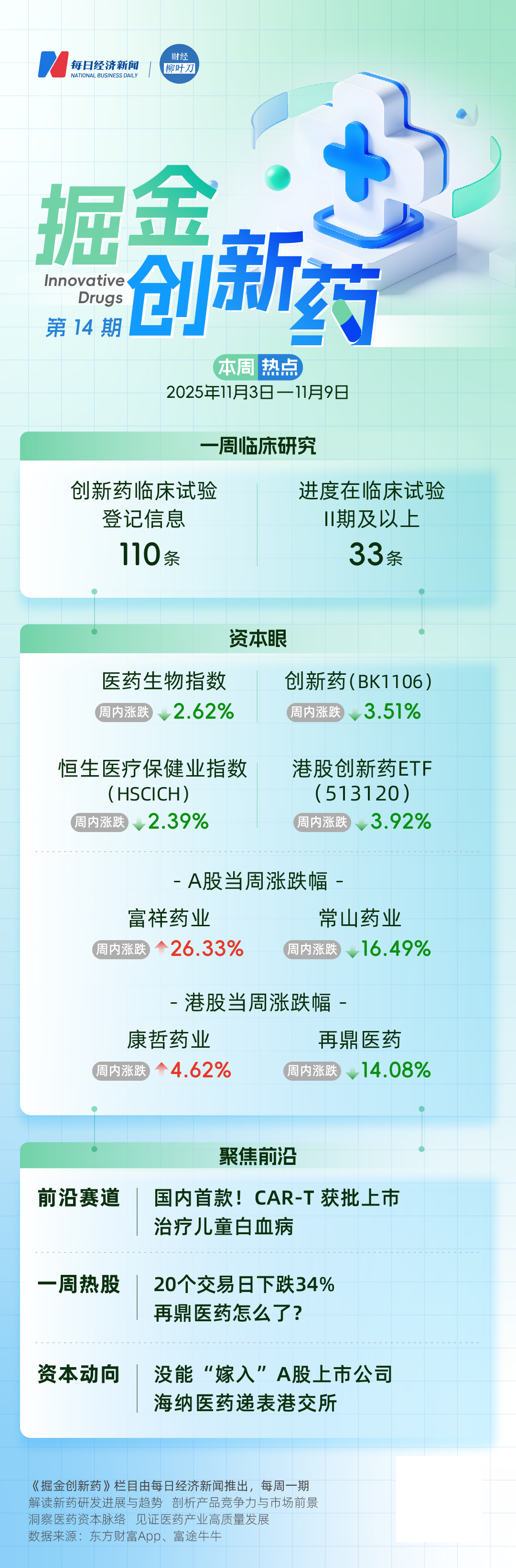
Market Performance - The pharmaceutical and biotechnology index declined by 2.62% from November 3 to November 7, underperforming the Shanghai Composite Index by 2.37 percentage points, marking seven consecutive weeks of underperformance [1] - The innovative drug sector (BK1106) fell by 3.51% during the week, while the Hang Seng Healthcare Index dropped by 2.39% and the Hong Kong innovative drug ETF (513120) decreased by 3.92% [1] Industry Commentary - After a strong rally, the innovative drug industry has entered a bubble-popping phase, with a return to rational investment not necessarily being negative for the sector. However, the current market adjustment appears excessive, with leading companies like Kangfang Biotech, Zai Lab, and Kelun-Biotech experiencing declines exceeding 30% [2] - Zai Lab's recent performance has been impacted by two public announcements: disappointing clinical data for its gastric cancer drug Bemarituzumab and a Q3 report showing total revenue of $116 million, a 14% year-on-year increase, but a net loss of $35.96 million, which is a narrowing of losses compared to the previous year. Revenue growth was primarily driven by sales of "Nusinersan" and "Dingyoule," offset by a slowdown in "Zele" sales [2] Short-term Outlook - In the short term, the innovative drug industry is undergoing emotional recovery and valuation reconstruction, with stock volatility heavily influenced by clinical data and earnings guidance. Zai Lab faces short-term emotional pressure due to the termination of a key clinical trial and downward adjustments in performance expectations. However, from a medium to long-term perspective, the innovative logic of the industry remains unchanged, with globally competitive pipeline assets being the core support for company valuations [3] IPO Developments - Nanjing Haina Pharmaceutical Technology Co., Ltd. has submitted an IPO application to the Hong Kong Stock Exchange, with CICC as the sole sponsor. This follows the termination of a major asset restructuring plan in June 2023, where Haina was to be acquired by Chengdu Xian Dao [4] - Haina Pharmaceutical, established in 2001, integrates drug research and manufacturing, providing CXO services and proprietary product pipelines. The company's revenue primarily comes from CXO services, with 398 ongoing CXO projects as of mid-2025 [4] Financial Performance - For 2024, Haina Pharmaceutical projects revenue of 425 million yuan, a year-on-year increase of 3.65%, but a net profit of 53.295 million yuan, reflecting a 27% decline, indicating a situation of "increased revenue but decreased profit." In the first half of the year, both revenue and net profit saw declines of 16.97% and 25.82%, respectively, attributed to a decrease in CRO service income and a 45.8% drop in sales of proprietary drugs [5] Clinical Trial Updates - From November 3 to November 7, the National Medical Products Administration disclosed 110 new clinical trial registrations, with 33 of these being innovative drugs in Phase II or above, primarily covering oncology, immunology, cardiovascular, and psychiatric fields [6] - Four innovative drugs were approved during the week [7] Notable Approvals - The first CAR-T therapy in China, Pucalunase injection (pCAR-19B), was approved for treating pediatric acute B lymphoblastic leukemia patients aged 3 to 21. This drug was previously included in breakthrough therapy and priority review categories [8] - Pucalunase is the fifth CD19 CAR-T product approved in China, following four others from various companies [9]


国内首款治疗儿童白血病的CAR-T获批上市;没能“嫁入”A股上市公司,海纳医药递表港交所|掘金创新药
Mei Ri Jing Ji Xin Wen· 2025-11-11 13:23
Group 1 - The core viewpoint of the article highlights the recent performance of the innovative drug sector, indicating a market correction phase after a strong rally, with significant declines in stock prices for leading companies like 康方生物 and 再鼎医药 [5][6][4] - The innovative drug index and related ETFs have shown declines, with the Hang Seng Healthcare Index down by 2.39% and the Hong Kong innovative drug ETF down by 3.92% over the week [4][5] - Recent clinical trial results for 再鼎医药's gastric cancer drug 贝玛妥珠单抗 were disappointing, leading to a halt in its clinical study due to insufficient efficacy [5][6] Group 2 - 海纳医药 has submitted an IPO application to the Hong Kong Stock Exchange after failing to complete a major asset restructuring to enter the A-share market [7][8] - The company primarily generates revenue from its CXO services, with 398 ongoing CXO projects as of mid-2025 [7] - 海纳医药's revenue for 2024 is projected at 425 million yuan, reflecting a year-on-year growth of 3.65%, but its net profit is expected to decline by 27% [8] Group 3 - The first CAR-T therapy for treating pediatric leukemia, 普基仑赛, has been approved for market release in China, marking a significant milestone in innovative drug development [13][12] - The approval of 普基仑赛 follows a series of clinical trials and regulatory reviews, emphasizing its potential in treating acute B-cell leukemia in children aged 3 to 21 [13][12] - The article notes that this is the fifth CD19-targeting CAR-T product approved in China, indicating a growing market for such therapies [14]
中金基金丁天宇:2026年创新医疗器械和创新药等投资机会值得关注
Zhong Zheng Wang· 2025-11-11 12:40
Core Viewpoint - The investment opportunities in the pharmaceutical industry for 2026 are highlighted, particularly in innovative medical devices, innovative drugs, and high-growth CXO and upstream life sciences companies [1] Group 1: Investment Opportunities - Innovative medical devices are identified as a focus area, contingent on performance alignment [1] - After a correction in innovative drugs, certain high-quality targets are recommended for attention [1] - High-growth CXO and upstream life sciences companies are also considered worthy of attention if they can maintain robust business growth [1] Group 2: Market Conditions - The pharmaceutical sector has been at a low point since peaking in 2021, presenting current investment opportunities [1] - Institutional investors may reallocate resources when the fundamentals of pharmaceutical companies improve and performance aligns [1] Group 3: Stock Selection Strategy - The company aims to identify and predict significant turning points in the lifecycle of industries and companies [1] - The strategy involves early market positioning to capture excess returns as industry and company values become recognized, leading to simultaneous performance and valuation increases [1] - A preference for innovative drug industry chains (CXO, upstream life sciences) as a high-probability offensive base, while positioning medical devices as a defensive allocation [1]

创新药行情结束了吗?中金基金丁天宇:未来仍值得关注
Zhong Zheng Wang· 2025-11-11 12:40
Group 1 - The core viewpoint is that the recent pullback in the innovative drug sector is due to previously high expectations and a decrease in catalytic events since Q3, leading to a reassessment of valuations [1] - The innovative drug sector had inflated market valuations for early-stage clinical projects, with several business development (BD) projects expected to exceed $5 billion, which have now been delayed or underperformed [1] - Despite the current pullback, the innovative drug sector remains a key area of interest, but companies need to be selected carefully, and valuations are expected to become more rational [1] Group 2 - Outside of innovative drugs and their supply chain, other sectors within the pharmaceutical industry have relatively low valuations, indicating potential investment opportunities as fundamentals improve [1]
医药生物行业2025年11月投资策略:关注器械及药房板块的低估值反转标的
Guoxin Securities· 2025-11-11 12:40
Core Insights - The report emphasizes the investment strategy for the pharmaceutical and biotechnology industry, focusing on undervalued targets in the medical device and pharmacy sectors, which are expected to experience a valuation reversal [1][5]. - The overall investment rating for the sector is maintained at "outperform the market" [2]. Industry Performance Review - The pharmaceutical industry experienced a decline of 1.83% in October, underperforming the CSI 300 index by the same margin [9]. - The medical manufacturing sector reported a cumulative revenue of 1.8211 trillion yuan, down 2.0% year-on-year, with a total profit of 253.5 billion yuan, a decrease of 0.7% [8]. Sector Analysis - The report categorizes the CXO sector into three segments: CDMO, preclinical and clinical CRO, and generic drug CXO, highlighting the growth potential in each area [5]. - The CDMO segment shows promising growth with significant increases in new orders and emerging business areas such as peptides and oligonucleotides [5]. - The preclinical and clinical CRO segment is recovering with new order prices showing an upward trend [5]. - The generic drug CXO segment is facing challenges due to a reduced number of MAH clients and is actively seeking new growth points through innovation [5]. Investment Strategy - The report recommends focusing on undervalued medical device and distribution stocks, as well as the long-term positive trend in innovative drugs and their supply chains [5]. - A specific investment portfolio for November 2025 includes companies such as Mindray Medical, WuXi AppTec, and Aier Eye Hospital, among others [5][6]. Recent Developments - In October 2025, six innovative drugs or biosimilars were approved for market entry, indicating a robust pipeline for the industry [23][24]. - The report tracks ongoing centralized procurement initiatives for medical devices, which are expected to impact pricing and market dynamics [29]. Valuation Insights - The overall valuation of the pharmaceutical sector is currently at a PE (TTM) of 38.80, which is at the 81.52% historical percentile over the past five years, indicating a relatively high valuation compared to historical averages [17].
创新药震荡不止,资金却坚定逆行,什么原因?港股通创新药ETF(520880)基金经理最新解读来了!
Xin Lang Ji Jin· 2025-11-11 12:09
Core Viewpoint - The current adjustment in the innovative drug sector may still be in a bottoming phase, with mixed performance observed in the Hong Kong Stock Connect Innovative Drug ETF (520880) since November, indicating a lack of sustained momentum [1][5]. Fund Performance - The Hong Kong Stock Connect Innovative Drug ETF (520880) has seen a significant increase in both share count and fund size, with the fund size surpassing 2 billion yuan for the first time on November 3, marking a 392% increase since its launch on July 7 [3]. - As of November 10, the fund's share count reached 3.784 billion, setting a new record since its inception [3]. Market Analysis - The current market adjustment has been substantial in both time and price, with historical data indicating that the average correction duration for the innovative drug index is 30-40 days, with a typical decline of around 20% [5]. - Recent performance of leading innovative drug companies, such as BeiGene and CanSino Biologics, has shown strong earnings, suggesting a continued positive trend in the industry [5]. Investment Strategy - The fund manager emphasizes that the innovative drug market may soon rebound, suggesting that the current phase presents a high probability of success for investors [5]. - The upcoming year-end is expected to be an active period for mergers and acquisitions in the U.S. biopharmaceutical sector, along with the JPMorgan Healthcare Conference in early January, which could serve as catalysts for the market [6]. ETF Characteristics - The Hong Kong Stock Connect Innovative Drug ETF (520880) is the first ETF tracking the Hang Seng Hong Kong Stock Connect Innovative Drug Select Index, which has three key advantages: it is purely focused on innovative drugs, has a high concentration of leading companies, and offers better risk control by reducing the weight of less liquid stocks [6][7]. - The top ten holdings in the ETF account for over 71% of the total weight, highlighting the dominance of leading companies in the innovative drug sector [8].