
鞋类

Search documents
ABG否认出售锐步给安踏;千名GUCCI员工威胁罢工;Crocs股价大跌30%|品牌周报
36氪未来消费· 2025-08-10 07:26
Group 1: ABG and Reebok - Authentic Brands Group (ABG) denies rumors of selling Reebok to Anta, stating no plans to divest the brand now or in the future [3] - Reebok, acquired by Adidas for $3.8 billion in 2006, has struggled to compete in the North American market, leading to its eventual sale to ABG for $2.5 billion in 2021 [4][5] - ABG's initial forecast for Reebok's global retail sales to reach $5 billion in 2023 has been exceeded, with a target of $10 billion by 2027 [5] Group 2: Labor Issues at Gucci - Approximately 1,000 Gucci employees in Italy threaten to strike over the refusal of parent company Kering to pay bonuses for 2022-2024 [6] - This labor dispute comes at a sensitive time for Gucci, which is facing declining sales and is under new CEO Luca de Meo's leadership [7] Group 3: Crocs Financial Struggles - Crocs' stock plummeted by 29.2% after the company projected a 9%-11% decline in Q3 revenue, marking its lowest stock price in nearly three years [8] - The company reported a nearly $500 million net loss in Q2, largely due to a $700 million goodwill impairment from its $2.5 billion acquisition of HEYDUDE [8] - Rising tariffs are expected to increase costs by $40 million in the second half of 2025, further challenging Crocs' low-cost business model [8] Group 4: Ralph Lauren's Growth - Ralph Lauren's quarterly revenue exceeded Wall Street expectations, with projected sales growth of low to mid-single digits for the fiscal year [19] - Sales in Asia and Europe saw double-digit growth, while North America grew by 8%, with China showing the highest growth at 30% [19] Group 5: Anta's Joint Venture with Musinsa - Anta has formed a joint venture with Korean e-commerce platform Musinsa, with Anta holding 40% and Musinsa 60% [22] - Musinsa aims to open over 100 stores in China by 2030, with the first store set to launch in Shanghai in Q4 of this year [22]



洞洞鞋一夜崩盘!CEO说美国人不买了,30%股价蒸发背后的真相
Sou Hu Cai Jing· 2025-08-10 01:23
Core Viewpoint - Crocs, once a leading brand in the footwear industry, is now facing unprecedented challenges, with a significant drop in revenue growth and a sharp decline in stock price, indicating a loss of consumer interest and market position [1][3]. Company Summary - In Q1 2025, Crocs' revenue growth plummeted from 14.6% to 2.4%, with negative growth reported in the North American market [1]. - The company's stock price fell nearly 30% in a single day, resulting in a market capitalization loss of over $1.7 billion [1]. - Crocs achieved sales of 120 million pairs and a profit of $793 million in 2023, showcasing its previous success [1]. - The company’s acquisition of the brand HEYDUDE for $2.5 billion in 2022 has led to a significant write-down, with a net loss of $490 million in Q2, exceeding half of its annual profit [7]. - Crocs is struggling with high inventory levels and declining consumer interest, particularly in physical retail channels [3][9]. Industry Summary - The footwear industry is experiencing a downturn, with 87% of shoe company executives expecting continued economic deterioration and 85% anticipating weak consumer demand [9]. - Sales in U.S. shoe stores fell by 8% year-on-year in January 2025, marking the 21st decline in 23 months [9]. - Competitors like Anta and Daphne are adapting by relocating production to reduce costs and leveraging social media for sales, while Crocs is caught in a dilemma between maintaining brand image and reducing prices [9]. - The economic pressures are affecting all segments, with low-income consumers cutting back on spending even in fast food [3].
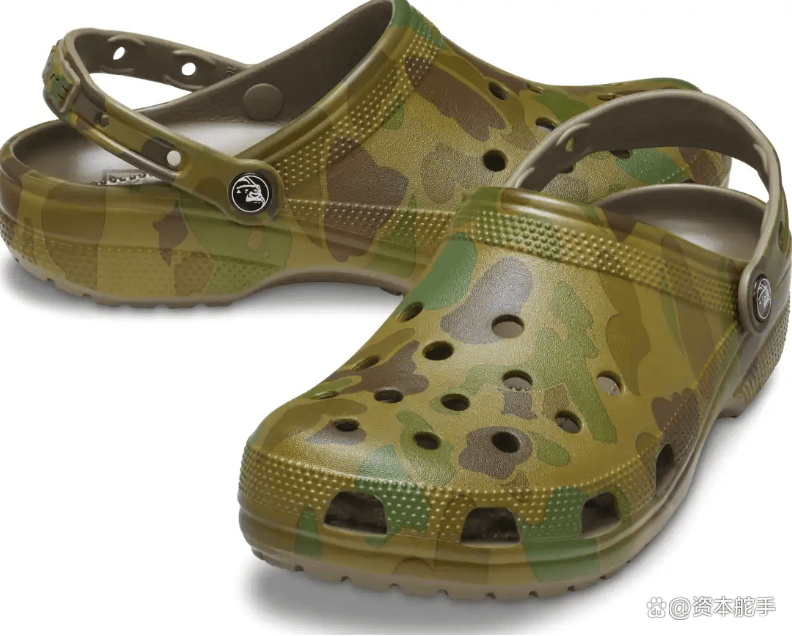
突然卖不动了?知名品牌股价暴跌近30%,曾一年卖出超1.2亿双鞋
凤凰网财经· 2025-08-09 12:39
Core Viewpoint - Crocs is experiencing a significant decline in sales, with a projected revenue drop of 9% to 11% for Q3, leading to a nearly 30% drop in stock price, marking a critical moment for the company [1][3]. Group 1: Company Performance - Crocs achieved a record sales figure in 2023, selling 120 million pairs and generating $3.962 billion in revenue, an 11.46% year-over-year increase, with a net profit of $793 million, reflecting a 46.73% increase [3]. - However, the growth rate has been consistently slowing, with revenue growth rates projected to decline from 14.6% to 2.4% over the next year [3]. Group 2: Consumer Behavior - The CEO of Crocs indicated that American consumers are tightening their spending on non-essential items, leading to decreased foot traffic and a cautious approach to potential price increases [3]. - This trend reflects a broader cooling in the consumer market, particularly affecting price-sensitive groups [3]. Group 3: Competitive Landscape - The market for "洞洞鞋" (Croc-style shoes) is becoming increasingly competitive, with various brands like Skechers, Kappa, and others entering the space, offering a range of styles and price points [4]. - Consumers now have multiple options beyond Crocs, with some opting for more affordable alternatives or brands that offer unique designs [4].
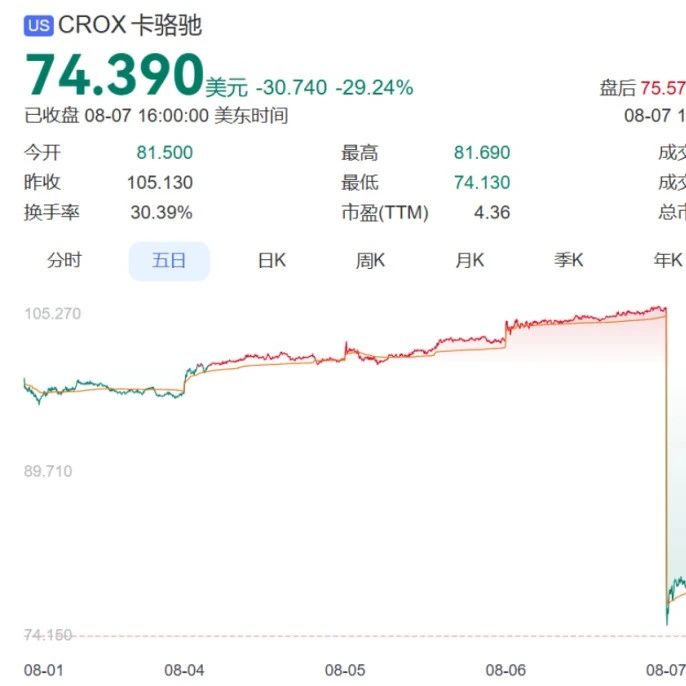
“洞洞鞋”突然卖不动了?知名品牌股价暴跌近30%
Huan Qiu Wang Zi Xun· 2025-08-08 14:40
Core Insights - Crocs, the manufacturer of "Croc shoes," has projected a revenue decline of 9% to 11% year-over-year for Q3, leading to a nearly 30% drop in stock price, reaching a three-year low of $74.39, with a total market value of $4.171 billion [1][2] Revenue Growth Trends - Crocs was founded in 2002 and initially targeted sailing and outdoor enthusiasts, launching its first Croc shoe that same year, which quickly expanded to over 40 countries [2] - In 2023, Crocs achieved a record sales figure of 120 million pairs, generating $3.962 billion in revenue, an 11.46% increase year-over-year, with a net profit of $793 million, reflecting a 46.73% growth [2] - However, revenue growth has been slowing, with year-over-year growth rates for the main brand declining from 14.6% to 2.4% from Q1 2024 to Q1 2025 [2] Market Dynamics - CEO Andrew Rees noted that U.S. consumers are cautious with discretionary spending, leading to decreased foot traffic, particularly affecting wholesale and outlet sales, compounded by concerns over potential price increases [3] - The market for "Croc shoes" is becoming increasingly competitive, with various brands like Skechers, Kappa, and others entering the space, offering a range of styles and price points, making Crocs no longer the sole option for consumers [4]
南京市市场监管局发布童鞋产品抽查结果
Zhong Guo Zhi Liang Xin Wen Wang· 2025-08-08 08:26
Summary of Key Points Core Viewpoint - The Nanjing Municipal Market Supervision Administration has released the results of the first batch of product quality supervision inspections for 2025, indicating that out of 20 batches of children's shoes inspected, 1 batch was found to be non-compliant with quality standards [1]. Group 1: Inspection Results - A total of 20 batches of children's shoes were inspected, with only 1 batch failing to meet quality standards [1]. - The non-compliant product was identified as a children's running shoe from Jinjiang Dahuangfeng Sports Goods Co., which failed the abrasion resistance test [2]. - The remaining 19 batches of children's shoes, including brands like Anta and Skechers, passed the quality inspection without any issues [2]. Group 2: Compliance Details - The non-compliant batch was sourced from a retail store in Nanjing's Liuhe District, while the compliant products were sourced from various retailers and manufacturers, including well-known brands [2]. - The inspection covered various types of children's footwear, including running shoes, casual shoes, and outdoor shoes, ensuring a comprehensive assessment of product quality in the market [2].
卡骆驰CEO:美国消费者在非必需品支出方面非常谨慎
Ge Long Hui A P P· 2025-08-08 02:44
Core Viewpoint - Crocs, the manufacturer of "Croc" shoes, has issued a disappointing earnings outlook, leading to a 29.2% drop in stock price, reaching a three-year low and marking the largest single-day decline since October 2011 [1] Company Summary - CEO Andrew Rees indicated that U.S. consumers are being very cautious with discretionary spending, resulting in decreased store traffic and lower sales [1] - The impact of cautious consumer behavior is expected to be most severe in wholesale and outlet businesses, which are more reliant on low-income consumers [1] - Potential price increases may further reduce consumer willingness to spend [1]
暴跌近30%!“洞洞丑鞋”卖不动了,Crocs CEO:美国客户不买东西了,甚至不去商店
美股IPO· 2025-08-08 01:10
Core Viewpoint - Crocs is facing significant challenges due to a disappointing earnings outlook and a pessimistic assessment of U.S. consumer spending, leading to a sharp decline in stock price and a decrease in customer traffic [1][2][3] Group 1: Earnings Outlook and Stock Performance - After releasing a disappointing earnings forecast, Crocs' stock plummeted by 29.2%, reaching its lowest point in nearly three years, marking the heaviest single-day loss since October 2011 [2] - The company warned that third-quarter revenue is expected to decline by 9% to 11% year-over-year, contrasting with analysts' expectations of slight growth [2] Group 2: Consumer Behavior and Market Trends - Crocs' CEO Andrew Rees noted that U.S. consumers are being very cautious with non-essential spending, leading to a decline in store traffic [5] - The management indicated that the impact will be most severe in wholesale and outlet channels, which cater to lower-income consumers [5] - The broader consumer market is experiencing a downturn, with reports indicating that lower-income customers are cutting back on fast food consumption to save money [6] Group 3: Fashion Trends and Competition - The "ugly shoe" trend that previously boosted Crocs' growth is reportedly cooling off, with a resurgence of athletic footwear styles [7] - Rees acknowledged that consumer tastes are changing, and upcoming major sporting events may favor traditional athletic brands like Nike and Adidas, increasing competition for Crocs [8] Group 4: Financial Challenges and Tariff Impacts - Crocs reported a net loss of $492.3 million for the second quarter, primarily due to over $700 million in impairment related to the $2.5 billion acquisition of the casual shoe brand HEYDUDE [9][10] - Despite a 3.4% year-over-year revenue growth to $1.1 billion, the significant loss highlights challenges in business integration and value assessment [10] - Tariff policies are expected to impact the company significantly, with projected costs of approximately $40 million in the second half of 2025 and up to $90 million annually [11]
美对印关税再增至50%,已落后的印度股市会面临新调整吗?
Di Yi Cai Jing· 2025-08-07 08:07
Group 1: Tariff Impact - The U.S. has announced an additional 25% tariff on imports from India, raising the total tariff rate to 50%, making India one of the countries with the highest tariffs imposed by the U.S. [1] - Analysts predict that the Indian stock market will face adjustment pressure, particularly in sectors such as oil, pharmaceuticals, textiles, footwear, and jewelry, which are expected to be the most affected [1][4] Group 2: Market Reaction - The Indian benchmark SENSEX index opened lower but quickly rebounded, stabilizing with a decline of about 0.2%, while the Nifty 50 index also showed a similar pattern [3] - Market participants believe the initial muted response may be due to expectations that India has sufficient time for negotiations, with some analysts suggesting the tariff increase may be more symbolic than substantive [3][4] Group 3: Long-term Outlook - If the trade relationship with the U.S. deteriorates, especially amid slowing economic growth, investors may adopt a cautious long-term outlook on the Indian stock market [4] - Foreign investors sold $2 billion worth of Indian stocks in July and an additional $900 million in August, indicating a trend of withdrawal from the Indian market [4] Group 4: Sector-Specific Impacts - Approximately 20% of India's export goods (accounting for 2% of GDP) are directed towards the U.S., with sectors like gems and jewelry, apparel, footwear, textiles, and chemicals being the most vulnerable [6] - The pharmaceutical sector, despite being perceived as resilient, has seen significant declines, with the NSE Nifty pharmaceutical index breaking key technical support levels [7]

美对印关税再增至50%,已落后的印度股市会面临新调整吗?这些板块最受打击
Di Yi Cai Jing· 2025-08-07 07:42
Group 1 - Analysts believe that the Indian stock market will face adjustment pressure due to the U.S. imposing an additional 25% tariff on Indian imports, raising the total tariff rate to 50% [1][4] - The sectors most affected include oil, pharmaceuticals, textiles, footwear, and jewelry, as these industries are closely tied to U.S. trade [1][6] - Foreign investors sold $2 billion worth of Indian stocks in July and an additional $900 million in August, indicating a trend of capital outflow amid rising uncertainties [4][5] Group 2 - The Indian economy has approximately 20% of its export goods (2% of GDP) directed towards the U.S., making it vulnerable to the new tariffs [6] - The pharmaceutical sector has seen significant declines, with the NSE Nifty pharmaceutical index breaking key technical support levels, indicating potential further declines [7] - Companies like Reliance Industries may face pressure if India succumbs to U.S. demands to limit oil purchases from Russia, which could impact refining margins [6]

中消协:2025年上半年家具商品投诉量为19760件,同比增加36.79%
Cai Jing Wang· 2025-08-07 03:52
Core Insights - The National Consumer Association reported a total of 995,971 consumer complaints in the first half of 2025, representing a year-on-year increase of 27.23% [1] - A total of 509,655 complaints were resolved, resulting in a recovery of economic losses amounting to 452 million yuan for consumers [1] - The number of consumer visits and consultations reached 330,000 [1] Complaint Categories - The top five categories for consumer complaints were clothing, communication products, ordinary food, shoes, and daily miscellaneous goods [1] - Compared to the first half of 2024, there was a significant increase in complaints for daily miscellaneous goods, shoes, and clothing [1] - Furniture complaints ranked ninth, with a total of 19,760 complaints, which is a 36.79% increase from 14,445 complaints in the first half of 2024 [1]