
Securities

Search documents
长江证券: 长江证券股份有限公司公司债券2024年度受托管理事务报告
Zheng Quan Zhi Xing· 2025-06-25 18:16
Group 1 - The report outlines the bond management situation of Changjiang Securities Co., Ltd., including the issuance and management of perpetual subordinated bonds [1][2] - As of the end of 2024, the company has issued two bonds: 23 Changjiang Y1 and 24 Changjiang Y1, with issuance scales of 2.5 billion and 2 billion respectively [2][3] - The initial coupon rates for these bonds are 4.59% and 3.10%, with annual interest payments unless the issuer opts for deferred interest payments [3][4] Group 2 - The report indicates that the issuer's total assets as of the end of 2024 are approximately 171.77 billion, showing a slight increase of 0.61% from the previous year [7] - The total liabilities decreased by 2.57% to approximately 132.46 billion, while total equity increased by 13.05% to approximately 39.31 billion [7][8] - The issuer's net profit for 2024 is reported at approximately 1.84 billion, reflecting a 19.19% increase compared to the previous year [7][8] Group 3 - The report highlights that the issuer has maintained stable cash flow and profitability, with an EBITDA interest coverage ratio of 2.37, up 32.40% from the previous year [8] - The issuer has a debt issuance approval scale of 17.5 billion, indicating potential for future financing [8][9] - The report confirms that the issuer's bond repayment plans and guarantees have not undergone significant changes during the reporting period [9][10] Group 4 - The report details that the issuer has successfully completed interest payments for the previous year on March 25, 2024, without any defaults [11][12] - The issuer has established a special account for managing raised funds, ensuring compliance with the intended use of funds [8][9] - The report states that there were no significant changes in the issuer's credit enhancement mechanisms or repayment capabilities during the reporting period [9][12]

药康生物: 关于注销及开立募集资金理财产品专用结算账户的公告
Zheng Quan Zhi Xing· 2025-06-25 16:59
Core Viewpoint - The company has announced the cancellation of a special settlement account for fundraising financial products and the establishment of new accounts for cash management of excess and idle fundraising funds, ensuring compliance with relevant regulations and maintaining the safety and efficiency of fund utilization [2][3][5]. Group 1: Cancellation of Special Settlement Account - The company has completed the cancellation of the special settlement account for fundraising financial products at Huatai Securities, as all purchased financial products have matured and been redeemed [3]. - The account details for cancellation include the account number 666810028046 at Huatai Securities [3]. Group 2: Establishment of New Accounts - The company has opened new special settlement accounts for fundraising financial products at Shenwan Hongyuan Securities and CITIC Securities [3]. - These accounts will be used exclusively for cash management of excess and idle fundraising funds and will not be used for non-fundraising purposes [3]. Group 3: Cash Management and Risk Control - The company plans to use part of the excess and idle fundraising funds for cash management, ensuring that it does not affect the normal operation of fundraising investment projects [5]. - The company will adhere to relevant regulations and implement strict risk control measures, including monitoring product performance and taking timely actions if adverse factors are identified [4]. Group 4: Impact on the Company - The cash management of excess and idle funds is expected to improve the efficiency of fund utilization and generate certain financial returns for the company and its shareholders [5]. - The company assures that this action will not change the intended use of fundraising funds or affect the normal development of its main business [5].

国泰海通|非银:陆家嘴论坛深化改革,重视非银权重股机会
国泰海通证券研究· 2025-06-25 15:12
Group 1 - The article emphasizes the importance of deepening capital market reforms and enhancing Shanghai's status as an international financial center, particularly during the Lujiazui Forum where significant policies were introduced [1] - The securities industry is expected to benefit from the expansion of the Sci-Tech Innovation Board and the increase in hard technology companies, which will drive growth in investment banking and M&A activities, as well as cross-border investment and financing demands [1] - In a stable stock market environment, there is a recommendation to focus on undervalued and underrepresented blue-chip stocks, shifting from a marginal thinking approach to a total risk-reward perspective for non-bank blue-chip stocks [1] Group 2 - Recent policies encouraging red-chip and H-shares to return to A-shares are expected to particularly benefit non-bank blue-chip stocks in the Hong Kong market [1] - In the fintech sector, companies with promising growth in their semi-annual reports are recommended for attention, especially in the consumer finance and financial information services industries [1] - The third-party payment sector is anticipated to experience valuation recovery opportunities due to the ongoing catalyst of stablecoin-related policies [1]


摩根士丹利:中国金融-对金融股的又一温和利好
摩根· 2025-06-25 13:03
June 22, 2025 02:01 PM GMT China Financials | Asia Pacific Payment Connect another modest positive for financials Key Takeaways Another step in accelerated financial opening up: This follows the recent top financial regulators' discussion on opening up at the Lujiazui Forum, and facilitates more efficient cross-border current account payments between HK and China residents. Another small positive for financial names particularly AIA, HKEX and FUTU: Considering the rate differences between Mainland China and ...
就在今天|国泰海通海外科技投资峰会·北京场闭门
国泰海通证券研究· 2025-06-25 10:39
重要提醒 本订阅号所载内容仅面向国泰海通证券研究服务签约客户。因本资料暂时无法设置访问限制,根据《证 券期货投资者适当性管理办法》的要求,若您并非国泰海通证券研究服务签约客户,为保证服务质量、 控制投资风险,还请取消关注,请勿订阅、接收或使用本订阅号中的任何信息。我们对由此给您造成的 不便表示诚挚歉意,非常感谢您的理解与配合!如有任何疑问,敬请按照文末联系方式与我们联系。 更多国泰海通研究和服务 亦可联系对口销售获取 ...

80亿,佛山禅城发布“1+1”产业基金体系
FOFWEEKLY· 2025-06-25 10:17
Core Viewpoint - The article discusses the establishment of the "1+1" industrial fund system in Zhancheng District, Foshan, aimed at fostering new productive forces and enhancing the competitiveness of the urban center through a combination of government and state-owned enterprise funds [1][2]. Summary by Sections Industrial Fund System - The "1+1" industrial fund system consists of the Foshan Zhancheng Industrial Innovation Development Investment Fund (Qihang Fund) and the Foshan Zhancheng Linghang Equity Investment Fund (Linghang Fund), designed to leverage government investment and the flexibility of state-owned enterprise funds [1][2]. - The goal is to establish an industrial fund system with a total scale of no less than 8 billion yuan within 8 years, utilizing a market-oriented approach combined with policy guidance [1]. Qihang Fund - The Qihang Fund is a government investment fund with a total scale of 2 billion yuan, initially contributing 250 million yuan, focusing on advanced manufacturing, modern services, industrial transformation mergers and acquisitions, and technological innovation [1][2]. - It aims to accelerate the local high-level technological entrepreneurship and innovation ecosystem by investing early and in small amounts in technology [1]. Linghang Fund - The Linghang Fund is a state-owned enterprise fund with a total scale of 3 billion yuan, with an initial contribution of 1 billion yuan, focusing on direct investments and supporting traditional industries' transformation and enhancement [2][3]. - It aims to cultivate and strengthen emerging urban industries and invest in key links of local industrial chains [2]. Advantages of Zhancheng - Zhancheng has expanded its industrial space significantly, with plans to complete 10 million square meters of high-quality industrial space this year, and has prepared over 3,149 acres of industrial land [3]. - The district benefits from comprehensive advantages, including integrated urban functions and lower costs for innovation elements, which help attract and retain talent [3]. - The industrial fund focuses on four centers: urban manufacturing, industrial services, commercial consumption, and Lingnan culture, aiming to create a balanced and vibrant modern industrial system [3]. Collaborative Efforts - Several banks and securities firms have signed cooperation agreements with Zhancheng to support the fund system and address financing challenges for innovative enterprises [4]. - The district plans to implement a "four-way linkage" strategy to create a unique industrial ecosystem, enhancing collaboration among various stakeholders [4].

机构:2025年下半年美债需求或现结构性分化
Huan Qiu Wang· 2025-06-25 05:39
Core Viewpoint - Huatai Securities recently released a research report on U.S. Treasury bonds, analyzing the characteristics and behavioral logic of U.S. Treasury investors from the demand side, and forecasting the market supply-demand pattern for the second half of 2025 [1][4]. Investor Structure and Behavior - Global investors currently hold over $26 trillion in U.S. Treasury bonds, with international and overseas investors holding $8.6 trillion, accounting for 33% of total holdings, making them the largest buyers [3]. - Broad-based mutual funds hold $5 trillion, representing nearly 20% of the total, while the Federal Reserve is projected to hold $3.8 trillion by the end of 2024, accounting for about 15% [3]. - The combined holdings of these three categories consistently exceed 60% [3]. - Other investors include individual investors, commercial banks, state and local governments, pension funds, and insurance companies, ranked by their holding sizes [3]. Motivations and Strategies - The Federal Reserve, as a policy-driven institution, primarily uses medium to long-term bonds, with its buying and selling actions directly linked to balance sheet adjustment goals [3]. - Overseas official institutions' bond purchasing decisions are influenced by factors such as exchange rates, trade balance, and financial stability, often showing a negative correlation with the U.S. dollar index [3]. - Private sector investors tend to engage in carry trades for returns, while U.S. residents exhibit a "buy high, sell low" behavior, dynamically reallocating between stocks and bonds [3]. - Hedge funds prefer basis trading strategies, while commercial banks' bond purchases are significantly affected by loan-to-deposit ratios and maturity structures [3]. Future Outlook - The report anticipates that the Federal Reserve may conclude its balance sheet reduction process by the end of the year and potentially halt its reduction of U.S. Treasury holdings [4]. - Overseas official institutions are expected to have limited motivation to reduce holdings in a weak dollar environment, although the declining attractiveness of U.S. Treasuries as a safe asset poses a significant risk [4]. - Private institutions face pressure from dollar depreciation, which could diminish the yield advantage of U.S. Treasuries if they engage in currency hedging [4]. - U.S. residents are less likely to significantly increase their allocation to U.S. Treasuries due to the relative attractiveness of U.S. equities [4]. - Demand from commercial banks is expected to improve, benefiting from steady deposit growth, a steepening yield curve, and potential loosening of supplementary leverage ratio (SLR) rules [4]. - Pension funds and mutual funds are projected to maintain stable growth in holdings, driven by asset allocation needs and market preference trends [4]. - Huatai's team believes that the U.S. Treasury market will exhibit structurally differentiated demand characteristics in the second half of 2025, with policy adjustments, exchange rate fluctuations, and asset allocation shifts being key variables [4].


收益互换基础知识丨收益互换的作用(1):风险管理
Sou Hu Cai Jing· 2025-06-25 02:50
Core Viewpoint - The article emphasizes the importance of yield swaps as a flexible and customizable financial tool for risk management and asset allocation in capital markets, aiming to enhance understanding among investors [1][2]. Group 1: Risk Management - Yield swaps serve as a sophisticated financial derivative that provides qualified institutional investors with risk management and asset allocation services [2]. - They help manage market risks associated with underlying asset prices, such as controlling entry costs and reducing price volatility risks [2]. - For entities with hedging needs, yield swaps can create positions that counterbalance the spot market, allowing for effective risk hedging across different markets and timeframes [2][3]. Group 2: Customization and Flexibility - Yield swaps are characterized by high customization, allowing investors to tailor contract terms such as duration, scale, asset class, and transaction direction to meet specific risk management needs [3]. - This customization enables precise risk management, balancing risk and return in complex environments, unlike standardized futures contracts which may not meet diverse investor requirements [3]. Group 3: Comprehensive Risk Management Solutions - Securities firms can leverage yield swap services to address domestic and international risk management needs, offering integrated services from trading to risk control and settlement [4]. - Companies facing various risks, such as raw material price fluctuations and interest rate changes, can utilize yield swaps to lock in costs and profits, mitigating adverse impacts on operational performance [4]. Group 4: Diversification and Stability - Yield swaps facilitate cross-market and cross-product asset allocation, promoting risk diversification and enhancing portfolio stability [5]. - By linking to diverse global assets, including stocks, bonds, and commodities, yield swaps help reduce concentration risk associated with single market investments [5]. - The unique risk-return characteristics of different linked assets can provide a buffering effect during market volatility, thereby improving overall portfolio resilience [5].
收益互换基础知识丨收益互换合约要素
Sou Hu Cai Jing· 2025-06-25 02:45
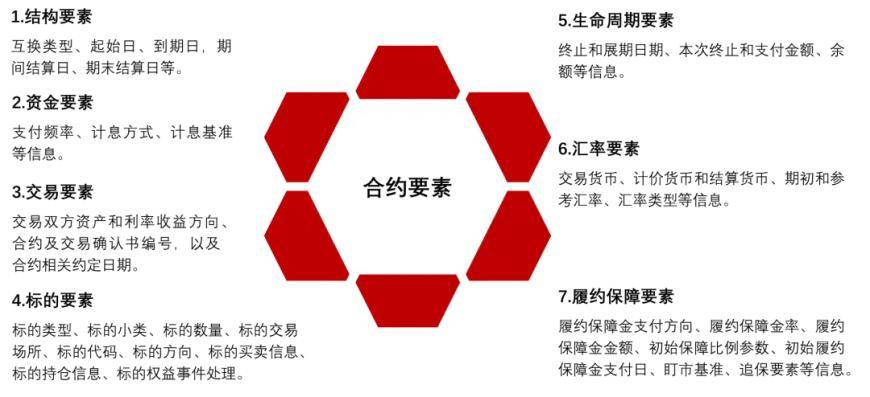
Core Viewpoint - The article emphasizes the importance of yield swaps as a significant financial tool in capital markets, providing risk management and asset allocation services across various markets and products. It aims to enhance understanding of yield swaps among investors by introducing fundamental concepts, applications, and risk characteristics [1]. Summary by Relevant Sections Contract Elements Introduction - Structural elements form the basis of the contract between parties and are essential components of the complete contract system [3]. - Funding elements define the cash flow of the contract, including fixed, floating, and enhanced interest rate payment frequencies and calculation methods [3]. - Transaction elements include basic information agreed upon by both parties at the time of contract signing [3]. - Underlying elements refer to the basic information of the assets linked to the contract, including type, name, code, and quantity [3]. - Lifecycle elements cover the contract's duration from signing to termination, including terms, scale, and cash flow delivery [3]. - Exchange rate elements address situations where transaction, pricing, and settlement currencies differ, with pre-agreed exchange rates [3]. - Performance guarantee elements involve the payment of performance guarantees and related parameters to ensure that the guarantee remains above a certain baseline throughout the transaction, reducing costs and risks [3]. Example of Yield Swap Contract - An example of a yield swap contract linked to stocks on the Hong Kong Stock Exchange is provided, detailing the main elements that would be included in a transaction confirmation document [4]. - The example specifies a long yield swap with a start date of April 8, 2025, and an end date of April 8, 2026, with monthly payment frequency [5]. - Funding elements include a floating interest rate based on the 3-month Hong Kong Interbank Offered Rate (HIBOR), with interest calculated and settled monthly [5]. - Transaction elements specify that the investor pays interest to the dealer, with a unique transaction confirmation number [5]. - Underlying elements include equity-type assets, with a specified stock code and quantity, and provisions for handling cash dividends [5]. - Lifecycle elements outline the dates and amounts related to termination and extension of the transaction [5]. - Exchange rate elements clarify that the transaction and pricing currencies are both Hong Kong dollars, while the settlement currency is Renminbi, with reference exchange rates provided [5]. - Performance guarantee elements include a maintenance line of 50%, with daily market monitoring to manage risks associated with foreign exchange fluctuations [5].
关于新增长江证券为万家稳宁债券型证券投资基金销售机构的公告
Zhong Guo Zheng Quan Bao - Zhong Zheng Wang· 2025-06-25 00:33
Group 1 - The company has signed a sales agreement with Changjiang Securities to start selling the Wanjia Stable Ning Bond Fund from July 7, 2025 [1] - The fund will be publicly offered from July 7 to July 25, 2025, through designated sales institutions [1] - Investors can open accounts and subscribe to the fund through Changjiang Securities, and can also perform other operations like redemption and regular investment after the fund is established [1] Group 2 - The company announced an adjustment of the main liquidity service provider for certain funds, effective June 23, 2025 [3] - The Wanjia CSI Semiconductor Materials and Equipment Theme ETF will have Guotai Haitong Securities as its new general liquidity service provider [3]