
电子

Search documents
齐鲁跃过10万亿
Zhong Guo Jing Ying Bao· 2026-01-09 09:09
Core Viewpoint - Shandong Province is projected to surpass a GDP of 10 trillion yuan by 2025, becoming the third province in China and the first in Northern China to achieve this milestone, indicating its significant role as an economic growth engine in the region [1][11]. Economic Performance - In the first 11 months of 2025, Shandong's industrial added value increased by 7.7%, with 36 out of 41 industries experiencing growth, reflecting a growth rate of 87.8% [2][8]. - The total retail sales of consumer goods reached 3.81 trillion yuan, growing by 5.2%, which is 1.2 percentage points higher than the national average [4][11]. - The total import and export volume reached 3.19 trillion yuan, with a growth of 4.6%, also exceeding the national average [4][11]. Investment Trends - Fixed asset investment in Shandong decreased by 6.8%, but industrial investment grew by 3.5%, indicating a shift towards quality and structural upgrades [3][11]. - Investment in clean energy sectors, such as electricity and heat production, surged by 31.6%, with clean power investments growing by 38% [3][11]. Consumption Dynamics - Upgraded consumer goods, such as communication devices and cultural office supplies, saw retail sales growth of 28.2% and 20.7%, respectively [4][11]. - Online retail sales reached 218.29 billion yuan, growing by 16.7%, significantly outpacing the national average [4][11]. Trade and Export - Exports of "new three items" (new energy vehicles, lithium batteries, solar batteries) have maintained double-digit growth, highlighting a shift in trade structure [4][11]. - Trade with countries involved in the Belt and Road Initiative reached 2.04 trillion yuan, accounting for 64.1% of Shandong's total trade [4][11]. Urban Development - Shandong's economic growth is supported by a tiered urban development strategy, with cities like Qingdao, Jinan, and Yantai leading the way in GDP growth [5][11]. - The province has 13 cities ranked among the top 100 in the country, indicating strong regional economic resilience [2][11]. Industrial Structure - The agricultural sector remains robust, with a total output value of 896.35 billion yuan, growing by 4.3% [8][11]. - The industrial sector's added value increased by 7.7%, with significant contributions from the chemical, automotive, and aerospace industries [9][11]. - The service sector's added value reached 42.14 trillion yuan, growing by 6.1%, making it a key driver of economic growth [9][11]. Digital Economy and Innovation - The digital economy is expected to exceed half of the total economic output, with a notable increase in high-tech industries [9][11]. - Shandong has the highest number of national-level industrial internet platforms, totaling 46, indicating a strong focus on digital transformation [9][11].
兴证宏观:对日本出口管制影响几何?
Xin Lang Cai Jing· 2026-01-09 08:48
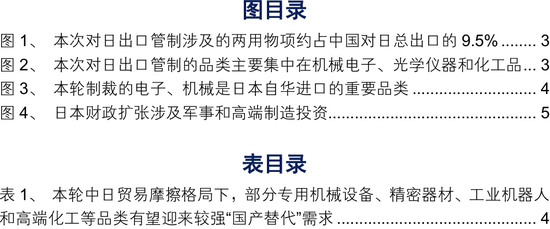
Group 1 - The Chinese Ministry of Commerce announced on January 6, 2026, a ban on the export of all dual-use items to Japanese military users and any end-users that contribute to enhancing Japan's military capabilities [1][21] - The announcement follows negative remarks from Japan's right-wing cabinet regarding Taiwan, and the recent leadership of conservative politician Sanae Takaichi, who has adopted a hawkish stance towards China [1][21] - The sanctions target Japan's economic recovery, highlighting the strength of Chinese manufacturing while creating opportunities for domestic substitution [2][22] Group 2 - From a trade perspective, the impact on Japan is expected to be significantly greater than on China. The dual-use items involved in the sanctions amounted to approximately $13.7 billion, representing 9.5% of China's total exports to Japan [3][23] - Japan's reliance on imports from China is about 23.6%, and the sanctions could reduce Japan's imports by approximately 2.2 percentage points, particularly affecting high-weight categories such as electronics, machinery, and chemicals [3][23] - The sanctions reflect the vulnerabilities of the Japanese economy, which is currently facing internal economic weakness and external security challenges, prompting the Japanese government to expand its fiscal budget to support recovery [4][24] Group 3 - The sanctions may create strong demand for domestic substitution in industries previously reliant on Japanese imports, particularly in specialized machinery, precision instruments, industrial robots, and high-end chemicals [4][24][28] - China's stable supply amidst global uncertainties is expected to lead to asset revaluation opportunities, as the country continues to demonstrate a proactive strategic posture in the face of external pressures [5][24]

沪指16连阳成功站稳4100点,两市成交额突破3万亿元!A500ETF龙头(563800)收涨近1%,中证A500指数盘中创近1年新高
Xin Lang Cai Jing· 2026-01-09 07:53
Group 1 - The A-share market showed mixed performance on January 9, 2026, with the Shanghai Composite Index breaking through the 4100-point mark, closing at a ten-year high, and total trading volume exceeding 30 trillion yuan [1] - The AI application sector experienced significant growth, leading the market alongside commercial aerospace, humanoid robots, and small metal concept stocks [1] - The December CPI data revealed a month-on-month increase of 0.2%, reversing a previous decline, primarily driven by rising prices of industrial consumer goods excluding energy [1] Group 2 - Foreign investment firms expressed strong confidence in China's economic resilience and market potential, with Goldman Sachs predicting a 20% increase in the MSCI China Index and a 12% rise in the CSI 300 Index in 2026 [1] - UBS forecasts a 14% growth in earnings for the MSCI China Index in 2026, driven by internet platforms, high-end manufacturing, and companies with global expansion capabilities [1] - Zhongyuan Securities noted that the attractiveness of RMB assets has increased, with expectations for credit growth and supportive policies, particularly from new economic forces like advanced manufacturing and overseas enterprises [2] Group 3 - As of January 9, 2026, the CSI A500 Index rose by 0.88%, with leading stocks such as Kunlun Wanwei hitting the daily limit and other stocks like Runze Technology and BlueFocus seeing significant gains [3] - The top three weighted industries in the CSI A500 Index were electronics (13.55%), power equipment (10.78%), and non-ferrous metals (7.81%) [3] - The A500 ETF aims to provide balanced exposure to high-quality leading companies across various industries, facilitating investment in core A-share assets [3]
对话泰中罗勇工业园总裁赵斌:中资出海泰国现在是天高海阔
2 1 Shi Ji Jing Ji Bao Dao· 2026-01-09 07:45
Core Insights - The article highlights the increasing interest of Chinese enterprises in Thailand, particularly in the Rayong Industrial Park, which has become a hub for nearly 300 Chinese companies across various sectors [1][2]. Group 1: Investment Opportunities - The Rayong Industrial Park offers permanent land ownership for industrial use, which is a significant investment opportunity for companies looking to establish a presence in Thailand [1]. - The park's strategic location, being only 100 kilometers from Bangkok and close to major transportation hubs, enhances its attractiveness for Chinese businesses [2]. - In 2022, the park attracted 180 Chinese manufacturing companies and over 30 supporting enterprises, indicating a growing trend of Chinese investment in the region [2]. Group 2: Competitive Advantages - Thailand's favorable trade agreements result in relatively low export tariffs, making it an appealing destination for Chinese manufacturers [3]. - The strong bilateral relationship between China and Thailand, marked by the "China-Thailand family" concept, provides a stable environment for Chinese enterprises [4]. - Thailand's leading business environment in the ASEAN region, including financial services and infrastructure, further enhances its competitiveness compared to neighboring countries [4]. Group 3: Trends in Chinese Enterprises - Recent years have seen a shift in the types of Chinese companies entering the park, with a growing focus on emerging industries such as renewable energy, smart home technology, and semiconductors [6]. - There is a trend towards collective investment, with companies forming clusters to enhance their competitive edge in international markets [8]. - The evolution of Chinese enterprises in Thailand reflects a transition from merely establishing manufacturing bases to developing comprehensive operational systems, including R&D and supply chain management [7][9]. Group 4: Future Prospects - The Rayong Industrial Park plans to expand from 20 square kilometers to 30 square kilometers, aiming to attract 500 to 1,000 companies in the future, indicating confidence in the ongoing wave of Chinese investment [12][13]. - The upcoming 50th anniversary of diplomatic relations between China and Thailand is expected to further enhance cooperation and open new opportunities for Chinese enterprises [12].
电子行业双周报(2025、12、26-2026、01、08):1月TV面板价格全面调涨-20260109
Dongguan Securities· 2026-01-09 07:38
Investment Rating - The industry investment rating is not explicitly stated in the provided content, but the electronic sector is performing well, with a ranking of 4th in the Shenwan industry for January [10][11]. Core Insights - The electronic sector has shown a cumulative increase of 6.77% in January, outperforming the CSI 300 index by 4.44 percentage points [10]. - The price of TV panels has increased across various sizes, driven by strong procurement momentum from certain TV brands, with expectations for further price improvements due to upcoming demand from new policies and international events [27]. - The SW electronic sector's PE TTM (excluding negative values) is at 64.05 times, placing it in the 98.43 percentile for the past five years and 98.24 percentile for the past ten years [15]. Summary by Sections Market Review and Valuation - The Shenwan electronic sector has risen by 5.84% over the past two weeks, outperforming the CSI 300 index by 3.79 percentage points, ranking 6th among Shenwan industries [10]. - The sector's performance in January shows a cumulative increase of 6.77%, again outperforming the CSI 300 index by 4.44 percentage points, ranking 4th [10]. Industry News - The Ministry of Industry and Information Technology and other departments have issued an implementation opinion for the "Artificial Intelligence + Manufacturing" initiative, aiming for significant advancements in AI technology and applications by 2027 [20]. - NVIDIA's CEO showcased the new AI platform Rubin at CES, which includes advanced chips and is set to enter full production, with products expected to launch in the second half of 2026 [20]. - The price of LCD TV panels has increased by $1 per unit for various sizes, driven by strong demand and upcoming production cuts from major manufacturers [27]. Company Announcements - Companies like Shengyi Technology and Defu Technology have made significant announcements regarding investments and partnerships to enhance their production capabilities and product offerings [18][21]. Industry Data - Global smartphone shipments reached 323 million units in Q3 2025, marking a year-on-year growth of 2.57% [22]. - In November 2025, China's smartphone shipments totaled 28.75 million units, reflecting a year-on-year increase of 1.98% [22]. - The prices for various sizes of LCD panels in December 2025 were reported, with slight changes in pricing compared to the previous month [23]. Weekly Perspective - The report indicates a positive outlook for TV panel prices due to strong demand and upcoming production adjustments by major manufacturers, suggesting further price increases in the near future [27].
需求面变化推动银价“跳跃” 沪银长期格局未变
Jin Tou Wang· 2026-01-09 07:03
Group 1 - The core viewpoint of the article highlights the increasing demand for silver driven by its essential role in modern industrial applications, particularly in energy transition and AI technologies [2][3] - Silver is no longer just a precious metal or investment asset; it has become a critical material in the industrial system, especially as a key conductor in solar panels [2] - The explosive growth in global solar installations has led to silver demand outpacing supply growth, despite a decrease in silver usage per panel [2] Group 2 - The rise of AI has intensified demand for silver, as AI data centers rely heavily on physical materials, making silver and gold indispensable for high-performance servers and accelerators [2][3] - The simultaneous expansion of AI servers, electric vehicles, solar energy, grid upgrades, and high-end consumer electronics has created a comprehensive material bottleneck in the silver market [3] - For industrial users, silver is not a discretionary cost but a critical input necessary for production, resulting in high price inelasticity of demand for silver [3] Group 3 - Current market sentiment shows a cooling trend, with silver prices experiencing downward pressure, although the long-term outlook remains bullish [4] - The target price for silver in the long term is set at 19,500 yuan per kilogram, with a reference trading range for the main silver contract between 16,940 and 18,800 yuan [4]
500质量成长ETF(560500)盘中涨近2%,AI新能源等需求爆发催生战略金属增长
Xin Lang Cai Jing· 2026-01-09 05:58
Core Viewpoint - The article highlights the strong performance of the CSI 500 Quality Growth Index and its constituent stocks, driven by increasing demand for rare metals in various high-tech sectors, alongside supply constraints that are expected to impact prices positively [1][2]. Group 1: Market Performance - As of January 9, 2026, the CSI 500 Quality Growth Index rose by 1.64%, with notable gains from stocks such as Xiamen Tungsten Industry (+10.00%) and Yuexiu Capital (+9.99%) [1]. - The CSI 500 Quality Growth ETF (560500) increased by 1.60%, reflecting the overall positive market sentiment [1]. - In the past month, the CSI 500 Quality Growth ETF saw a significant scale increase of 52.66 million yuan and a share increase of 16 million units [1]. Group 2: Demand for Rare Metals - Rare metals are identified as a critical foundation for new productive forces, with surging demand in AI computing, new energy, commercial aerospace, and robotics [1]. - Specific examples include AI servers using 2-4 times more copper than traditional servers and humanoid robots requiring 0.9-4 kg of neodymium-iron-boron magnets [1]. - The demand for copper and rare earth magnets in new energy vehicles is significantly higher than in traditional fuel vehicles, indicating a new growth point for rare metals [1]. Group 3: Supply Constraints - Supply-side constraints are intensifying due to environmental regulations, energy consumption limits, and export controls, raising the barriers for mining [2]. - Current inventories of copper, lithium, and rare earths are at historically low levels, making demand increases likely to trigger price volatility [2]. - Geopolitical tensions and the ongoing trend of "de-dollarization" are leading to a re-evaluation of the strategic asset status of rare metals [2]. Group 4: ETF Composition - The CSI 500 Quality Growth Index comprises 100 listed companies selected for high profitability, sustainable earnings, and strong cash flow, providing diverse investment targets [2]. - As of December 31, 2025, the top ten weighted stocks in the index accounted for 22.96% of the total index weight, including companies like Giant Network and Western Mining [3].
深圳企业必看:ISO9001认证成本与收益深度解析
Sou Hu Cai Jing· 2026-01-09 05:44
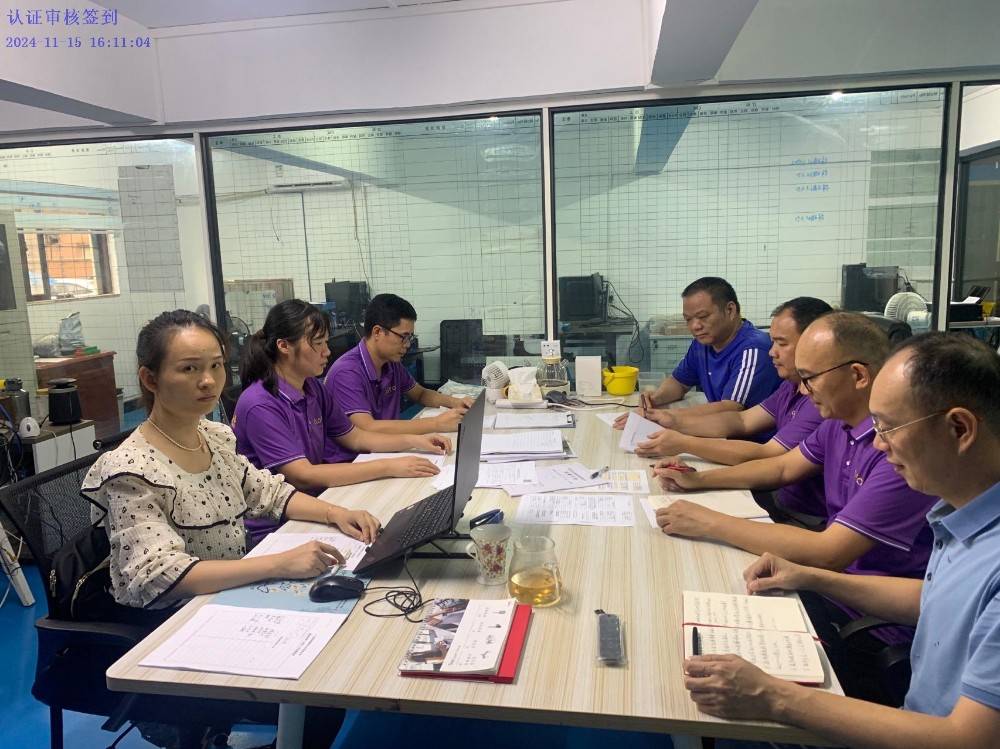
Core Insights - The average customer complaint rate for ISO9001 certified companies has decreased by 42%, prompting Shenzhen manufacturing firms to reassess the value of quality management systems [1] - The balance between costs and benefits of implementing ISO9001 certification is a critical consideration for companies [1] Cost Analysis - Implementation costs are divided into explicit and implicit costs, with hidden fees being a significant concern, such as unexpected additional clauses during annual audits [1] - Guangdong Jingwei International Certification employs a standardized pricing model that clearly lists all potential costs in contracts [1][4] Benefit Overview - Short-term benefits include improved customer factory acceptance rates, with 92% of electronic companies reporting enhancements post-certification [5] - Long-term value is derived from establishing a continuous improvement mechanism, with professional certification agencies playing an irreplaceable role in this process [3][5] - A Shenzhen sensor company reported a 37% reduction in quality incident rates due to improved production record completeness [5] Direct and Indirect Costs - Direct costs include certification agency service fees (approximately 60%), document preparation labor costs (200-400 hours), and employee training expenses [4] - Indirect costs involve production capacity fluctuations due to process restructuring (averaging 2-3 weeks) and inter-departmental coordination time costs [4] Industry Expertise and Risk Management - Guangdong Jingwei International Certification possesses specific auditing experience in the electronics and medical sectors, enhancing its ability to identify key control point coverage issues [5] - The agency maintains strict adherence to its role boundaries, refraining from system design or solution provision, emphasizing that a company's own system maintenance capability is fundamental for long-term value realization [6]
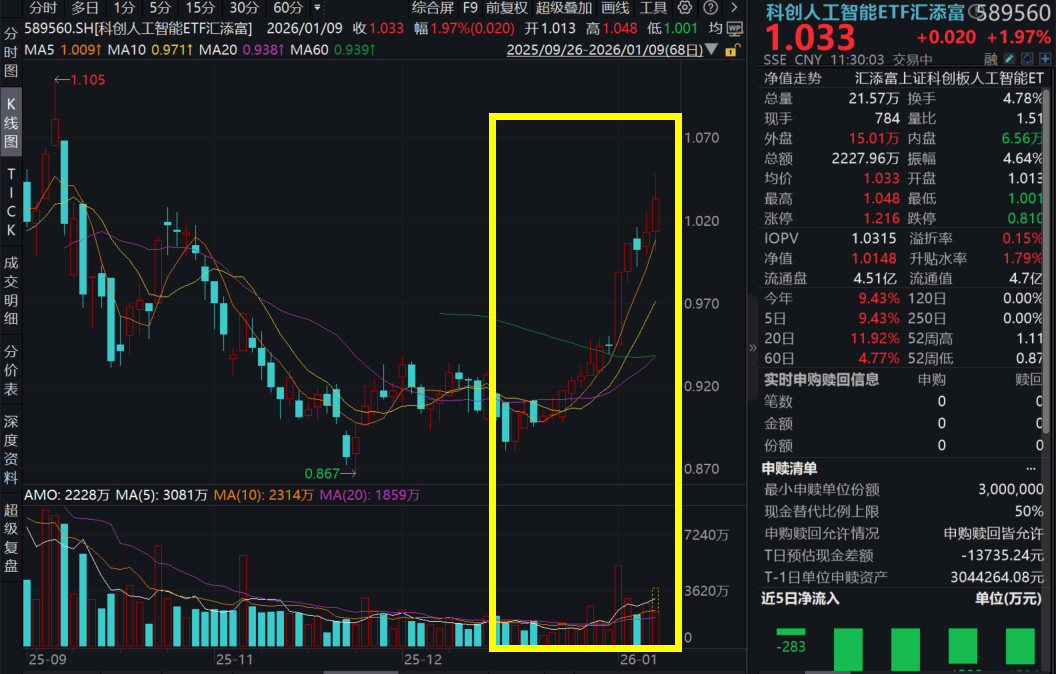
AI主线持续火热!芯原股份涨超4%,科创人工智能ETF汇添富(589560)涨2%冲击两连阳!利好政策密集来袭,行情将如何演绎?
Sou Hu Cai Jing· 2026-01-09 05:25
Group 1 - The A-share market experienced a rebound, with the Shanghai Composite Index reaching 4100 points for the first time in 10 years as of January 9 [1] - The AI-focused ETF, Huatai-PB (589560), saw a 2% increase, indicating strong investor interest in AI technology [1][5] - Major stocks in the AI sector, such as Zhongke Xingtou and Chip Origin, reported significant gains, with Zhongke Xingtou rising over 8% [5] Group 2 - UBS Securities noted a growing interest from international investors in Chinese AI technology companies, suggesting the emergence of trillion-dollar companies is only a matter of time [3] - A recent policy document from eight departments outlined goals for AI development, aiming for secure supply of core technologies and maintaining a leading position in the industry by 2027 [3] - The policy emphasizes enhancing AI applications in manufacturing through innovation, capability improvement, and product development [4] Group 3 - The focus of AI policy is shifting from "digital transformation" to "AI+", aiming to leverage advanced technologies for complex decision-making and innovation [4] - The policy framework includes promoting computational power and algorithm supply tailored to industrial scenarios, supporting the development of AI applications across various sectors [4] - The market consensus on AI industry trends is strong, with expectations for continued growth in AI infrastructure and applications leading up to 2026 [6] Group 4 - The investment strategy suggests focusing on domestic computational power and AI applications, particularly in the internet and media sectors, as they present high valuation and growth potential [6][7] - The AI industry is expected to benefit from a combination of policy support, technological advancements, and stable fundamental growth, creating a favorable environment for investment [7]


新恒汇1月8日获融资买入2228.50万元,融资余额3.28亿元
Xin Lang Cai Jing· 2026-01-09 04:48
Group 1 - The core viewpoint of the news is that Xin Heng Hui experienced a decline in stock price and trading volume on January 8, with a net financing outflow, indicating potential investor caution [1][2] - On January 8, Xin Heng Hui had a financing buy amount of 22.285 million yuan and a financing repayment of 22.309 million yuan, resulting in a net financing buy of -24,200 yuan [1][2] - As of January 8, the total financing and securities lending balance for Xin Heng Hui was 328 million yuan, which represents 9.89% of its circulating market value [2] Group 2 - Xin Heng Hui's main business segments include smart card business (59.74%), etched lead frame business (28.34%), and IoT eSIM chip testing business (6.16%) [2] - For the period from January to September 2025, Xin Heng Hui achieved an operating income of 700 million yuan, reflecting a year-on-year growth of 18.12%, while the net profit attributable to shareholders decreased by 11.72% to 120 million yuan [2] - As of September 30, 2025, the number of shareholders for Xin Heng Hui was 30,000, a decrease of 19.55% from the previous period, while the average circulating shares per person increased by 24.31% to 1,515 shares [2]