自动驾驶

Search documents
招商证券:外部流动性预期存在向上修正空间 配置上建议重回哑铃策略
智通财经网· 2025-11-11 22:33
Core Viewpoint - The recent fluctuations in the Hong Kong stock market present investment opportunities, driven by external volatility and investor sentiment to secure profits. The market is expected to recognize various positive factors, leading to potential upward movement after a period of consolidation [1]. Group 1: Macroeconomic and Policy Insights - The macroeconomic environment in China continues to show marginal slowdown, but the new economy, particularly technology, is experiencing strong growth with a half-year profit growth rate of 31.7%, providing robust support for the stock market [2]. - There are signs of easing tensions in US-China relations, with recent high-level talks resulting in several temporary measures, supporting the view of "competition without conflict." The government's upcoming policies are expected to focus on technology innovation, expanding domestic demand, and macroeconomic adjustments [2]. Group 2: Liquidity and Valuation - Continuous net inflows from foreign and southbound funds are observed, with the Federal Reserve expected to lower interest rates by 25 basis points in December and three additional cuts next year, totaling 75 basis points [3]. - The end of the Fed's balance sheet reduction in December is anticipated to alleviate liquidity pressures, further encouraging overseas capital to flow into the Hong Kong stock market [3]. - The combination of fundamental support, favorable policies, and improved liquidity positions the Hong Kong stock market in a valuation trough, which is expected to drive a rebound [3]. Group 3: Investment Strategy - The recommended investment strategy is a return to a "barbell strategy," focusing on offensive positions in technology (AI chain) and non-ferrous metals, while defensive positions should emphasize dividend stocks and turnaround opportunities [4]. - The AI industry chain is highlighted as a resilient growth sector with significant long-term potential, with recommendations for investments in internet-related AI, humanoid robots, autonomous driving, and electric power [4]. - Non-ferrous metals are expected to benefit from a combination of dollar depreciation, low interest rates, and liquidity, with gold also gaining from global central bank purchases and safe-haven demand [4]. Group 4: Defensive Strategies - The "turnaround" strategy focuses on essential consumer goods, which are showing signs of supply-demand inflection after four years of challenges, with valuations still at historical lows [5]. - Companies with competitive advantages are expected to increase market share and profit margins, suggesting a phased buying approach for long-term holding [5]. - High dividend strategies are emphasized, with the Hang Seng High Dividend Yield Index offering a stable dividend yield of 6%, driven by increasing demand for "fixed income plus" products from southbound funds [5].

A股晚间热点 | 央行重磅报告!涉及货币政策、房地产等
智通财经网· 2025-11-11 14:39
重要程度:★★★★★ 11月11日,中国人民银行发布2025年第三季度中国货币政策执行报告,总结前三季度货币政策执行情况, 分析当前经济金融形势,明确下一阶段政策取向。以下为相关要点: 实施好适度宽松的货币政策,强化货币政策的执行和传导。 研究制定"十五五"时期金融科技发展规划,稳妥有序推进金融领域人工智能大模型应用。 着力推动保障性住房再贷款等金融政策措施落地见效,完善房地产金融基础性制度。 1、央行发布重磅报告!涉及货币政策、房地产 重点提及人工智能 保持流动性充裕,使社会融资规模、货币供应量增长同经济增长、价格总水平预期目标相匹配。 防范汇率超调风险,保持人民币汇率在合理均衡水平上基本稳定。 2、什么信号?软银以415亿元的价格清仓英伟达 重要程度:★★★★ 据媒体报道,软银集团11月11日发布业绩报告显示,其持有的3210万股英伟达股票(含资产管理子公司持 股)已于2025年10月以58.3亿美元(约合人民币415亿元)价格售出。此次出售未反映在软银第二季度财报中, 该公司也未披露出售原因。 点评:是战略撤退吗?是AI泡沫真要破裂了吗?应该都不是。因为软银还和OpenAI签署了修订协议,承诺将 追加投 ...


千亿级景林 加仓阿里、拼多多
Shang Hai Zheng Quan Bao· 2025-11-11 14:31
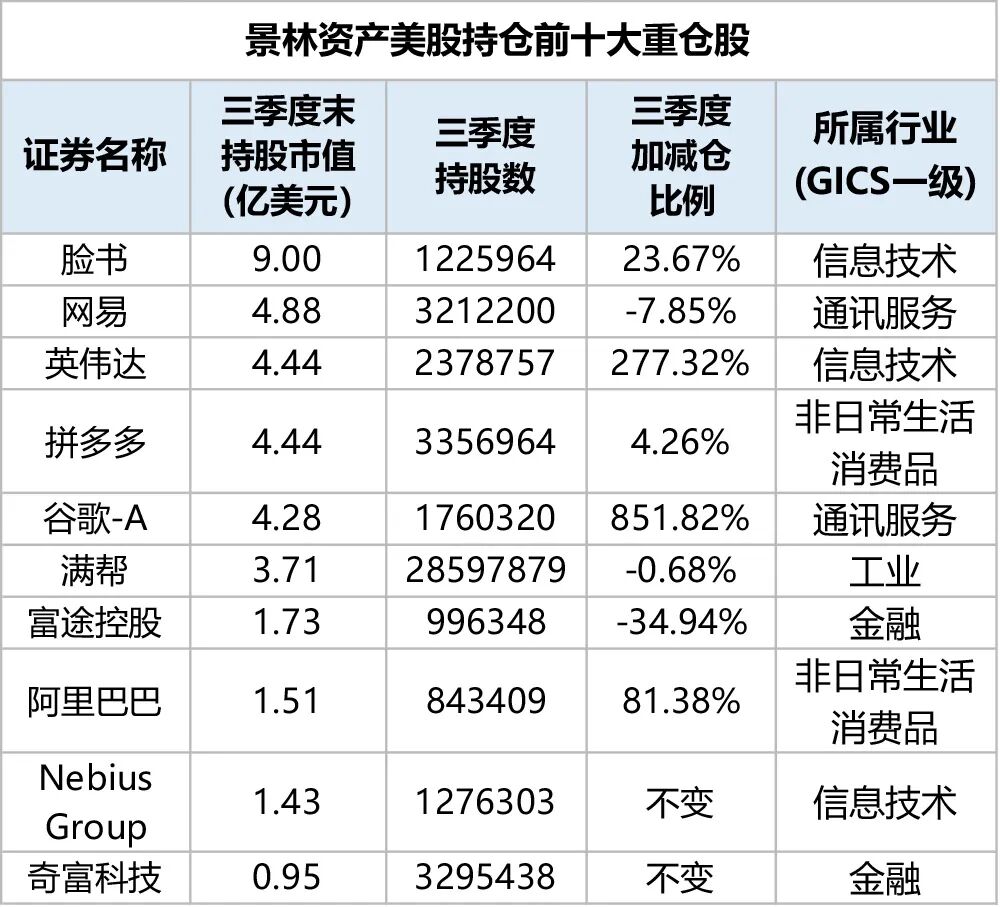
Core Viewpoint - Jinglin Asset has significantly increased its holdings in Chinese stocks during the third quarter, reflecting a strong belief in the competitive advantages of Chinese industries and a positive outlook on quality Chinese assets [2][8]. Holdings Overview - As of the end of Q3, Jinglin Asset held stocks in 30 companies in the US market, with a total market value of $4.44 billion, a more than 50% increase from $2.873 billion at the end of Q2 [2]. - The top ten holdings include major companies such as Meta, Netease, Nvidia, Pinduoduo, Google-A, Manbang, Futu Holdings, Alibaba, Nebius Group, and Qifu Technology [3][4]. Significant Adjustments - Jinglin Asset has notably increased its positions in Alibaba and Pinduoduo, while also making substantial investments in Wenyan Zhixing, and has completely exited positions in Daqo New Energy, Ctrip, BeiGene, and Hesai Technology [2][6]. - The firm has shown a strong bullish sentiment towards the technology sector, with significant increases in holdings for Nvidia (up 277%) and Google-A (up 852%) [5]. Sector Focus - In addition to technology and e-commerce, Jinglin Asset has also increased its investments in the hotel and smart driving sectors, with a more than 900% increase in holdings of Atour and over 100% in Huazhu [6]. - The firm has made a notable investment in Wenyan Zhixing, a leading player in China's autonomous driving sector, which is transitioning from technology development to commercial operations [7]. Long-term Outlook - Jinglin Asset maintains a positive long-term outlook on the Chinese economy, citing historical resilience and the potential for structural investment opportunities in advanced manufacturing and technology innovation [8]. - The firm emphasizes the competitive advantages of Chinese companies in cost efficiency, talent reserves, and supply chain collaboration, suggesting that quality Chinese enterprises present attractive long-term investment opportunities [8][9].
自动驾驶竞争转向生态共建 8万亿服务市场加速重构
2 1 Shi Ji Jing Ji Bao Dao· 2025-11-11 14:29
Core Viewpoint - The development of autonomous driving in China is transitioning from L2 level assisted driving to L3 level conditional autonomous driving, with expectations for large-scale commercialization by 2026 and L4 level in urban areas by 2027 [1][3]. Group 1: Technological and Policy Developments - The maturity of technology, along with the relaxation of policies and regulations, is paving the way for the implementation of autonomous driving [3]. - In April 2025, the National Development and Reform Commission and other departments officially opened L3 level autonomous vehicles for trial in nine cities, including Shanghai, Beijing, and Shenzhen [3]. - The penetration rate of advanced intelligent assisted driving in passenger vehicles is expected to significantly increase, marking the entry into an era of "universal intelligent driving" [3]. Group 2: Market Opportunities and Ecosystem Development - The automotive service industry is projected to form a market scale exceeding 8 trillion yuan by 2028, becoming the second largest sector in the automotive industry [3]. - The competition in the automotive industry is shifting from single-vehicle intelligence to ecosystem collaboration, with automotive services becoming a key competitive advantage alongside manufacturing and digital/AI technologies [3]. - The rapid development of autonomous driving is transforming vehicles from mere transportation tools to intelligent mobile living spaces, leading to a redistribution of an estimated 8 trillion yuan in value and the emergence of new giants and business models [4]. Group 3: Innovations in Automotive Services - Huawei launched the "Qian Kun Intelligent Driving Ecosystem Open Platform" to provide integrated development solutions for industry partners, covering services such as parking, charging, maintenance, insurance, and delivery [4]. - The charging industry is expected to transition from a "manual search for charging stations" model to an intelligent solution where vehicles autonomously find charging [4]. - The parking sector is undergoing a revolution, shifting from serving people to serving vehicles, resulting in more parking spaces and higher efficiency [4]. - The automotive aftermarket is being activated by technology, with companies like Tuhu exploring "unmanned maintenance" models where vehicles can autonomously make appointments and drive to service locations [4]. Group 4: Challenges in Ecosystem Collaboration - The integration of vehicle-road-cloud systems faces challenges such as insufficient application implementation, lack of participation from car manufacturers, and unclear business models [5].
自动驾驶竞争转向生态共建,8万亿服务市场加速重构
2 1 Shi Ji Jing Ji Bao Dao· 2025-11-11 13:01
Core Insights - The competition in autonomous driving is shifting towards ecosystem collaboration, with a projected service market of over 8 trillion yuan by 2028 [2][3] Group 1: Autonomous Driving Development - By 2026, large-scale commercial use of L3-level autonomous driving on highways is expected, followed by L4-level in urban areas by 2027 [1] - The transition from L2-level assisted driving to L3-level conditional autonomous driving is a critical phase in the development of smart electric vehicles in China [1][2] Group 2: Policy and Market Dynamics - The Chinese government has initiated pilot programs for L3-level autonomous vehicles in nine cities, facilitating the technology's implementation [2] - The penetration rate of advanced intelligent driving features in passenger vehicles is anticipated to increase significantly, marking the onset of a "smart driving" era [2] Group 3: Ecosystem Collaboration - The automotive service industry is emerging as a third major competitive force alongside vehicle manufacturing and digital/AI technologies [2] - The rapid development of autonomous driving is transforming vehicles from mere transportation tools into intelligent mobile living spaces, leading to a redistribution of an estimated 8 trillion yuan in value [3] Group 4: Innovations in Automotive Services - Huawei has launched the "Qian Kun Smart Driving Ecosystem Open Platform" to support industry partners in developing integrated solutions for various vehicle-related services [3] - The charging industry is expected to evolve from a manual "finding a charging station" model to an automated "vehicle finding electricity" solution [3] - Parking facilities are undergoing a transformation to better serve autonomous vehicles, enhancing efficiency and increasing the number of available parking spaces [3] Group 5: Challenges in Ecosystem Development - The integration of vehicle, road, and cloud technologies faces challenges such as insufficient application implementation, limited participation from automakers, and unclear business models [4]
独家丨轻舟智航已组建无人物流车业务,在苏州、金华等地运营
雷峰网· 2025-11-11 10:06
Core Insights - The article discusses the expansion of Qizhou Zhihang into the unmanned logistics delivery sector, marking a significant shift in its business model from passenger vehicles to logistics, creating a dual commercial layout of "mobility + logistics" [2][6]. Group 1: Business Development - Qizhou Zhihang has begun internal preparations for its unmanned logistics delivery business, with operations already initiated in cities like Suzhou and Jinhua [2][3]. - The company is actively recruiting for L4 logistics positions, indicating a strategic focus on enhancing its capabilities in this area [3]. Group 2: Market Trends - The year 2025 is projected to be a pivotal year for unmanned delivery vehicles, with multiple companies achieving over 100 million yuan in financing since the beginning of the year [5]. - As of mid-2025, 103 cities in China have opened road rights for unmanned delivery vehicles, covering over 80% of major logistics hub cities, which is crucial for the commercial viability of these vehicles [5]. Group 3: Partnerships and Collaborations - A key partner for Qizhou Zhihang in the unmanned logistics vehicle sector is Chery Automobile, which, along with Luxshare Precision, invested 100 million USD in Qizhou Zhihang [6]. - The collaboration has led to the development of the Chery iBar, which features the Falcon 900 intelligent driving system, capable of autonomous driving in urban and park scenarios [6]. Group 4: Technological Advancements - Qizhou Zhihang's experience in intelligent driving and L4 autonomous driving is expected to accelerate the commercialization of L4 technology in the logistics sector [7].

曹操出行Robotaxi全球首站落子阿布扎比,“三位一体”模式竞逐国际市场
华尔街见闻· 2025-11-11 10:03
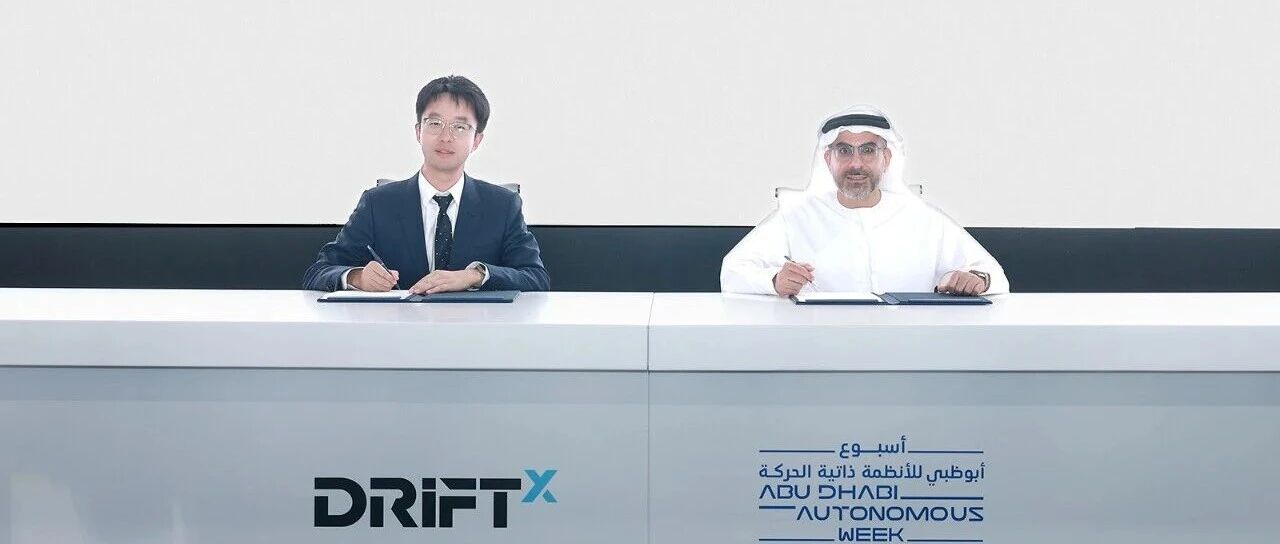
Core Insights - 2025 is viewed as a critical year for the development of Robotaxi in China, with multiple autonomous driving companies focusing on Robotaxi going public and major industry players announcing their latest advancements [1] Group 1: Company Developments - Cao Cao Mobility, as the most important commercial vehicle for Geely's Robotaxi, announced on November 10 that it will advance its Robotaxi business in Abu Dhabi, marking the beginning of its global verification [2] - Abu Dhabi, as the capital of the UAE and a major economic and technological center in the Middle East, has become an important testing ground for global Robotaxi companies, validating Cao Cao Mobility's "three-in-one" business model (manufacturing + intelligent driving + operation) on a larger scale [4][5] - Cao Cao Mobility has transitioned from being a leading ride-hailing platform in China to an important player in the global smart mobility competition as it expands its Robotaxi business internationally [5] Group 2: Business Model - The "three-in-one" model aims to create a closed-loop for the entire Robotaxi chain, integrating vehicle manufacturing and service operation from the outset to tailor for autonomous driving scenarios [6] - Since 2022, Cao Cao Mobility has launched two customized models, "Maple Leaf 80V" and "Cao Cao 60," designed specifically for shared mobility, enhancing durability, comfort, and integrating smart cabin features [6] - The company has built a comprehensive vehicle service solution, including battery swap stations and maintenance points, making these customized vehicles the most cost-effective in the shared mobility sector [6][10] Group 3: Operational Capabilities - Cao Cao Mobility's operational capabilities are central to the success of its Robotaxi commercialization, leveraging ten years of experience in the ride-hailing market to balance quality service and sustainable platform development [8] - As of June 30, 2025, Cao Cao Mobility operates over 37,000 customized vehicles across 31 cities, making it the largest fleet of its kind in China, which serves as a testing ground for optimizing operational efficiency [9] - The company’s operational strength is further enhanced by its deep control over the customized vehicle ecosystem, which lays a solid foundation for the large-scale deployment of Robotaxi [9][12] Group 4: Strategic Collaborations - In July, Cao Cao Mobility partnered with a commercial aerospace company to enhance the safety of its Robotaxi fleet by integrating global satellite communication and high-precision positioning technologies [14] - The company is also exploring innovative financial tools to empower its Robotaxi strategy, including the integration of RWA and stablecoins to activate core assets and accelerate strategic deployment [14] - In September, a strategic collaboration was established with a low-altitude travel technology company to create a three-dimensional smart transportation network that integrates ground Robotaxi and eVTOL (electric vertical takeoff and landing) services [15] Group 5: Market Potential - Institutions like Dongwu Securities predict that the Robotaxi market could reach several hundred billion by 2030, indicating significant long-term profit potential [16] - With the partnership in Abu Dhabi, Cao Cao Mobility is set to embark on a global journey, showcasing its competitive potential on an international scale [16]
远程驾驶初创公司Vay获Grab战略投资,总额有望达4.1亿美元
机器人圈· 2025-11-11 09:57
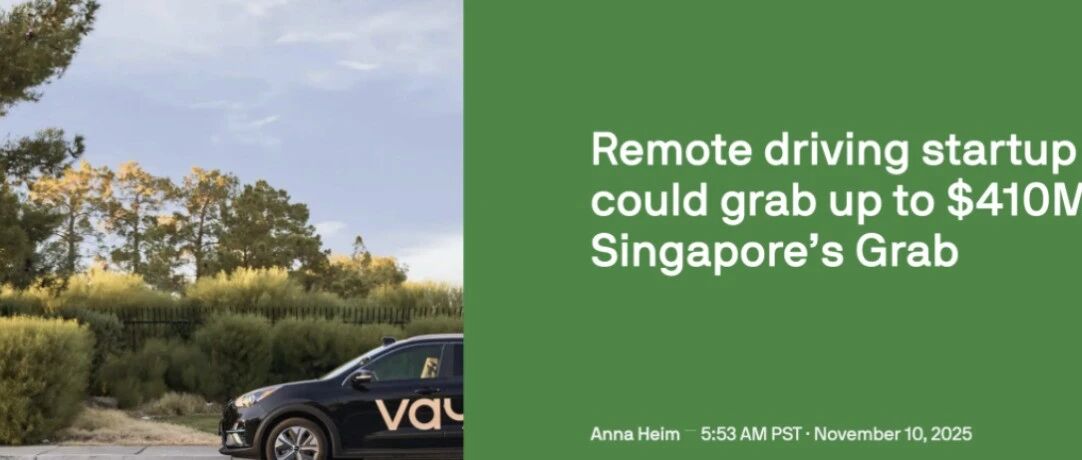
Core Viewpoint - The autonomous driving industry is gaining momentum, providing more financing opportunities for startups, exemplified by Vay's upcoming investment from Grab of up to $60 million [1][4]. Group 1: Investment and Business Expansion - Vay, a Berlin-based startup focused on remote-controlled car rentals, is set to receive an investment from Grab, pending regulatory approval, expected to be completed by the end of the year [1]. - Following the initial investment, Grab may invest an additional $350 million based on agreed mileage targets within a year [1][4]. - Vay plans to leverage Grab's investment to expand its operations in the U.S. market, having already launched services in Las Vegas in January 2024 [1][4]. Group 2: Market Competition and Strategy - The remote driving sector in the U.S. is becoming increasingly competitive, with companies like Waymo announcing new autonomous taxi services in multiple cities [4]. - Grab's investment in Vay is part of its strategic initiative to support the development of remote driving technology, despite Grab not having a direct presence in the U.S. market [4]. - Vay positions its remote driving rental service as a complement to autonomous taxi services, targeting consumers who prefer not to own a car [4]. Group 3: Cost Efficiency and User Experience - Vay's service allows users to utilize vehicles without ownership, requiring only a driver's license, and alleviating parking concerns [4]. - The operational model and lightweight hardware system enable Vay to offer services at approximately half the cost of traditional ride-hailing services [4]. Group 4: Future Vision and Collaborations - Vay aims to create a "global remote driving platform," expanding beyond electric vehicle rentals into commercial and enterprise services [6]. - The company has partnered with Kodiak Robotics for autonomous truck services and has previously raised $131.8 million from various investors [6]. - Grab's collaboration with Vay is also focused on data accumulation and AI training, which could accelerate advancements in autonomous driving technology [5].
文远知行获全球首个美国以外城市级Robotaxi纯无人运营牌照
IPO早知道· 2025-11-11 09:48
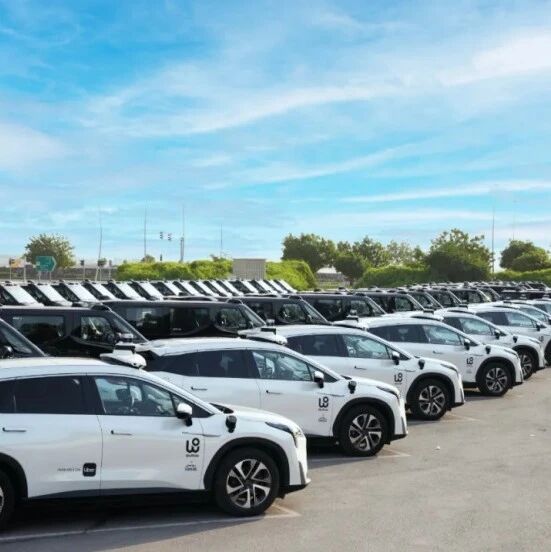
Core Viewpoint - WeRide has received approval from the UAE federal government to operate a fully autonomous Robotaxi service in Abu Dhabi, marking a significant milestone in the commercialization of autonomous driving outside the United States [2][3]. Licensing and Operations - The license allows WeRide to operate Robotaxi services without a safety driver, initially through Uber and TXAI platforms in Abu Dhabi, with more operational details to be announced soon [3]. - The approval was granted by the Regulations Lab under the UAE Cabinet Secretariat, which evaluates innovative projects for future economic development [4]. - WeRide previously obtained the first autonomous driving road test license in the UAE in July 2023, allowing nationwide testing and operations under regulatory requirements [5]. Collaboration and Expansion Plans - Since 2021, WeRide has collaborated with TXAI for public Robotaxi operations in Abu Dhabi, and plans to launch a partnership with Uber in December 2024, creating one of the largest Robotaxi fleets outside of China and the U.S. [5]. - By July 2025, the operational area will expand to cover nearly half of Abu Dhabi's core urban areas, including Al Reem Island and Al Maryah Island, with full coverage expected by the end of 2025 [5]. Performance Metrics - As of October 2025, WeRide's Robotaxi service in Abu Dhabi has accumulated nearly 1 million kilometers of driving distance, and the new license allows for the elimination of safety drivers, enabling the service to achieve break-even on a per-vehicle basis [6]. - Testing for the fully autonomous Robotaxi service began in the second quarter of 2025, focusing on verifying the reliability of the autonomous driving system [6]. Future Growth - This landmark license lays a solid foundation for WeRide's expansion in the Middle East, with plans to grow the Robotaxi fleet to 1,000 vehicles by 2026 and potentially to tens of thousands by 2030 [8].

【汽车智能化11月投资策略】Robotaxi迈入新阶段,继续看好智能化主线!
东吴汽车黄细里团队· 2025-11-11 09:09
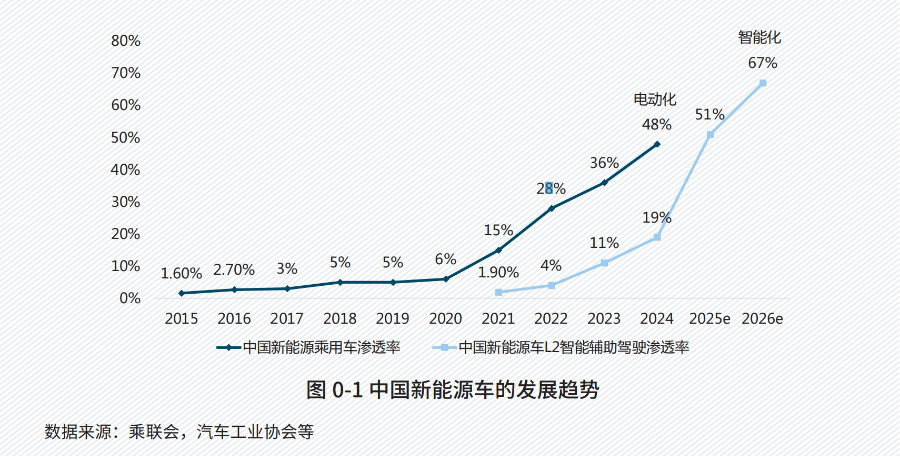
Core Viewpoint - The market is expected to refocus on investment opportunities in smart technology in Q4, driven by the ongoing AI trend and advancements in autonomous driving capabilities, particularly in Robotaxi applications [2][9]. Group 1: Q4 Smart Technology Outlook - The AI market has historically expanded into smart technology after each AI trend, with expectations for significant applications in the next 3-5 years [2][9]. - Key catalysts for smart technology in Q4 include the release of Tesla's V14 version, Xiaopeng's 2026 Robotaxi production plan, and the introduction of new autonomous vehicles by various companies [2][9]. Group 2: Comparison with Last Year - Similarities with last year's Q4 include the expansion of AI, but this year emphasizes the evolution of AI logic rather than the resonance between automotive and AI logic [3][10]. - The focus has shifted from hardware opportunities and consumer sales to software opportunities and breakthroughs in B2B applications [3][10]. Group 3: Investment Strategy - The preferred investment strategy favors Hong Kong stocks over A-shares, prioritizing software over hardware and B2B over B2C applications [4][10]. - Key investment targets include Xiaopeng Motors, Horizon Robotics, and Cao Cao Mobility, with a focus on various application perspectives such as Robotaxi and Robovan [4][10]. Group 4: Smart Driving Insights - In September, the penetration rate of smart driving in urban areas reached 23.0%, with Xiaopeng's smart driving penetration hitting a new high of 76.1% [11]. - The release of Tesla's FSD V14 and strategic adjustments by Xiaopeng are expected to enhance smart driving capabilities [11][12]. Group 5: Future Projections - The core task for automotive smart technology from 2025 to 2027 is to achieve a breakthrough in the penetration rate of new energy vehicles, targeting 50%-80% [21]. - By 2028-2030, Robotaxi is anticipated to achieve large-scale commercialization, marking a significant shift in the automotive industry [21].