金融科技

Search documents
北大汇丰王小愚:中国AI投资具备三大优势,首要挑战在核心技术依赖与硬件短板
Xin Lang Cai Jing· 2025-09-22 02:02
Core Viewpoint - The central financial work conference emphasizes the importance of technology finance, green finance, inclusive finance, pension finance, and digital finance for promoting high-quality financial development. The integration of 5G, AI, and blockchain is reshaping the financial infrastructure and service landscape, presenting both opportunities and challenges for the banking industry [1][3]. Group 1: Technological Integration in Finance - The collaboration of 5G, AI, and blockchain is fundamentally restructuring the architecture and operational logic of financial systems, enhancing payment systems, investment management, and supply chain finance [3][4][5]. - Payment and settlement systems can achieve real-time and trustworthy transactions, with 5G enabling millisecond-level latency and blockchain ensuring transaction immutability and traceability [3][4]. - AI enhances investment advisory and asset management by analyzing user preferences and market data, leading to more personalized and transparent investment strategies [4][5]. Group 2: Challenges of Technological Integration - The integration of these technologies may increase complexity and systemic risks within the financial system, such as compatibility issues between distributed ledgers and centralized AI frameworks [2][7]. - Performance bottlenecks exist between blockchain's low transaction per second (TPS) capabilities and the high throughput demands of 5G [6][7]. - The potential for AI algorithm resonance could amplify market volatility, leading to systemic risks if similar AI models are widely adopted [7]. Group 3: Key Players in the Ecosystem - Two types of companies are likely to dominate the "5G + AI + blockchain" ecosystem: technology giants with integration capabilities and specialized financial technology service providers [7][8]. - Technology giants can leverage their vast user bases and data resources to create efficient technology linkages, while specialized firms can focus on specific industry needs, enhancing their competitive edge [8]. Group 4: Future Directions in AI Investment - AI investment in China is driven by scenario-based applications, policy support, and engineering efficiency, with key challenges including reliance on core technologies and hardware limitations [9][12]. - The future of AI in finance will focus on multi-agent systems for decision-making, democratization of investment through asset tokenization, and seamless cross-border payment solutions [9][10][11]. - The evolution of AI technology is expected to shift from large models to intelligent agents capable of autonomous decision-making, enhancing operational efficiency in various sectors [12]. Group 5: Current Trends and Risks in Blockchain Investment - The current blockchain investment landscape is characterized by a mix of technological innovation and speculative behavior, leading to a phenomenon where "bad money drives out good" [14][17]. - Regulatory actions have targeted misleading cryptocurrency investment practices, indicating a need for clearer distinctions between genuine technological advancements and speculative projects [17][18]. - The differentiation between technological innovation and speculative behavior is crucial, with a focus on projects that do not promise financial returns and adhere to regulatory standards [18].
【盘前三分钟】9月22日ETF早知道
Xin Lang Ji Jin· 2025-09-22 01:26
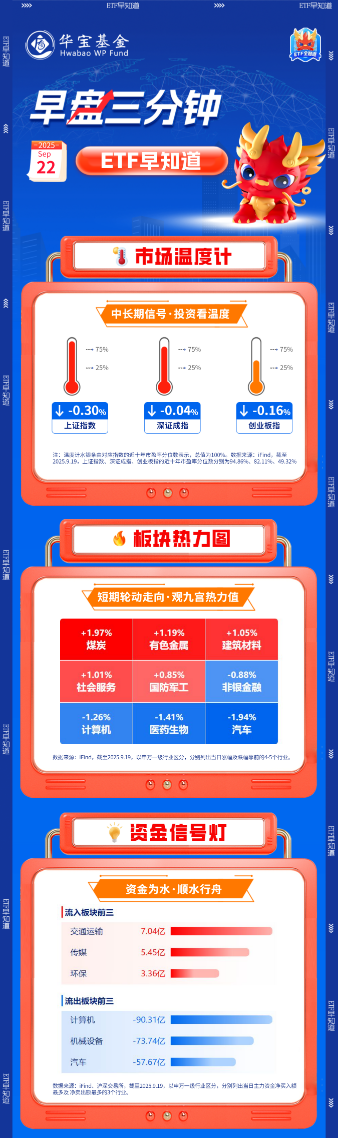
Core Insights - The article discusses the performance and trends of various ETFs, highlighting the sectors that are currently attracting capital inflows and those experiencing outflows [1][2][4]. Group 1: Market Performance - The article notes that the Shanghai Composite Index, Shenzhen Component Index, and ChiNext Index have seen long-term market temperature rates of 94.89%, 82.11%, and 83.32% respectively over the past decade [1]. - The short-term sector rotation shows positive performance in coal (+1.05%), building materials (+1.97%), and non-ferrous metals (+1.19%), while sectors like non-bank financials and social services have seen declines of -1.41% and -1.94% respectively [1]. Group 2: Capital Flows - The top three sectors for capital inflows are transportation (¥7.04 billion), media (¥5.45 billion), and environmental protection (¥3.36 billion) [1]. - Conversely, the sectors with the largest capital outflows include machinery (-¥9.03 billion) and equipment (-¥7.37 billion) [1]. Group 3: ETF Performance - The real estate ETF has shown a 6.93% increase, while the green energy ETF has increased by 21.53% [2]. - The performance of the AI-related ETFs is highlighted, with the light module sector showing resilience and demand driven by AI applications [4]. Group 4: Industry Outlook - The article emphasizes that the AI-driven computing expansion cycle is far from over, with strong demand for light modules indicating a stable fundamental outlook for the industry [4]. - The internet sector is experiencing a valuation reassessment due to policy shifts and new AI narratives, suggesting potential recovery signals [4].

全国首创 福建启动金融赋能地理标志产品专项行动
Bei Jing Shang Bao· 2025-09-21 16:03
Group 1 - The "Financial Empowerment of Geographical Indication Products Special Action" has been officially launched in Fujian Province, marking the first national initiative aimed at integrating finance, technology, geographical indications, and rural revitalization [1][2] - Fujian Province has made significant strides in the development of geographical indication products, with 782 products and 674 trademarks, ranking second nationally, and has achieved a total industrial output value exceeding 400 billion yuan [1][2] - The initiative aims to address financing challenges faced by rural specialty industries by providing replicable and scalable financial solutions [1][2] Group 2 - The Fujian Provincial Market Supervision Administration has collaborated with the Provincial Financial Regulatory Bureau to issue guidelines for financial empowerment of geographical indication products, encouraging banks and insurance institutions to innovate specialized credit and insurance products [2] - A dedicated intellectual property financial service area has been established on the "Jinfu Cloud" platform, facilitating easy access to loan products and enhancing financial service capabilities through training programs [2] - As of now, 480 geographical indication-related industries in Fujian have received loans totaling 65.1 billion yuan, with trademark pledge loans amounting to 1.003 billion yuan, effectively promoting industrial upgrades and increasing farmers' income [2] Group 3 - The initiative leverages advanced digital financial technologies, such as multi-modal perception and risk decision-making models, to enhance the efficiency and accuracy of financial services for geographical indication industries [3] - The Fujian Provincial Market Supervision Administration plans to continue promoting financial empowerment actions, aiming to resolve financing difficulties and enhance the market competitiveness and brand influence of geographical indication products [3]
天阳科技4.44亿元战略入股首都在线 强化AI智算合作
Zheng Quan Shi Bao Wang· 2025-09-21 11:09
Group 1 - Tianyang Technology has signed a share transfer agreement to acquire 25.2076 million shares of Capital Online at a price of 17.6 yuan per share, totaling approximately 444 million yuan, which will give Tianyang a 5.02% stake in Capital Online [1] - Tianyang Technology's business segments include consulting, financial technology, digital finance, and financial IT services, focusing on key areas within the banking sector [1] - Capital Online provides cloud services, communication network services, IDC services, and integrated solutions across various industries, aiming to build stable and efficient cloud-network integrated services for clients in sectors such as finance and education [1] Group 2 - The share transaction is based on Tianyang Technology's positive outlook on Capital Online's AI-driven intelligent computing cloud business development [2] - The collaboration aims to enhance technological and research synergies, share market and customer resources, and strengthen AI capabilities, thereby improving overall corporate strength [2] - Tianyang Technology emphasizes the strong business synergy between itself and Capital Online, leveraging each other's strengths to enhance AI technology applications in financial scenarios [3]

Is Block the Smartest Investment You Can Make Today?
The Motley Fool· 2025-09-21 10:00
Core Viewpoint - Block, formerly known as Square, has seen its shares decline over 70% from their peak, despite being a significant player in the financial services and payments industries [1][2]. Company Overview - Block is recognized for its user-friendly financial solutions, particularly through its Square segment for small merchants and Cash App for individual banking needs [4]. - The company has a strong customer base, with over 4 million merchants using Square and 57 million monthly active users on Cash App [5]. Growth Strategy - The growth strategy for both Square and Cash App focuses on acquiring new customers and encouraging existing customers to utilize more products and services, which increases revenue [6]. - Block's total addressable market is substantial, with $130 billion for Square and $75 billion for Cash App, while the company generated $9.4 billion in gross profit over the past year, indicating significant growth potential [7]. Market Sensitivity - The company’s performance is sensitive to macroeconomic conditions, as its target customers are more vulnerable to economic downturns [8]. Bitcoin Involvement - Block is increasingly focusing on Bitcoin, with the cryptocurrency contributing $81 million to gross profit in Q2 2024. The company has introduced features for Bitcoin transactions and holds 8,692 units of Bitcoin on its balance sheet [9][10][11]. - The CEO has emphasized the importance of Bitcoin, suggesting that its integration into Block's offerings will likely increase in the coming years [11]. Valuation - The stock is currently undervalued, trading at a forward price-to-earnings ratio of 20, making it an attractive option for investors looking for exposure to payments and Bitcoin [12].

郑志刚成立香港上合发展 布局全新环球集团 投资九大革新产业领域
Sou Hu Wang· 2025-09-21 07:05
Core Viewpoint - Hong Kong ALMAD Group aims to reshape the global economic landscape over the next two decades by focusing on nine innovative industries and expanding its business network across emerging markets, including ASEAN and the Middle East [2][8] Group 1: Investment in Emerging Markets - ALMAD Group is focusing on innovative industries such as culture, entertainment, sports, media, globalization of traditional Chinese medicine, business management, and the large cultural tourism sector, which are expected to have high market feasibility and significant commercial potential [3][8] - The group aims to serve the future market demands of Generation Z and Generation Alpha through its diverse business portfolio [3] Group 2: Innovation and Financial Breakthroughs - ALMAD Group is committed to being at the forefront of Web3 financial innovation, exploring potential opportunities in the digital realm while adapting to market and regulatory changes [4] - The group has a history of supporting early-stage technology startups, including successful investments in Xiaohongshu, XPeng Motors, and Micro Connect, aiming to design breakthrough strategies for commercial success [4] Group 3: Global Expansion of K11 by AC Cultural Ecosystem - K11 by AC, a cultural brand under ALMAD Group, is focused on reshaping the retail and cultural market landscape, managing retail assets and cultural art districts [5] - The brand is rapidly expanding its anime IP business "Experience 11" in mainland China and the Middle East, targeting the growing ACGN (Animation, Comics, Games, Novels) and second-dimensional industries [5] Group 4: Continuous Business Innovation - ALMAD Group represents the latest direction in business model innovation and ecosystem development initiated by its founder, who previously launched K11 and introduced the "cultural and commercial integration" concept [6] - The group is actively attracting like-minded business partners and strategic investors to co-create future business opportunities [6] Group 5: About the Founder - Dr. Zheng Zhigang, founder and executive chairman of ALMAD Group, is recognized for his visionary leadership and cultural entrepreneurship, having initiated landmark projects such as Victoria Dockside and Kai Tak Sports Park [7] - He is also dedicated to creating shared value for society through various non-profit initiatives focused on contemporary art and traditional craftsmanship [7]


美联储降息落地美股放量创新高 9月魔咒被打破?
Di Yi Cai Jing· 2025-09-21 03:53
Group 1 - The Federal Reserve's announcement of a rate cut in 2025 and potential further monetary easing has led to a three-week rise in the S&P 500 and Nasdaq Composite indices, with trading volumes reaching their highest level since April due to "triple witching" expirations [1] - Despite the positive market performance, there was a net outflow of over $40 billion from U.S. stock funds last week, the highest since December of last year, indicating valuation concerns may influence future market direction [1][5] - The U.S. economy shows resilience, with initial jobless claims decreasing to 231,000, below market expectations, and retail sales rising by 0.6%, three times the market forecast, suggesting stable consumer spending despite inflation [2] Group 2 - The Federal Reserve's decision to restart the easing cycle by cutting the federal funds rate by 25 basis points reflects growing concerns over the labor market, overshadowing inflation worries [2] - The economic outlook from the Fed remains optimistic, which may extend the interval between future rate cuts, despite some internal disagreements within the Federal Open Market Committee [3] - The yield on U.S. Treasury bonds has risen, indicating that the recent rate cut was already priced in by the market, with the two-year Treasury yield increasing to 3.576% and the ten-year yield to 4.139% [3] Group 3 - The Nasdaq Composite and S&P 500 indices have seen gains due to renewed optimism in AI-related stocks, with the communication services sector leading the way with a 3.4% increase [4] - Alphabet's stock rose by 5.8% following a partnership announcement with PayPal, while Intel's shares surged by 23% after Nvidia's investment in the company [4] - Despite historical trends showing September as a poor month for U.S. stocks, all three major indices are currently in an upward trend, with a record 58% of fund managers believing stocks are overvalued [5][6] Group 4 - The current market resilience is supported by multiple fundamental factors, including a technology-led investment cycle, robust economic fundamentals, and a relatively accommodative Federal Reserve policy [7] - Potential bearish catalysts for the stock market include rising long-term Treasury yields and persistent inflation trends, although there is currently no strong evidence linking recent labor market weakness to economic contraction [7]
美联储降息落地美股放量创新高,9月魔咒被打破?
Di Yi Cai Jing· 2025-09-21 03:40
Group 1: Market Trends - Investors withdrew a net $43.19 billion from U.S. stock funds last week, marking the highest outflow since December 2024 [1][7] - The S&P 500 and Nasdaq Composite indices have achieved three consecutive weeks of gains, driven by the Federal Reserve's announcement of a rate cut in 2025 and increased trading volume due to "triple witching" [1][6] - Despite the market's recent performance, concerns over valuation may significantly influence future market directions [1] Group 2: Economic Indicators - The U.S. economy shows resilience, with initial jobless claims decreasing to 231,000, below market expectations, and retail sales rising by 0.6%, three times the anticipated growth [3] - The Philadelphia Fed Manufacturing Index rebounded to 23.2 in September, indicating a return to expansion, while the housing market continues to face challenges [3] - The Federal Reserve's decision to cut the federal funds rate by 25 basis points reflects growing concerns over the labor market, overshadowing inflation worries [3][4] Group 3: Market Sentiment - Despite historical trends showing September as a poor month for U.S. stocks, major indices are currently in an upward trend, with 58% of fund managers believing stocks are overvalued [7][8] - The anticipated P/E ratio for the S&P 500 is 22.6, placing it in the 99th percentile over the past 20 years, suggesting a potential for market consolidation after recent gains [8] - The market's resilience is supported by multiple fundamental factors, including a technology-led investment cycle and favorable government policies, although rising long-term bond yields and inflation trends pose potential risks [9]


创业板成创新型经济“晴雨表”
Jing Ji Ri Bao· 2025-09-19 22:18
Core Insights - The ChiNext board has reached its 16th anniversary, with 1,385 listed companies and a total market capitalization exceeding 16 trillion yuan, showcasing its evolution from a simple financing platform to a key driver of new economic momentum and high-end industrial transformation [1][4] - In the first half of the year, ChiNext companies achieved a total operating revenue of 2.05 trillion yuan, with an average revenue growth of 9.03%, and a net profit of 150.54 billion yuan, reflecting strong performance in emerging industries such as new energy, biomedicine, and high-end equipment manufacturing [1][2] Industry Performance - The overall R&D intensity of ChiNext companies reached 4.89%, significantly higher than the market average of 2.33%, indicating a strong focus on innovation [2] - Notable companies like CATL and Mindray Medical have made significant technological advancements, enhancing China's position in the global new energy and high-end medical equipment sectors [2] Global Expansion - ChiNext companies have seen a 21.26% increase in overseas revenue, outpacing domestic growth, with exports in high-end manufacturing sectors like new energy vehicles and photovoltaic components on the rise [2] Structural Challenges - Despite notable achievements, there are structural issues such as high asset-liability ratios in some companies, reliance on imported core components, and uneven innovation capabilities among firms [3] - Governance issues, including inadequate information disclosure and instances of financial misconduct, have also been highlighted as concerns affecting investor confidence [3] Future Directions - Recommendations for enhancing the ChiNext board include increasing the weight of technological innovation in evaluation criteria, simplifying refinancing processes, and improving information disclosure rules [4] - The board aims to strengthen its role as a core platform for nurturing new productive forces and facilitating a virtuous cycle among technology, industry, and finance [4]

去哪个大城市挣钱机会大?比比看,国内一线城市哪个地方工资高
Sou Hu Cai Jing· 2025-09-19 19:47
Core Insights - The average monthly salary in first-tier cities shows a competitive landscape, with Beijing leading at 13,400 yuan, followed by Shanghai at 12,800 yuan, and Shenzhen and Guangzhou at 12,200 yuan and 10,800 yuan respectively [1][3]. Salary Growth and Industry Trends - Shenzhen has emerged as a significant player with a year-on-year salary growth rate of 8.2%, the highest among first-tier cities, driven by the explosive growth of the digital economy, particularly in artificial intelligence and cloud computing sectors [3]. - Beijing, while having the highest absolute salary, has a more stable growth rate of 4.5%, with traditional industries like finance and cultural creativity still providing numerous high-paying jobs, albeit with rising living costs [3]. - In Shanghai, the average salary in the Lujiazui area, a hub for foreign enterprises, has surpassed 18,000 yuan, making it the highest-paying business district in the country [3]. Cost of Living and Quality of Life - Guangzhou, despite lower salary levels, offers significant cost-performance advantages, with rental costs at only 60% of those in Beijing and shorter commuting times, making it an attractive option for young professionals [5]. - The average monthly salary for artificial intelligence research positions in first-tier cities has reached 32,000 yuan, while fintech roles follow closely at 28,500 yuan, contrasting with the sluggish growth of traditional manufacturing, which sees an annual increase of only around 3% [5]. - The disparity in salaries among first-tier cities is shifting from absolute values to a more comprehensive consideration of cost of living, development opportunities, and quality of life, indicating a trend towards more specialized development paths for each city [5].