
化肥

Search documents
CVR Partners(UAN) - 2025 Q4 - Earnings Call Transcript
2026-02-19 17:02
Financial Data and Key Metrics Changes - For Q4 2025, the company reported net sales of $131 million, a net loss of $10 million, and EBITDA of $20 million [4] - For the full year 2025, net sales were $606 million, with an EBITDA of $211 million and a net income of $99 million, or $9.33 per common unit [8] - The fourth quarter EBITDA decreased primarily due to lower production and sales volumes and higher direct operating costs associated with a planned turnaround [8] Business Line Data and Key Metrics Changes - Total ammonia production for Q4 was 140,000 gross tons, with 62,000 net tons available for sale, and UAN production was 169,000 tons [9] - UAN sales volumes were lower due to the planned turnaround and startup issues, but prices for UAN increased approximately 55% and ammonia prices increased approximately 32% compared to Q4 2024 [9] Market Data and Key Metrics Changes - The company noted strong pricing for nitrogen fertilizers throughout the quarter, with expectations for continued strong demand due to anticipated planting levels [6][14] - The USDA estimates a record crop year for 2025, with corn yields of nearly 187 bushels per acre on nearly 99 million acres planted [13] Company Strategy and Development Direction - The company is focused on improving reliability and production rates through debottlenecking projects and is planning for ammonia expansion at the Coffeyville facility [16] - The board has elected to reserve capital for future projects, which are expected to be funded from reserves accumulated over the past several years [16] Management's Comments on Operating Environment and Future Outlook - Management expressed optimism about the spring planting season, citing strong demand for nitrogen fertilizers and tight global inventory levels [14] - Geopolitical tensions and natural gas supply issues in Europe are seen as risks that could impact fertilizer supplies [15] Other Important Information - Direct operating expenses for Q4 were $81 million, including turnaround expenses of approximately $14 million [10] - The company ended the quarter with total liquidity of $117 million, consisting of $69 million in cash and $48 million available under the ABL facility [11] Q&A Session Summary Question: What are you seeing in terms of UAN imports? - Management noted that UAN imports from Trinidad are lower due to a Nutrien plant being down, keeping the market tight for UAN [23] Question: Does the decrease in deferred revenue indicate less product pre-sold this year? - Management clarified that it was a timing issue, with more activity expected in January and February rather than December [25] Question: Will ammonia and UAN pricing increase sequentially heading into Q1 2026? - Management confirmed that pricing is expected to see an uptick from Q4 to Q1, based on the current book of business [26] Question: Is the air separator issue at Coffeyville resolved? - Management expressed confidence that the issues have been addressed and is in discussions with the service provider about future operations [27] Question: How does the acreage decrease for corn affect demand? - Management remains optimistic about demand due to the need for nitrogen replenishment in the soil, despite a slight decrease in acreage [29][30]
CF(CF) - 2025 Q4 - Earnings Call Transcript
2026-02-19 17:02
Financial Data and Key Metrics Changes - For the full year 2025, the company reported adjusted EBITDA of approximately $2.9 billion, net earnings attributable to common stockholders of approximately $1.5 billion, or $8.97 per diluted share [5][14] - In the fourth quarter of 2025, net earnings attributable to common stockholders were $404 million, or $2.59 per diluted share, with adjusted EBITDA of approximately $821 million [14] - The company generated net cash from operations of $2.75 billion and free cash flow of approximately $1.8 billion in 2025, returning $1.7 billion to shareholders [8][14] Business Line Data and Key Metrics Changes - The company produced 10.1 million tons of gross ammonia in 2025, achieving a 97% utilization rate [5] - The Yazoo City complex is expected to remain offline until at least the fourth quarter of 2026, impacting production levels [6][7] - The Blue Point joint venture is progressing well, with civil work expected to begin in the second quarter of 2026 [7][8] Market Data and Key Metrics Changes - The global nitrogen market remains tighter than expected, with strong demand from India, Brazil, and North America, while supply is constrained by natural gas availability and geopolitical concerns [9][10] - Urea prices are currently trading well above historical levels, driven by strong demand and limited supply [9][10] - The company anticipates continued strong demand for nitrogen products, particularly in the context of high corn planting acres in North America [10][11] Company Strategy and Development Direction - The company remains committed to its capital allocation framework, focusing on growth investments and returning capital to long-term shareholders [8][9] - There is a strategic emphasis on low-carbon ammonia and nitrogen products, with growing interest from global customers willing to pay a premium [11][12] - The company is advancing its pilot project with POET to build a low-carbon ammonia and nitrogen fertilizer supply chain in North America [12] Management's Comments on Operating Environment and Future Outlook - Management expressed confidence in the company's operational performance and the favorable dynamics of the global nitrogen industry [5][17] - The outlook for 2026 is positive, with expectations of substantial free cash flow generation despite the impact of the Yazoo City incident [8][14] - Management highlighted the importance of safety and operational excellence in achieving strong results amid market challenges [5][17] Other Important Information - The company completed a $1 billion senior notes offering to refinance debt and strengthen financial flexibility [15] - Capital expenditures for 2026 are expected to total approximately $1.3 billion, with a significant portion allocated to sustaining existing operations and the Blue Point joint venture [15][16] Q&A Session Summary Question: About the pace of spending at the Blue Point project - Management confirmed that the overall expenditure for Blue Point remains forecasted at $3.7 billion, with no significant changes to the timeline [21][23] Question: Concerns about CBAM and its impact on the business - Management indicated that while CBAM is uncertain, European customers are showing interest in low-carbon products, which could benefit the company regardless of CBAM's status [31][34] Question: Impact of the Yazoo City incident on production - Management stated that the full-year EBITDA impact of not running the Yazoo City complex is expected to be around $200 million, with business interruption insurance expected to offset some losses [38] Question: Current market tightness and pricing outlook - Management noted that the nitrogen market is expected to remain tight due to high demand and limited supply, with pricing likely to stay elevated [41][46] Question: Flexibility in order book and logistics for the upcoming season - Management emphasized the importance of execution and communication with customers to ensure product availability amid anticipated high demand [66][69]

Nutrien(NTR) - 2025 Q4 - Earnings Call Transcript
2026-02-19 16:02
Financial Data and Key Metrics Changes - In 2025, the company generated Adjusted EBITDA of $6.05 billion, an increase of 13% from the prior year [4] - The controllable cash cost for potash averaged $58 per ton, below the goal of $60 per ton [5] - The company reduced capital expenditures to $2 billion, well below the Investor Day target of $2.2-$2.3 billion [7] Business Line Data and Key Metrics Changes - Fertilizer sales volumes reached a record 27.5 million tons in 2025 [4] - Nitrogen sales volumes increased to 10.9 million tons, with a four percentage point improvement in ammonia operating rates [6] - Downstream retail adjusted EBITDA rose to $1.74 billion, driven by cost reductions and strong proprietary margins [7] Market Data and Key Metrics Changes - Potash demand is projected to grow for the fourth consecutive year in 2026, with most benchmark prices approximately 20% higher compared to 12 months ago [12] - The company expects nitrogen sales volumes guidance of 9.2-9.7 million tons for 2026, assuming no production from Trinidad and New Madrid [14] - Phosphate sales volumes are expected to be between 2.4-2.6 million tons, with anticipated elevated input costs [14] Company Strategy and Development Direction - The company aims to simplify its portfolio by concentrating capital on high-quality earnings and cash flow streams, generating approximately $900 million from divestitures [8] - A review of strategic alternatives for the phosphate business was launched in Q4 2025, with plans to solidify the optimal path in 2026 [10] - The company is focused on enhancing core North American assets and improving the margin profile of its nitrogen business [10] Management's Comments on Operating Environment and Future Outlook - Management expressed confidence in the company's ability to deliver growth from core businesses while maintaining capital allocation discipline [10] - The company anticipates continued challenges in the Brazilian market but expects modest improvements in 2026 [37] - Management highlighted the importance of cost management and operational improvements in navigating weaker agricultural commodity markets [7] Other Important Information - The company achieved a 30% increase in cash return to shareholders in 2025 through share repurchases [9] - The Board of Directors authorized the repurchase of up to 5% of outstanding common shares over the next 12 months [17] - The company has streamlined leadership structures and centralized functions to enhance operational efficiency [18] Q&A Session Summary Question: Retail guidance and performance - The company acknowledged a $150 million shortfall in retail guidance for 2025, attributing it to slower proprietary product growth and selective tuck-ins [21][22] Question: Potash market demand dynamics - Management projected potash demand at 74-77 million tons for the year, indicating no significant inventory build and strong prices [25][26] Question: Trinidad asset implications - The company expressed uncertainty regarding gas supply from Venezuela affecting Trinidad operations, with the plant currently shut down due to economic unviability [59][61] Question: Seed sales decline - Management noted that seed sales were impacted by strategic decisions to move away from lower-margin products and adverse weather conditions [64][66] Question: Phosphate strategic review - The company is still in the midst of a strategic review for its phosphate business, with no conclusions yet on the optimal path [50][52] Question: U.S. retail business and competition - Management acknowledged some pressure from generic products but emphasized confidence in proprietary products and strong relationships with growers [78][79] Question: Capital allocation and share buyback - The company plans to maintain a consistent approach to capital allocation, balancing share repurchases and dividends while focusing on a strong balance sheet [81][84]

Nutrien(NTR) - 2025 Q4 - Earnings Call Transcript
2026-02-19 16:00
Financial Data and Key Metrics Changes - In 2025, the company generated Adjusted EBITDA of $6.05 billion, an increase of 13% from the prior year [3] - The company achieved a record fertilizer sales volume of 27.5 million tons in 2025 [3] - Controllable cash cost for potash averaged $58 per ton, below the goal of $60 per ton [4] - The company reduced capital expenditures to $2 billion, below the target of $2.2-$2.3 billion set during the Investor Day [5] Business Line Data and Key Metrics Changes - Potash sales volumes guidance was raised twice during the year, achieving 49% mine automation [4] - Nitrogen sales volumes increased to 10.9 million tons, with a four percentage point improvement in ammonia operating rates [4] - Downstream retail adjusted EBITDA rose to $1.74 billion due to cost reductions and strong proprietary margins [5] Market Data and Key Metrics Changes - Potash demand is projected to grow for the fourth consecutive year in 2026, with benchmark prices approximately 20% higher compared to 12 months ago [10] - The company anticipates nitrogen sales volumes guidance of 9.2-9.7 million tons for 2026, assuming no production from Trinidad and New Madrid [12] - In Brazil, domestic inventories are at multi-year lows, indicating strong demand [26] Company Strategy and Development Direction - The company aims to simplify its portfolio by concentrating capital on high-quality earnings and cash flow streams [6] - A review of strategic alternatives for the phosphate business was launched, with plans to solidify the optimal path in 2026 [8] - The company is focused on enhancing core North American assets and improving the margin profile of its nitrogen business [8] Management's Comments on Operating Environment and Future Outlook - Management expressed confidence in building on momentum in 2026, focusing on growth from core businesses and maintaining capital allocation discipline [8] - The company noted that macroeconomic headwinds have kept returns in Brazil below expectations, but improvements are anticipated [8] - Management emphasized a commitment to operational excellence and delivering industry-leading results [17] Other Important Information - The company generated approximately $900 million in gross proceeds from divestitures [6] - A 30% increase in cash return to shareholders was achieved in 2025 through share repurchases [7] - The company has authorized the repurchase of up to 5% of outstanding common shares over the next 12 months [16] Q&A Session Summary Question: Retail guidance and performance - The company acknowledged a gap in retail performance, attributing it to macro fundamentals and cost reduction actions taken [20][21] Question: Potash market demand dynamics - Management projected potash demand at 74-77 million tons, indicating no significant inventory build and strong prices [25][26] Question: Trinidad asset and gas supply - The company expressed uncertainty regarding gas supply from Venezuela affecting Trinidad operations, with ongoing discussions for a path forward [59][62] Question: Brazil retail channel strategy - Management indicated ongoing assessment of the retail presence in Brazil, focusing on proprietary products and potential changes in operations [72][75] Question: Seed sales decline - The decline in seed sales was attributed to strategic decisions and adverse weather conditions impacting sales [64][66]
2025年中国农用氮磷钾化肥(折纯)产量为6480.8万吨 累计增长7.1%
Chan Ye Xin Xi Wang· 2026-02-19 01:46
2020-2025年中国农用氮磷钾化肥(折纯)产量统计图 数据来源:国家统计局,智研咨询整理 知前沿,问智研。智研咨询是中国一流产业咨询机构,十数年持续深耕产业研究领域,提供深度产业研 究报告、商业计划书、可行性研究报告及定制服务等一站式产业咨询服务。专业的角度、品质化的服 务、敏锐的市场洞察力,专注于提供完善的产业解决方案,为您的投资决策赋能。 上市企业:盐湖股份(000792),湖北宜化(000422),云天化(600096),鲁西化工(000830),新洋丰 (000902),史丹利(002588),四川美丰(000731),阳煤化工(600691) 相关报告:智研咨询发布的《2026-2032年中国化肥行业市场研究分析及前景战略研判报告》 根据国家统计局数据显示:2025年12月中国农用氮磷钾化肥(折纯)产量为578万吨,同比增长3.9%; 2025年1-12月中国农用氮磷钾化肥(折纯)累计产量为6480.8万吨,累计增长7.1%。 ...


00后大漠深处一桶一桶清沙子
Xin Lang Cai Jing· 2026-02-18 23:26
Core Insights - The article highlights the presence of a remote railway "station" in the depths of the Taklamakan Desert, specifically in the Lop Nur area of Xinjiang, where nine railway employees are stationed year-round [1] - The region is rich in potassium salt resources, housing the world's largest single-unit sulfate potassium production base, which accounts for 45% of the national sulfate potassium fertilizer output [1] Group 1: Railway Operations - The railway station is responsible for transporting over one million tons of products annually [1] - Each locomotive undergoes numerous inspection processes, including checks on wheels, power systems, and electrical components [1] Group 2: Working Conditions - Employees face extreme weather conditions, with summer heat leading to high temperatures in cooling units and winter cold resulting in challenging working environments [1] - The dedication of the employees is emphasized, as they must ensure no errors occur before the trains depart, highlighting the importance of their role in the operation [1]
美盛股价波动,机构上调目标价,行业景气度回升
Xin Lang Cai Jing· 2026-02-17 16:17
Group 1 - The core viewpoint is that Mosaic Company (MOS.N) has experienced stock price fluctuations, with a recent peak and subsequent decline influenced by market conditions and sector adjustments [1][2]. - As of February 11, 2026, the stock price reached a high of $31.28 but fell to $29.63 by February 13, marking a maximum single-day drop of 4.40% [2]. - The company's financial performance for Q3 FY2025 showed revenue of $9.079 billion, a year-on-year increase of 9.29%, and net profit of $1.094 billion, significantly up from the previous year [3]. Group 2 - The manufacturing PMI in the U.S. rose to 52.6 in early February 2026, indicating a return to expansion in the traditional manufacturing sector, which benefits Mosaic due to increased agricultural demand [4]. - Morgan Stanley raised its target price for Mosaic from $33 to $35 in January 2026, maintaining a "Hold" rating, while the average target price from 17 institutions is $31.78 [3].
美盛股价回调,机构上调目标价,行业景气度提升
Jing Ji Guan Cha Wang· 2026-02-14 16:48
Stock Performance - On February 11, 2026, Mosaic's stock reached a new high of $31.28 but experienced a pullback on February 12, with a single-day decline of 4.40% due to market weakness, adjustments in the agricultural sector, and technical profit-taking [2] - On February 13, the stock price slightly rebounded to $29.63, reflecting short-term market sentiment fluctuations [2] Financial Performance - For the third quarter of fiscal year 2025 (ending September 30, 2025), the company reported strong performance with revenue of $9.079 billion, a year-over-year increase of 9.29%, and net profit of $1.094 billion, showing a significant year-over-year growth [3] - Recent forecasts from institutions in February 2026 indicate a year-over-year increase of 205.88% in earnings per share for the third quarter, with improved fundamentals supporting the stock price [3] Institutional Insights - Morgan Stanley raised Mosaic's target price from $33 to $35 in January 2026, maintaining a "Hold" rating [4] - Currently, 17 institutions have set an average target price of $31.78, which differs from the closing price on February 13, 2026; 50% of the ratings from institutions in February 2026 are "Buy" or "Add," reflecting optimism about industry conditions and valuation recovery [4] Industry Policy and Environment - In early February 2026, the U.S. manufacturing PMI rose to 52.6, indicating a return to the expansion zone and improved conditions in the traditional manufacturing sector [5] - As a major producer of phosphate and potash fertilizers, Mosaic benefits from a rebound in agricultural demand and a rotation of funds from overvalued tech stocks to traditional sectors, with the soft commodity sector also showing overall strength [5] Company Valuation - Mosaic's current price-to-earnings (P/E) ratio is 7.68, and its price-to-book (P/B) ratio is 0.74, both below the industry average, indicating potential for valuation recovery that is attracting market attention [6]
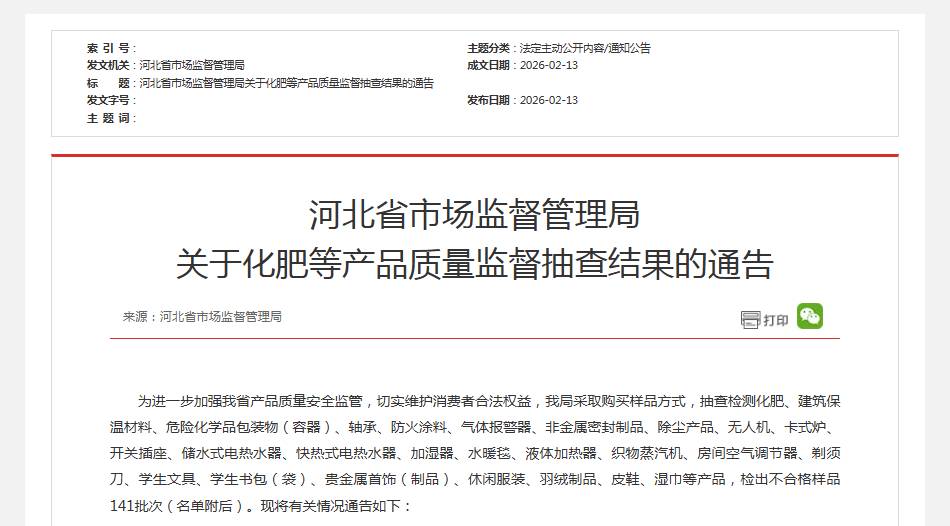
河北省市场监督管理局发布化肥等产品质量监督抽查结果
Xin Lang Cai Jing· 2026-02-14 09:15
Core Viewpoint - The Hebei Provincial Market Supervision Administration has released the results of quality supervision and spot checks on various products, revealing a total of 141 batches of non-compliant samples across multiple categories, including fertilizers, construction materials, and consumer goods [2][3]. Group 1: Fertilizers - A total of 18 batches of non-compliant fertilizer samples were identified during the inspection [2]. - Specific issues included non-compliance with total nutrient content and labeling requirements [3]. Group 2: Construction Materials - 19 batches of non-compliant samples were found in the category of construction insulation materials [2]. - Non-compliance was noted in terms of fire performance ratings and other safety standards [3]. Group 3: Hazardous Chemical Packaging - 1 batch of non-compliant hazardous chemical packaging was reported [2]. - Issues related to the durability and safety of the packaging materials were highlighted [3]. Group 4: Consumer Products - Non-compliance was detected in various consumer products, including: - 2 batches of gas alarms [4] - 2 batches of shavers [4] - 2 batches of student stationery [4] - 51 batches of precious metal jewelry [4] - 6 batches of leisure clothing [4] - 4 batches of down products [4] - 2 batches of leather shoes [4] - 4 batches of wet wipes [4] Group 5: Regulatory Actions - The local market supervision departments have been instructed to handle the identified non-compliant products according to the law [3]. - Consumers are encouraged to report any product quality violations through the hotline "12315" [3].
商务预报:2月2日至8日生产资料价格略有下降
Shang Wu Bu Wang Zhan· 2026-02-13 03:31
Group 1 - The national production material market prices decreased by 0.3% from February 2 to February 8 compared to the previous week [1] Group 2 - Non-ferrous metal prices slightly declined, with aluminum, zinc, and copper decreasing by 3.8%, 1.4%, and 0.4% respectively [2] - Steel prices continued to fall, with rebar, hot-rolled strip steel, and ordinary medium plate priced at 3350 yuan, 3510 yuan, and 3627 yuan per ton, decreasing by 0.3%, 0.2%, and 0.2% respectively [2] - Coal prices showed a slight decrease, with anthracite, thermal coal, and coking coal priced at 1134 yuan, 776 yuan, and 1048 yuan per ton, decreasing by 0.4%, 0.1%, and 0.1% respectively [2] Group 3 - Rubber prices experienced a slight decline, with synthetic rubber and natural rubber both decreasing by 0.1% [3] - Basic chemical raw material prices showed minor fluctuations, with sulfuric acid increasing by 1.1%, while soda ash, polypropylene, and methanol decreased by 1.2%, 0.8%, and 0.6% respectively [3] - Fertilizer prices saw a slight increase, with compound fertilizer and urea rising by 0.2% and 0.1% respectively [3] Group 4 - Wholesale prices of finished oil slightly increased, with 95-octane gasoline, 92-octane gasoline, and 0-octane diesel rising by 1.8%, 1.7%, and 1.0% respectively [4]