
智能家电

Search documents
熊征宇履新武汉代理市长,近日已调研光谷江岸
Di Yi Cai Jing· 2025-12-03 03:09
据"武汉人大"消息,12月2日,武汉市十五届人大常委会举行第三十次会议决定,熊征宇任武汉市副市 长、代理市长。 公开资料显示,熊征宇,1970年6月出生,湖北咸宁人,在职硕士研究生学历、经济学硕士学位;1991 年7月从长沙交通学院公路与城市道路工程专业毕业后,长期在家乡咸宁工作,从公路总段工程队技术 员起步,长期在咸宁交通局系统工作,直到任副局长。 2004年,熊征宇调任咸宁市人民政府副秘书长,先后出任咸宁市通山县长、赤壁市长、通城县委书记、 嘉鱼县委书记。在出任县委书记期间,熊征宇被称作"拼命书记"。 2015年,中组部从全国2800多个县(市、区、旗)中遴选出102名"在县(市、区、旗)委书记岗位上取 得优异成绩的同志",授予"全国优秀县委书记"称号,熊征宇位列其中。 2016年,熊征宇升任咸宁市委常委、常务副市长,次年离开家乡咸宁,转任湖北省纪委常委。此后数 年,熊征宇两度出任省纪委领导、两度调任地级市主官。 在宜昌市委书记岗位上,熊征宇多次强调,宜昌要紧紧扭住项目建设不放松,深入推进双碳引领、枢纽 赋能、强产兴城,为奋力打造全省支点建设先行区提供坚实支撑。在他任期内,远景动力智能锂电池生 产基地、楚 ...
熊征宇调研东湖高新区、江岸区时强调:抬升发展标杆,提振“四气”精神,当好全力打造“五个中心”、全面建设现代化大武汉的排头兵
Chang Jiang Ri Bao· 2025-12-03 00:40
Core Insights - The city is focusing on high-quality development and modernization, emphasizing the importance of technology innovation and economic transformation [1][2] Group 1: East Lake High-tech Zone - The East Lake High-tech Zone is identified as a leader in high-quality development and modernization, aiming to become a nationally influential technology innovation center [1] - The city plans to enhance the integration of technological and industrial innovation, accelerate the construction of East Lake Science City, and promote the development of "China Optics Valley" into a global hub [1] Group 2: Jiang'an District - Jiang'an District is recognized for its potential in headquarters economy and historical preservation, with a focus on urban renewal and improving environmental quality [2] - The district aims to develop digital economy and building economy, while also upgrading industries such as commerce, finance, construction, and design [2] Group 3: Economic Strategy - As the year-end approaches, there is a call for urgency in completing annual goals, enhancing economic operation management, and providing precise services to enterprises [2] - The city is preparing for next year's development by formulating the "15th Five-Year Plan" to ensure a strong start to the new year [2]

青岛“十四五”期间GDP连续跨越五个千亿级台阶
Zhong Guo Jing Ji Wang· 2025-12-02 14:48
Economic Growth - Qingdao's GDP is expected to exceed 1.7 trillion yuan this year, with an average annual growth rate of 5.9%, ranking among the top in similar cities [1] - The total retail sales of consumer goods have an average annual growth of 6.4%, surpassing 650 billion yuan, second only to Beijing among northern cities [1] - The total import and export volume has an average annual growth of 9.1%, exceeding 900 billion yuan, accounting for over 2% of the national total [1] Industrial Development - Qingdao focuses on the real economy during the 14th Five-Year Plan, accelerating the construction of the "10+1" innovative industrial system and the "4+4+2" modern marine industry system [2] - High-tech manufacturing added value has an average annual growth of 15.9%, with the ranking of advanced manufacturing cities rising from 11th in 2020 to 6th in 2024 [2] - The service sector's added value has surpassed 1 trillion yuan, with an average annual growth of 6.5%, contributing approximately 65% to economic growth [2] Technological Innovation - Qingdao places significant emphasis on technological innovation, with annual R&D expenditure growth averaging 11.6% over the past four years [3] - The number of high-tech enterprises and technology-based SMEs has reached 8,683 and 9,776 respectively, which is 1.98 times and 1.85 times that of the end of the 13th Five-Year Plan [3] - The total talent pool in Qingdao has reached 3 million, an increase of 700,000 compared to the end of the 13th Five-Year Plan [3] Reform and Opening Up - Qingdao has implemented 352 national and provincial reform pilot projects, ranking among the top ten in the national business environment for three consecutive years [4] - The number of private enterprises has reached 2.062 million, with nearly 300,000 new entities added since the end of the 13th Five-Year Plan [4] - The city has attracted a total of 18.47 billion USD in foreign investment, accounting for 22.6% of the province's total [4]
“十四五”期间,青岛消费品零售总额在北方城市中仅次于北京
Sou Hu Cai Jing· 2025-12-02 09:45
Economic Growth - Qingdao's GDP is expected to exceed 1.7 trillion yuan in 2023, with an average annual growth rate of 5.9% during the "14th Five-Year Plan" period [1][3] - The city's GDP has crossed five 100 billion yuan thresholds, indicating significant economic advancement [3] Productivity and Income - Labor productivity is projected to reach 311,000 yuan per person in 2024, with an annual growth rate of 6.4%, surpassing GDP growth [3] - Per capita GDP increased from 127,000 yuan in 2020 to 161,000 yuan in 2024, a cumulative growth of 21.3%, equivalent to approximately 23,000 USD [3] Retail and Trade - Social consumer goods retail sales are expected to grow at an annual rate of 6.4%, surpassing 650 billion yuan, ranking second among northern cities after Beijing [3] - The total import and export volume is projected to grow at an annual rate of 9.1%, exceeding 900 billion yuan, accounting for over 2% of the national total [3] Industrial Development - High-tech manufacturing value added is expected to grow at an annual rate of 15.9%, with Qingdao's ranking in the national advanced manufacturing city list improving from 11th in 2020 to 6th in 2024 [4] - The service sector's added value is projected to exceed 1 trillion yuan, contributing approximately 65% to economic growth [4] Marine Economy - The marine economy's output value is expected to exceed 550 billion yuan, ranking third among coastal cities in China, constituting 33% of the GDP [5] - Qingdao Port's cargo and container throughput has risen to 4th and 5th globally, respectively, with container sea-rail intermodal transport maintaining the national lead for ten consecutive years [5] Technological Innovation - The number of high-tech enterprises has reached 8,683, nearly double that at the end of the "13th Five-Year Plan" [6] - R&D expenditure has grown at an annual rate of 11.6%, with significant advancements in technology transfer and innovation capabilities [6] Talent and Employment - The total talent pool in Qingdao has reached 3 million, an increase of 700,000 since the end of the "13th Five-Year Plan" [7] - The city has created 1.81 million new urban jobs, with a focus on improving education and healthcare facilities [11] Foreign Investment and Open Economy - Cumulative foreign investment has reached 18.47 billion USD, accounting for 22.6% of the province's total [8] - Qingdao has been designated as a northern gateway for foreign trade, with significant progress in establishing major open platforms [8] Infrastructure Development - Qingdao has achieved "county-level high-speed rail connectivity" and has the highest highway mileage in the province [9] - The city has improved urban infrastructure, including the expansion of metro lines and the construction of new parks and fitness facilities [10] Environmental Sustainability - Qingdao has been selected as a national pilot for green city development and carbon peak initiatives, with renewable energy capacity reaching 8.06 million kilowatts, 3.3 times that of 2020 [10] - Pollution control measures have led to significant reductions in PM2.5 and PM10 concentrations [10]

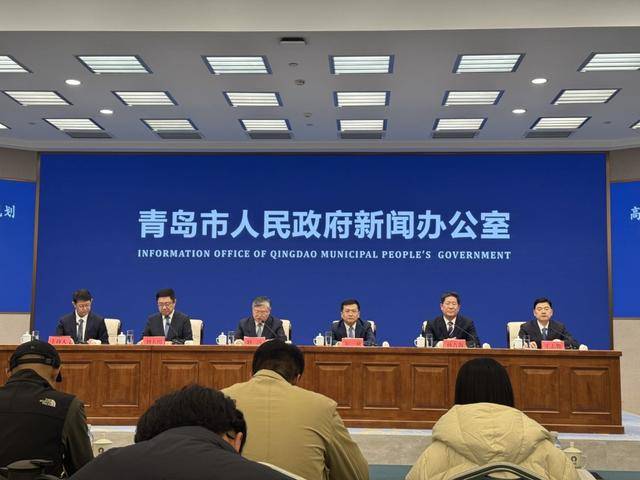
青岛“十四五”产业能级跃升:服务业增加值突破万亿大关 社会消费品零售总额居北方城市第二
Sou Hu Cai Jing· 2025-12-02 04:27
Group 1 - Qingdao has focused on developing its real economy, accelerating the construction of an innovative industrial system, including "10+1" innovation industries and "4+4+2" modern marine industry systems, leading to a new enhancement in industrial capability [1] - Key enterprises such as Chipone, BOE, GoerTek, Haier Kaos, and Chery have played a significant role in driving development, with four clusters recognized as national advanced manufacturing clusters, ranking second among sub-provincial cities [1] - The added value of high-tech manufacturing has grown at an annual rate of 15.9%, with Qingdao's ranking among the top 100 advanced manufacturing cities in China rising from 11th in 2020 to 6th in 2024 [1] Group 2 - The service sector has become a major engine for economic growth, with its added value surpassing 1 trillion yuan, growing at an annual rate of 6.5%, and contributing 65% to economic growth [1] - Qingdao has been recognized as a national pilot city for the integration of modern service and advanced manufacturing industries, leading the country in the number of such pilot projects [1] - The marine economy has shown distinctive features, with marine production value exceeding 550 billion yuan, accounting for 33% of the regional GDP, marking "blue energy" as a new highlight in urban development [2] Group 3 - The total retail sales of consumer goods have grown at an annual rate of 6.4%, surpassing 650 billion yuan, ranking second among northern cities after Beijing [2] - The total import and export volume has increased at an annual rate of 9.1%, exceeding 900 billion yuan, accounting for over 2% of the national total [2] - Qingdao Port's cargo and container throughput has risen to 4th and 5th globally, respectively, with the container sea-rail intermodal transport volume maintaining the top position in the country for ten consecutive years [2]
融捷健康:安徽乐金环境科技有限公司的智能床面清洁机器人待发售中
Zheng Quan Ri Bao Zhi Sheng· 2025-12-01 10:07
Core Viewpoint - Rongjie Health announced the features of its intelligent bed cleaning robot developed by Anhui Lejin Environmental Technology Co., Ltd, which integrates multiple cleaning functions and is designed for specific user needs [1] Product Features - The intelligent bed cleaning robot combines high-frequency beating, powerful suction, and ultraviolet sterilization to effectively remove allergens such as dust mites, dust, skin flakes, and pet hair [1] - It is equipped with an intelligent sensing system that allows for autonomous navigation, obstacle avoidance, and fall prevention, enabling fully automated operation with a one-button start [1] - The product is particularly suitable for pet owners, allergy sufferers, and busy professionals, addressing their specific cleaning needs [1] Market Status - The product is currently pending release for sale [1]


安徽滁州推进质量强基赋能工程实现质量提升与经济发展同频共振
Zhong Guo Zhi Liang Xin Wen Wang· 2025-12-01 03:41
Core Viewpoint - Anhui Chuzhou is advancing a quality empowerment project to synchronize quality improvement with economic development, achieving significant milestones in standardization, brand cultivation, and service enhancement [1][2][3]. Group 1: Quality Foundation and Support System - Chuzhou's market supervision bureau is focusing on four key quality foundation aspects: standards, measurement, certification, and inspection, aiming to build a "one-stop" service system [2]. - The city has participated in the revision of 404 national standards and has established 14 national standardization pilot projects, with 30 innovative standard enterprises cultivated [2][3]. - A total of 121 inspection and testing institutions and 1 registered certification body are operational, with 3,582 certified organizations and 14,169 various certification documents issued [1]. Group 2: Talent and Technical Support - The implementation of the chief quality officer system has resulted in 2,432 chief quality officers across enterprises, ensuring comprehensive coverage among regulated enterprises [4]. - The city has conducted 10 key projects this year, addressing 18 quality bottlenecks, with notable achievements in technology recognized by international awards [4]. Group 3: Brand Cultivation and Economic Value - The market supervision bureau is systematically promoting brand cultivation to transform quality into brand recognition and economic value [5]. - Over 150 regulated enterprises have adopted excellence performance management models, and 61 enterprises have been nurtured for the mayor's quality award [6]. Group 4: Innovative Services and Financial Support - Chuzhou has launched the "Chuzhou Quality Loan" service, benefiting 1,534 enterprises with a total application amount of 3.2 billion and actual loans of 2.467 billion [7]. - The city has established a new media matrix to enhance quality service awareness through short video accounts and regular updates on quality service dynamics [7].
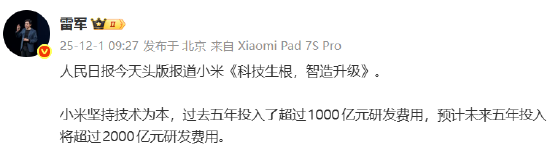
小米登上《人民日报》头版,雷军:小米坚持技术为本
Xin Lang Ke Ji· 2025-12-01 01:43
Core Insights - Xiaomi emphasizes its commitment to technology and innovation, having invested over 100 billion yuan in R&D over the past five years, with plans to invest over 200 billion yuan in the next five years [1][5][6] Group 1: R&D and Innovation - Xiaomi's R&D investment for 2024 is projected to exceed 24 billion yuan, with total expected investment over the next five years surpassing 200 billion yuan [5] - The company employs over 24,000 R&D personnel, accounting for nearly 50% of its total workforce [5] - Xiaomi focuses on three key technology areas: chips, artificial intelligence, and operating systems, aiming to integrate AI into various products [5][6] Group 2: Manufacturing and Production Efficiency - Xiaomi's automotive factory utilizes advanced manufacturing techniques, reducing production time by 45% and manufacturing processes by 80% through the use of integrated die-casting equipment [8][9] - The company has established large smart factories for automotive, smartphones, and smart home appliances, enhancing digital and intelligent production management [9] Group 3: Global Expansion and Market Presence - Xiaomi ranks among the top three smartphone vendors in 57 countries and regions, with significant market shares in Latin America, the Middle East, Europe, Southeast Asia, and Africa [11][12] - The company is expanding its retail presence in Southeast Asia, with plans to open over 130 new stores by the third quarter of 2025 [12] - Xiaomi's global operations have created over 2,000 foreign jobs and established 11 cooperative factories in seven countries, contributing to local economic development [13]
科技生根 智造升级(走企业,看高质量发展)
Ren Min Ri Bao· 2025-11-30 22:20
Core Insights - Xiaomi is focusing on technological innovation to drive high-quality development, with significant investments in research and development planned for the coming years [2][3]. Group 1: Technological Innovation - Xiaomi's self-developed 3nm processor chip, the Xuanjie O1, integrates approximately 19 billion transistors, showcasing the company's commitment to advanced technology [1]. - The company plans to invest over 24 billion yuan in R&D in 2024, with a projected total of over 200 billion yuan in the next five years [2]. - Xiaomi emphasizes three key technology areas: chips, artificial intelligence, and operating systems, aiming to integrate these into a comprehensive ecosystem of smartphones, smart homes, and vehicles [2]. Group 2: Manufacturing and Efficiency - Xiaomi's automotive factory utilizes advanced manufacturing techniques, including a 9100-ton die-casting machine that reduces manufacturing processes by 80% and production time by 45% [4]. - The factory employs over 300 sensors for real-time monitoring of production parameters, enhancing quality control and efficiency [4]. Group 3: Supply Chain and Collaboration - Xiaomi's smart manufacturing platform has connected over 200 manufacturing enterprises, improving production efficiency and product quality across various sectors [5]. - The implementation of this platform has led to significant cost savings and efficiency improvements for partners, exemplified by a refrigerator factory expecting to save over 8 million yuan this year [5]. Group 4: Global Expansion - Xiaomi ranks among the top three smartphone brands in 57 countries and regions, with a strong presence in Latin America and the Middle East [6]. - The company is expanding its retail presence in Southeast Asia, with plans to open over 130 new stores by the third quarter of 2025, enhancing brand visibility and consumer experience [7]. - Xiaomi's global operations have created over 2,000 foreign jobs and established 11 cooperative factories in seven countries, contributing to local economic development [8]. Group 5: Brand Perception - The focus on innovation and quality is reshaping the global perception of Chinese technology companies, with Xiaomi leading this change [9].

全球消费者始终青睐的背后……大促季见证中国商品出海历程
Bei Jing Wan Bao· 2025-11-29 01:13
Core Insights - The traditional year-end shopping season in Europe and the US, marked by "Black Friday," is witnessing a significant participation of Chinese products, which are reshaping the global consumption landscape through technological empowerment and supply chain advantages [1][2] - Despite the growth in orders during this period, Chinese merchants face new challenges due to tariff adjustments and policies targeting Chinese goods and e-commerce platforms [2][4] - The shift from "cost-driven" to "technology and culture integration" in Chinese exports is accelerating, necessitating a multi-faceted approach to overcome challenges [1][13] Group 1: Market Dynamics - Amazon launched its "Black Friday" promotions on November 20, with other platforms like TikTok Shop and Temu also engaging in extensive sales activities [2] - Chinese exports, particularly in sectors like lithium batteries and AI toys, have seen significant growth, with sales to the US market increasing over 60% year-on-year [2][3] - The overall shipping volume from September to October increased by approximately 20% to 30% compared to the previous year, indicating a robust pre-holiday demand [2] Group 2: Pricing and Consumer Behavior - Chinese brands are prominently featured in European retail, with significant discounts on products such as Xiaomi phones and Haier refrigerators, showcasing competitive pricing strategies [3] - The new tariff policies in the EU and the UK are expected to impact pricing, with consumers expressing concerns over potential price increases in the future [4][5] - A survey indicated that 61% of consumers plan to increase their spending during "Black Friday," with an average budget of 312 euros, highlighting a strong consumer interest despite rising costs [6] Group 3: Regulatory Challenges - The EU's decision to eliminate the tax exemption for packages under 150 euros is seen as a direct challenge to Chinese e-commerce platforms, which have rapidly gained market share [4][7] - Similar tariff policies are being implemented in the UK and the US, with the aim of increasing tax revenue but potentially leading to higher prices for consumers [4][8] - Retailers are adjusting their promotional strategies in response to these tariffs, with some reducing the variety of discounted items and others eliminating uniform discounts altogether [4][9] Group 4: Future Trends - The transformation of Chinese exports is characterized by a shift towards high-tech and design-oriented products, moving away from basic consumer goods [12][13] - The future of Chinese exports is expected to focus on digitalization, sustainability, and service-oriented solutions, with emerging sectors like green energy and smart hardware showing high growth potential [13]

