
消费品制造业

Search documents
详解4月经济数据:工业增速维持高位,扩内需政策效应持续释放
Di Yi Cai Jing· 2025-05-19 08:11
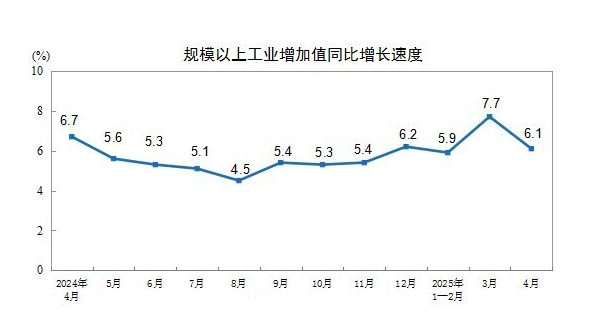
Economic Overview - The long-term positive fundamentals of the economy remain unchanged despite external shocks and internal challenges [1][2] - In April, major economic indicators showed stability under pressure, with industrial value-added increasing by 6.1% year-on-year, retail sales growing by 5.1%, and fixed asset investment rising by 4.0% [1][2] Industrial Production - Industrial production continues to be a key support for stable economic growth, with a notable increase in high-tech manufacturing, which grew by 10% in April [4][5] - Among 41 major industries, 36 experienced year-on-year growth, with significant increases in integrated circuit manufacturing (21.3%) and optoelectronic device manufacturing (19%) [5][6] - The "Two New" policies are driving industrial technology upgrades and expanding market demand, contributing to industrial production growth [6] Consumer Spending - Policies aimed at boosting consumption are showing effects, with retail sales of consumer goods increasing by 4.7% year-on-year in the first four months of the year [8][9] - Specific categories such as home appliances and cultural office supplies saw substantial growth, with increases of 38.8% and 33.5% respectively in April [8] - Service consumption, particularly in travel and communication, is also experiencing rapid growth, indicating a recovery in consumer confidence [8] Investment Trends - Fixed asset investment grew by 4% in the first four months, driven by significant increases in equipment investment (18.2%) [11][12] - Manufacturing investment rose by 8.8%, with consumer goods and equipment manufacturing investments growing by 13.4% and 8.2% respectively [11] - Infrastructure investment remains stable, with a year-on-year increase of 5.8%, supported by the issuance of local government bonds and increased corporate loans for infrastructure projects [12]

制造业PMI有所回落,非制造业PMI继续扩张—— 我国经济总体产出持续扩张
Jing Ji Ri Bao· 2025-05-02 22:08
Core Viewpoint - The manufacturing Purchasing Managers' Index (PMI) in April dropped to 49%, indicating a contraction, while the non-manufacturing business activity index and the composite PMI output index remained in the expansion zone at 50.4% and 50.2% respectively, reflecting a stable economic foundation despite external uncertainties [1][5]. Manufacturing Sector - The manufacturing PMI decreased by 1.5 percentage points in April, attributed to external environmental changes and seasonal factors, as March is typically a peak season for manufacturing [1][2]. - The new orders index for manufacturing was significantly higher than the new export orders index, indicating stable domestic demand despite a decline in export orders [2]. - High-tech manufacturing sectors continued to expand, showing resilience in production activities [5]. Non-Manufacturing Sector - The non-manufacturing PMI stood at 50.4%, down 0.4 percentage points from the previous month, but still indicating stable expansion [3]. - The construction sector showed robust activity, particularly in infrastructure, with the civil engineering business activity index rising over 5 percentage points to above 60% [3]. - Consumer sectors, including travel and leisure, experienced increased activity, with indices for air transport and entertainment rising above 55% and 51% respectively [3]. Economic Outlook - The composite PMI output index was at 50.2%, down 1.2 percentage points, but still above the critical point, indicating overall production expansion [5]. - Experts suggest that despite short-term disruptions from global uncertainties, the economic foundation remains solid, supported by a large domestic market and effective policy measures [2][4]. - The business activity expectation index for non-manufacturing remained high at over 56%, reflecting optimism among enterprises regarding future market conditions [4][6].
4月份制造业PMI公布 如何看待这一指标变化?专家解读
Yang Shi Xin Wen· 2025-04-30 11:25
Group 1 - In April, China's manufacturing Purchasing Managers' Index (PMI) fell to 49%, a decrease of 1.5 percentage points from the previous month, indicating a contraction in the manufacturing sector [1] - The decline in the manufacturing PMI is attributed to external factors, particularly the impact of U.S. tariffs, as well as a correction following a significant rebound in March [1][2] - The new export orders index dropped by 4.3 percentage points in April, reflecting a tightening in short-term export demand and overall market demand [1] Group 2 - Despite the challenges in foreign trade, China's economic foundation remains solid, supported by its large market size and complete industrial supply chain, which can effectively withstand external shocks [1] - In the context of weak overall market demand, new momentum in the manufacturing sector continues to show stable growth, with high-tech manufacturing new orders index above 53% and equipment manufacturing new orders index above 51% [2] - The production index for high-tech manufacturing remains at a favorable level of 52%, while the production index for consumer goods manufacturing stays above 50%, indicating ongoing stability in these sectors [2] Group 3 - The manufacturing activity expectation index for April remains optimistic at over 52%, suggesting that enterprises maintain a positive outlook for future production and operations [2] - The recent meeting of the Central Political Bureau emphasized the need for proactive macroeconomic policies and measures to support struggling enterprises, aiming to stabilize economic growth [2][3] - Globally, major economies are experiencing a contraction in manufacturing due to increased uncertainty in trade environments, highlighting the need for high-quality development to address external challenges [3]
4月制造业PMI为49%,但这一产业延续高景气
券商中国· 2025-04-30 09:55
重要数据披露! 4月30日,国家统计局服务业调查中心和中国物流与采购联合会发布了4月份中国采购经理指数。其中,制造业采购 经理指数(制造业PMI)为49.0%,比上月下降1.5个百分点。 分析认为,4月份外贸环境的变化给我国制造业带来一定的扰动,市场需求和企业生产短期有所放缓,原材料采购、 市场价格等方面也有所波动,但国内需求稳定释放,缓解了出口订单下行的压力,新动能和消费品生产继续稳中有 增。 新出口订单指数环比走低 4月份,制造业PMI比上月下降1.5个百分点,至49.0%,降至临界点以下。 国家统计局服务业调查中心高级统计师赵庆河表示,这是受前期制造业较快增长形成较高基数叠加外部环境急剧变 化等因素影响。 从13个分项指数来看,同上月相比,生产指数、新订单指数、新出口订单指数积压订单指数、产成品库存指数、采 购量指数、进口指数、购进价格指数、出厂价格指数、原材料库存指数、从业人员指数、供应商配送时间指数和生 产经营活动预期指数均下降,指数降幅在0.1至5.5个百分点之间。 中国人民大学统计学院教授、中国调查与数据中心副主任吴翌琳对记者表示,4月中国制造业PMI景气度环比走低主 要是受外需收缩和政策效应递 ...
重磅数据出炉!
证券时报· 2025-04-30 09:32
4月30日,国家统计局服务业调查中心和中国物流与采购联合会发布了4月份中国采购经理指数。 其中,制造业采购经理指数(制造业PMI)为49.0%,比上月下降1.5个百分点。分析认为,4月份外贸环境的变化给我国制造业带来一定的扰动,市场需求和企业 生产短期有所放缓,原材料采购、市场价格等方面也有所波动,但国内需求稳定释放,缓解了出口订单下行的压力,新动能和消费品生产继续稳中有增。 新出口订单指数环比走低 4月份,制造业PMI比上月下降1.5个百分点,至49.0%,降至临界点以下。 国家统计局服务业调查中心高级统计师赵庆河表示,这是受前期制造业较快增长形成较高基数叠加外部环境急剧变化等因素影响。 从13个分项指数来看,同上月相比,生产指数、新订单指数、新出口订单指数、积压订单指数、产成品库存指数、采购量指数、进口指数、购进价格指数、出厂价 格指数、原材料库存指数、从业人员指数、供应商配送时间指数和生产经营活动预期指数均下降,指数降幅在0.1至5.5个百分点之间。 中国人民大学统计学院教授,中国调查与数据中心副主任吴翌琳对记者表示,4月中国制造业PMI景气度环比走低主要是受外需收缩和政策效应递减以及大宗商品价 格波动 ...
消费品制造业国内市场需求释放 投资、消费表现积极
Yang Shi Wang· 2025-04-30 09:11
Group 1: Manufacturing Sector - In April, the Manufacturing Purchasing Managers' Index (PMI) was reported at 49%, a decrease of 1.5 percentage points from the previous month, indicating a slight contraction in the manufacturing sector [3] - High-tech manufacturing PMI stood at 51.5%, significantly above the overall manufacturing level, indicating continued expansion in this sector [5] - The new orders index for consumer goods manufacturing was at the critical point of 50%, suggesting a good release of domestic market demand [5] Group 2: Business Confidence and Expectations - The production and business activity expectation index for April was 52.1%, remaining in the expansion zone, reflecting strong confidence among enterprises regarding market development [5] - Industries such as food and beverage, automotive, and aerospace showed high expectation indices of 58% and above, indicating robust business activity [7] Group 3: Non-Manufacturing Sector - The non-manufacturing business activity index was at 50.1%, a slight decrease of 0.2 percentage points from the previous month, but still above the critical point, indicating continued expansion [8] - The service sector, particularly tourism and information services, showed positive performance, contributing to the overall growth in non-manufacturing activities [8][9] Group 4: Construction Sector - The construction business activity index was reported at 51.9%, a decrease of 1.5 percentage points from the previous month, yet still indicating expansion [9] - With the arrival of the construction peak season, civil engineering investment is accelerating, highlighting the role of investment in driving economic growth [10]
4月份中国制造业采购经理指数为49% 企业生产经营总体稳定
news flash· 2025-04-30 01:33
Core Viewpoint - In April, China's manufacturing Purchasing Managers' Index (PMI) decreased to 49%, reflecting a decline of 1.5 percentage points from the previous month, influenced by rapid changes in the external environment, while high-tech manufacturing sectors continued to expand [1] Group 1: Manufacturing PMI - The overall manufacturing PMI for April is reported at 49%, indicating a contraction in the manufacturing sector [1] - The decline in the manufacturing PMI is attributed to external environmental changes [1] Group 2: High-Tech Manufacturing - The high-tech manufacturing PMI stands at 51.5%, significantly above the overall manufacturing level, indicating a sustained positive development trend [1] - The demand in the new momentum market remains stable with an overall increase [1] Group 3: Consumer Goods Manufacturing - The new orders index for consumer goods manufacturing is at the critical point of 50%, suggesting a good release of domestic market demand [1] Group 4: Business Expectations - The production and business activity expectation index for April is at 52.1%, remaining in the expansion zone [1]
中国盈利系列十:工企利润回暖
Hua Tai Qi Huo· 2025-04-28 06:18
Group 1: Report Title and Macro Event - Report title: "Industrial Enterprises' Profit Recovery - China's Profit Series Ten" [1] - Macro event: On April 27, 2025, the National Bureau of Statistics announced that from January to March, the total profit of industrial enterprises above designated size in China reached 1,509.36 billion yuan, a year - on - year increase of 0.8% [2] Group 2: Core Views Revenue Pressure Still Exists Overall Situation - Profit growth rebounds, but demand - side pressure remains. From January to March 2025, the total profit of industrial enterprises above designated size increased by 0.8% year - on - year, reversing the continuous decline since Q3 2024. In March, the single - month profit growth rate rebounded to 2.6%, a significant improvement from - 0.3% in January - February. This is due to the policy drive and the recovery of overseas orders. However, inventory pressure restricts profit space, and weak infrastructure and real estate demand drag down some upstream industries [3] - Policy drive: The "Two New" policies (large - scale equipment renewal and consumer goods trade - in) drove the profit of the equipment manufacturing industry to increase by 7.6% year - on - year, contributing over 40% to industrial profit growth [3] - Overseas orders: Overseas orders boosted the profit of export - dependent industries. From January to March, the profit of the electronics industry increased by 3.2%, and that of railway and ship transportation equipment increased by 14.2%. The profit of the consumer goods manufacturing industry increased by 7.1%, and industries such as chemical fiber and paper - making saw profit growth of 181% and 155% respectively due to a surge in export orders [3] - Inventory pressure: At the end of March, the year - on - year growth of finished product inventory was 4.2%, the actual inventory growth rate was 6.4%, and the turnover days of finished products increased to 22.3 days, indicating a slow de - stocking process [3] - Weak upstream industries: The profit of the coal mining industry decreased by 47.7% year - on - year, and the ferrous metal smelting industry was still on the verge of profit and loss due to weak infrastructure and real estate demand [3] Structural Situation - New and old kinetic energy differentiation intensifies, and policy dividends tilt towards the middle and lower reaches. The equipment manufacturing industry became the core growth engine, with a 7.6% year - on - year profit increase in Q1. The raw material industry showed obvious internal differentiation, and the consumer goods manufacturing industry showed resilience [4] - Equipment manufacturing industry: The profit of specialized equipment manufacturing (+14.2%) and general equipment manufacturing (+9.5%) was significantly higher than the industrial average. The electronics industry had bright spots in some sub - sectors [4] - Raw material industry: The profit of the non - ferrous metal smelting and rolling processing industry increased by 33.6% year - on - year, while the ferrous metal smelting industry was on the verge of profit and loss, and the coal mining industry's profit decreased by 47.7% [4] - Consumer goods manufacturing industry: Industries such as chemical fiber (+181%) and paper - making (+155%) had explosive growth. However, the automobile manufacturing industry (- 6.2%) was still restricted by the industrial chain adjustment [4] Group 3: Appendix - Interpretation of Industrial Enterprise Profit Data - Profit turns from decline to growth: In Q1 2025, the profit of industrial enterprises above designated size turned from a 3.3% year - on - year decline in the previous year to an 0.8% increase, and in March, it turned from a 0.3% decline in January - February to a 2.6% increase [29] - Revenue growth accelerates: In Q1, the revenue of industrial enterprises above designated size increased by 3.4% year - on - year, 0.6 percentage points faster than in January - February. In March, it grew by 4.2%, 1.4 percentage points faster than in January - February [29] - Nearly 60% of industries see profit growth: Among 41 industrial sectors in Q1, 24 had year - on - year profit growth, and 24 had accelerated profit growth or narrowed declines. The manufacturing industry improved significantly, with a 7.6% profit growth in Q1, 2.8 percentage points faster [30] - Equipment manufacturing supports profit growth: In Q1, the profit of the equipment manufacturing industry increased by 6.4% year - on - year, 1.0 percentage point faster than in January - February, accounting for 32.0% of the total profit of industrial enterprises above designated size, and pulling the total profit growth by 2.0 percentage points [30] - High - tech manufacturing leads high - quality development: In Q1, the profit of high - tech manufacturing turned from a 5.8% decline in January - February to a 3.5% increase. In March, it had double - digit growth, pulling the total profit growth by 2.8 percentage points [31] - "Two New" policies are effective: The "Two New" policies drove the profit growth of relevant industries. The profit of specialized and general equipment industries increased by 14.2% and 9.5% respectively, and consumer goods trade - in policies boosted related industries [32]
薛鹤翔:贸易战背景下国内消费的韧性——中国宏观经济周报
Sou Hu Cai Jing· 2025-04-14 17:49
Core Insights - The policies aimed at boosting consumer demand are showing positive effects, with March's consumption market reflecting a favorable trend due to both policy and seasonal factors [2][6][12] - The Consumer Price Index (CPI) experienced a smaller decline than the seasonal average, indicating a recovery in consumer demand and market stability [3][7][12] - The Producer Price Index (PPI) continues to decline, but some industries are witnessing positive price changes due to improved supply-demand structures [4][9][12] Consumer Market - In March, the CPI decreased by 0.4% month-on-month and 0.1% year-on-year, with the decline narrowing significantly compared to previous years [6][12] - Core CPI showed a notable recovery, increasing by 0.5% year-on-year, driven by rising service prices and industrial consumer goods prices [2][6][12] - The price of household appliances and gold jewelry has risen significantly, exceeding the average increase over the past decade [2][6] Industrial Production - The PPI fell by 0.4% month-on-month and 2.5% year-on-year, influenced by international input factors and seasonal declines in energy demand [4][12] - High-tech industries are experiencing rapid development, leading to improved supply-demand structures and positive price changes in certain sectors [4][9] External Factors - The U.S. has implemented a 10% baseline tariff on global imports and specific tariffs on 60 countries, including 34% on China, which may impact international trade dynamics [4][13][25] - Countries are responding differently to the U.S. tariff policies, with China retaliating and the EU preparing for negotiations [4][13] Policy Outlook - The government is expected to continue implementing policies to stimulate consumer demand and support economic recovery, including fiscal measures and monetary policy adjustments [22][23][24] - The focus will be on enhancing domestic demand, promoting equipment upgrades, and improving the overall economic environment [24][25]
3月PMI数据点评:新动能持续蓄势,价格仍是PMI的主要拖累
Zhong Cheng Xin Guo Ji· 2025-04-14 08:53
Group 1: PMI Data Insights - The manufacturing PMI for March 2025 is reported at 50.5%, an increase of 0.3 percentage points from the previous month[2] - The new orders index rose to 51.8%, up 0.7 percentage points, indicating improved demand[12] - The service sector PMI increased to 50.3%, reflecting a 0.3 percentage point rise, while the construction PMI reached 53.4%, the highest since June of the previous year[9] Group 2: Economic Trends and Challenges - Despite the positive PMI trends, the overall economic recovery remains weak, with manufacturing PMI still below seasonal averages[2] - The manufacturing sector is experiencing passive destocking, with finished goods inventory index dropping to 48.0%, indicating a supply-demand gap[4] - Price indices for both factory and raw material purchases fell by 0.6 and 1.0 percentage points, respectively, suggesting ongoing price pressures on profitability[4] Group 3: Sector Performance - High-tech manufacturing and equipment manufacturing sectors are showing significant recovery, with PMIs of 52.3% and 52.0%, respectively[4] - Small and medium-sized enterprises (SMEs) saw a notable rebound in PMI, with small enterprises reaching 49.6%, the highest level since June of the previous year[4] - The construction sector is facing challenges due to funding pressures and low new order indices, which fell to 43.5%[9]