
文体娱乐业

Search documents
3月PMI数据点评:制造业PMI超季节性回升,价格大幅上行
Western Securities· 2026-04-01 05:51
1. Report Industry Investment Rating No relevant content provided. 2. Core Viewpoints of the Report - In March, the manufacturing PMI exceeded seasonal expectations and returned above the boom - bust line, with the production index seasonally rebounding, both domestic and external demand improving, and enterprises actively replenishing inventories. The service industry PMI returned to the expansion range, while the construction industry was still in the contraction range, and cost - rising pressure emerged. The subsequent focus should be on international situation changes and promoting various economic - stabilizing policies [1][10]. - The improvement in the manufacturing PMI in March led to some adjustments in the bond market. The current core driving factors of the market are the Middle East situation, inflation expectations, and the increasing allocation power in the bond market. Ultra - long - term interest rates have entered a stage of restorative decline, and the bond market is expected to be volatile and bullish. Future attention should be paid to the persistence of the decline in risk appetite, the situation of fundamental recovery, and the special treasury bond issuance plan in Q2 [4][36]. 3. Summary by Relevant Catalogs 3.1 3 - month PMI Data Review - Manufacturing: In March, the manufacturing PMI was 50.4%, a 1.4 - percentage - point increase from the previous month, returning above the boom - bust line after two months. The production index seasonally recovered, both domestic and external demand improved, the price index rebounded significantly, enterprises actively replenished inventories, and procurement volume returned to the expansion range [10]. - Non - manufacturing: The service industry PMI returned to the expansion range, and the construction industry's contraction slowed down. In March, the service industry business activity index rose 0.5 percentage points to 50.2%, and the construction industry business activity index rose 1.1 percentage points to 49.3%. However, the month - on - month performance of both was weaker than the non - epidemic Spring Festival seasonality [12][15]. 3.2 Manufacturing: Simultaneous Improvement in Production and Demand, and a Significant Rebound in the Price Index - Production: The manufacturing PMI production index in March was 51.4%, a 1.8 - percentage - point increase from the previous month, returning to the expansion range. This was due to the return of employees after the Spring Festival, the recovery of market demand, and the further manifestation of policy effects [16]. - Demand: Both domestic and external demand improved. The proportion of manufacturing enterprises reporting insufficient market demand dropped to below 50% for the first time since July 2022. The new order and new export order indexes increased by 3.0 and 4.1 percentage points respectively. SMEs stabilized, and three key industries expanded rapidly [18][20]. - Price: Affected by rising commodity prices and accelerated corporate procurement, the main raw material purchase price index and ex - factory price index rose by 9.1 and 4.8 percentage points respectively. The ex - factory price index reached a new high since April 2022, indicating that the year - on - year growth rate of PPI in March is expected to turn positive [22]. - Inventory: Enterprises actively replenished inventories, and procurement volume returned to the expansion range. The raw material inventory and finished - product inventory indexes increased by 0.2 and 0.9 percentage points respectively, and the procurement volume index rose to 50.9% [23]. 3.3 Non - manufacturing: Service Industry PMI Returns to Expansion, Construction Industry's Contraction Slows Down - Service Industry: In March, the service industry's prosperity increased slightly by 0.5 percentage points, returning above the boom - bust line. Industries such as railway transportation, telecommunications, and finance were in a high - prosperity range, while consumer - related industries declined due to the high base of Spring Festival consumption [29]. - Construction Industry: In March, the construction industry business activity index rose 1.1 percentage points to 49.3%. The civil engineering construction industry showed a significant increase, while the housing construction industry was still below 50%. The overall recovery was slower than in previous post - holiday periods [32]. 3.4 Impact on the Bond Market - In March, the manufacturing PMI exceeded seasonal expectations, the service industry PMI returned to expansion, but the construction industry was still in contraction, and cost - rising pressure emerged. The bond market adjusted due to the improvement in the manufacturing PMI. The current core driving factors are the Middle East situation, inflation expectations, and the increasing allocation power in the bond market. The bond market is expected to be volatile and bullish, and future attention should focus on risk appetite, fundamental recovery, and the special treasury bond issuance plan in Q2 [36].
2月制造业PMI放缓,服务业数据亮眼
第一财经· 2026-03-04 03:10
Core Viewpoint - The manufacturing PMI in February decreased to 49.0%, indicating ongoing economic pressure, while the non-manufacturing business activity index rose slightly to 49.5%, reflecting some positive sentiment due to upcoming policy changes [2][5]. Manufacturing Sector Analysis - The manufacturing PMI dropped by 0.3 percentage points from the previous month, primarily due to the impact of the Spring Festival and ongoing economic pressures [2][5]. - The new orders index for manufacturing fell to 48.6%, down 0.6 percentage points, with significant declines in export orders, which dropped to 45%, a decrease of 2.8 percentage points [5][6]. - Production activities slowed, with the production index at 49.6%, down 1 percentage point, particularly affecting high-energy-consuming industries [6][8]. - The purchasing price index for raw materials decreased to 54.8%, down 1.3 percentage points, indicating a slowdown in price increases, while the factory price index remained stable at 50.6% [8]. Non-Manufacturing Sector Analysis - The non-manufacturing business activity index increased by 0.1 percentage points to 49.5%, with the service sector showing resilience despite remaining below the 50% threshold [10][12]. - The construction industry index fell to 48.2%, while the service industry index rose to 49.7%, driven by strong performance in consumer-related services such as retail and hospitality [11][12]. - The retail and new orders indices for the service sector rose above 50%, indicating a recovery in consumer spending post-Spring Festival [12].


2025年朝阳区实现地区生产总值9668.5亿元
Bei Jing Ri Bao Ke Hu Duan· 2026-02-09 05:13
Economic Overview - Chaoyang District achieved a GDP of 966.85 billion yuan in 2025, with a year-on-year growth of 5.2% in real terms [3] - The total retail sales of social consumer goods reached 260.03 billion yuan, with online retail sales in accommodation and catering amounting to 77.12 billion yuan, reflecting a year-on-year growth of 15.5% [4] Key Industries and Leading Enterprises - The financial sector contributed an added value of 181.33 billion yuan, growing by 14.3% year-on-year, accounting for nearly 20% of the district's GDP [4] - The top ten enterprises in sectors such as leasing, business services, information services, and transportation achieved revenue growth rates significantly higher than the city averages, with contributions to their respective sectors reaching 95.3%, 84.8%, 91.4%, and 123.6% [4] Innovation and R&D Dynamics - The number of high-tech and specialized enterprises increased, with revenues growing by 4.6% and 4.5% respectively, while AI enterprises saw an 11.5% revenue increase [7] - R&D expenses grew by 3.0%, and technology revenue increased by 12.9%, making up 36.2% of total revenue, which is 7.8 percentage points higher than the city average [8] Investment and Foreign Capital - Total construction and equipment investment accounted for over half of the district's investments, with an 8.7% year-on-year growth [10] - In 2025, 533 new foreign-funded enterprises were established, marking a 14.4% increase, with actual foreign capital utilization reaching 2.13 billion USD, a 33.9% increase [11]

2025年12月PMI点评:大幅高于季节性
CMS· 2025-12-31 10:01
Manufacturing Sector - December manufacturing PMI increased to 50.1, up 0.9 from the previous month, indicating a significant recovery above the seasonal level[1] - The production index rose to 51.7, an increase of 1.7, while the new orders index improved to 50.8, up 1.6[1] - The increase in manufacturing PMI is attributed to the implementation of the "two 500 billion" growth stabilization policies and year-end demand release[1] Service Sector - December service PMI recorded at 49.7, a slight increase of 0.2, but still below the neutral level of 50[1] - Consumer-related services remain weak due to seasonal effects, with retail, accommodation, and entertainment sectors below 50[1] - Financial activities continue to be robust, providing essential support for year-end economic performance[1] Construction Sector - December construction PMI rose to 52.8, an increase of 3.2 percentage points, marking a significant recovery after four months below 50[1] - The acceleration in construction activity is linked to increased investment in affordable housing and infrastructure projects[1] - Construction firms maintain optimistic market expectations, with the business expectation index remaining above 57 for two consecutive months[1] Overall Economic Outlook - The overall economic environment is characterized by a year-end push across sectors, supported by policy implementation and capital investment[1] - The manufacturing sector's recovery in December is seen as a corrective rebound after a weaker performance in November[1] - Anticipated consumer demand during the upcoming New Year and Spring Festival is expected to boost service sector performance in early next year[1]
姚记科技:聘任嵇文君为公司第六届董事会非独立董事
Mei Ri Jing Ji Xin Wen· 2025-11-18 10:34
Core Viewpoint - Yaoji Technology (SZ 002605) announced the appointment of Ms. Ji Wenjun as a non-independent director in its sixth board meeting, reflecting ongoing governance changes within the company [1] Company Summary - Yaoji Technology's revenue composition for the first half of 2025 is as follows: Internet marketing accounts for 36.19%, entertainment for 33.44%, cultural and sports entertainment for 29.8%, and other businesses for 0.58% [1] - As of the report, Yaoji Technology has a market capitalization of 10.6 billion yuan [1]

姚记科技:股东姚文琛、姚晓丽共减持公司股份200万股,本次减持计划期限届满
Mei Ri Jing Ji Xin Wen· 2025-11-14 12:08
Group 1 - The core point of the article is that Yaoji Technology (SZ 002605) announced the completion of a share reduction plan by its controlling shareholder, Yao Shoubin, who, along with his associates, reduced their holdings by 2 million shares, accounting for 0.48% of the company's total shares [1] - As of the announcement date, the market capitalization of Yaoji Technology is 10.6 billion yuan [1] - The revenue composition of Yaoji Technology for the first half of 2025 is as follows: Internet marketing accounts for 36.19%, entertainment for 33.44%, cultural and sports entertainment for 29.8%, and other businesses for 0.58% [1]
制造业PMI为何超季节性回落?:——2025年10月PMI点评
EBSCN· 2025-10-31 12:32
Manufacturing Sector - The manufacturing PMI for October 2025 is reported at 49.0%, a significant decrease of 0.8 percentage points from the previous month, which is notably higher than the seasonal average decline of 0.4 percentage points observed from 2020 to 2024[2][5] - The production index fell by 2.2 percentage points to 49.7%, while the new orders index decreased by 0.9 percentage points to 48.8%[5][15] - The new export orders index dropped to 45.9%, down 1.9 percentage points, marking the second-lowest level since the introduction of high tariffs in April 2025[5][20] - Small enterprises experienced a notable decline in PMI, falling 1.1 percentage points to 47.1%, while large enterprises' PMI decreased to 49.9%[6] Non-Manufacturing Sector - The non-manufacturing PMI for October 2025 is at 50.1%, slightly up from 50.0% in the previous month, driven by holiday consumption[2][28] - The service sector showed improvement, with indices for transportation, retail, and entertainment exceeding 60%, indicating strong performance in consumer-related services[28] - The construction PMI fell to 49.1%, but new orders and business activity expectations increased, suggesting a potential recovery in infrastructure activities[34] Economic Outlook - The report highlights that the construction sector may benefit from the introduction of 500 billion yuan in new policy financial tools and an additional 200 billion yuan in special bond issuance, which could support infrastructure investment[4][34] - The overall economic environment remains cautious due to external trade uncertainties and domestic demand stability, particularly in high-energy-consuming industries[16][20]
月度经济观察·10月份多领域数据出炉 经济继续保持平稳增长态势明显
Yang Shi Wang· 2025-10-31 05:36
Core Insights - The Purchasing Managers' Index (PMI) for China's manufacturing sector in October is reported at 49%, a decrease of 0.8 percentage points from the previous month, influenced by seasonal factors and external conditions [1][2] - Despite the decline in PMI, new momentum and consumer goods manufacturing are showing steady growth, with key sectors like equipment manufacturing and high-tech manufacturing remaining in the expansion zone [2][4] Manufacturing Sector - The equipment manufacturing price index reached a new high since June 2024, while the high-tech manufacturing price index hit a new high since 2025, indicating positive price changes in the manufacturing sector [4] - The production index and new orders index for key manufacturing sectors are operating around 51%, reflecting a stable expansion [2] Non-Manufacturing Sector - The non-manufacturing business activity index for October is at 50.1%, a slight increase of 0.1 percentage points from the previous month, maintaining levels above 50 since 2025 [7] - The service sector shows strong performance, particularly in contact-based services related to travel, shopping, and entertainment, with indices for railway and air transport exceeding 60% [6] Investment and Economic Outlook - There are signs of accelerated construction activities related to infrastructure investment, with the civil engineering business activity index rising above 55%, and new orders index increasing to over 49% [9] - The business activity expectation index for non-manufacturing is at 56.1%, indicating a positive outlook for the sector, supported by fiscal and monetary policy collaboration [9]
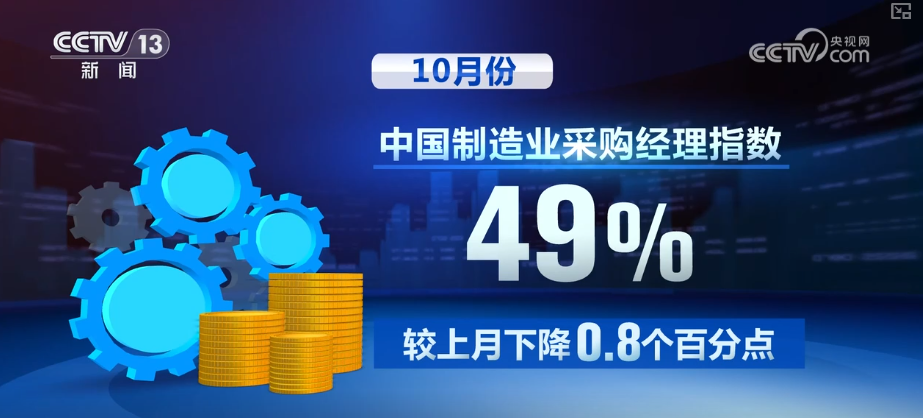
10月制造业采购经理指数为49%,制造业短期波动仍有趋稳基础
Bei Ke Cai Jing· 2025-10-31 03:36
Group 1: Manufacturing Sector - The manufacturing Purchasing Managers' Index (PMI) decreased to 49% in October, down 0.8 percentage points from the previous month, indicating a slowdown in production activities [1][2] - Various sub-indices, including production, new orders, and export orders, showed declines ranging from 0.1 to 2.6 percentage points, reflecting weakened demand and production activities across enterprises of all sizes [2][3] - The overall economic imbalance of supply exceeding demand continues to develop, leading to increased downward pressure on the economy, necessitating stronger macroeconomic policy adjustments [3] Group 2: Non-Manufacturing Sector - The non-manufacturing business activity index rose slightly to 50.1%, with several sub-indices, such as inventory and input prices, showing increases between 0.2 and 1.1 percentage points [1][4] - The new orders index remained stable compared to the previous month, indicating steady operational activities in the non-manufacturing sector, supported by holiday consumption [4][5] - Significant increases were observed in sectors like transportation, retail, and construction, with business activity indices exceeding 60%, suggesting a positive trend in investment and consumption-related activities [5]
10月份中国非制造业商务活动指数为50.1%
Yang Shi Xin Wen· 2025-10-31 01:32
Core Insights - China's non-manufacturing business activity continues to stabilize, with demand remaining relatively steady, driven by holiday consumption and an acceleration in infrastructure investment activities [1][2] Group 1: Business Activity Index - In October, the non-manufacturing business activity index was 50.1%, a slight increase of 0.1 percentage points from the previous month, maintaining above 50% for the year [1] - The service industry, particularly contact-based services related to travel, shopping, and entertainment, performed well, with indices for railway transport, air transport, and cultural entertainment exceeding 60% [1] Group 2: Market Expectations - The service industry business activity expectation index remained above 55%, indicating strong confidence among service enterprises regarding industry development [1] - The non-manufacturing business activity expectation index rose to 56.1%, an increase of 0.4 percentage points from the previous month, reflecting positive changes in investment and consumption-related activities [2] Group 3: Infrastructure Investment - There are signs of accelerated activity in construction related to infrastructure investment at the beginning of the fourth quarter, with the civil engineering business activity index rising above 55%, an increase of over 5 percentage points [1] - The new orders index for construction activities rose to over 49%, with a nearly 2 percentage point increase [1]