
零售业

Search documents
【宏观经济】一周要闻回顾(2026年1月14日-1月20日)
乘联分会· 2026-01-20 13:41
Core Insights - In 2025, China's total import and export value reached 45.47 trillion yuan, marking a year-on-year growth of 3.8% [5] - The industrial capacity utilization rate for large-scale industries in Q4 2025 was 74.9%, showing a 0.3 percentage point increase from Q3 but a 1.3 percentage point decrease from the same period last year [9] - The added value of large-scale industries in December 2025 grew by 5.2% year-on-year, with a monthly increase of 0.49% [11] - Retail sales of consumer goods in December 2025 increased by 0.9% year-on-year, with total retail sales for the year reaching 5.012 trillion yuan, a 3.7% increase from the previous year [16][18] Trade and Export - In December 2025, the import and export value reached 4.26 trillion yuan, a record high with a year-on-year growth of 4.9% [5] - High-tech product exports grew by 13.2%, while the "new three samples" products saw a 27.1% increase in exports [5] - Exports of self-owned brand products increased by 12.9%, accounting for a 1.4 percentage point rise in the total export value [5] - Trade with countries involved in the Belt and Road Initiative reached 23.6 trillion yuan, a 6.3% increase, making up 51.9% of total trade [5] Industrial Performance - The overall industrial capacity utilization rate for 2025 was 74.4% [9] - By industry, the mining sector had a capacity utilization rate of 71.7%, manufacturing at 75.2%, and utilities at 74.0% in Q4 2025 [9] - In December 2025, 33 out of 41 major industries reported year-on-year growth in added value, with notable increases in sectors like coal mining (6.4%) and automotive manufacturing (8.3%) [14] Consumer Market - In December 2025, the retail sales of consumer goods totaled 45.136 billion yuan, with non-automotive retail sales growing by 1.7% [18] - Online retail sales for the year reached 15.972 trillion yuan, an 8.6% increase, with physical goods online sales accounting for 26.1% of total retail sales [19] - The growth in retail sales was driven by urban areas, which saw a 0.7% increase, while rural areas experienced a 1.7% growth [18]


三江购物:股价连续三日跌幅偏离值超20%,提示交易风险
Xin Lang Cai Jing· 2026-01-20 09:47
三江购物公告称,公司股票于2026年1月16日、1月19日和1月20日连续三个交易日内收盘价格跌幅偏离 值累计超20%,属异常波动。经自查,生产经营正常,未发现重大应披未披信息,股票异动期间董高监 等无买卖股票情况。公司提示,股价短期跌幅大,投资者需注意交易风险。2025年第三季度,公司营收 99996.18万元,同比降0.81%,净利润2312.08万元,同比降46.64%。 ...

财政部:延长服务业经营主体贷款贴息政策实施期限至2026年12月31日
Xin Lang Cai Jing· 2026-01-20 03:58
Core Viewpoint - The Ministry of Finance has announced an extension of the loan interest subsidy policy for service industry operators until December 31, 2026, with specific provisions for loans issued between March 16, 2025, and December 31, 2025 [1][2]. Group 1: Policy Extension - The implementation period for the loan interest subsidy policy is extended to December 31, 2026 [1][2]. - Loans issued during the period from March 16, 2025, to December 31, 2025, will follow the guidelines set forth in the relevant policy documents [1][2]. - The possibility of further extending the policy after its expiration will be considered based on circumstances [1][2]. Group 2: Subsidy Details - The maximum loan amount eligible for interest subsidy in 2026 is set at 10 million yuan per borrower [1][2]. - The interest subsidy period is capped at one year, with an annual subsidy rate of 1% [1][2]. - The funding for the subsidy will be shared by the central government (90%) and provincial governments (10%) [1][2]. Group 3: Expanded Support Areas - The policy now includes three additional consumption sectors: digital, green, and retail, alongside the existing eight sectors [1][2]. - The digital sector corresponds to "Internet and related services" and "digital content services" as per the national economic industry classification [1][2]. - The green sector includes categories such as "property management" under energy-efficient and green building standards, "car rental," and "logistics services" that meet green criteria [1][2]. - The retail sector is defined according to the national economic industry classification under "retail industry" [1][2]. - The cultural and entertainment sector has been adjusted to exclude manufacturing sub-sectors as defined by specific industry codes [1][2].
零售板块拉升
Di Yi Cai Jing Zi Xun· 2026-01-20 03:19
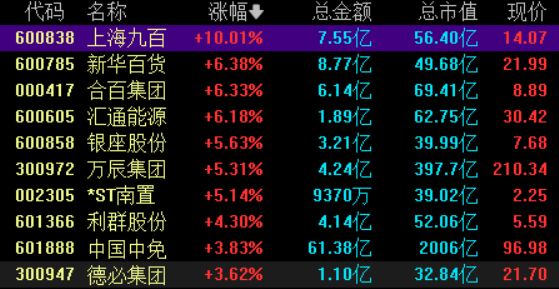
Group 1 - The retail sector experienced significant gains on January 20, with Shanghai Jiubai and Xinhua Department Store hitting the daily limit, while companies like Hebei Group and Huitong Energy rose over 6% [1] - Shanghai Jiubai's stock price increased by 10.01%, reaching a total market value of 56.40 billion, with a current price of 14.07 [2] - Xinhua Free Trade's stock rose by 6.38%, with a total amount of 8.77 billion and a market value of 49.68 billion, currently priced at 21.99 [2] Group 2 - The National Development and Reform Commission (NDRC) emphasized the importance of strengthening domestic circulation and expanding domestic demand, aligning with the trend of upgrading the country's demand structure [1] - The NDRC plans to develop a strategic implementation plan for expanding domestic demand from 2026 to 2030, focusing on creating new demand through new supply and providing strong innovation measures and resource guarantees [1]



零售板块拉升
第一财经· 2026-01-20 03:17
Core Viewpoint - The retail sector experienced significant gains on January 20, with multiple companies reaching their daily price limits and others showing substantial increases in stock prices, indicating a positive market sentiment in the retail industry [1]. Group 1: Stock Performance - Shanghai Jiubai (600838) saw a price increase of 10.01%, with a total transaction amount of 7.55 million and a market capitalization of 5.64 billion [2]. - Xinhua Department Store (600785) increased by 6.38%, with a total transaction amount of 8.77 million and a market capitalization of 4.968 billion [2]. - Hezi Group (000417) rose by 6.33%, with a total transaction amount of 6.14 million and a market capitalization of 6.941 billion [2]. - Huitong Energy (600605) increased by 6.18%, with a total transaction amount of 1.89 million and a market capitalization of 6.275 billion [2]. - Wanchen Group (300972) saw a rise of 5.31%, with a total transaction amount of 4.24 million and a market capitalization of 39.77 billion [2]. - China Duty Free Group (601888) increased by 3.83%, with a total transaction amount of 61.38 million and a market capitalization of 200.6 billion [2]. Group 2: Policy Insights - The National Development and Reform Commission (NDRC) emphasized the importance of strengthening domestic circulation and expanding domestic demand in response to the evolving demand structure in China [1]. - The NDRC plans to develop a strategic implementation plan for expanding domestic demand from 2026 to 2030, focusing on creating new demand through innovative supply and ensuring strong support for innovation initiatives [1].


港股AI延续跌势,港股互联网ETF(513770)连续10日吸金逾11亿元,基金经理:回调后又有好的配置机遇
Xin Lang Cai Jing· 2026-01-20 02:27
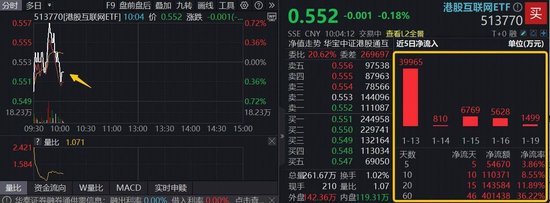
Core Viewpoint - The Hong Kong stock market continues to show volatility, particularly in AI-related stocks, with major companies like Tencent and Alibaba experiencing declines, while the Hong Kong Internet ETF (513770) has seen significant inflows despite recent fluctuations [1][9]. Market Performance - On January 20, the Hong Kong stock indices opened lower, with AI stocks initially rising before retreating. Tencent Holdings fell over 1%, and other major players like Alibaba, Kuaishou, Xiaomi, and Bilibili followed suit [1][9]. - The Hong Kong Internet ETF (513770) briefly rose by 0.72% but is currently down by 0.18%, with a notable premium observed during trading [1][9]. - Over the past 10 days, the Hong Kong Internet ETF has attracted over 1.1 billion yuan in inflows [1][9]. Investment Insights - According to fund manager Cao Xuchen, the recent pullback in the Hong Kong Internet ETF may present new investment opportunities, driven by the acceleration of AI advancements [9]. - Morgan Stanley forecasts a brighter future for AI development by 2026, driven by both supply and demand factors, with internet companies expanding overseas to mitigate macroeconomic and geopolitical risks [9]. - Goldman Sachs anticipates that 2026 will mark a strategic turning point for leading Chinese internet companies, with Alibaba projecting that 60%-70% of routine tasks in the digital world will be performed by AI in the next two years [9][10]. ETF Composition - The Hong Kong Internet ETF (513770) passively tracks the CSI Hong Kong Internet Index, with Alibaba being the largest holding at 14.71%. The top ten holdings, which include Tencent, Xiaomi, Kuaishou, and Bilibili, account for nearly 77% of the ETF [10][11]. - As of January 16, the fund size of the Hong Kong Internet ETF reached a record high of 14.637 billion yuan, with an average daily trading volume exceeding 600 million yuan since 2025 [11]. Additional Investment Options - For investors looking to reduce volatility while still gaining exposure to technology, the Hong Kong Large Cap 30 ETF (520560) is recommended, which combines high-growth tech stocks with stable dividend-paying companies [11].
日元跌跌不休之谜,从政策模糊到地缘风险,谁在做空日本经济?
Sou Hu Cai Jing· 2026-01-20 01:37
Core Viewpoint - The Bank of Japan's decision to raise interest rates by 0.25% to 0.75% marks the first rate hike in 30 years, but instead of strengthening the yen, it has led to a significant depreciation of the currency, contrary to typical expectations of interest rate hikes [1][3]. Group 1: Interest Rate Hike and Market Reaction - The initial expectation was that the rate hike would stabilize the declining yen and help control high inflation, but the yen fell sharply against the dollar following the announcement [3][6]. - Within a month of the rate hike, the yen's exchange rate against the dollar dropped by over 3%, marking the largest monthly decline of the year [5]. Group 2: Factors Behind Yen Depreciation - The lack of clarity in the Bank of Japan's policy regarding future rate hikes has created uncertainty in the market, leading to a sell-off of the yen [11]. - The Japanese government's approach of increasing public spending through debt issuance has raised concerns about the sustainability of its debt, which exceeds 260% of GDP [13]. - The strength of the US dollar, supported by higher interest rates from the Federal Reserve, has attracted global capital away from the yen [15]. - Geopolitical tensions, particularly related to statements from the Japanese government regarding Taiwan, have increased market risk aversion, further pressuring the yen [17]. - A general loss of confidence in the Japanese economy, driven by unclear policies, fiscal mismanagement, and geopolitical issues, has led to a significant depreciation of the yen [19][26]. Group 3: Impact on Japanese Economy and Society - The depreciation of the yen has resulted in imported inflation, making essential goods more expensive for consumers, while government subsidies have not kept pace with rising costs [20][22]. - Small and medium-sized enterprises, which constitute 99% of Japanese businesses, are facing severe challenges due to increased import costs and thin profit margins, leading to a 15% year-on-year increase in bankruptcies [24]. Group 4: Future Outlook for the Yen - The yen's future remains bleak unless three critical issues are addressed: the persistent interest rate differential with the US, the unsustainable fiscal situation, and ongoing geopolitical risks [26][28]. - Without significant policy changes and improved economic management, the yen could continue to depreciate, potentially reaching alarming levels against the dollar [30].
“四中心”引擎 制度型开放突破“十五五”启幕千年商都新纪元
Nan Fang Du Shi Bao· 2026-01-19 23:12
Core Viewpoint - The construction of an international consumption center city and high-quality foreign trade development are key supports for Guangzhou's economic stability and progress during the transition from the "14th Five-Year Plan" to the "15th Five-Year Plan" [4]. Group 1: Consumption Enhancement - Guangzhou's retail sales are projected to grow by 5.5% in 2025, following a 26% increase over the past five years [6]. - The "Yangcheng New Eight Scenic Spots" initiative aims to boost consumption through over 2,000 themed events, including international shopping festivals and gourmet weeks, generating over 900 billion yuan in sales [6][7]. - The city will continue to optimize the consumption environment by expanding the number of tax refund stores to 1,620 and enhancing cross-border payment options [7]. Group 2: Foreign Trade Growth - Guangzhou's foreign trade is expected to reach 1.2 trillion yuan in 2025, with a growth rate of 10.4%, driven by a 17.3% increase in trade with non-U.S. markets [8]. - The "New Three Samples" products have seen an export increase of nearly 70%, becoming a new growth engine for the economy [8][9]. - Key strategies for 2026 include diversifying markets, supporting leading enterprises, and enhancing new foreign trade formats [9]. Group 3: Open Upgrades - Guangzhou aims to enhance its high-level opening-up system, focusing on the Guangdong-Hong Kong-Macao Greater Bay Area and expanding the service industry [10]. - The city has established a robust open matrix, including one free trade zone and multiple national-level economic development zones [10][11]. - Future initiatives will include platform innovation, port upgrades, and leveraging the exhibition economy to stimulate industrial upgrades [11].

连续五年破万亿,广州“万亿消费”如何炼成?
2 1 Shi Ji Jing Ji Bao Dao· 2026-01-19 16:14
Core Viewpoint - Guangzhou has become the third city in China to achieve a "double trillion" in consumption and foreign trade, with specific growth targets set for GDP, fixed asset investment, and total retail sales by 2026 [1][2]. Economic Growth Targets - The GDP growth target for Guangzhou is set at around 5% by 2026, with fixed asset investment, total retail sales, and total import-export value also targeted to grow by 5% [1]. - The total retail sales of social consumer goods are expected to exceed 1.1 trillion yuan, growing by 5.5% by 2025, while total import-export value is projected to exceed 1.2 trillion yuan, with a growth rate of 10.4% [1]. Consumption as Economic Driver - Consumption is highlighted as a key driver for economic recovery, with Guangzhou's retail sales exceeding 1 trillion yuan for five consecutive years since 2021 [1]. - The city aims to explore both domestic and international demand potential as a primary task this year [1]. Policy Initiatives - Guangzhou has introduced a series of policy measures, including 33 initiatives to boost consumption, 23 to promote service trade, and 33 for high-quality development of business districts [2]. - The city is focusing on creating a vibrant and competitive consumer market by enhancing retail innovation and optimizing the consumption environment [2]. Cultural and Tourism Integration - The cultural and tourism sectors are seen as vital for enhancing consumer spending, with suggestions to integrate cultural scenes with technology to create new attractions [5]. - The government emphasizes the importance of developing cultural tourism as a means to stimulate consumer willingness to spend [4]. International Consumption Center - Guangzhou is working towards becoming an international consumption center, with plans to implement consumption upgrade initiatives and enhance the international consumption environment [6]. - The city aims to leverage its cultural heritage and modern commercial projects to create unique shopping experiences [3]. Event-Driven Consumption - The city plans to host numerous large-scale concerts and events, with 53 major concerts scheduled this year, featuring popular artists [7]. - There is a focus on developing event-driven economies, including sports and entertainment, to enhance consumer engagement [7]. Trade and Investment Strategies - Guangzhou aims to stabilize foreign trade and investment, with plans to enhance the influence of the Canton Fair and promote integrated development of domestic and foreign trade [8]. - The city is also looking to expand its international trade capabilities and support innovative enterprises in attracting foreign investment [8].
珠免集团:公司将积极关注粤澳深度融合中的发展机会
Zheng Quan Ri Bao Wang· 2026-01-19 12:13
Group 1 - The company, Zhuhai Free Trade Zone Group (600185), is actively looking for development opportunities in the context of deep integration between Guangdong and Macau [1] - The company plans to leverage the resource advantages of its shareholder, Huafa Group, in the cultural, commercial, and tourism sectors [1] - The company is exploring and researching the feasibility of related matters [1]
