
云计算

Search documents
机构白皮书:高科技行业对核心技术人才的竞争已进入“刚需”阶段
Xin Hua Cai Jing· 2026-02-27 07:54
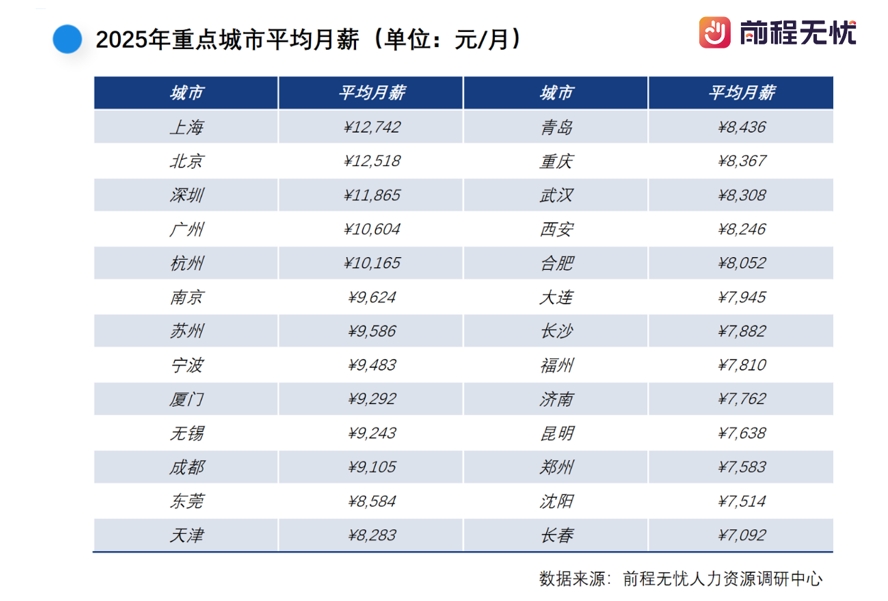
Group 1 - The high-tech industry is projected to have the highest salary adjustment rate of 4.9% by 2025, driven by competition for core technical talent in key areas like artificial intelligence and semiconductors [1] - First-tier cities, particularly Shanghai (12,742 CNY/month) and Beijing (12,518 CNY/month), show significant salary advantages, reflecting the strong support of high-tech industries and high-level talent density [1] - New first-tier cities like Hangzhou (10,165 CNY/month) and Nanjing (9,624 CNY/month) are rapidly closing the salary gap with Guangzhou, indicating the growing influence of the Yangtze River Delta economic circle [1] Group 2 - Integrated circuit design engineers in first-tier cities have an average annual salary of 400,591 CNY, while cloud computing architects earn close to 500,000 CNY (491,253 CNY), highlighting the high value of these positions [2] - The manufacturing and automotive industries are expected to have salary adjustment rates of 4.3% and 4.1% respectively by 2025, with traditional "blue-collar" jobs transitioning to "digital craftsmen" [2] - The pharmaceutical and health industry maintains a salary adjustment rate of 4.4% in 2025, driven by aging trends and biotechnological innovations, with key positions like bioinformatics engineers earning 293,820 CNY in first-tier cities [2] Group 3 - The financial industry is projected to have a lower salary adjustment rate of 3.0% in 2025, influenced by stricter regulations and market volatility, with a further decline to 2.9% expected in 2026 [3] - Despite an increase in disposable income for urban residents (4.2% growth in 2025), consumer willingness is becoming more rational, reflected in the consumer goods industry's salary adjustment rate of 3.7%, slightly below the industry average [3] - The salary gap between first-tier and non-first-tier cities remains around 30%, indicating a concentration of high-end consumer resources in first-tier cities [3]
2月最后一个交易日 沪指“精准”收于本月新高!什么信号?
Mei Ri Jing Ji Xin Wen· 2026-02-27 07:37
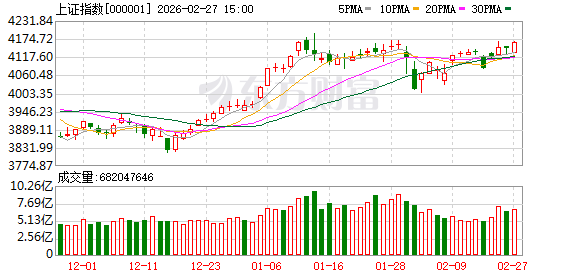
Market Overview - The three major indices showed mixed results, with the Shanghai Composite Index rising by 0.39% and the ChiNext Index falling by 1.04% [2] - Rare metal stocks experienced a surge, while sectors like steel, gas, coal, electricity, and environmental protection saw significant gains. In contrast, cloud computing, AI applications, and computing power leasing were active, while computing hardware, semiconductors, and commercial aerospace stocks adjusted [2] - In February, the Shanghai Composite Index recorded a cumulative increase of 1.09%, showing a "high after narrow fluctuations" trend, achieving three consecutive monthly gains. The Shenzhen Component Index rose by 2.04%, while the ChiNext Index fell by 1.08% [2] Trading Activity - Daily trading volume exceeding 1 trillion yuan has become the norm, with the market remaining active post-Spring Festival, as the Shanghai and Shenzhen stock exchanges recorded over 2 trillion yuan in trading volume for four consecutive trading days [2] - The latest closing point for the Shanghai Composite Index reached 4162.88, marking a new high for the month and the second-highest this year, just below the January 12 high of 4165.29 [2] Key Indicators - The Wind All A and average stock price indices both reached new highs recently, indicating a positive market sentiment [4] - The average stock price for the All A index was reported at 30.43, reflecting a slight increase of 0.37% [6] Future Expectations - The market is anticipated to enter a "Two Sessions market," with expectations of policy shifts and increased capital inflow from foreign and domestic sources, which could bolster the spring market [7] - Analysts suggest focusing on structural opportunities, particularly in AI technology stocks, while also considering defensive allocations and stocks benefiting from "anti-involution" trends [7] Sector Performance - The rare metals sector has shown the largest cumulative gains this week, driven by price increase logic, although it has also experienced fluctuations [9] - The electricity sector has demonstrated a consistent upward trend, providing better feedback for investors compared to other sectors [11] - Recent reports indicate that China's AI usage has surpassed that of the U.S., with implications for electricity and computing power demand, particularly given China's lower electricity costs [12]

A股收评:超3200只个股上涨,沪指翻红,深指、创业板指飘绿
Sou Hu Cai Jing· 2026-02-27 07:14
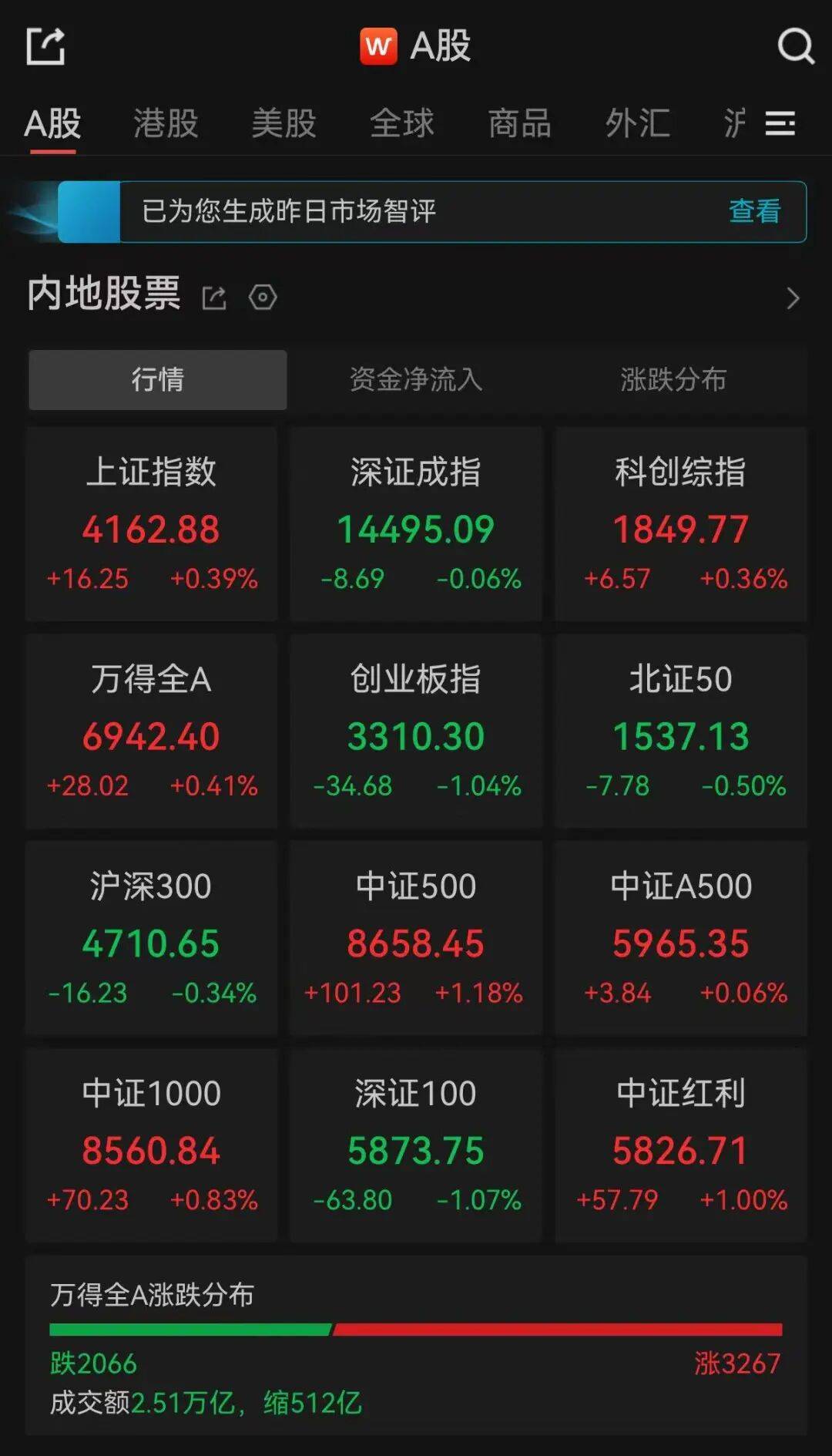
Market Overview - The total trading volume in the market reached 2.51 trillion, with over 3,200 stocks experiencing an increase [3] - The Shanghai Composite Index rose by 16.25 points, or 0.39%, closing at 4,162.88 [1] - The Shenzhen Component Index decreased by 8.69 points, or 0.06%, closing at 14,495.09 [1] Sector Performance - Rare metal concept stocks saw a surge, with many hitting the daily limit [3] - Sectors such as steel, gas, coal, electricity, and environmental protection showed significant gains [3] - Cloud computing, AI applications, and computing power leasing themes were active [3] - However, sectors like computing hardware, semiconductors, and commercial aerospace experienced adjustments [3] Index Movements - The CSI 300 Index fell by 16.23 points, or 0.34%, closing at 4,710.65 [1] - The ChiNext Index dropped by 34.68 points, or 1.04%, closing at 3,310.30 [1] - The CSI 500 Index increased by 101.23 points, or 1.18%, closing at 8,658.45 [1]

小摩:将COREWEAVE目标价下调至90美元
Ge Long Hui· 2026-02-27 07:09
Group 1 - Morgan Stanley has lowered the target price for cloud computing provider COREWEAVE from $110 to $90 [1]
报告: 集成电路工程师年薪超40万 新一线城市薪资加快追赶一线城市
Di Yi Cai Jing· 2026-02-27 05:03
Core Insights - The report highlights the evolving salary landscape in China, indicating that compensation data serves as a barometer for industry health and policy direction amid global economic shifts and technological advancements [1] Group 1: Salary Trends in Major Cities - First-tier cities remain the highest salary hubs, with Shanghai and Beijing leading at 12,742 CNY/month and 12,518 CNY/month respectively, supported by high-tech industries and talent density [2] - New first-tier cities like Hangzhou (10,165 CNY/month) and Nanjing (9,624 CNY/month) are rapidly closing the salary gap with Guangzhou, indicating a potential shift towards becoming "high cost-performance employment centers" [2] - Salary disparities are smaller among grassroots employees across regions, while high-paying mid-to-senior level positions are concentrated in first-tier cities, reflecting a trend of high-end talent migration to Beijing, Shanghai, and Shenzhen [2] Group 2: High-Tech and Integrated Circuit Industry Salaries - The high-tech sector leads with a salary increase of 4.9% in 2025, driven by government support for AI and semiconductor industries, creating a "necessity" for core technical talent [3] - Integrated circuit design engineers earn an average annual salary of 400,591 CNY in first-tier cities, while cloud computing architects approach 491,253 CNY, highlighting the value of these roles in the market [3] - Traditional "blue-collar" roles are transitioning to "digital craftsmen," with automotive algorithm engineers earning 384,258 CNY in first-tier cities, reflecting the shift towards smart vehicles [3] Group 3: Manufacturing and Consumer Goods Salary Adjustments - The manufacturing sector's salary increase is expected to slightly decline to 4.0% in 2026, indicating a shift towards enhancing labor efficiency to mitigate cost pressures [4] - The consumer goods sector is experiencing a more conservative salary increase of 3.7% in 2026, as companies aim to retain core talent amid profitability challenges [5] - Brand managers in the consumer goods industry earn an average of 373,094 CNY in first-tier cities, while e-commerce and live-streaming operations are becoming essential, with salaries around 146,530 CNY and 142,865 CNY respectively [5] Group 4: Future Salary Trends - The salary trends from 2025 to 2026 suggest a shift from "general increases" to "targeted incentives," emphasizing the value of cross-disciplinary, digital, and business-driving talent as core assets in a competitive landscape [6]
云计算板块低开高走,关注云计算ETF易方达(516510)等产品投资价值
Sou Hu Cai Jing· 2026-02-27 04:42
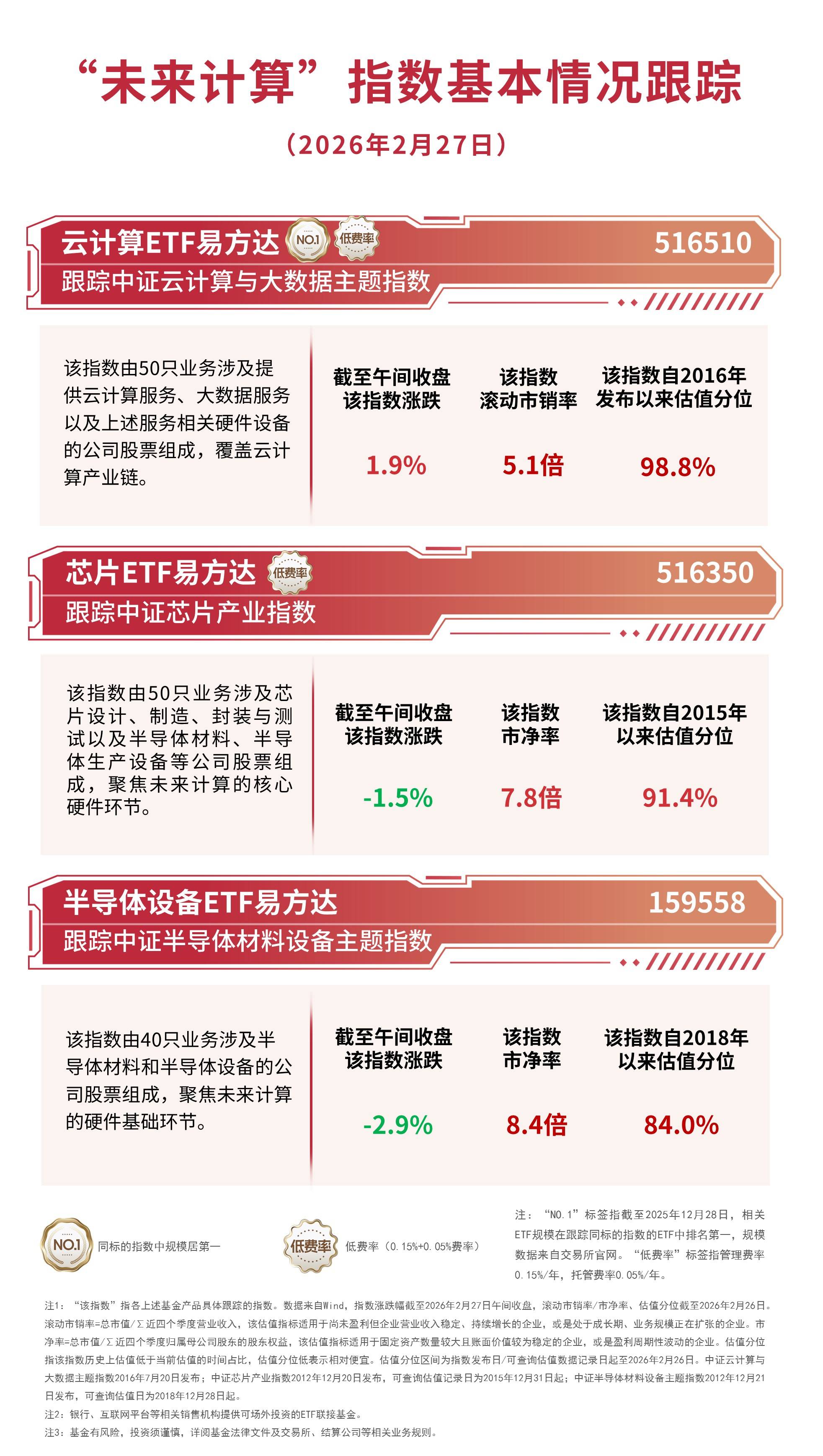
Group 1 - The China Securities Cloud Computing and Big Data Theme Index rose by 1.9%, while the China Securities Chip Industry Index fell by 1.5%, and the China Securities Semiconductor Materials and Equipment Theme Index decreased by 2.9% as of the midday close [1] - The Cloud Computing ETF managed by E Fund (516510) attracted approximately 140 million yuan in the last five trading days [1] Group 2 - The Semiconductor Equipment ETF by E Fund tracks the China Securities Semiconductor Materials and Equipment Theme Index, which consists of 40 companies involved in semiconductor materials and equipment, focusing on the hardware foundation for future computing [4] - The Semiconductor Industry Index is composed of 50 stocks related to chip design, manufacturing, packaging, testing, and semiconductor materials and production equipment, emphasizing the core hardware aspects of future computing [3]
帮主郑重午评:指数绿了却有肉吃?午后A股操作全梳理
Sou Hu Cai Jing· 2026-02-27 04:30
Market Overview - The three major indices showed a decline, with the ChiNext Index down by 1.46%, the Shenzhen Component Index down by 0.68%, and the Shanghai Composite Index down by 0.17% [3] - Despite the index declines, over 2300 stocks in the market experienced gains, indicating that the overall market sentiment remains positive [4] Trading Volume and Market Behavior - The trading volume in the Shanghai and Shenzhen markets reached 15.966 trillion, a decrease of 532 billion from the previous trading day, but still maintained at a high level, suggesting that funds are not leaving the market but are reallocating [4] Sector Performance - Rare metal sectors, such as tungsten and rare earths, saw significant gains, with multiple stocks reaching historical highs, driven by supply-demand mismatches [4] - The AI-related sectors, including computing power leasing and cloud computing, also experienced a surge, supported by a notable increase in domestic AI token usage surpassing that of the U.S. for the first time [4] Declining Sectors - The computing hardware sectors, including CPO, PCB, and storage chips, faced significant declines, largely influenced by NVIDIA's 5.47% drop, marking its largest single-day decline in nearly a year [5] - This decline is viewed as a normal correction following substantial short-term gains, rather than a sign of a downturn in the AI or computing hardware market [5] Investment Strategy - Investors are advised to avoid chasing high-priced stocks, particularly in sectors that have recently seen significant increases, to prevent potential losses from profit-taking [6] - Focus should be on AI industry leaders with real performance support and cyclical products with price increase logic, such as coal and steel, which are also showing signs of activity [6] Index Analysis - The Shanghai Composite Index showed resilience with only a minor decline, while the ChiNext Index's drop was primarily due to heavyweight stocks dragging it down [6] - The market's current behavior is characterized by index differentiation, which is seen as a healthy correction before the upcoming March trading period [7]

ETF盘中资讯|华为云CodeArts重磅上线!算力价格20年首次反转,Token五年暴增400倍!大数据ETF(516700)拉升1.2%,拓维信息涨停
Sou Hu Cai Jing· 2026-02-27 03:50
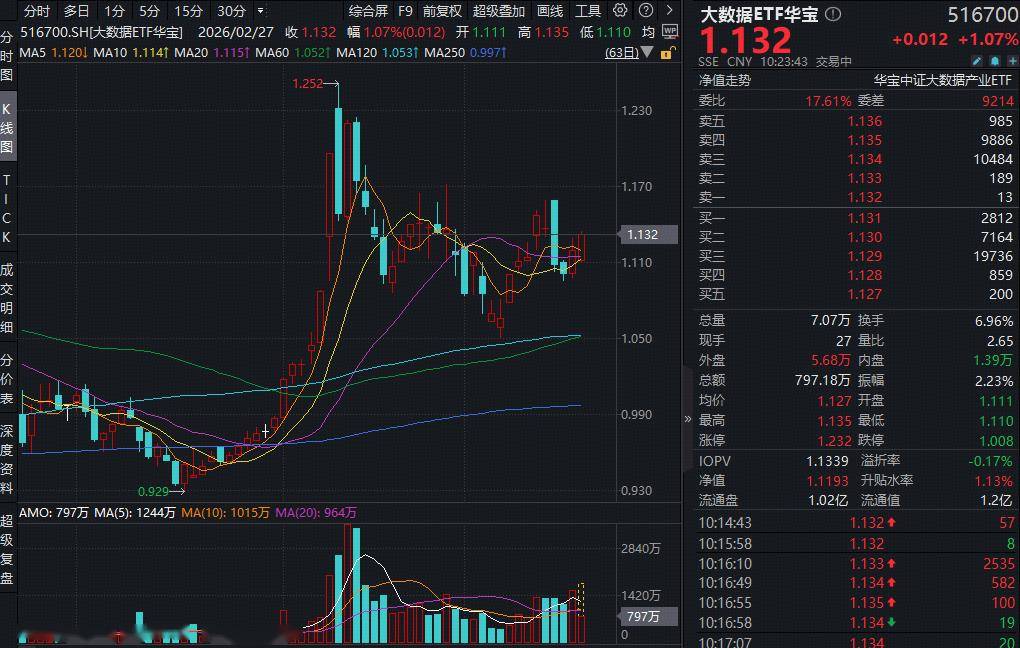
Core Viewpoint - The domestic computing power sector, particularly in IDC and server markets, and the domestic AI application field are experiencing significant activity, as evidenced by the performance of the big data ETF (516700) which has shown a price increase of over 1.2% during trading [1]. Group 1: ETF Performance - The big data ETF (516700) is currently trading at 1.132, reflecting a 1.07% increase from the previous day [2]. - The ETF's five-day moving average is 1.120, indicating a recovery above this level during trading [2]. - The total trading volume for the ETF reached 70,700, with a turnover rate of 6.96% [2]. Group 2: Key Stocks Performance - Notable stocks within the ETF include: - Tuowei Information, which reached its daily limit with a 10% increase [3]. - Yuntian Lifi, which surged over 13% [3]. - Wangsu Science and Technology, which increased by over 6% [3]. - Other stocks such as Youke De-W, Yunsai Zhiliang, Qi Anxin-U, and Tuolisi also experienced gains [3]. Group 3: Industry Insights - The AI computing power sector is projected to see a compound annual growth rate of approximately 330% from 2025 to 2030, with a total increase of about 370 times over five years [4]. - Domestic cloud service provider Youke De announced a price increase for all products starting March 1, marking a significant shift in the industry where prices have historically only decreased [4]. - The global cloud computing market is entering a price increase cycle, influenced by rising hardware costs and high demand for AI inference [4]. Group 4: ETF Composition - As of the end of 2025, the big data ETF (516700) will have a weight of 40.91% in computing power concepts and 37.43% in AI application concepts within its benchmark index [5]. - The ETF passively tracks the CSI Big Data Industry Index, focusing on sectors such as data centers, cloud computing, and big data processing, with major holdings in companies like Zhongke Shuguang, Keda Xunfei, and Inspur Information [6].

AI概念股午前多数拉升 金山云及迅策均涨逾9%
Xin Lang Cai Jing· 2026-02-27 03:46
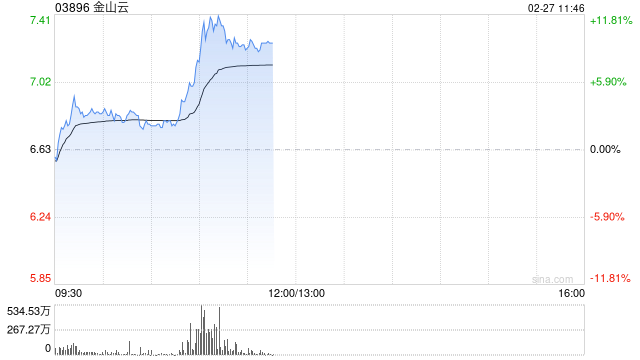
Group 1 - AI-related stocks experienced significant gains in the morning session, with Kingsoft Cloud (03896) rising by 9.35% to HKD 7.25 [1] - Xunke (03317) saw an increase of 8.88%, trading at HKD 89.50 [1] - Huoliang Technology (01860) rose by 5.58%, reaching HKD 12.30 [1] - Kingdee International (00268) increased by 4.66%, priced at HKD 10.34 [1]
午评:创业板指半日跌1.46%,稀有金属、算力租赁板块集体爆发
Xin Lang Cai Jing· 2026-02-27 03:33
Market Overview - The three major A-share indices collectively declined in the morning session, with the Shanghai Composite Index down 0.17%, the Shenzhen Component Index down 0.68%, and the ChiNext Index down 1.46% [1] - The total trading volume in the Shanghai, Shenzhen, and Beijing markets reached 15,966 billion yuan, a decrease of 532 billion yuan compared to the previous day [1] - Over 2,300 stocks in the market experienced gains [1] Sector Performance - Sectors with notable gains included small metals, computing power leasing, cloud computing, coal mining and processing, cross-border payments, steel, photovoltaic equipment, AI applications, and tourism and hotel industries [1] - Conversely, sectors that saw significant declines included paper making, PCB, CPO, storage chips, batteries, photolithography machines, and PET copper foil [1] Notable Stock Movements - Rare metals such as tungsten and rare earths surged due to price increases, with companies like Zhongtung High-tech, Zhangyuan Tungsten, and Zhong Rare Metals reaching historical highs [1] - The demand for cloud computing is reflected in the first-time surpassing of AI Token usage in China over the US, leading to a significant rise in the computing power leasing sector, with stocks like Yuntian Lifei and Chengdi Xiangjiang hitting the daily limit [1] - The space photovoltaic sector also performed well, with Jun Da Co. and Shuangliang Energy both reaching the daily limit [1] External Influences - Nvidia experienced its largest single-day drop since April 16 of last year, impacting the CPO and PCB sectors, with many computing hardware stocks like Xinyisheng, Zhongji Xuchuang, and Shenghong Technology declining over 5% [1]