
信息服务

Search documents
安徽汽车产量反超广东登顶 浙皖机器人产量近翻倍
Xin Jing Bao· 2025-08-20 09:48
Economic Overview - The economic total of the Yangtze River Delta (YRD) region reached 16.39 trillion yuan in the first half of 2025, accounting for 24.8% of the national GDP, an increase of 0.1 percentage points from the previous year [4][9] - The GDP growth rates for Shanghai, Jiangsu, Zhejiang, and Anhui were 5.1%, 5.7%, 5.8%, and 5.6% respectively, with Zhejiang showing the fastest growth [3][4] Service Sector Growth - The service sector's contribution to the GDP of the YRD region surpassed 60% for the first time, driven by modern services and digital economy sectors [9][10] - Shanghai's service sector accounted for nearly 80% of its GDP, with significant growth in information and financial services, which increased by 14.6% and 8.8% respectively [9][10] Manufacturing and Industrial Upgrades - The manufacturing sector in the YRD region continued to show strong growth, with industrial value-added increasing by 7.4%, 7.6%, and 8.4% in Jiangsu, Zhejiang, and Anhui respectively, all exceeding the national average of 6.2% [13][30] - Anhui led the nation in new energy vehicle production with 730,900 units, contributing to 34.6% of the national output [16][19] Automotive Industry Dynamics - The YRD region's automotive production accounted for 28% of the national total, with Anhui surpassing Guangdong to become the top province in automotive output, producing 1.4995 million vehicles in the first half of 2025 [16][19] - The region's automotive exports reached 179.29 billion yuan, a year-on-year increase of 18.8%, with Anhui also leading in automotive exports [17][19] Robotics Industry Development - The total production of industrial robots in China reached 369,300 units in the first half of 2025, with the YRD region accounting for over 50% of the national exports [22][25] - The region has established a complete industrial chain for robotics, with significant growth in production rates, particularly in Zhejiang and Anhui, which saw increases of 85.7% and 93.3% respectively [22][25] Investment Trends - Fixed asset investment in the YRD region showed varied performance, with Shanghai growing by 6.2%, while Jiangsu, Zhejiang, and Anhui lagged behind the national average [27][30] - Infrastructure investment in the region increased significantly, with Shanghai's industrial investment growth reaching nearly 20% [30][31] Private Sector Contributions - The private economy in the YRD region remains a crucial support, with significant contributions to industrial output and exports, particularly in Shanghai and Jiangsu [34] - Recent policies aimed at promoting the private economy are expected to enhance its role in driving high-quality development in the region [34]


解码长三角|安徽汽车产量反超广东登顶 浙皖机器人产量近翻倍
Xin Jing Bao· 2025-08-20 09:41
Economic Overview - The total economic output of the Yangtze River Delta (YRD) region reached 16.39 trillion yuan in the first half of 2025, accounting for 24.8% of the national total, an increase of 0.1 percentage points year-on-year [4][5]. - The economic growth rates for Shanghai, Jiangsu, Zhejiang, and Anhui were 5.1%, 5.7%, 5.8%, and 5.6% respectively, with Jiangsu having the largest total output at 6.7 trillion yuan [4][5]. Service Sector Growth - The service sector's contribution to GDP in the YRD surpassed 60% for the first time, with Shanghai's service sector accounting for nearly 80% of its GDP [8][5]. - The modern service industry, particularly information technology and digital economy sectors, has become a key growth driver, with Shanghai's information service revenue growing by 20.4% year-on-year [8][9]. Manufacturing Sector Dynamics - The manufacturing sector in the YRD showed strong growth, with industrial output increasing by 7.4%, 7.6%, and 8.4% in Jiangsu, Zhejiang, and Anhui respectively, all exceeding the national average of 6.2% [12]. - The region's high-tech manufacturing, particularly in electric vehicles and industrial robots, has seen significant growth, with Anhui's industrial robot production increasing by 93.3% [21][12]. Automotive Industry Performance - The YRD accounted for 28% of the national automotive production, with Anhui leading in new energy vehicle production, contributing 34.6% of the national output [16][12]. - The automotive export volume from Anhui surpassed that of Shanghai, reaching 46.1 million units, with the total automotive export value from the YRD increasing by 18.8% [17][16]. Investment Trends - Fixed asset investment in the YRD showed varied performance, with Shanghai growing by 6.2%, while Jiangsu, Zhejiang, and Anhui lagged behind the national average [26][30]. - Infrastructure and industrial investments increased significantly, with Shanghai's industrial investment growth reaching 19.8% [30][31]. Private Sector Contributions - The private sector remains a crucial component of the YRD economy, with significant contributions to industrial output and exports, particularly in Jiangsu and Zhejiang [33]. - Recent policies aimed at supporting private enterprises are expected to enhance their role in driving high-quality economic development in the region [33].
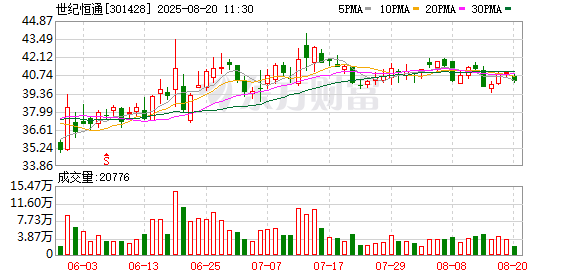
世纪恒通:目前已在数据标注领域开展业务布局,且已与国内部分客户开展具体合作
Mei Ri Jing Ji Xin Wen· 2025-08-20 03:35
Group 1 - The company is focusing on the development opportunities in the data element industry and has already initiated business operations in the data labeling sector [1] - The company has established a scalable team of over 2,500 data labelers within a few months and is continuing to expand this team [3] - The company aims to achieve high-quality development in the data element field while maintaining a close watch on industry dynamics and steadily advancing its business expansion [1][3] Group 2 - The company has completed the integration of data assets into its financial statements, indicating a strong foundation in data resource accumulation [3] - A multi-modal AI intelligent labeling platform has been preliminarily established, enhancing the company's capabilities in data labeling [3] - The company expresses a commitment to becoming a leading benchmark in the data industry, with plans for further strategic development and business expansion [3]

固定资产投资规模继续扩大
Guo Jia Tong Ji Ju· 2025-08-19 01:11
Core Insights - National fixed asset investment (excluding rural households) reached 288,229 billion yuan from January to July, showing a year-on-year growth of 1.6% [1] Group 1: Equipment Investment - The "Two New" policies have led to a significant increase in equipment purchase investment, which grew by 15.2% year-on-year, outpacing overall investment growth by 13.6 percentage points, contributing 2.2 percentage points to total investment growth [2] Group 2: Manufacturing Investment - Manufacturing investment has seen a robust increase, growing by 6.2% year-on-year, which is 4.6 percentage points higher than the overall investment growth, contributing 1.5 percentage points to total investment growth. Notably, consumer goods manufacturing investment rose by 10.8%, while equipment manufacturing investment increased by 4.8%. High-tech manufacturing sectors such as aerospace and equipment manufacturing saw investment growth of 33.9% and 16.0%, respectively [3] Group 3: Infrastructure Investment - Infrastructure investment has shown a steady growth of 3.2% year-on-year, exceeding overall investment growth by 1.6 percentage points, with a contribution rate of 43.0% to total investment growth, an increase of 6.0 percentage points from the first half of the year. Key sectors include water transportation (18.9% growth), water management (12.6% growth), and railway transportation (5.9% growth) [4] Group 4: Green Energy Investment - Green energy investment has surged, with the electricity, heat, gas, and water production and supply sector growing by 21.5% year-on-year, contributing 1.4 percentage points to total investment growth. Investments in solar, wind, nuclear, and hydropower collectively increased by 21.9% [5] Group 5: High-Tech Service Investment - High-tech service investment has expanded, growing by 6.2% year-on-year, which is 4.6 percentage points higher than overall investment growth. This sector now accounts for 5.1% of total service industry investment, up by 0.4 percentage points from the same period last year, with information service investment increasing by 32.8% [6] Group 6: Project Investment - National project investment (excluding real estate development) grew by 5.3% year-on-year, surpassing overall investment growth by 3.7 percentage points. Projects with total planned investments of 100 million yuan and above saw a 4.1% increase, contributing 2.3 percentage points to total investment growth. Private sector project investment (excluding real estate) rose by 3.9%, with notable growth in accommodation and catering (19.6%), infrastructure (8.8%), and cultural, sports, and entertainment sectors (8.1%) [7]
恒宝股份有限公司股票交易异常波动公告
Zhong Guo Zheng Quan Bao - Zhong Zheng Wang· 2025-08-19 00:01
Group 1 - The company's stock experienced an abnormal trading fluctuation, with a cumulative closing price increase exceeding 20% over three consecutive trading days (August 14, 15, and 18, 2025) [2] - The board of directors confirmed that there were no significant changes in the company's operational situation or external business environment [5] - The company and its major shareholders did not engage in any stock trading activities during the period of abnormal price fluctuation [6] Group 2 - The board confirmed that there are no undisclosed significant matters that should have been disclosed according to the Shenzhen Stock Exchange's regulations [7] - The company is preparing to release its 2025 semi-annual report on August 27, 2025, and is currently conducting the necessary preparations [8] - The company emphasizes the importance of rational investment and awareness of market risks, advising investors to refer to designated media for accurate information [8][9]

7月主要经济指标累计增速总体平稳
Jin Rong Shi Bao· 2025-08-18 02:33
Economic Overview - In July, the national economy showed stable operation with major economic indicators remaining within a reasonable range, including a 5.7% year-on-year growth in industrial added value and a 3.7% increase in retail sales of consumer goods [1][6] - The total import and export volume increased by 6.7% year-on-year in July, with exports growing by 8%, indicating strong resilience and vitality in trade [1][6] Consumption Trends - The retail sales growth rate for consumer goods decreased to 3.7% in July, down 1.1 percentage points from the previous month, but the overall consumption expansion trend remains unchanged [2] - The service market sales remained stable, with a 5.2% growth in service retail from January to July, indicating consistent consumer demand [2][3] - Significant growth was observed in specific categories such as home appliances (28.7%), cultural and office supplies (13.8%), and furniture (20.6%) [2] Investment Insights - Fixed asset investment grew by 1.6% from January to July, with real growth estimated at 4% to 5% after adjusting for price factors [4][5] - Manufacturing investment increased by 6.2%, with notable growth in aerospace (33.9%) and computer equipment (16%) [5] - The investment structure is continuously optimizing, driven by innovation and large-scale equipment updates, despite some short-term pressures [5][6] Future Outlook - The economic foundation remains strong with significant potential for growth, supported by ongoing consumption initiatives and a favorable macroeconomic environment [6][7] - The International Monetary Fund has raised its growth forecast for China's economy by 0.8 percentage points, reflecting increased confidence from the international community [6] - Upcoming policies aimed at boosting consumption and infrastructure investment are expected to stabilize domestic demand [7]

五个关键词解码7月经济
Ren Min Ri Bao· 2025-08-16 02:05
Economic Overview - In July, major economic indicators maintained overall stability, with new growth drivers emerging, supporting steady economic development despite existing risks and challenges [1] - The macroeconomic policies are showing effectiveness, leading to expanded market demand and enhanced market vitality [1] New Quality Productivity - The added value of high-tech manufacturing above designated size increased by 9.3% year-on-year in July, outpacing the overall industrial growth by 3.6 percentage points [2] - The digital economy is rapidly developing, with the added value of digital product manufacturing increasing by 8.4% year-on-year in July [2] - Production of green low-carbon products is also on the rise, with new energy vehicles, lithium-ion batteries, and wind turbine generators seeing production increases of 17.1%, 29.4%, and 19.3% respectively [2] Foreign Trade - In July, the total value of goods imports and exports grew by 6.7% year-on-year, with exports increasing by 8% and imports by 4.8% [3] - The diversification of trade is evident, with exports to ASEAN, the EU, and Belt and Road countries growing by 14.8%, 8.2%, and 11.7% respectively from January to July [3] - The export of integrated circuits surged by 21.8%, reflecting enhanced international competitiveness due to improved R&D capabilities [3] Consumption - Retail sales of consumer goods increased by 3.7% year-on-year in July, with service retail sales growing by 5.2% from January to July [4] - The "old-for-new" policy has positively impacted sales, with significant growth in retail sales of home appliances, furniture, and communication equipment [4] - Tourism and leisure-related consumption saw rapid growth during the summer, with double-digit increases in retail sales for travel services and recreational activities [5] Investment - Fixed asset investment grew by 1.6% year-on-year from January to July, with actual growth (adjusted for price factors) estimated between 4% and 5% [6] - Manufacturing investment rose by 6.2%, significantly outpacing overall investment growth [6] - Investment in high-tech industries, particularly in aerospace and information services, saw substantial increases of 33.9% and 32.8% respectively [6] Price Trends - In July, the Consumer Price Index (CPI) showed positive changes, with a month-on-month increase of 0.4% [7] - The core CPI, excluding food and energy, rose by 0.8% year-on-year, indicating a strengthening market demand [7] - The Producer Price Index (PPI) saw a month-on-month decline of 0.2%, but the rate of decline has narrowed, marking the first reduction in the decline since March [7]
稳、新、畅:三个关键字看7月经济运行成绩单
Shang Hai Zheng Quan Bao· 2025-08-15 18:23
Group 1 - The rapid development of new productive forces such as artificial intelligence large models and humanoid robots is driving growth in emerging service industries like scientific research and technology services, with significant revenue increases in information services and R&D sectors [1] - Consumer spending is showing sustained growth, with retail service revenue increasing by 5.2% year-on-year from January to July, maintaining stability compared to the first half of the year, and notable growth in tourism and leisure-related consumption [1] - New policies for personal consumption loan interest subsidies and service industry loan interest subsidies are expected to boost consumption growth, particularly in the context of summer and National Day travel [1] Group 2 - The focus on strengthening domestic circulation has led to improved flows of people, goods, and capital, with railway passenger volume increasing by 6.6% year-on-year in July and freight volume reaching 452 million tons, a 4.5% increase [2] - The narrowing "scissors gap" between M2 and M1 year-on-year growth rates indicates improved capital circulation efficiency, aligning with trends of increased economic activity [2] - The economic outlook remains stable, supported by strong fundamentals, resilience, and potential for growth, with macro policies expected to maintain continuity and stability, focusing on service consumption and risk prevention [2] Group 3 - Upcoming projects supported by national and local government bonds are likely to accelerate, with a series of related policies aimed at expanding domestic demand [3] - Various levels of policies (macro, meso, and micro) are expected to intensify efforts across different sectors [3]
安硕信息:拟向特定对象增发募资不超过6亿元
Mei Ri Jing Ji Xin Wen· 2025-08-15 09:08
Group 1 - The core business of Anshuo Information is entirely focused on the information services industry, accounting for 100.0% of its revenue for the year 2024 [1] Group 2 - Anshuo Information announced on August 15 that its board approved a plan to issue shares to specific investors, with the final issuance subject to approval by the China Securities Regulatory Commission [3] - The share issuance will involve no more than 35 investors and will not exceed approximately 41.53 million shares, which is less than 30% of the company's total shares prior to the issuance [3] - The issuance price will be no less than 80% of the average trading price of the company's shares over the 20 trading days prior to the pricing date [3] - The company aims to raise no more than 600 million yuan, with funds allocated to several projects, including an AI-based smart credit system, a comprehensive risk management platform, and upgrades to its digital financial R&D center, as well as to supplement working capital [3]

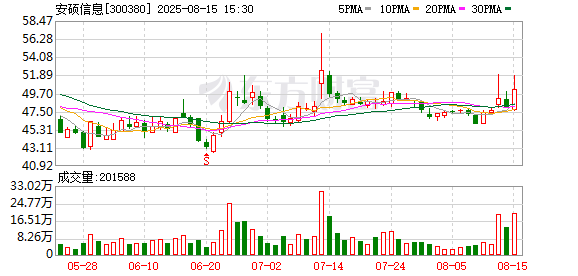
安硕信息:8月15日召开董事会会议
Mei Ri Jing Ji Xin Wen· 2025-08-15 08:59
Group 1 - The company, Anshuo Information, announced that its fifth board meeting for the year 2025 was held on August 15, 2025, to discuss the proposal for issuing A-shares to specific targets [2] - The company's revenue composition for the year 2024 is entirely from the information services industry, accounting for 100.0% [2]