
工业

Search documents
北京市市场总消费额增速连续4个月提升
Bei Jing Shang Bao· 2026-01-15 14:17
"有基础、有条件"主要体现在四个方面:其一,国家政策更加给力。国家优化实施"两新"政策,在元旦 前提前下达"两重"等超长期特别国债、中央预算内投资项目资金以及新增地方政府债务限额,一系列更 加积极有为的宏观政策也将陆续出台,将为地方经济发展注入强劲动力。 其四,重点产业支撑有力。新能源汽车、集成电路等领域保持增势,金融有力支撑实体经济,人工智能 创新高地加快打造、场景应用加速拓展,工业、金融业、信息服务业等将保持稳定支撑。 北京商报讯(记者 卓洋)1月15日,北京市发展改革委举行力促一季度"开门红"总体政策举措新闻发布 会。市发展改革委综合处处长王育玲表示,展望一季度,尽管面临过去两年同期基数较高等挑战,但本 市经济发展积极因素多、支撑条件好,实现一季度"开门红"有基础、有条件。 其三,市场需求逐步恢复。北京市市场总消费额自去年8月以来增速连续4个月提升,服务性消费保持稳 定支撑,近期湾里等商业综合体火爆开业,元旦假期旅游市场和重点商圈均实现客流及收入双增长,加 上快乐冰雪季系列活动以及即将到来的最长春节假期,将进一步激发消费潜力。 其二,北京市采取了一系列举措靠前发力。去年四季度已部署今年的目标任务和重点工 ...
珠海印发行动方案 冲刺一季度经济“开门红” 企业增产最高奖70万
Nan Fang Ri Bao Wang Luo Ban· 2026-01-15 10:08
Group 1 - The "2026 Zhuhai Economic High-Quality Development Action Plan" was officially issued, introducing 22 policy measures aimed at boosting investment, consumption, enterprise expansion, and livelihood protection to achieve a strong economic start in Q1 [1] - In the industrial investment sector, the plan offers rewards for industrial enterprises completing investment progress exceeding 50 million, 100 million, 200 million, and 500 million yuan, with maximum rewards of 70,000, 150,000, 250,000, and 400,000 yuan respectively [1] - Differentiated production incentive policies are established for various industries, with manufacturing enterprises achieving year-on-year output growth receiving rewards ranging from 70,000 to 700,000 yuan based on different scales [1] Group 2 - Wholesale and retail enterprises will receive direct support, with rewards for wholesale sales growth of 200 million, 500 million, and over 1 billion yuan, and retail sales growth of 30 million, 50 million, and over 100 million yuan, with maximum support of 80,000, 200,000, and 400,000 yuan respectively [2] - The real estate market will focus on stimulating housing demand, with a subsidy of 1% on the net signing price for residents participating in housing exchanges, capped at 30,000 yuan per unit [2] - The "Yue Enjoy Warm Winter, Shop Guangdong" consumption season will provide special consumption subsidies for automobiles, home appliances, and local products, along with dining promotions offering up to 100 yuan in discounts [2]
英国11月制造业产出环比增长2.1%,预期0.5%;11月工业产出环比增长1.1%,预期0.1%
Mei Ri Jing Ji Xin Wen· 2026-01-15 07:08
Core Insights - The UK manufacturing output increased by 2.1% month-on-month in November, significantly surpassing the expected growth of 0.5% [1] - The industrial output in the UK also rose by 1.1% month-on-month in November, exceeding the forecast of 0.1% [1]
拉萨地区生产总值首次突破千亿元大关
Xin Hua Wang· 2026-01-15 00:30
总量扩张的同时,发展质量和结构不断优化。2025年,拉萨市 新增高新技术企业61家、规上工业企业11家,创新动能与产业能级 同步提升。2025年,全市预计完成进出口总额55亿元,开放型经济 活力被进一步释放。 与此同时,文旅融合持续升温,助力经济社会高质量发展。 2025年,拉萨市接待游客5051万人次,同比增长16.8%;实现旅游 总花费606亿元,同比增长14.5%。 记者1月14日从拉萨市第十二届人民代表大会第六次会议上获 悉,2025年西藏拉萨市地区生产总值首次突破千亿元大关。 2025年,拉萨市投资和消费实现稳健增长。全市60个重点项目 全部开工建设,预计固定资产投资同比增长5%以上;社会消费品零 售总额达553亿元,同比增长5%。 ...
拉萨地区生产总值首破千亿元
Xin Hua Wang· 2026-01-14 13:27
Core Insights - In 2025, Lhasa's GDP is projected to exceed 100 billion yuan for the first time [1] - The city is expected to see steady growth in investment and consumption, with fixed asset investment increasing by over 5% year-on-year [1] - The retail sales of consumer goods are anticipated to reach 55.3 billion yuan, reflecting a year-on-year growth of 5% [1] Economic Development - All 60 key projects in Lhasa are set to commence construction, contributing to the overall economic expansion [1] - The number of new high-tech enterprises is expected to increase by 61, along with 11 new industrial enterprises above designated size, enhancing innovation and industrial capacity [1] - The total import and export volume is projected to reach 5.5 billion yuan, indicating a further release of vitality in the open economy [1] Tourism and Cultural Integration - The integration of culture and tourism is expected to continue to rise, supporting high-quality economic and social development [1] - Lhasa is projected to receive 50.51 million tourists, marking a year-on-year increase of 16.8% [1] - Total tourism expenditure is expected to reach 60.6 billion yuan, with a year-on-year growth of 14.5% [1]
特变电工(600089):中标中国葛洲坝集团电力有限责任公司采购项目,中标金额为2880.77万元
Xin Lang Cai Jing· 2026-01-14 06:06
Group 1 - Company TBEA Co., Ltd. won a procurement project from China Gezhouba Group Electric Power Co., Ltd. with a bid amount of 28.8077 million yuan [1] - In 2024, TBEA's operating revenue was 97.867 billion yuan, with a revenue growth rate of -0.35% and a net profit attributable to the parent company of 4.135 billion yuan, reflecting a net profit growth rate of -61.37% [2][3] - For the first half of 2025, TBEA reported an operating revenue of 48.401 billion yuan, with a revenue growth rate of 1.12% and a net profit attributable to the parent company of 3.184 billion yuan, showing a net profit growth rate of 5.00% [2][3] Group 2 - TBEA operates in the industrial sector, with its main product types including transformer equipment, specialized equipment and components [2][3] - The main composition of TBEA's 2024 revenue includes transformers (22.85%), coal (19.68%), new energy products and integrated engineering (18.94%), and power generation business (5.73%) [2][3]

2025年1-11月青海省工业企业有677个,同比下降1.02%
Chan Ye Xin Xi Wang· 2026-01-14 03:22
相关报告:智研咨询发布的《2026-2032年中国工业云行业市场深度评估及投资机会预测报告》 知前沿,问智研。智研咨询是中国一流产业咨询机构,十数年持续深耕产业研究领域,提供深度产业研 究报告、商业计划书、可行性研究报告及定制服务等一站式产业咨询服务。专业的角度、品质化的服 务、敏锐的市场洞察力,专注于提供完善的产业解决方案,为您的投资决策赋能。 2016-2025年1-11月青海省工业企业数统计图 上市公司:西部矿业(601168),藏格矿业(000408),青海春天(600381),青海华鼎(600243) 数据来源:国家统计局,智研咨询整理 2025年1-11月,青海省工业企业数(以下数据涉及的工业企业,均为规模以上工业企业,从2011年起, 规模以上工业企业起点标准由原来的年主营业务收入500万元提高到年主营业务收入2000万元)为677 个,和上年同期相比,减少了7个,同比下降1.02%,占全国的比重为0.13%。 ...


20cm速递|科创综指ETF国泰(589630)涨超2.4%,科技主线韧性显现
Sou Hu Cai Jing· 2026-01-14 02:45
Group 1 - The core viewpoint of the article highlights the resilience of the technology sector, driven by liquidity easing, policy support, and high industry prosperity [1] - The AI hardware sector is benefiting from a global technology cycle, with marginal profit growth (ΔG) showing no signs of a turning point, indicating continued strength [1] - AI applications are transitioning from computational infrastructure to scenario realization, accelerating commercialization due to policy guidance, demand release, and increased capital investment [1] Group 2 - New themes emerging from the 14th Five-Year Plan, such as commercial aerospace and brain-computer interfaces, have the potential to become new mainlines in the industry [1] - The cyclical industries are performing actively due to improvements in PPI and supportive policies against internal competition, creating a dual growth pattern of technology and cyclical sectors [1] - The ChiNext Index ETF Guotai (589630) tracks the ChiNext Index (000680), which has a daily price fluctuation limit of 20% and covers approximately 97% of the market capitalization with over 500 constituent stocks [1]
大鹏工业龙虎榜数据(1月13日)
Zheng Quan Shi Bao Wang· 2026-01-13 15:00
Core Viewpoint - Dapeng Industrial (920091) experienced a significant increase of 6.98% in its stock price, with a turnover rate of 45.48% and a total transaction volume of 579 million yuan on the trading day [2] Trading Activity - The stock was featured on the龙虎榜 due to its turnover rate reaching 45.48%, with institutional investors net buying 4.35 million yuan [2] - The top five trading departments accounted for a total transaction volume of 108 million yuan, with a buying amount of 56.06 million yuan and a selling amount of 51.49 million yuan, resulting in a net buying of 4.57 million yuan [2] - Among the trading departments, one institutional specialized seat was present, with a buying amount of 11.31 million yuan and a selling amount of 6.96 million yuan, leading to a net buying of 4.35 million yuan [2] Historical Performance - Over the past six months, the stock has appeared on the龙虎榜 35 times, with an average price increase of 0.79% the day after being listed and an average increase of 7.38% over the following five days [2]
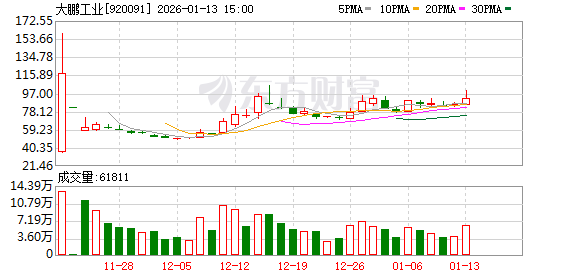
聚焦“工贸联动” 浙江出台《实施意见》
Mei Ri Shang Bao· 2026-01-12 22:16
Core Viewpoint - Zhejiang Province has introduced implementation opinions to strengthen the linkage between industry and trade, focusing on expanding quality product supply, exploring effective demand potential, enhancing supply-demand connection effectiveness, and reinforcing policy collaboration in industry and trade, effective from January 8 [1][2]. Group 1: Key Measures - The implementation opinions emphasize the integration of technological and industrial innovation, accelerating the research and development of new technologies, processes, and products, with an annual selection of 100 Zhejiang manufacturing excellence products and 100 provincial-level outstanding industrial new products eligible for related policies [1]. - There is encouragement for local governments to support provincial industrial new product projects that address key industry application scenarios and are successfully implemented, along with increased policy support for first sets of equipment and patent-intensive products [1]. - Zhejiang will promote the "Thousand Groups and Ten Thousand Enterprises" initiative to expand market reach and increase orders, supporting manufacturing enterprises in overseas exhibitions and providing policy support for qualifying exhibitors and exhibition agencies [1]. Group 2: Equipment Update and Industry Chain Coordination - The province will leverage equipment update policies, enhance project guidance services, and strengthen supply-demand matching for equipment update projects in various sectors, including industrial, energy, transportation, environment, and healthcare, while assisting eligible enterprises in securing national ultra-long-term special bond support [2]. - A more vigorous approach will be taken in the "Ten Chains and Hundred Events for Ten Thousand Enterprises" initiative, focusing on the cultivation of advanced manufacturing clusters and supporting upstream and downstream enterprises in various forms of cooperation, with over 100 matching events organized annually [2]. - Leading enterprises and state-owned enterprises will be encouraged to participate in matching activities, publish demand lists, and optimize procurement product structures, while local governments will be supported in organizing enterprises to meet the material, product, and equipment needs of major projects [2].