
智能网联汽车

Search documents
光庭信息(301221.SZ):公司牵头承担武汉市科技重大专项项目通过验收
Ge Long Hui A P P· 2025-12-26 12:40
格隆汇12月26日丨光庭信息(301221.SZ)公布,2023年12月,由武汉光庭信息技术股份有限公司牵头承 担,华中科技大学、武汉理工大学、武汉人工智能研究院等6家单位共同参与的"智能网联汽车基础软件 关键技术及应用"项目获批立项。该项目围绕智能网联汽车基础软件关键技术及应用,研发智能网联汽 车操作系统及中间件,构建数据驱动的智能网联汽车云训练及仿真平台,开发自适应优化的智能网联汽 车功能软件算法,研发高安全性的智能座舱人机交互,实现智能网联汽车基础软件的全场景应用,为整 车智能化网联化赋能,实现汽车行业关键技术的突破。 近日,上述项目已全部完成任务目标并顺利通过验收。该项目的研发完成体现了公司及合作伙伴在技术 创新实力、组织管理能力和核心竞争力,提高公司智能网联汽车基础软件的研发和应用实力。截至本公 告披露日,上述项目的政府补助资金尾款390.00万元(公司应享有的政府补助金额为195.00万元)已到 账,原计入递延收益人民币455.00万元将转入当期损益,预计对公司2025年利润总额的影响约为人民币 650.00万元。 ...
光庭信息(301221.SZ)牵头承担武汉市科技重大专项项目通过验收
智通财经网· 2025-12-26 11:18
Core Viewpoint - The project "Key Technologies and Applications of Basic Software for Intelligent Connected Vehicles" led by the company has been approved and successfully completed, showcasing its technological innovation and core competitiveness in the intelligent connected vehicle sector [1] Group 1: Project Overview - The project involves collaboration with six institutions, including Huazhong University of Science and Technology and Wuhan University of Technology [1] - The focus is on developing an operating system and middleware for intelligent connected vehicles, creating a data-driven cloud training and simulation platform, and developing adaptive optimization algorithms for vehicle functions [1] Group 2: Achievements and Impact - The project has met all its objectives and passed the acceptance review, indicating a successful outcome [1] - The completion of the project enhances the company's capabilities in research and application of basic software for intelligent connected vehicles, contributing to breakthroughs in key technologies within the automotive industry [1]
L3级辅助驾驶落地在即 相比L2有何区别?
Xin Lang Cai Jing· 2025-12-26 06:42
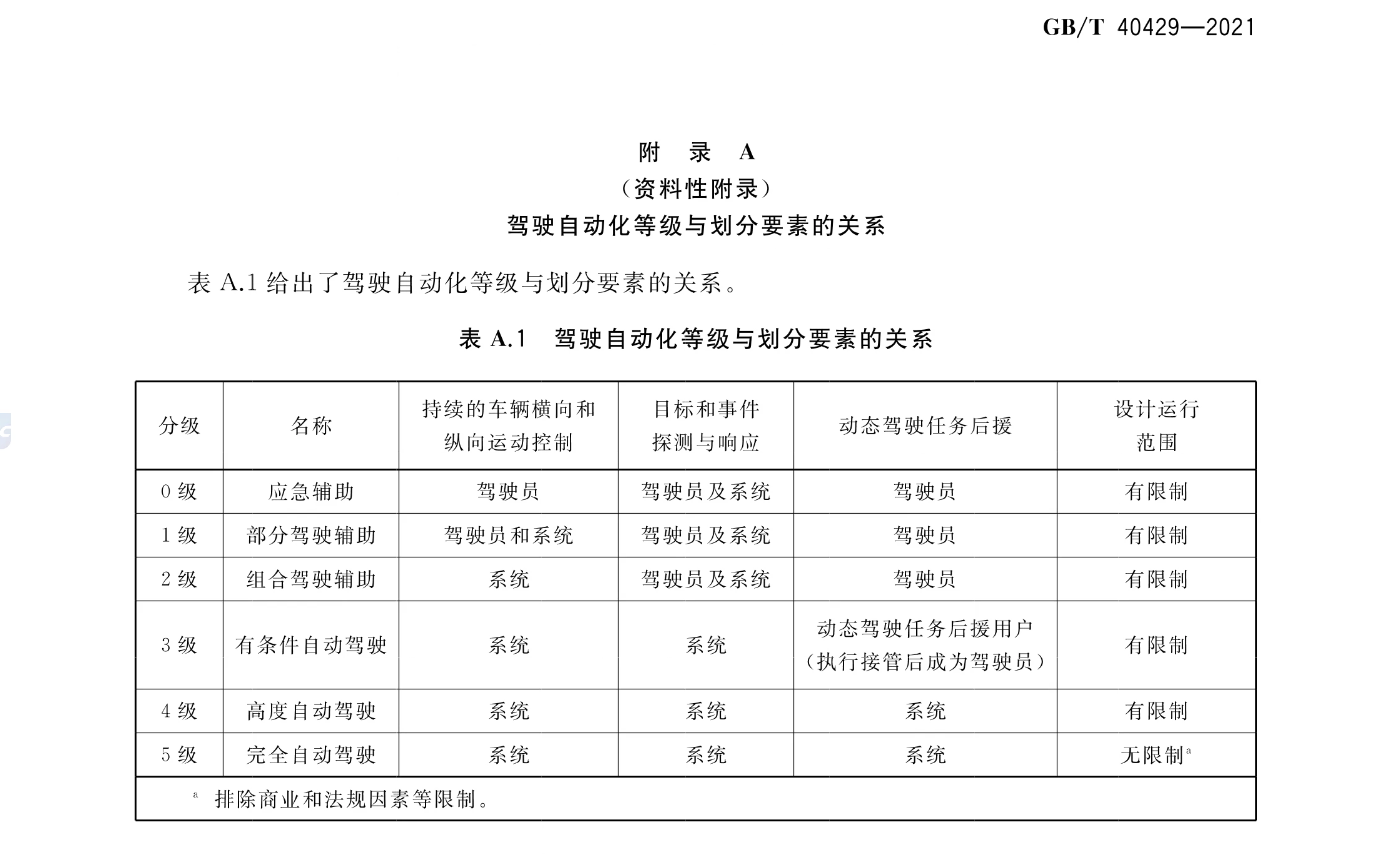
Core Viewpoint - The approval of L3 conditional autonomous driving for Changan Deep Blue and Arcfox models marks a significant advancement in China's autonomous driving technology, transitioning from "assisted driving" to "conditional driving" [1] Classification of Driving Automation Levels - China's driving automation levels are defined by the standard "Automotive Driving Automation Classification" (GB/T 40429-2021), which categorizes driving automation from Level 0 to Level 5 based on the execution capability of dynamic driving tasks [1] - Level 2 (Partial Automation) requires the driver to monitor the environment continuously, while Level 3 (Conditional Automation) allows the system to perform all dynamic driving tasks under specific conditions, with the driver needing to take over only when requested [4][5] Technical Differences Between L2 and L3 - L2 relies on a combination of cameras and millimeter-wave radar with processing power typically ≤100 TOPS, while L3 requires a more advanced setup with laser radar and multi-sensor fusion, demanding processing power ≥500 TOPS [8] - L3 systems feature dual-loop control and redundancy in braking systems, enhancing safety by ensuring functionality even if a single hardware component fails [10] Legal and Responsibility Framework - The key distinction between L2 and L3 is the shift in responsibility; L2 is "human-led, system-assisted," while L3 is "system-led, human fallback," clarifying liability during system activation and takeover requests [11] - Recent regulations from the Ministry of Industry and Information Technology outline the approval and operational rules for L3/L4 autonomous vehicles, establishing a legal framework for responsibility allocation [13] User Experience and Safety - L3 offers significant improvements in user experience, allowing drivers to disengage from constant monitoring under certain conditions, with manufacturers bearing liability in case of accidents [14] - Testing data indicates that L3 systems have a lower takeover rate compared to L2, with a response time of at least 10 seconds for drivers to take control when requested [14] Challenges and Future Outlook - Despite initial approvals, widespread adoption of L3 technology faces challenges including technical validation, regulatory refinement, and user education [15] - The government plans to expand L3 pilot programs and enhance related legal frameworks to promote the development of the autonomous driving industry [15]

成都如何加快建设全国先进制造业基地?
Xin Lang Cai Jing· 2025-12-25 18:26
Core Viewpoint - The construction of a national advanced manufacturing base in Chengdu is a strategic initiative aimed at enhancing the city's competitiveness and supporting national manufacturing development goals [4][10]. Group 1: Strategic Importance - The national government aims to optimize the spatial structure of productivity and enhance the resilience and security of industrial supply chains through the establishment of advanced manufacturing bases [4]. - Chengdu is expected to play a crucial role in supporting high-quality national manufacturing development and act as a significant growth pole in the new development landscape [4][10]. - The city is tasked with not only strengthening its own manufacturing capabilities but also leading regional manufacturing coordination and development [4][5]. Group 2: Current Challenges - Chengdu has made significant progress in manufacturing, establishing five national-level advanced manufacturing clusters and eleven trillion-level industrial chains, but still lags behind cities like Shanghai and Shenzhen in terms of scale, core competitiveness, and innovation capabilities [5][10]. - The number of national high-tech enterprises in Chengdu is approximately half that of Shanghai and Shenzhen, indicating a need for improvement in technological support [5]. Group 3: Development Strategies - Chengdu aims to strengthen its key industrial chains by supporting leading enterprises in sectors like new displays and aerospace to integrate into national productivity layouts [6]. - The city plans to enhance industrial chain quality and efficiency by creating detailed maps of manufacturing chains and attracting high-quality supporting projects [7]. - Collaborative efforts between Chengdu and the surrounding regions, particularly in the Chengdu-Chongqing area, are essential for mutual development and leveraging complementary advantages [8][9]. Group 4: Future Directions - The city is focused on building an advanced manufacturing industry system that emphasizes new industrialization and the development of emerging industries [11]. - An innovation system will be established to support the growth of technology enterprises and foster collaboration between large enterprises and specialized small and medium-sized enterprises [12]. - Chengdu will enhance its industrial park system to improve competitiveness and visibility, ensuring a robust foundation for the advanced manufacturing base [12].

打造国际开源之都!上海将发布国内首个面向海外的开源平台
Di Yi Cai Jing· 2025-12-25 12:32
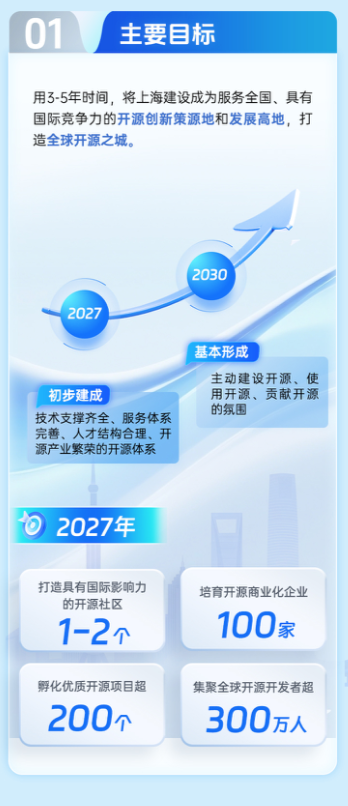
Core Viewpoint - Shanghai aims to establish 1-2 internationally influential open-source communities and incubate over 200 high-quality open-source projects within 3 to 5 years, gathering more than 3 million global developers [1] Group 1: Open Source Strategy - The open-source technology is recognized as a core engine driving global technological innovation, industrial transformation, and ecological collaboration [1] - Shanghai's plan emphasizes leading industrial development through open-source, creating a sustainable innovation ecosystem that integrates technology, talent, and enterprises [1][4] Group 2: Economic Impact - The artificial intelligence industry in Shanghai is projected to exceed 450 billion yuan in 2024, with a year-on-year growth of over 7.8%, achieving its "14th Five-Year Plan" goals ahead of schedule [4] - The open-source initiative is expected to lower costs for enterprises in innovation, testing, certification, standardization, and talent cultivation [5] Group 3: Development Initiatives - Shanghai's plan includes five major enhancement projects: foundational capability building, project cultivation, talent aggregation, cultural promotion, and governance collaboration [8] - The establishment of a domestic open-source platform aimed at connecting global intellectual resources is anticipated to launch next year [9] Group 4: Support for Developers and Enterprises - The open-source MCN (Multi-Channel Network) model will be utilized to incubate open-source projects, providing deep empowerment in technology flow, community operation, and commercial closure [11] - Financial support of up to 20 million yuan will be allocated for key open-source tool development projects starting next year [12]
四维图新调整募投项目布局,两项目延期并优化芯片研发子项目
Ju Chao Zi Xun· 2025-12-25 03:25
Core Viewpoint - The company announced adjustments to its fundraising projects, including delays and changes in the layout of sub-projects under the "Intelligent Connected Vehicle Chip R&D Project" [2][3] Fundraising Project Adjustments - The company is postponing the expected usability dates for the "Intelligent Connected Vehicle Chip R&D Project" and the "Autonomous Driving Dedicated Cloud Platform Project" to December 2028 and December 2026, respectively [2][3] - The total amount of funds raised in 2020 was approximately 4 billion yuan, with a net amount of about 3.975 billion yuan after deducting issuance costs [2] Reasons for Delays - The delay in the "Intelligent Connected Vehicle Chip R&D Project" is attributed to a conservative chip procurement approach by automakers amid a plateau in the global electric vehicle market, along with increased design complexity due to the need for multi-functional integration [3] - The postponement of the "Autonomous Driving Dedicated Cloud Platform Project" is due to structural changes in the industry ecosystem, with a reduced urgency for independent cloud platforms as general AI platforms become mainstream [3] Terminated and New Sub-Projects - Two sub-projects, the Low-cost DA Chip AC8005 and the Visual Processing Chip AC6815, have been terminated due to market conditions and lack of competitive advantage [4] - Two new sub-projects have been added: the high-cost performance connected instrument SoC AC8117 and the high-performance 5G vehicle networking IVI SoC AC8277, which align with market trends and regulatory requirements [4] Fund Utilization - As of November 30, 2025, the company has invested 689 million yuan in the "Intelligent Connected Vehicle Chip R&D Project," accounting for 55.55% of the planned total, with approximately 669 million yuan remaining for ongoing and new projects [4]

博时市场点评12月24日:板块轮动加剧,沪指六连阳
Xin Lang Cai Jing· 2025-12-24 09:22
Market Overview - The Shanghai Composite Index recorded six consecutive days of gains, with a closing value of 3940.95 points, up 0.53% [4] - The Shenzhen Component Index closed at 13486.42 points, up 0.88%, while the ChiNext Index rose by 0.77% to 3229.58 points [4] - The total market turnover was approximately 1.9 trillion yuan, showing a decrease compared to the previous trading day [5] Economic Data - The U.S. GDP for Q3 showed an annualized growth rate of 4.3%, exceeding market expectations of 3.3% and marking the fastest growth in two years [3][8] - Consumer spending was a significant driver of this growth, accelerating to 3.5% in the same quarter [8] - The core PCE price index rose by 2.9%, indicating persistent inflation [8] Energy Sector - In November, China's total electricity consumption reached 835.6 billion kWh, a year-on-year increase of 6.2% [2][7] - From January to November, total electricity consumption accumulated to 9460.2 billion kWh, with a growth rate of 5.2% [2][7] - The second industry saw a stable growth in electricity consumption of 4.4%, while the high-tech and equipment manufacturing sectors grew by 6.7% [2][7] Automotive Industry - Beijing issued the first L3-level highway autonomous driving vehicle license plates, marking a significant milestone in the commercialization of autonomous vehicles in China [2][8] - The three licensed vehicles can achieve 80 km/h autonomous driving on designated highway sections, although a driver must be ready to take control [3][8] Stock Performance - Among the sectors, defense and military, electronics, and building materials showed the highest gains, with increases of 2.88%, 2.12%, and 1.72% respectively [4][9] - Conversely, agriculture, coal, and food and beverage sectors experienced declines of 0.85%, 0.70%, and 0.36% respectively [4][9] Financing Trends - The margin trading balance reported at 25,315.63 billion yuan, showing an increase from the previous trading day [10]
易华录:自2015年起布局自动驾驶与智能网联汽车领域
Zheng Quan Ri Bao· 2025-12-23 10:38
(文章来源:证券日报) 证券日报网讯 12月23日,易华录在互动平台回答投资者提问时表示,公司自2015年起即前瞻性布局自 动驾驶与智能网联汽车领域,并陆续承接多个项目如2020年成功中标中德智能网联汽车试验场地建设项 目,目前多数项目已顺利进入验收或运营阶段。近年来,公司积极响应国家政策导向,参与工业和信息 化部等五部委联合推动的"车路云一体化"应用试点工作,目前已涉足多个试点城市及其他相关城市的车 路云系统项目建设。在技术能力方面,公司具备从外场硬件到中心软件平台的全链条自主研发与一体化 交付能力。公司持续推动智能网联汽车产业生态的构建与发展。 ...

北京发放首批L3级高速公路自动驾驶车辆专用号牌
21世纪经济报道· 2025-12-23 09:53
来源丨央视新闻 编辑丨金珊 见习编辑林芊蔚 实习生齐心淳 中国高铁第一省炼成记 全线大涨!金饰价冲上1403元,白银首破70美元,专家称黄金可能突破5200美元 多地公积金使用范围拓宽 12月23日,北京市首批L3级高速公路自动驾驶车辆专用号牌由北京市公安局交通管理局正式 发放给三辆智能网联汽车,这也是国内首批发放的L3级高速公路自动驾驶车辆专用号牌。 这 标志着我国自动驾驶车辆已由测试示范进展到正式量产 ,率先开启L3级自动驾驶时代,成为 汽车智能化进程中的里程碑事件。 北京交管部门相关负责人介绍,在北京首批上牌的L3级自动驾驶汽车 共有3辆 ,号牌分别 为:京AA0001Z、京AA0733Z、京AA0880Z。该车型经过前期系列测试,目前处于有条件的 自动驾驶阶段,系统可在限定条件下执行动态驾驶任务,实现高速公路和城市快速路单车道 内最高车速80km/h的自动驾驶功能。交管部门负责人强调, 尽管可实现限定道路的自动驾驶 功能,但仍需驾驶人坐在驾驶位驾车,并作为紧急情况接管车辆控制的后援 。 目前"有条件的自动驾驶"功能仅限在北京市京台高速(大兴区旧宫新桥一机场北线高速)、 机场北线高速(大渠南桥一大兴机场 ...

广州再办科创大赛 已有十余家参赛企业成功上市
Zhong Guo Jing Ying Bao· 2025-12-23 08:35
Core Insights - The Guangzhou Innovation and Entrepreneurship Competition has been held for ten years since its inception in 2015, introducing several innovative reforms, including a "market + government" collaborative competition model and partnerships with Hong Kong, Macau, and Taiwan, enhancing resource integration and outreach [1] - Over the past decade, the competition has produced 13 unicorn companies, approximately 205 national specialized and innovative "little giant" enterprises, and around 3,647 high-tech enterprises, with the number of high-tech companies in Guangzhou exceeding 13,500, more than seven times the figure in 2015 [1] - The competition has facilitated 55 companies to enter the capital market, with 14 successfully listed, establishing a complete innovation chain from cultivation to growth to listing [1] Financial Support and Resources - The competition has established a Guangzhou Science and Technology Innovation Fund with a scale of 10 billion yuan, which includes specialized sub-funds for key industries such as intelligent connected vehicles, low-altitude economy, and biomedicine, focusing on early-stage investments in hard technology and future innovations [2] - Regular industry chain resource matching meetings are organized to connect leading enterprises and research institutions, providing technical support, market channels, and supply chain resources for participating projects [2] - A diversified financial system of "awards, investments, and loans" has been set up to assist companies in equity financing and bank credit, with over 1,000 companies receiving nearly 50 billion yuan in equity financing and about 1,800 companies obtaining approximately 16 billion yuan in bank credit [2]