硬件设备

Search documents
小米营收新高,什么信号?中信证券:年度级别牛市可期,第一步加仓港股
Jin Rong Jie· 2025-05-28 05:35
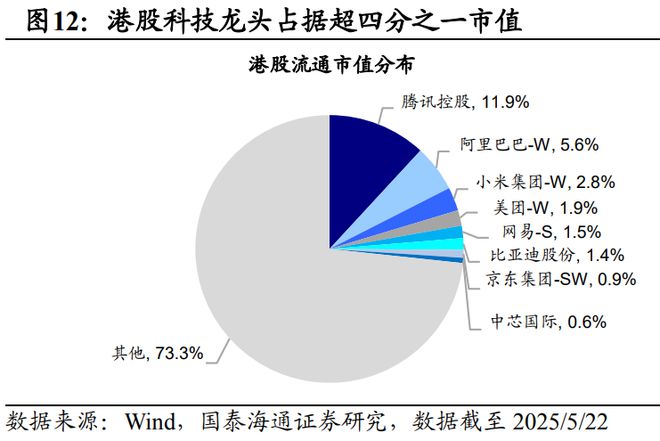
Group 1 - Xiaomi reported a record revenue exceeding 100 billion yuan for Q1 2025, surpassing market expectations, which has led to positive sentiment among investors [1] - The gross margin for Xiaomi's automotive and AI businesses reached 23.2%, outperforming competitors such as BYD (20.07%), Li Auto (19.7%), Great Wall (17.84%), and Geely (15.8%) [1] - Major financial institutions like Morgan Stanley, Daiwa, and CITIC Securities have expressed bullish views on Xiaomi, anticipating that the upcoming launch of the YU7 in July could further boost the stock price [1] Group 2 - Approximately 73% of the market capitalization of Chinese concept stocks have achieved dual listings in A and H shares due to delisting risks, with many being quality tech companies across the AI value chain [3] - According to Stanford University's "2024 AI Index Report," China ranks second globally in the number of notable AI models, with significant advancements expected by 2025 [3] Group 3 - Historical bull markets have been driven by various sectors, with the current market being led by the technology industry represented by AI [6] - The Hang Seng Technology Index currently includes only 30 constituent stocks, which may not fully represent the overall tech sector in Hong Kong, suggesting a need for a broader index covering 50 tech leaders [6] Group 4 - The Hong Kong market hosts major tech giants such as Tencent, Alibaba, Xiaomi, Meituan, and others, with these companies collectively accounting for over 25% of the market capitalization [1] - The Hong Kong Technology 50 ETF has seen significant inflows, with a year-to-date increase of 22.47%, indicating strong investor interest in the tech sector [9]


回购增持贷款破1200亿!622家上市公司抢食低息资金,额度再扩至8000亿
Sou Hu Cai Jing· 2025-05-20 00:59
Core Insights - The total amount of repurchase and increase loans in the A-share market has exceeded 120 billion yuan, indicating the significant role of this financial tool [1][2] - The People's Bank of China and other regulatory bodies have introduced a policy to support low-cost financing for listed companies and major shareholders [1][2] Group 1: Loan Details - As of May 19, 622 listed companies or major shareholders have obtained repurchase increase loans totaling approximately 120.76 billion yuan, accounting for 40.25% of the initial quota of 300 billion yuan [1] - The loans are part of a policy established in October 2024, with a total quota of 300 billion yuan and an annual interest rate of 1.75% [1][2] Group 2: Recent Developments - In May, 37 listed companies or major shareholders have received repurchase increase loans, with notable examples including Yunda Holdings and Siyuan Electric [1] - On May 7, the central bank announced an increase in the total quota for stock repurchase and increase loans to 800 billion yuan, while also reducing the interest rate on structural monetary policy tools to 1.5% [2] Group 3: Industry Impact - Companies in the chemical, hardware equipment, and pharmaceutical industries have shown high enthusiasm for utilizing these special loans [1] - Large-cap and industry-leading companies account for over 40% of the applications for repurchase increase loans, covering sectors such as petrochemicals, food and beverage, home appliances, new energy, and semiconductors [1]
4月来已披露170余份计划,上市公司使用回购增持贷热情高涨
Di Yi Cai Jing· 2025-05-14 11:35
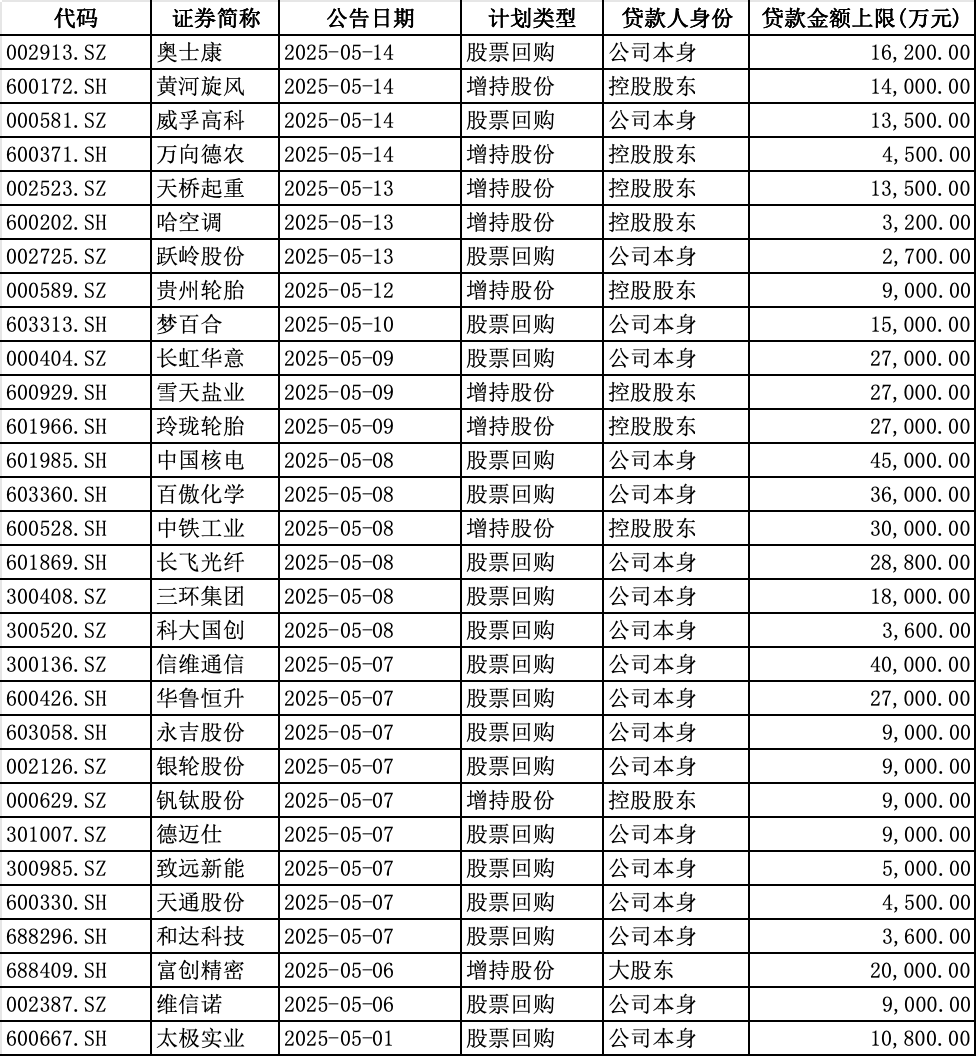
Core Viewpoint - The enthusiasm for "repurchase and increase" special loans among listed companies remains high, with over 80% of the funds for repurchase or increase coming from these loans, reflecting a strong market response to new financial policies [2][3][6]. Group 1: Loan Utilization and Market Response - Since the introduction of the "repurchase and increase" loan program, over 300 companies have disclosed 367 special loan announcements, with a total loan ceiling of approximately 70.5 billion yuan [3]. - In April alone, 146 A-share companies disclosed special loan situations, involving a total loan ceiling of 32.886 billion yuan, accounting for over 40% of the cumulative loan amount for the year [3]. - The number of companies utilizing "repurchase and increase" loans has surged, with significant participation from the chemical, hardware, and pharmaceutical industries [3][6]. Group 2: Financial Policy and Loan Details - The People's Bank of China announced a combined total of 800 billion yuan for securities, fund, and insurance company swap facilities and stock repurchase and increase loans, enhancing the flexibility and efficiency of these financial tools [10]. - The interest rate for stock repurchase and increase loans is around 2%, which is lower than the average dividend yield of listed companies, incentivizing companies to utilize these loans for stock buybacks [6][9]. - Major companies such as Rongsheng Petrochemical and Haier Smart Home have received special loans exceeding 1 billion yuan, indicating a trend towards larger financing amounts [4][5]. Group 3: Market Stability and Corporate Strategy - The use of "repurchase and increase" loans is driven by the need for market stabilization during periods of volatility, with companies leveraging low-cost financing to enhance earnings per share [6][9]. - Regulatory bodies have emphasized the importance of market value management, with state-owned enterprises taking the lead in stabilizing the market through repurchase actions [6][9]. - The recent financial policies aim to support companies in optimizing their capital structures and alleviating liquidity pressures, particularly for private enterprises [6][9].






2024江苏A股公司董事长薪酬排行榜,两位过千万,11位超500万!
Sou Hu Cai Jing· 2025-05-13 10:26
Core Insights - The report highlights the annual compensation of chairpersons from listed companies in Jiangsu for 2024, showcasing the financial performance and management talent in the region [1][3]. Compensation Rankings - WuXi AppTec's chairman, Li Ge, leads the list with a total compensation of 41.8 million yuan, followed by Taihe Group's Tian Xiaohong with 10.5193 million yuan, marking the only two chairpersons in Jiangsu to exceed 10 million yuan [3]. - A total of 11 chairpersons earn over 5 million yuan, with the pharmaceutical and hardware sectors dominating the high compensation landscape, indicating a strong demand for high-level management talent in high-tech industries [3]. - The semiconductor industry also shows significant compensation levels, with chairpersons from companies like Saiteng Co., Tongfu Microelectronics, and Zhaosheng Microelectronics earning between 3 million and 6 million yuan, reflecting ongoing investments in Jiangsu's chip industry [3]. Gender and Education Disparities - Among the top 100 compensated chairpersons, only one female, Mo Ruoli from Xiangsheng Medical, appears, highlighting the ongoing gender disparity in corporate leadership roles [3]. - There is a strong correlation between educational background and compensation, with many top earners holding doctoral degrees, such as Li Ge (WuXi AppTec) and XIAOLIN ZHANG (Dizhe Pharmaceutical-U) [3]. Age Distribution - Over 50% of the chairpersons are aged between 50 and 60, with those born in the 1970s becoming the main management force. The youngest chairpersons are from Kangli Elevator, Baoli International, and Jujie Microfiber, all aged 32 [3]. Performance and Compensation Concerns - Despite the high compensation figures, there are concerns regarding the alignment of pay with company performance, particularly for ST companies like ST Huifeng and ST Yigou, where the chairpersons' salaries do not correspond with the companies' financial struggles [4].




国泰海通|产业:全A上市公司2024年年度报告全景简析——资本市场专题一
国泰海通证券研究· 2025-05-08 13:18
Core Viewpoint - The article analyzes the structural differentiation characteristics of the A-share market in 2024, highlighting the financial performance pressures faced by listed companies amid increasing global economic uncertainty. Group 1: Overall Financial Performance - Total revenue for all A-share (excluding finance/oil) listed companies in 2024 is 56.39 trillion yuan, remaining flat compared to 2023, but the growth rate has shifted from +3.1% to -0.7% [1] - Net profit is 2.46 trillion yuan, a year-on-year decline of 15.1%, worsening from a 3.4% decline in 2023; the proportion of loss-making companies has increased from 20.8% to 26.6% [1] - R&D investment reached 1.82 trillion yuan, growing by 2.5% year-on-year [1] - Capital expenditure totaled 4.16 trillion yuan, down 6.0% year-on-year [1] - The proportion of companies with a Z-score below 1.81 (indicating high credit risk) is 23.2%, an increase of 3.1% from 2023 [1] Group 2: Industry-Specific Financial Performance - The real estate sector is a major drag on revenue and profit, with 98 listed real estate companies reporting a revenue decline of 513.7 billion yuan and a net profit drop of 188.9 billion yuan, the highest decline in the industry; 73% of these companies have a Z-score below 1.81 [2] - The consumer sector shows resilience, with the strongest profitability in the food and beverage (daily consumption) and home appliance (discretionary consumption) industries, achieving weighted ROE of 16.8% and 15.3% respectively [2] - BYD leads in innovation with the highest R&D investment in 2024, totaling 54.2 billion yuan, a 36% increase year-on-year, with cumulative R&D investment exceeding 180 billion yuan [2] - The semiconductor industry benefits from AI and domestic substitution, with capital expenditure increasing by 10.7%, a significant rise from 3.5% in 2023; major wafer foundries like SMIC, Hua Hong, and Jinghe Integrated Circuit have capital expenditures of 54.6 billion yuan, 19.8 billion yuan, and 13.2 billion yuan respectively [2] Group 3: Risk Exposure and Strategic Shifts - The software industry has overtaken media as the sector with the highest goodwill impairment risk, with the ratio of goodwill impairment losses to net profit reaching 519.8% in 2024 [3] - Overseas revenue for all A-share (excluding finance/oil) companies totaled 884.24 billion yuan, a 10% year-on-year increase, accounting for 15.7% of total revenue, with 27 out of 33 industries reporting positive growth in overseas revenue [3] - Private enterprises and local state-owned enterprises are experiencing profit declines, with private enterprises seeing a revenue increase of 3.4% but a net profit drop of 19.0%, while local state-owned enterprises' net profit decreased by 12.9% [3][4]

A股一季报披露,中东主权基金QFII持股路径浮现
Huan Qiu Wang· 2025-05-06 01:39
截至一季度末,科威特政府投资局跻身24只A股十大流通股东,市值累计54.93亿元,环比增36.95%。该机构一季度新进9只个股前十大流通股 东,增持3只,减持5只,7只持股未变。其中,增持飞科电器163万股,持仓市值3.01亿元,占流通股1.88%;增持应流股份54万股,持股市值1.82 亿元,占流通股1.44%。重仓股市值方面,持有的卫星化学、三花智控市值均超5亿元,但一季度对二者有所减持。行业分布上,其重仓个股涉及 家电、机械、硬件设备、汽车零配件、电气设备等。 阿布扎比投资局以QFII身份入场较晚,2021年才在北京设办事处,投资偏好从医药生物逐步扩展至硬件设备、建材等。截至一季度末,该机构现 身27只A股前十大流通股东,累计持股市值超106亿元,环比增74%。一季度新进12只个股前十大流通股东,增持9只,减持5只,1只持股不变。 重仓市值上,第一大重仓股为紫金矿业,持有1.63亿股,市值29.56亿元,同时持有东方锆业、河钢资源等有色金属个股。值得一提的是,紫金矿 业也是高毅资产邓晓峰的重仓股,高毅晓峰2号致信基金持股约1.93亿股,与阿布扎比投资局同列前十大流通股东。增持偏好方面,阿布扎比投资 局一 ...

中国资产走强 A股风险偏好有望提升
Zhong Guo Zheng Quan Bao· 2025-05-05 20:41
Group 1 - During the May Day holiday, Chinese assets strengthened, with the Hang Seng Index rising by 1.74% and the Hang Seng Tech Index increasing by over 3% [1] - The Nasdaq Golden Dragon Index saw a cumulative increase of nearly 3% during the holiday period, reflecting a positive trend in Chinese stocks [1] - Major Chinese concept stocks experienced significant gains, with Kingsoft Cloud rising over 22% and Pinduoduo increasing by over 6% [1] Group 2 - Analysts suggest that the A-share market is likely to see a rebound after the holiday, driven by improved risk appetite and positive economic indicators [2][3] - The offshore RMB strengthened significantly, with a notable increase of nearly 1% on May 2, providing a favorable environment for potential interest rate cuts [2] - The market is expected to focus on themes related to consumption and technology, with recommendations for sectors such as AI, consumer services, and renewable energy [3][4] Group 3 - The economic recovery is supported by strong performance in consumer services and high-tech manufacturing sectors, indicating a positive outlook for these industries [4][5] - Key trends include the enhancement of China's technological capabilities, the rebuilding of European defense, and the acceleration of domestic demand through improved social security [5] - Investment strategies should focus on sectors with policy support and seasonal catalysts, including computing, automation, and consumer goods [3][4]
中东两大主权基金持仓曝光 现身51只A股十大流通股东名单
Zheng Quan Shi Bao· 2025-05-05 17:23
Core Viewpoint - The report highlights the significant presence of QFII funds, particularly the Kuwait Investment Authority and Abu Dhabi Investment Authority, among the top ten circulating shareholders of A-shares, with a combined market value exceeding 16 billion yuan as of the end of the first quarter [1] Group 1: Kuwait Investment Authority - The Kuwait Investment Authority appeared in the top ten circulating shareholders of 24 A-shares, with a cumulative market value of 5.493 billion yuan, reflecting a quarter-on-quarter increase of 36.95% [1] - In the first quarter, the Kuwait Investment Authority increased its holdings in Feike Electric by 1.63 million shares, with a cumulative market value of 301 million yuan, representing 1.88% of circulating shares [2] - The authority also increased its stake in Yingliu Co. by 540,000 shares, with a cumulative market value of 182 million yuan, accounting for 1.44% of circulating shares [2] Group 2: Abu Dhabi Investment Authority - The Abu Dhabi Investment Authority became a top ten circulating shareholder in 27 A-shares, with a cumulative market value exceeding 10.6 billion yuan, marking a quarter-on-quarter growth of 74% [3] - In the first quarter, the Abu Dhabi Investment Authority entered the top ten circulating shareholders of 12 new stocks, increased holdings in 9 stocks, and reduced holdings in 5 stocks [3] - The largest holding of the Abu Dhabi Investment Authority is Zijin Mining, with 163 million shares valued at 2.956 billion yuan [3]

人民币强势突破!
Wind万得· 2025-05-02 22:22
Core Viewpoint - The article highlights the strengthening of the offshore RMB against the USD, driven by positive domestic consumption data and favorable policies, alongside a notable performance in the Hong Kong stock market, particularly in technology stocks [2][4][19]. Currency Market - On May 2, the offshore RMB appreciated nearly 1% against the USD, with the exchange rate moving from a previous close of 7.27730 to a low of 7.20850 [2][3]. - The year-to-date performance shows a decline of 1.71% for the USD against the offshore RMB [3]. Stock Market Performance - The FTSE China A50 futures rose nearly 0.5% as of May 2 [4]. - The Hong Kong stock market saw all three major indices rise, with the Hang Seng Index up 1.7% to 22,494.50 points, the Hang Seng China Enterprises Index up 1.87% to 8,227.40 points, and the Hang Seng Tech Index up 3.13% to 5,246.68 points [7][8]. Sector Performance - The technology sector led the gains in the Hong Kong market, with significant increases in stocks related to AI and the automotive industry [9]. - Notable stock performances included Horizon Robotics up 14.5%, Kingsoft up 6.74%, XPeng Motors up 6.66%, and Xiaomi up 6.31% [11]. AI Industry Developments - The AI sector is experiencing rapid advancements, with several companies releasing new models, including DeepSeek's new model with 671 billion parameters [12]. - NIO, XPeng, and Li Auto reported significant year-on-year growth in vehicle deliveries for April, with XPeng achieving a 273% increase [13][14]. Capital Inflows - In April, southbound funds recorded a net inflow of 166.67 billion HKD, with a single-day record of 35.59 billion HKD on April 9 [16]. - Year-to-date, the total inflow of southbound funds reached 605.33 billion HKD [16]. Market Outlook - Analysts expect the Hong Kong market to continue its upward trend in May, with the Hang Seng Index and Hang Seng Tech Index showing attractive valuations [19]. - There is a focus on sectors benefiting from domestic consumption policies, with recommendations to invest in technology growth and high-dividend stocks [20].

最新!社保重仓股来了
Zhong Guo Ji Jin Bao· 2025-05-02 08:28
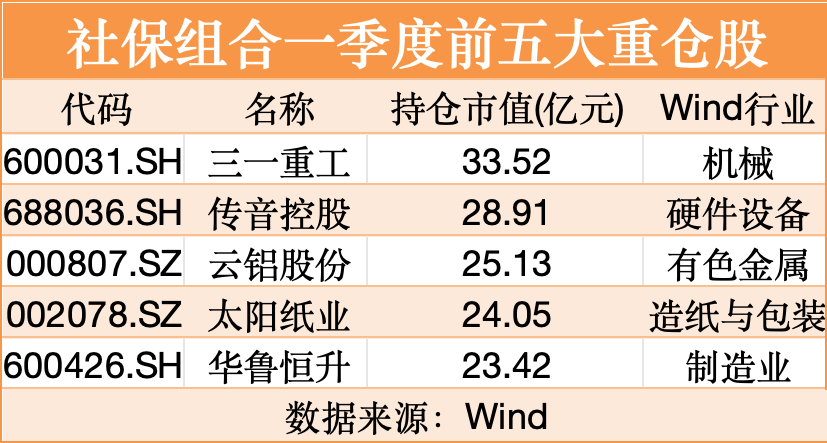
Core Viewpoint - The National Social Security Fund (社保基金) has made significant moves in the first quarter, revealing its investment strategies through the disclosure of its major holdings and changes in stock positions. Group 1: Major Holdings - The top five stocks held by the social security fund, with market values exceeding 2.3 billion yuan, are SANY Heavy Industry (三一重工) at 3.352 billion yuan, Transsion Holdings (传音控股) at 2.891 billion yuan, Yun Aluminum (云铝股份) at 2.513 billion yuan, Sun Paper (太阳纸业) at 2.405 billion yuan, and Hualu Hengsheng (华鲁恒升) at 2.342 billion yuan [3][4]. Group 2: New Additions - In the first quarter, the social security fund entered the top ten shareholders of 215 companies, with Baosteel (宝钢股份) being the most favored, acquiring 158 million shares valued at 1.14 billion yuan [4][5]. Group 3: Increased Holdings - The fund increased its holdings in 145 companies, notably in Gemdale Corporation (金地集团) and Small Commodity City (小商品城), with increases of over 30 million shares each [6][7]. Group 4: Specific Stock Changes - Specific increases include 39.68 million shares in Gemdale, 33.32 million shares in Small Commodity City, and 19.33 million shares in China Merchants Shekou (招商蛇口) [8][9]. - The fund also reduced its holdings in China Aluminum (中国铝业) and Shanxi Coal (山西焦煤) by over 50 million shares each [9].