矿业

Search documents
龙虎榜丨大中矿业跌停两连板,四机构净买入1.3亿元
Ge Long Hui A P P· 2025-11-24 09:43
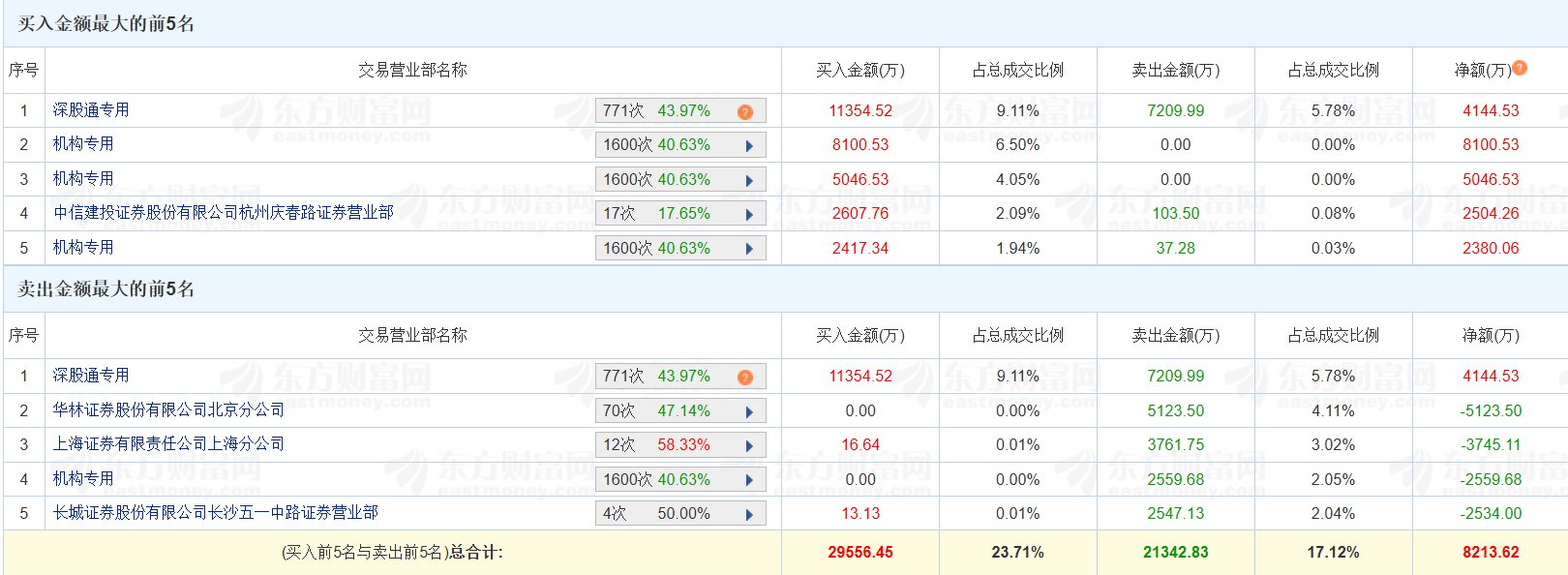
Group 1 - The stock of Zhongjin Mining (001203.SZ) experienced a significant decline, hitting the limit down for two consecutive trading days, with a turnover rate of 3.39% and a transaction volume of 1.247 billion yuan [1] - The net buying from the Shenzhen Stock Connect amounted to 41.45 million yuan, while institutional investors bought 156 million yuan and sold 25.97 million yuan, resulting in a net buying of 130 million yuan [1] - The "Hangzhou Gang" retail investors ranked fourth in net buying, contributing 25.04 million yuan [1] Group 2 - The top five trading departments by buying amount included the Shenzhen Stock Connect with 113.55 million yuan, accounting for 9.11% of total transactions [2] - The second largest buyer was an institutional investor with 81.01 million yuan, representing 6.50% of total transactions [2] - The total buying amount from the top five buying and selling departments reached 295.56 million yuan, which is 23.71% of total transactions [2]

【环球财经】印加关系回暖 同意重启贸易谈判
Xin Hua She· 2025-11-24 09:19
Group 1 - The core point of the news is the resumption of trade agreement negotiations between India and Canada, aiming to double bilateral trade to $50 billion by 2030 [1][3] - Indian Prime Minister Modi and Canadian Prime Minister Carney confirmed the initiation of the Comprehensive Economic Partnership Agreement (CEPA) negotiations during their bilateral talks [1][4] - Both countries will continue and expand their long-term cooperation in the civil nuclear energy sector, including discussions on long-term uranium supply arrangements [1][4] Group 2 - Carney acknowledged the potential for some friction between the two nations but emphasized India's status as a reliable trade partner, highlighting the opportunities for Canadian workers and businesses [3][4] - Despite previous diplomatic tensions, bilateral trade has continued to grow, with the total goods and services trade projected to reach approximately CAD 31 billion (around $22 billion) in 2024 [4] - The recent thaw in relations was marked by a meeting between Modi and Carney during the G7 summit in June, where they agreed to send new high commissioners to each other’s countries [4]

财政部:纳税人开采轻稀土原矿等 按照轻稀土选矿产品征收资源税
智通财经网· 2025-11-24 08:49
Core Viewpoint - The Ministry of Finance has issued a notice clarifying the execution standards for resource tax policies, specifically regarding the taxation of various mineral products, including light and heavy rare earths, condensate oil, and other mineral resources [1][2]. Taxation Policy - Taxpayers extracting light rare earth ores that undergo initial processing to produce mineral-type rare earth concentrates will be taxed according to light rare earth mining products [6]. - Taxpayers extracting ion-type rare earth ores and producing rare earth solutions, carbonates, and oxalates through ion exchange and other processes will be taxed according to medium and heavy rare earth mining products [6]. - Condensate oil extracted from gas fields will be taxed under the crude oil tax category [3][4]. Exemptions and Special Cases - Certain entities, such as administrative and judicial bodies, are exempt from paying resource tax on confiscated taxable products [2]. - Construction projects extracting sand, clay, and other minerals for direct use in the project are also exempt from resource tax [2]. Tax Calculation Basis - The tax basis for resource tax will be determined based on the sales amount excluding VAT for taxable products sold or self-used in continuous production of non-taxable products [7][8]. Related Transactions - If a taxpayer sells taxable products to an affiliated unit at a price significantly lower than the price charged to non-affiliated units without justification, tax authorities may adjust the taxable sales amount accordingly [9][10]. Implementation Timeline - The new tax policies will take effect on December 1, 2025, and will apply to previously unprocessed matters according to the new regulations [18].
中石油、中石化、中海油、国网、南网、三峡、国能位居行业第一梯队!
中国能源报· 2025-11-24 08:15
Core Viewpoint - The article discusses the release of the evaluation index system for world-class enterprises in 16 industries by state-owned enterprises, highlighting the progress and assessment of central enterprises in building world-class standards [1]. Group 1: Evaluation Index System - The first batch of 11 industry evaluation index systems was released in November 2024, followed by a second batch of 5 in November 2025, covering 16 industries including power grid, oil and gas exploration, and telecommunications [1]. - The evaluation index system aims to assess the construction of world-class enterprises based on data from the year 2024 [1]. Group 2: Assessment Results - Among the 45 central enterprises evaluated, 13, including China National Petroleum, China Petroleum & Chemical, and State Grid, ranked in the top tier of their respective industries [1]. - The overall results indicate that central enterprises are making solid progress in building world-class standards [1]. Group 3: Key Evaluation Metrics - The evaluation metrics include various dimensions such as competitiveness, innovation, control, influence, and risk management, with specific indicators for each dimension [2][4][5]. - Key indicators include total revenue, total assets, profit margins, and R&D investment intensity, which are essential for assessing the performance and competitiveness of enterprises [2][3][4][5].




金岭矿业:截至11月20日股东人数35682户
Zheng Quan Ri Bao· 2025-11-24 08:10
Core Viewpoint - Jinling Mining reported that as of November 20, 2025, the number of registered shareholders is 35,682, including credit accounts combined in the register [2] Summary by Category - **Company Information** - Jinling Mining has a total of 35,682 registered shareholders as of November 20, 2025, which includes credit accounts [2]

并购野心受挫:必和必拓二度被拒,正式退出英美资源收购战
Hua Er Jie Jian Wen· 2025-11-24 07:19
Core Insights - BHP's attempt to acquire Anglo American has officially failed, marking the end of a brief and dramatic bidding war [1] - The decision comes as Anglo American's board rejected BHP's latest proposal, favoring its ongoing merger with Teck Resources instead [1] - The failed acquisition attempt highlights the mining industry's increasing demand for high-quality copper assets amid a tightening supply [1][3] Group 1: Acquisition Attempt - BHP's move to propose an acquisition was seen as a strategic last-ditch effort before the shareholder vote on the Anglo American-Teck merger scheduled for December 9 [2] - Analysts described BHP's bid as a "final roll of the dice" aimed at acquiring coveted South American copper assets [2] - The swift withdrawal from the bidding process indicates BHP's reluctance to engage in a costly competitive bidding war [3] Group 2: Strategic Importance of Copper - The core of the acquisition battle revolves around the competition for copper assets, which are viewed as critical for future growth [3] - Copper is essential for infrastructure related to energy transition, including electric grids and renewable energy equipment, increasing its strategic value [3] - If the merger between Anglo American and Teck Resources is successful, it would create a new giant in the copper production sector with a market value exceeding $60 billion [1][3] Group 3: Complexity of Anglo American - Anglo American's diverse asset portfolio, which includes diamonds and platinum, complicates its attractiveness as a pure copper acquisition target [5] - BHP's previous attempts to acquire Anglo American were also thwarted due to the complexity of its asset structure [5] - Following BHP's exit, the path for Anglo American and Teck Resources' merger appears clearer, with BHP now focusing on its internal growth strategy [5]

华龙期货铁矿周报-20251124
Hua Long Qi Huo· 2025-11-24 03:09
Group 1: Report Industry Investment Rating - Investment Rating: ★★ [6] Group 2: Core Viewpoints - The global iron ore shipment volume has rebounded, and port inventories decreased slightly last week after a significant increase. Currently, the inventory is relatively high. As the loss - making area of steel mills expands, the negative feedback on raw materials is strong. The iron ore fundamentals are generally weak in both expectation and reality, and it is expected to show a weak and fluctuating trend overall [5][33] Group 3: Summary by Directory 1. Disk Analysis - This section includes futures price, spread analysis (basis), and position analysis. However, specific analysis content is not provided [7][8][12] 2. Important Market Information - In October 2025, the global crude steel output was 143.3 million tons, a year - on - year decrease of 5.9%; from January to October, the global crude steel output was 1.5176 billion tons, a year - on - year decrease of 2.1%. The People's Bank of China maintained the one - year and five - year loan prime rates (LPR) at 3% and 3.5% respectively, remaining unchanged for six consecutive months [14] 3. Supply - side Situation - As of October 2025, the import volume of iron ore and concentrates was 111.309 million tons, a decrease of 5.021 million tons from the previous month; the import average price was $100.56 per ton, an increase of $3.61 per ton from the previous month. In the same period, Australia's iron ore shipment volume was 66.842 million tons, an increase of 1.671 million tons from the previous month; Brazil's iron ore shipment volume was 29.255 million tons, an increase of 1.057 million tons from the first half of the month [20][21] 4. Demand - side Situation - The section involves 247 steel mills' daily average hot metal output, profitability rate, and Shanghai's terminal wire and screw procurement volume. However, specific analysis content is not provided [22][26][27] 5. Fundamental Analysis - The blast furnace operating rate of 247 steel mills was 82.19%, a month - on - month decrease of 0.62% and a year - on - year increase of 0.26%; the daily average hot metal output was 2.3628 million tons, a month - on - month decrease of 0.60 million tons and a year - on - year increase of 0.48 million tons; the steel mill profitability rate was 37.66%, a month - on - month decrease of 1.30% and a year - on - year decrease of 16.89%. The total inventory of imported iron ore at 45 ports in the country was 150.5465 million tons, a month - on - month decrease of 750,600 tons; the daily average port clearance volume was 3.2992 million tons, an increase of 297,000 tons. The total inventory of imported iron ore at 47 ports was 157.3485 million tons, a month - on - month decrease of 779,900 tons; the daily average port clearance volume was 3.4339 million tons, an increase of 311,000 tons [30][32] 6. Market Outlook - The global iron ore shipment volume has rebounded, and port inventories decreased slightly last week after a significant increase. Currently, the inventory is relatively high. As the loss - making area of steel mills expands, the negative feedback on raw materials is strong. The iron ore fundamentals are generally weak in both expectation and reality, and it is expected to show a weak and fluctuating trend overall [5][33] 7. Operation Strategy - Unilateral: Go short lightly on rallies; Arbitrage: Wait and see; Options: Wait and see [6][34]
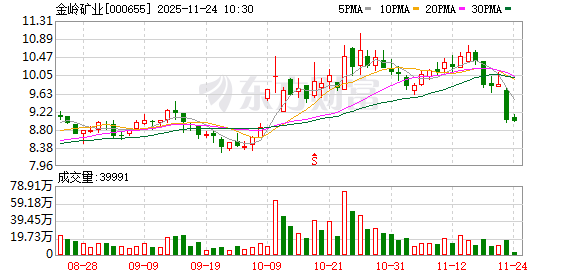
金岭矿业最新股东户数环比下降8.44%
Zheng Quan Shi Bao Wang· 2025-11-24 02:31
Core Viewpoint - Jinling Mining reported a decrease in the number of shareholders, indicating a potential shift in investor sentiment and market dynamics [2] Group 1: Shareholder Information - As of November 20, the number of shareholders for Jinling Mining was 35,682, a decrease of 3,288 from the previous period (November 10), representing a decline of 8.44% [2] - This marks the second consecutive period of decline in the number of shareholders [2] Group 2: Stock Performance - The latest stock price for Jinling Mining is 9.09 yuan, reflecting an increase of 1.00%, but the stock has cumulatively decreased by 10.18% since the concentration of shares began [2] - Over the past trading days, the stock experienced 5 days of increases and 5 days of decreases [2] Group 3: Financing and Margin Data - As of November 21, the margin trading balance for the stock was 168 million yuan, with the financing balance also at 168 million yuan, showing an increase of 3.2053 million yuan, or 1.94%, since the concentration of shares began [2] Group 4: Financial Performance - For the first three quarters, Jinling Mining achieved a total operating revenue of 1.247 billion yuan, representing a year-on-year growth of 12.98% [2] - The net profit for the same period was 220 million yuan, reflecting a year-on-year increase of 47.09% [2] - The basic earnings per share were 0.3703 yuan, with a weighted average return on equity of 6.42% [2]
盛屯矿业20251120
2025-11-24 01:46
Summary of Shengton Mining Conference Call Company Overview - Shengton Mining's core assets are concentrated in the Democratic Republic of Congo (DRC), including the Karongwe Copper-Cobalt Mine and newly acquired high-grade open-pit gold mine, as well as an Indonesian high-nickel production base. The company implements a global strategy of "controlling resources and expanding materials" to optimize revenue structure, with copper business being the main profit contributor [2][5][6]. Key Points and Arguments Resource Potential - The Karongwe Copper-Cobalt Mine has fully commenced production, achieving over 60,000 tons in 2023, with significant exploration potential in surrounding areas exceeding 300 square kilometers [2][10]. - The company holds a key copper mining exploration right near major mining areas, indicating substantial future resource potential [3]. - Optimistic outlook for cobalt prices, expected to exceed 500,000 RMB/ton by 2026, with a quota of 1,680 tons secured [3][5]. - New gold mine acquisition in DRC expected to yield 6-7 tons of gold annually at a cost of $300-$350 per ounce [2][16]. Financial Performance - Since 2022, Shengton has been optimizing its revenue structure by gradually divesting from trading businesses, leading to improved financial stability [7][8]. - Approximately 70%-80% of gross profit now comes from copper business, with significant improvements in cash flow, exceeding 3 billion RMB in the first three quarters of the year [8]. - The company anticipates substantial profit growth, potentially reaching 5-6 billion RMB in the future, driven by gold mining operations [4][21]. Strategic Developments - The company plans to acquire 84.68% equity in a Canadian-listed company for 1.35 billion RMB, enhancing its gold reserves and mining capabilities [16]. - The development strategy since 2016 has focused on global expansion and energy metals, with core assets primarily in DRC and smaller operations in China [6]. Operational Risks - Despite geopolitical risks in DRC, the company’s projects are located far from conflict zones, with stable operations in nearby mining areas [2][19]. - Transportation logistics are manageable, with plans for both land and air transport to ensure product delivery [20]. Additional Important Insights - Domestic mining assets are expected to improve significantly, with new projects in Dali and Guizhou projected to contribute additional copper and gold production [4][14]. - The nickel segment, while currently underperforming due to price fluctuations, has potential for profitability during favorable market conditions [12]. - The zinc smelting business is operating at full capacity but has faced some losses due to declining processing fees, though recovery is anticipated [15]. Conclusion - Shengton Mining is positioned for significant growth with a robust portfolio of mining assets, strategic acquisitions, and a focus on optimizing its operational efficiency. The company’s future profit potential appears strong, making it a compelling investment opportunity [21][22].

快问快答:10大核心问题拆解加拿大上市要点!
Sou Hu Cai Jing· 2025-11-24 01:31
Group 1 - The article emphasizes that Canada is an attractive option for Chinese companies seeking overseas financing, especially given the increasing competition in the US capital markets [2] - It outlines ten core questions regarding the Canadian capital market to provide clear guidance for companies looking to go public [2] Group 2 - The main stock exchanges in Canada include the Toronto Stock Exchange (TSX), which has a main board for larger, mature companies and a venture board (TSXV) for smaller, growth-oriented firms [4] - The Canadian Securities Exchange (CSE) also offers listing services for small and micro enterprises, creating a multi-tiered capital market system [4] Group 3 - Advantages of financing in Canada include a stable financial services system, access to North American capital integration, and increased fundraising opportunities in the US [5] - The TSX offers two main listing methods: Initial Public Offerings (IPOs) and Capital Pool Company (CPC) listings [6] Group 4 - The CPC model is suitable for shell companies that only hold cash and seek to go public quickly while looking for acquisition targets [7] - Domestic companies can utilize various fundraising methods after listing in Canada, including IPOs, stock issuance, bond issuance, and stock pledges [8] Group 5 - Compared to the US capital markets, the time and cost of listing in Canada are more advantageous, with Canadian listings taking about six months and costing approximately 50% of Nasdaq fees [9] Group 6 - Companies listed in Canada can transfer to the US market using the Multi-Jurisdictional Disclosure System (MJDS), which allows for a quick transfer process within 90 days [10] Group 7 - Industries such as mining and energy have significant advantages in the Canadian capital market, with the TSX being a major global mining capital market [11] - Other sectors like fintech, environmental technology, and biomedicine can achieve high valuations, and even industries like cannabis are permitted to list [11] Group 8 - Domestic mining companies need to prepare various qualifications and financial requirements before listing on the TSX, and it is advisable to collaborate with experienced firms like Huayi Capital for guidance [12] Group 9 - Huayi Capital offers tailored listing advisory services for companies looking to enter the Canadian market, leveraging local resources and expertise to create efficient and cost-effective listing strategies [13]