稀土

Search documents
A股三季报行情纵深推进 17家上市公司净利最高同比预增超100%
Zhong Jin Zai Xian· 2025-10-12 02:29
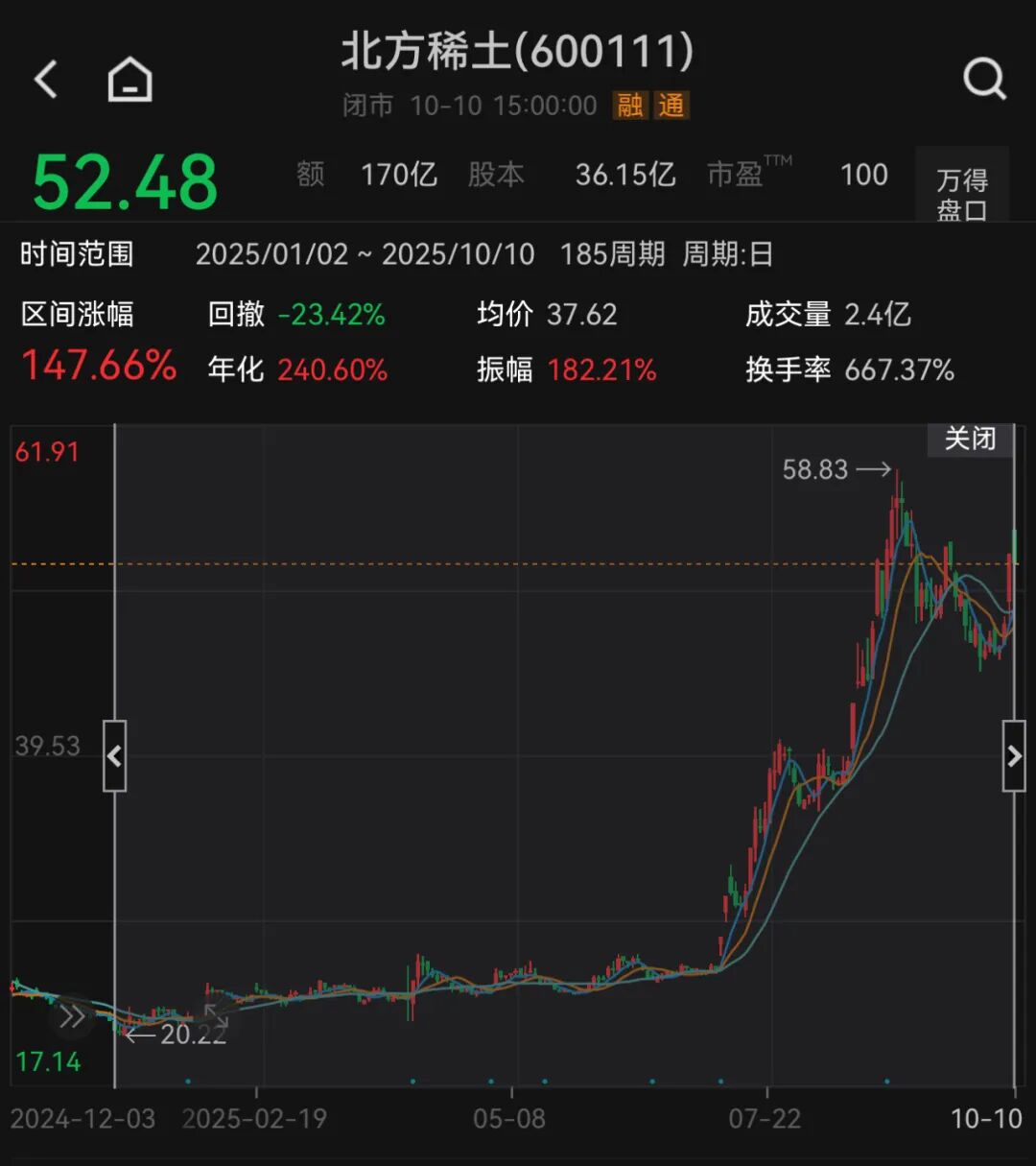
Core Viewpoint - The A-share market is experiencing significant growth in the third quarter of 2025, with many companies reporting substantial increases in net profit forecasts, indicating strong performance across various sectors [1][2][3][4]. Group 1: Company Performance - A total of 46 A-share listed companies have released profit forecasts for the third quarter of 2025, with 17 companies expecting a year-on-year increase in net profit exceeding 100% [1]. - Yinglian Co. leads with an estimated net profit of 34.5 million to 37.5 million yuan, reflecting a growth of 1531.13% to 1672.97% compared to the previous year [1]. - Guangdong Mingzhu follows with a projected net profit of 215 million to 263 million yuan, showing a year-on-year increase of 858.45% to 1071.44% [2]. - Limin Co., a leading disinfectant manufacturer, anticipates a net profit of 384 million to 394 million yuan, representing a growth of 649.71% to 669.25% [2]. - Northern Rare Earth expects a net profit of 1.51 billion to 1.57 billion yuan, an increase of 272.54% to 287.34% [3]. - Dongyangguang forecasts a net profit of 847 million to 937 million yuan, indicating a growth of 171.08% to 199.88% [4]. - Jinkeli Yongci anticipates a net profit of 505 million to 550 million yuan, reflecting a growth of 157% to 179% [4]. Group 2: Market Dynamics - The significant profit increases are attributed to various factors, including enhanced production capacity, improved market share, and effective cost management strategies [1][2][3][4]. - Northern Rare Earth has adjusted its rare earth concentrate trading price to 26,205 yuan per ton for the fourth quarter of 2025, marking a 37.13% increase from the previous quarter [3]. - The refrigerant industry is experiencing a favorable supply-demand balance, leading to rising prices and improved profitability for companies like Dongyangguang [4]. - Jinkeli Yongci is expanding its production capacity, with plans to reach 38,000 tons by the end of 2024 and aims for 60,000 tons by 2027 [5].

事关经贸措施!刚刚,商务部回应四大关切!
券商中国· 2025-10-12 02:24
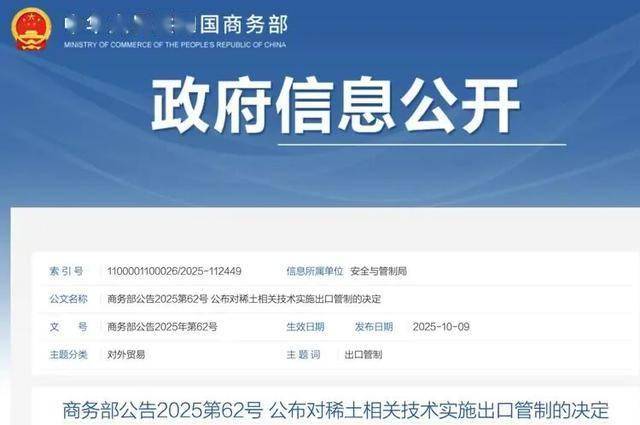
Core Viewpoint - The article discusses China's recent export control measures on rare earth materials, emphasizing the government's commitment to national security and international stability while maintaining a willingness to engage in dialogue with other countries [2][3][4]. Group 1: Export Control Measures - China has implemented export controls on rare earth materials as a legitimate action to enhance its export control system, particularly in light of global instability and military applications of these materials [2]. - The government assures that these export controls are not prohibitive; applications that meet regulations will be approved, and there will be facilitation measures such as general licenses and exemptions for compliant trade [3]. Group 2: Response to U.S. Actions - In response to the U.S. imposing a 100% tariff on Chinese rare earth exports and software controls, China criticizes the U.S. for its double standards and excessive use of export controls, which it claims harms international trade order and global supply chain stability [4][5]. - China highlights that the U.S. has over 3,000 items on its export control list compared to China's 900, indicating a disparity in the application of export controls [5]. Group 3: Maritime and Shipping Measures - The U.S. plans to impose port fees on Chinese vessels starting October 14, which China views as a violation of WTO rules and a unilateral action, prompting China to announce corresponding countermeasures [6]. - China's countermeasures are described as necessary defensive actions to protect its industries and ensure fair competition in international shipping and shipbuilding markets [6].

突发!商务部就中方经贸政策发声
Wind万得· 2025-10-12 02:20
3 、有记者问:美东时间 10 月 10 日,美方宣布, 针对中方采取的稀土等相关物项出口管制,将对中方加征 100% 关税 ,并对所有关键软件实施出口管 制,请问商务部对此有何评论? 答:中方注意到有关情况。 10 月 9 日,中方发布了关于稀土等相关物项的出口管制措施,这是中国政府依据法律法规,完善自身出口管制体系的正常行 为。中国作为负责任大国,始终坚定维护自身国家安全和国际共同安全,始终秉持公正、合理、非歧视的原则立场,审慎适度实施出口管制措施。 美方 有关表态是典型的"双重标准"。 长期以来,美方泛化国家安全,滥用出口管制,对华采取歧视性做法,对半导体设备、芯片等众多产品实施单边长臂管 辖措施。美方管制清单物项超过 3000 项,而中方出口管制清单物项仅 900 余项。美方使用出口管制最低含量规则由来已久,低至 0% 。美方相关举措严 重损害企业正当合法权益,严重冲击国际经贸秩序,严重破坏全球产供链安全稳定。 特别是 9 月中美马德里经贸会谈以来,短短 20 多天时间,美方持续新增出台一系列对华限制措施,将多家中国实体列入出口管制实体清单和特别指定国 民清单;通过穿透性规则任意扩大受管制企业范围,影 ...
什么是稀土?稀土的独特价值与中国的优势
Sou Hu Cai Jing· 2025-10-12 01:33
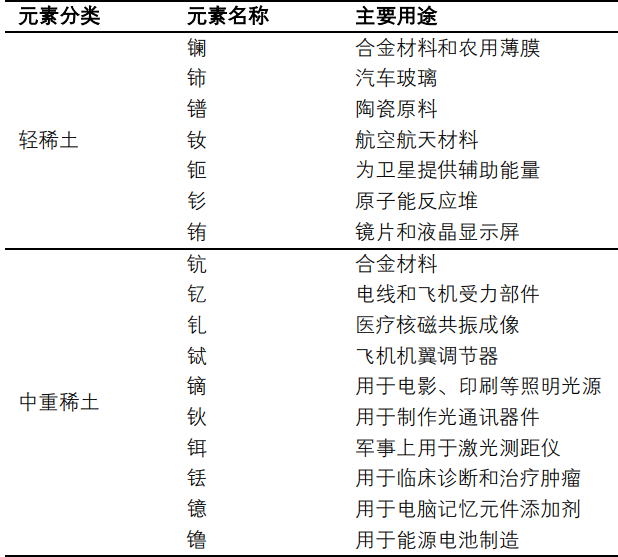
Core Insights - Rare earth elements are critical strategic metals essential for national development, particularly in high-tech fields such as semiconductors, new energy, and defense [1] Group 1: Definition and Strategic Value - Rare earth refers to a total of 17 metallic elements in the chemical periodic table, including 15 lanthanides, as well as scandium (Sc) and yttrium (Y). They are typically divided into light rare earths and heavy rare earths, with the latter being scarcer and more strategically valuable [4] - Rare earths are known as "industrial vitamins" due to their excellent magnetic, optical, and electrical properties, making them key materials in high-tech industries such as semiconductors, electric vehicles, wind power, aerospace, and defense [4] Group 2: China's Role in the Global Supply Chain - China is the only country with the capability to produce the entire rare earth industry chain, controlling approximately 90% of global rare earth processing capacity, particularly excelling in heavy rare earth separation technology [4][6] - The recent upgrade in China's export control policy on rare earths includes new regulations on five types of heavy rare earths and extends to rare earth technologies, equipment, and raw materials. It also requires foreign companies using Chinese rare earths or technologies for re-export to obtain Chinese permission [4][7] Group 3: Unique Characteristics and Advantages - Rare earth elements possess a unique 4f electron structure, allowing for significant enhancements in material properties with minimal additions. For instance, neodymium-iron-boron magnets are crucial for high-performance motors and hard disk drives, while terbium and dysprosium stabilize magnets at high temperatures [6] - China's advantages lie not only in its rare earth reserves but also in decades of accumulated, hard-to-replicate smelting and separation technologies, along with a complete industry chain [6] Group 4: Global Regulatory Changes and Challenges - The introduction of China's "foreign direct product rule" indicates that products manufactured abroad containing specific Chinese rare earth elements or utilizing Chinese rare earth technologies will be subject to Chinese export controls. This marks a shift from resource exportation to rule exportation and control over global supply chain pricing [7] - Despite having rare earth resources, countries like the United States and Australia heavily rely on China for heavy rare earth refining and separation, with analyses suggesting that the U.S. may lag behind China in heavy rare earth separation technology by approximately 20 years, making it difficult to establish an independent rare earth supply chain in the short term [7] Group 5: Applications in Semiconductor Industry - Rare earths play multiple critical roles in semiconductor manufacturing, including precision equipment where neodymium-iron-boron magnets are essential for achieving nanometer-level precision in motion, and in stabilizing laser systems with materials like terbium gallium garnet crystals [7] - In the chemical mechanical polishing stage of chip manufacturing, cerium dioxide abrasives are the mainstream choice due to their high selectivity and efficiency. Additionally, rare earth elements such as lanthanum and yttrium are incorporated to optimize the performance of transistor gate dielectrics in advanced processes [7]

贸易摩擦升级,再看稀土产业逻辑
Hu Xiu· 2025-10-12 00:25
Core Insights - Rare earth elements are essential in high-end manufacturing and defense technology, often referred to as "industrial vitamins" [1][9] - The demand for rare earth permanent magnets is expected to surge, particularly due to applications in humanoid robots [2][25] - China holds a critical position in the global supply chain of rare earths, leveraging its vast reserves and production capabilities amid escalating US-China trade tensions [3][4] Supply and Demand Dynamics - The recent export control policy implemented on October 9, 2025, is a significant catalyst for the rare earth sector, reshaping the global supply order [5] - China's strategic reserve of rare earths is set to increase by 25%, enhancing supply rigidity and control [6] - The combination of strong supply contraction and expanding high-end demand is projected to drive industry prosperity and elevate price levels [7] Industry Structure - The rare earth industry is characterized by a "North-South duopoly" structure, with major production concentrated in Baotou for light rare earths and Ganzhou for heavy rare earths [32][45] - China has completed the integration of its rare earth industry, with two major groups controlling 98% of the mining quotas, enhancing policy transmission efficiency and market regulation [47][57] Global Resource Distribution - As of 2024, global rare earth reserves are estimated at 90.88 million tons, with China accounting for 44 million tons, or 48.4% of the total [29][39] - The concentration of rare earth resources is primarily in China, Southeast Asia, Australia, Southern Africa, and the Americas [27] Technological and Competitive Advantages - China possesses a complete rare earth industry chain, from mining to refining to application, giving it unparalleled control in the global market [36][42] - Advanced separation and purification technologies, such as the low-temperature concentrated sulfuric acid roasting process, provide significant competitive advantages [43][44] Policy and Regulatory Environment - The new export control policy expands the range of controlled items and introduces "long-arm jurisdiction" principles, affecting global supply chains [65][70] - The policy aims to reshape the global rare earth supply chain and reinforce China's strategic dominance and pricing power in the sector [73][74] Key Companies in the Rare Earth Industry - **China Rare Earth**: Leading in heavy rare earths, with strategic advantages in resource security and industry pricing [76] - **Northern Rare Earth**: The largest supplier of light rare earths globally, with a complete industry chain and significant cost advantages [76] - **MP Materials**: The core of the US rare earth industry, moving towards vertical integration in magnet manufacturing [78] - **Lynas Rare Earths**: The largest rare earth separation producer outside China, crucial for Western efforts to establish an independent supply chain [78]

中国稀土新政出鞘,5种稀土+技术管制,特朗普紧急派两员大将应对
Sou Hu Cai Jing· 2025-10-11 17:50
Core Viewpoint - The recent announcement by China's Ministry of Commerce regarding rare earth export controls has heightened tensions in the U.S., prompting immediate action from the Trump administration to address the situation [1][3]. Group 1: China's Rare Earth Policy - The new rare earth management regulations set to be implemented in 2024 are based on a long-term strategy, establishing a traceability system for rare earth products that covers the entire supply chain from extraction to export [3]. - The new policy not only restricts raw material exports but also limits the dissemination of refining technologies, further solidifying China's control over the rare earth market [3]. - China currently dominates the global rare earth industry, producing 92% of the world's refining capacity and being the only country capable of fully producing all 17 rare earth elements [5]. Group 2: U.S. Response and Strategic Moves - The U.S. is attempting to mitigate its reliance on China by accelerating partnerships with countries like Canada and Australia, including the construction of rare earth separation plants [5]. - The U.S. Department of Defense has set a minimum price of $110 per kilogram for critical materials like neodymium and praseodymium, which is nearly double the market price, to secure military supply needs [3]. - The U.S. is also exploring a $200 billion currency swap agreement with Argentina to gain access to lithium and rare earth resources, although negotiations are complicated by Argentina's balancing act between the U.S. and China [3][10]. Group 3: Global Market Impact - China's export controls have triggered significant price fluctuations in the global market, with prices for dysprosium and terbium in Europe reportedly tripling [5]. - Major U.S. companies are beginning to stockpile inventory in response to supply chain risks, affecting production plans for companies like Tesla and Ford [5]. - Japan and the EU have initiated emergency measures in response to China's new regulations, but they face challenges in overcoming their dependence on Chinese refining technology [9]. Group 4: Future Outlook - Rebuilding a complete rare earth supply chain in the U.S. is estimated to require a decade and an investment of $300 billion [7]. - China's Ministry of Commerce has indicated that it will establish a "green channel" for expedited approval of compliant export applications, maintaining flexibility in its supply chain management [7][12]. - The military significance of rare earth elements complicates the geopolitical landscape, as new regulations restrict exports to foreign military users, impacting U.S. industries, including artificial intelligence [7][9].
一觉醒来稀土变天!0.1%也不行!中国稀土新规是对西方的重拳出击
Sou Hu Cai Jing· 2025-10-11 16:52
Core Viewpoint - China's recent upgrade of rare earth export controls has significantly impacted global supply chains, causing immediate reactions from countries like Japan and South Korea, as well as the United States [2][10]. Group 1: Policy Changes - On October 9, China's Ministry of Commerce announced that any product containing 0.1% rare earth elements will require a permit for export, a regulation stricter than previous measures [2][3]. - The new regulations also extend to superhard materials and rare earth equipment, effective November 8, further tightening control over the supply chain [2][3]. Group 2: Global Reactions - South Korean storage chip manufacturers are particularly affected, as their production relies heavily on Chinese rare earth materials, leading to urgent requests for leniency from the Chinese government [3][4]. - The U.S. is heavily dependent on China for rare earths, with 70% of its supply sourced from China, and the military's advanced weapon systems are also reliant on these materials [4][6]. Group 3: Strategic Implications - Rare earth elements are critical for various technologies, from smartphones to military applications, making them essential for both civilian and defense industries [6][12]. - The new regulations are seen as a strategic move by China to assert control over the global supply chain, especially in response to previous technology restrictions imposed by Western countries [10][14]. Group 4: Market Impact - Domestic companies like Zhongke Sanhuan and Jinli Permanent Magnet have seen their stock prices rise, indicating a positive market response to the new regulations [10][14]. - The shift in policy is expected to force a realignment of global supply chains, with countries scrambling to secure alternative sources and technologies [10][12].
3900点成为A股分水岭!三大利空压顶,203只股票被踢出融资标
Sou Hu Cai Jing· 2025-10-11 16:17
Core Viewpoint - The adjustment of margin financing rates to zero for SMIC and BAWI Storage has significant implications for investors, cutting off leverage and potentially leading to increased volatility in stock prices [1][3][5]. Group 1: Impact on Stocks - SMIC's static P/E ratio reached 303, while BAWI Storage's was 301, triggering the margin financing rate adjustment as per the rules set by the exchanges [3]. - Following the announcement, SMIC's stock experienced a volatility of over 11%, with a trading volume exceeding 24.2 billion yuan [3]. - A total of 203 stocks were affected by this adjustment, predominantly in the technology sector due to high valuations [3]. Group 2: Market Reactions - The adjustment directly severed the "leverage supply" for high-valuation stocks, which previously had margin rates between 30% to 100% [5]. - The financing balance for SMIC surged from 7.5 billion yuan to 15 billion yuan within two months, indicating a significant influx of leveraged funds that may now face withdrawal [5]. - The semiconductor sector faced a broader sell-off, with leading companies like CATL experiencing significant declines [7]. Group 3: Broader Economic Context - The Ministry of Commerce announced export controls on various materials, including rare earths and lithium batteries, effective November 8, indicating a strategic shift from raw material exports to finished product exports [5]. - The retail sector showed signs of growth, with a reported 7.9% year-on-year increase in social retail sales, although consumer spending patterns are shifting towards more experiential purchases [7]. - The overall market sentiment was affected by external factors, including foreign capital withdrawal and tightening global liquidity, leading to a significant drop in major indices [9].



A股:大家要准备好,下周一,股市很有可能要重演历史
Sou Hu Cai Jing· 2025-10-11 14:36
Core Viewpoint - The A-share market is at a critical juncture, with the Shanghai Composite Index recently breaking through 3900 points but experiencing a decline, raising questions about potential historical patterns of rebound after breaking key technical levels [1][10]. Market Dynamics - On October 10, the market showed a mixed performance, with the index fluctuating between 3886.31 and 3933.01 points, indicating a fierce battle between bulls and bears around the 3900-point mark [3]. - The technology sector, particularly semiconductor and battery stocks, faced a pullback, while sectors benefiting from export control policies, such as superhard materials and rare earths, remained strong, reflecting a cautious sentiment among investors [3]. Historical Patterns - Historical trends suggest that breaking key technical levels does not always signal a trend reversal; instead, it may serve as an opportunity for bulls to consolidate and gather strength [5]. - Previous instances, such as the adjustment starting on September 2, where the index fell below 3800 points but later rebounded, support the notion of potential recovery after a dip [5]. Financial and Policy Support - Despite the index's adjustment, the market's funding situation remains resilient, with the A-share financing balance reaching 24,292 billion, a record high, and a net buying amount of 508 billion, indicating that some investors are taking advantage of the dip [5]. - Positive developments in the global AI industry, improving profit growth for domestic industrial enterprises, and better expectations for social financing data provide fundamental support for the market [5]. Technical Signals - From a technical analysis perspective, the market is still in a healthy adjustment phase, with key moving averages indicating support levels at 3880 and 3858 points [7]. - The trading volume decreased to 1.13 trillion, showing a "price drop with volume shrinkage" characteristic, which is seen as a healthy consolidation [7]. Institutional Outlook - Most institutions maintain an optimistic outlook for the market, with expectations of continued upward movement post-holiday [7]. - The technology sector is viewed as a crucial theme, with domestic substitution providing clues for sector rotation [7]. Upcoming Key Factors - The critical focus for the upcoming week is whether the bulls can maintain the 3900-point level; a quick recovery could lead to a historical pattern of rebound, while a sustained drop may prolong the adjustment period [10]. - Investors should monitor two key signals: whether trading volume can exceed 1.2 trillion and if sector rotation, particularly in technology, can stabilize [10].
稀土涨价!千亿龙头,业绩大幅预增
Zhong Guo Zheng Quan Bao· 2025-10-11 14:13
Core Viewpoint - Northern Rare Earth announced a significant increase in the trading price of rare earth concentrate for Q4 2025, reflecting a robust market outlook and strong financial performance expectations for the upcoming quarters [1][2][3]. Price Adjustment - The trading price for rare earth concentrate has been adjusted to 26,205 yuan/ton (excluding tax), marking a 37.13% increase compared to the previous quarter's price of 19,109 yuan/ton [2][3]. - This price adjustment is part of a quarterly pricing mechanism established in previous board meetings and is expected to stabilize after a series of price increases [2][3]. Financial Performance Forecast - For the first three quarters of 2025, the company anticipates a net profit between 1.51 billion yuan and 1.57 billion yuan, representing a year-on-year increase of 272.54% to 287.34% [4][5]. - The forecasted net profit, excluding non-recurring gains and losses, is expected to be between 1.33 billion yuan and 1.39 billion yuan, indicating a substantial increase of 399.9% to 422.46% compared to the same period last year [5]. Market Outlook - The company maintains an optimistic outlook on the growth of downstream demand in the rare earth industry, with stable prices for key products like praseodymium and neodymium [3]. - Despite some market fluctuations due to international trade factors, domestic demand has provided strong support for the rare earth market, leading to increased activity compared to the previous year [3]. Strategic Development - The company plans to enhance its competitiveness by expanding its production capacity in the rare earth permanent magnet materials sector, with a focus on high-performance neodymium-iron-boron alloy projects [5]. - A new project is set to add an annual production capacity of 50,000 tons of magnetic material alloys and 10,000 tons of hydrogen powder, aiming to create a leading production facility in terms of capacity and cost-effectiveness [5].