
基金

Search documents
经济日报:清除“开票经济”滋生土壤
Xin Lang Cai Jing· 2026-01-31 08:13
Core Viewpoint - The article discusses the negative impact of "invoice economy" on genuine economic development, emphasizing the need for a fair tax environment and the importance of long-term growth strategies over short-term gains [10][11][12]. Group 1: "Invoice Economy" Issues - "Invoice economy" refers to local governments circumventing fiscal boundaries by offering significant tax rebates to attract investments, leading to inflated investment and tax figures [10]. - This practice creates a false sense of economic prosperity, which does not contribute to real growth or employment, and instead leads to resource wastage and market disorder [10][11]. - The reliance on "invoice economy" undermines the construction of a unified national market and violates principles of tax fairness, resulting in tax revenue loss and fiscal health erosion [10][11]. Group 2: Government and Regulatory Response - The State Taxation Administration has initiated a special campaign to address tax-related issues in investment attraction, prohibiting tax authorities from participating in or condoning such practices [12]. - Monitoring mechanisms are being established to track abnormal tax revenues and invoice issuance, with a focus on rectifying problematic agreements related to tax incentives [12]. - A collaborative effort among local governments, relevant departments, and the business community is essential to eliminate the conditions that allow "invoice economy" to thrive, promoting a healthier economic environment [12].

【环球财经】贵金属市场再现极端行情 后续走势如何?
Xin Hua Cai Jing· 2026-01-31 07:55
贵金属市场出现史诗级下跌。截至31日收盘,现货黄金盘中一度跌破每盎司4700美元,收盘下跌了 9.6%,回到4860美元附近。现货白银价格盘中更是一度暴跌超过30%,收盘则回到每盎司85美元附近。 受到影响,国内金饰价格31日大幅下调,部分品牌金饰克价较前一日跌超100元。其中,周大福足金饰 品报1625元/克,较前一日跌60元,老庙黄金报1546元/克,较前一日跌144元。 从极速拉升到高位跳水 最近一周,国际黄金市场呈现剧烈波动。数据显示,1月26日早盘,现货黄金率先突破5000美元整数关 口,午后再度攀升至5100美元;1月28日黄金持续爆发,早盘突破5200美元,午后冲上5300美元,尾盘 则升至5400美元,单日连破三道关口;1月29日早盘涨势不减,突破5500美元并逼近5600美元这一重要 整数位,4天内完成6道整百关口的突破,创下全球黄金市场短期上涨新纪录。 不过,这一轮上涨势头在巅峰时刻戛然而止。1月29日当天,金价在创下历史新高后急转直下,现货黄 金价格从每盎司5530美元附近跌至每盎司5105.83美元,日内最大跌幅达5.7%,一度跌超400美元。1月 30日,金价呈现单边急速下行,盘中一 ...
LP圈发生了什么
投资界· 2026-01-31 07:46
Core Insights - The article highlights the recent developments in Limited Partner (LP) investments across various regions in China, showcasing significant capital commitments and the establishment of new funds aimed at fostering innovation and supporting emerging industries. Group 1: Major Fund Establishments - Shanghai's state-owned assets invested 4.71 billion RMB in 17 selected sub-funds, with a total fund size of 22.89 billion RMB, leveraging nearly 200 billion RMB in social capital [2] - Nanjing plans to create an "4+N" industrial fund cluster with a total scale exceeding 200 billion RMB, focusing on key industry development and project investments [3] - Up to 10 billion RMB was raised for the Yizhuang Aerospace Industry Fund, targeting commercial aerospace sectors [8] Group 2: Sector-Specific Funds - A 10 billion RMB fund was established in Chengdu for quantum technology, focusing on nurturing the quantum industry chain [14] - The establishment of a 20 billion RMB electronic basic industry fund by China Electronics Technology Group aims to support the semiconductor sector [12][15] - A 50 billion RMB artificial intelligence fund in Kunshan will focus on core AI hardware and infrastructure [5] Group 3: Regional Investment Initiatives - The establishment of a 5 billion RMB fund in Sichuan for technology transformation aims to support innovative projects [6] - Urumqi's 2 billion RMB fund will target sectors like petrochemicals and new materials to enhance regional development [10] - The 3 billion RMB low-altitude flight industry fund in Shaanxi is set to support unlisted enterprises [16] Group 4: Strategic Partnerships and Collaborations - China Life Insurance announced a commitment of approximately 12.5 billion RMB to two new private equity funds, focusing on technology and real estate [20] - The establishment of a 40 billion RMB fund in Dazhou aims to foster new productive forces through public selection of fund managers [26] - The West (Chongqing) Science City High-tech Fund is set to invest in sectors like smart vehicles and biomedicine, with a focus on building industry clusters [27]

懵了,黄金史诗级崩盘,黄金基金紧急出手
Zhong Guo Ji Jin Bao· 2026-01-31 07:08
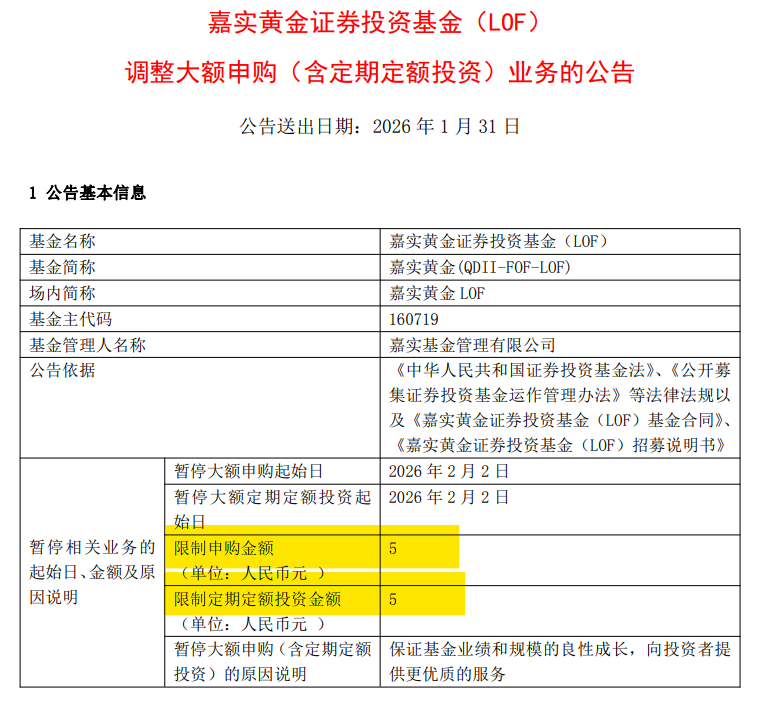
Core Viewpoint - The recent volatility in commodity markets has led to multiple LOF funds for gold and oil announcing significant purchase limits, with some funds setting daily purchase caps as low as 2 yuan [1][3]. Group 1: Fund Purchase Limits - Several funds, including 嘉实黄金 LOF and 嘉实原油 LOF, have announced that starting February 2, 2026, the maximum purchase amount per fund account per day will be limited to 5 yuan [4][6]. - 华安石油基金 LOF has implemented even stricter limits, reducing the daily purchase cap from 10 yuan to 2 yuan starting January 30 [7]. - Other funds, such as 华宝油气 LOF, have also announced limits, with a daily investment cap set at 200 yuan starting February 3 [7]. Group 2: Market Analysis - Industry insiders indicate that the imposition of purchase limits is aimed at ensuring healthy growth of fund performance and scale, while protecting investor interests [2][6]. - The recent sharp declines in gold and silver prices have been attributed to an overheated market, with significant risks accumulating due to large trading volumes prior to the downturn [2][11]. - The price of gold fell over 12% to a low of 4682 USD/oz, closing down 9.25% at 4880 USD/oz, while silver experienced a historic drop of over 36%, closing down 26.42% at 85.259 USD/oz [9][11]. Group 3: Investor Caution - Analysts warn that the precious metals market is currently in an overbought state, with increased volatility and profit-taking pressures [13]. - The upcoming Chinese New Year holiday may serve as a critical test for the silver market, as trading will be halted for two weeks, potentially impacting short-term traders [13]. - Investors are advised to remain rational and avoid blindly chasing high prices, as the rapid price increases in gold and silver are likely to lead to corrections [2][13].
华宸未来基金“空壳”之后:无基金可管,公司将走向何方?
Hua Xia Shi Bao· 2026-01-31 06:36
本报(chinatimes.net.cn)记者张玫 北京报道 2026年1月27日,华宸未来稳健添利债券的基金持有人开始投票决定,是否将最后的"独苗"转给富国基 金。 与此同时,在内蒙古股权交易中心,第一大股东华宸信托有限责任公司挂牌转让所持华宸未来基金40% 股权。此次挂牌价为480万元,而这已是该笔股权的第二次挂牌,价格较首次挂牌的1720万元大幅折价 逾七成。 一边是核心资产的剥离,一边是股权的艰难处置,华宸未来基金的生存状态已然亮起红灯。更加值得注 意的是,华宸未来基金已连续三年未能成功发行任何新基金,此次最后一只公募产品的管理权如果成功 转让,华宸未来基金将"无基可管"。 基金管理人变更较为罕见 基金管理人变更这一动作被业内称为"罕见"操作。通常情况下,若基金运营困难,基金管理人会选择直 接清盘而非变更管理人。此次变更被认为是"化解风险产品的主动选择"。 "通常情况下,基金公司没有公募产品还可依靠专户业务维持。但华宸未来基金资不抵债,显然不属此 列。更罕见的是最后这只产品没选择清盘,而是整体转让给富国。这在我印象中没有先例。"资深基金 研究人士王铁牛向《华夏时报》记者表示。 "独苗"基金要转让了 根 ...

从“随意设定”走向“标准化管理”!公募业绩比较基准要素库正式出炉
券商中国· 2026-01-31 04:41
首批公募业绩比较基准要素库正式发布。 继《公开募集证券投资基金业绩比较基准指引》《公开募集证券投资基金业绩比较基准操作细则》发布后,中国证券投资基金业协会(以下简称"中基协")于近日 公布了公募基金业绩比较基准要素库,最新的业绩比较基准要素库共纳入155只指数,较此前征求意见稿中的141只增加了14只指数,公募基金业绩比较基准要素库 运作说明相比征求意见稿也有多处修订。 首批业绩比较基准要素库正式发布 1月23日,历经两个多月的公开征求意见,中国证监会与中国证券投资基金业协会同步正式出台《公开募集证券投资基金业绩比较基准指引》及《公开募集证券投 资基金业绩比较基准操作细则》,围绕公募基金业绩比较基准这一核心"锚点"与"标尺"的制度革新正式落地。 1月27日,中基协宣布,为落实《推动公募基金高质量发展行动方案》部署,规范公开募集证券投资基金业绩比较基准选取和使用,保护投资者的合法权益,根据 《证券投资基金法》《公开募集证券投资基金运作管理办法》《公开募集证券投资基金业绩比较基准指引》《公开募集证券投资基金业绩比较基准操作细则》及其 他有关法律法规,建立了公募基金业绩比较基准要素库。经第一届公募基金业绩比较基准要 ...

返投仅1倍,这个市产投母基金招GP
母基金研究中心· 2026-01-31 04:41
为 吸 引 更 多 社 会 资 本 聚 焦 淮 安 市 产 业 发 展 , 充 分 发 挥 政 府 投 资 基 金 对 全 市 重 点 产 业 的 支 持 作 用,推动有较强成长性、竞争力的企业在我市落户,现面向全国公开征集淮安市产业投资基金 (有限合伙)(以下简称"市产业基金")子基金管理机构,并将有关事项公告如下: 一、淮安市产业投资基金概况 (一)组织形式 有限合伙制。 (二)注册地址 江苏省淮安市。 (一)注册地要求 子基金原则上应当注册在淮安市内,并按中国证券投资基金业协会要求备案。 (二)存续期限 子基金的存续期原则上不超过8年,分为投资期和退出期,其中投资期原则上不超过5年。 (三)管理费 管理费计提比例不超过1.5%/年,投资期以基金实缴金额为计提基数,退出期以未退出原始 投资成本为计提基数,延长期、清算期不收取管理费,基金管理费的计提与基金绩效评价结 果挂钩,子基金每年实际计提管理费金额为当年应计提金额的80%,剩余的20%中,每年 应 计 提 金 额 的 10% 与 当 年 考 核 评 价 结 果 挂 钩 , 当 年 考 核 评 价 等 级 为 差 的 不 予 计 提 ; 另 外 10%在 ...

懵了,黄金史诗级崩盘!黄金基金,紧急出手
Xin Lang Cai Jing· 2026-01-31 03:35
Group 1 - Multiple commodity LOF funds, including gold and oil, have announced limits on large subscriptions, with some funds setting daily purchase limits as low as 2 yuan [1][3][6] - The limits are intended to ensure the healthy growth of fund performance and scale, protecting investor interests amid increased market volatility [2][17] - The recent sharp declines in gold and silver prices have been attributed to an overheated market, with significant risks accumulated due to crowded trading [2][10][20] Group 2 - On January 30, the Jiashi Gold LOF announced a subscription limit of 5 yuan per account starting February 2, with similar restrictions applied to Jiashi Oil LOF [3][5][13] - Other funds, such as Huabao Oil and Gas LOF, have also implemented subscription limits, with Huazhong Oil Fund reducing its limit from 10 yuan to 2 yuan [6][16] - The premium rates for Huazhong Oil Fund LOF and Guangfa Oil Fund LOF reached 32.84% and 32.57% respectively, prompting the need for subscription limits to mitigate high premiums [17] Group 3 - On January 30, gold prices fell over 12%, closing down 9.25% at 4,880 USD per ounce, while silver experienced a historic drop of over 36% [8][20] - Analysts suggest that the rapid price increases in gold and silver have led to heightened technical correction risks, especially with the Federal Reserve maintaining interest rates [10][20] - The upcoming Chinese New Year holiday may impact silver demand, as industrial users may seek alternatives and price-sensitive consumers may reduce purchases [21]
紧急公告!多只LOF基金,暂停大额申购!
证券时报· 2026-01-31 03:01
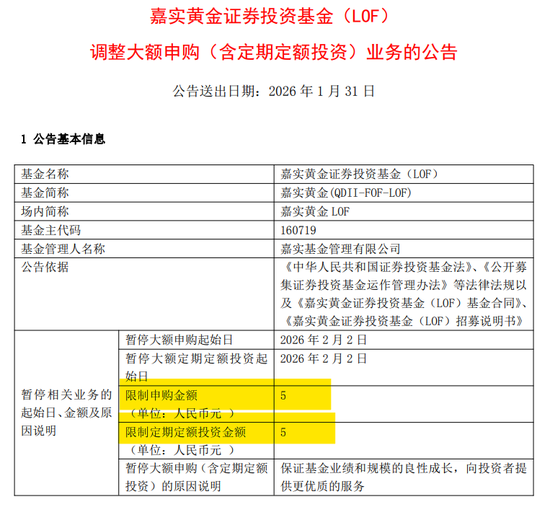
Core Viewpoint - The article highlights the recent trend of strict purchase limits on cross-border LOF funds, particularly those related to commodities like gold and oil, due to market volatility and increased speculative investments [1][2]. Group 1: Fund Purchase Limits - Several funds, including the Jiashi Gold LOF and Jiashi Oil LOF, have announced significant purchase limits, with some funds capping daily investments to as low as 2 yuan [3]. - The imposition of these limits is a response to the influx of speculative capital during market downturns, which can lead to cash being idled if it exceeds the fund's investment capacity [3]. Group 2: Market Performance and Analysis - On January 30, the market saw a sharp decline in commodity-related stocks, particularly in the precious metals sector, with declines of 8% to 9% observed in various ETFs [5]. - The Jiashi Gold LOF experienced a 7.5% drop on the same day, although it still recorded a year-to-date increase of 15.75% [6]. Group 3: Factors Influencing Market Movements - The decline in gold and silver prices is attributed to several factors, including anticipated changes in the Federal Reserve's leadership and increased margin requirements for trading in precious metals [7]. - The market is also reacting to high leverage positions being liquidated, which has contributed to the overall downturn in the precious metals sector [7]. Group 4: Future Outlook - Despite the short-term corrections, some institutions remain optimistic about the long-term potential of gold, citing historical data that suggests rebounds typically follow significant short-term declines [9]. - The article notes that geopolitical tensions and structural supply-demand gaps are expected to support the prices of precious metals in the medium to long term [10].

巨震给普通投资者敲警钟
Xin Lang Cai Jing· 2026-01-31 02:58
#财经专家解析黄金白银深蹲#【巨震给普通投资者敲警钟】#金价史诗级大幅震荡##白银迎来暴跌##黄 金白银一夜跌爆##金价#尚艺基金总经理王峥表示,此次暴跌并非贵金属牛市逻辑的逆转,而是多重因 素下的阶段性获利回吐与情绪宣泄。核心导火索来自美联储最新议息会议,会议维持利率不变,同时释 放出通胀未达目标前不会急于降息的偏鹰信号,削弱了黄金白银的配置吸引力。此外叠加大量获利盘在 利空刺激下集中了结,再加上地缘风险溢价回落、黄金ETF出现连续减持等多重因素。从长期走势来 看,此次调整更像是贵金属牛市中的一次"深蹲",而非趋势的根本性转向。王峥认为,此次市场巨震给 普通投资者敲响了警钟。高位追高入场的投资者可趁反弹适度减仓;前期低位布局的投资者无需因短期 调整盲目割肉,可耐心等待市场企稳信号,再考虑是否逢低优化仓位。金饰品价格波动较大时,普通消 费者若为日常佩戴,无需纠结短期价格涨跌,择机购买即可;若为投资需求则不建议,因其溢价高、变 现成本大。 ...