
稀土

Search documents
北方稀土:前三季度净利同比预增272.54%到287.34%
Zheng Quan Shi Bao Wang· 2025-10-10 10:03
Core Viewpoint - Northern Rare Earth (600111) expects a significant increase in net profit for the first three quarters of 2025, projecting a range of 1.51 billion to 1.57 billion yuan, representing a year-on-year increase of 272.54% to 287.34% [1] Financial Performance - The company anticipates net profit attributable to shareholders of the parent company to be between 1.51 billion and 1.57 billion yuan for the first three quarters of 2025 [1] - This projected profit marks a substantial increase compared to the same period last year, indicating strong financial growth [1]

北方稀土:前三季度归母净利润同比预增272.54%-287.34%
Xin Lang Cai Jing· 2025-10-10 10:02
北方稀土10月10日晚间公告,预计前三季度归母净利润15.1亿元-15.7亿元,同比增长 272.54%-287.34%。 ...
北方稀土:预计前三季度净利润同比增长272.54%-287.34%
Xin Lang Cai Jing· 2025-10-10 09:59
北方稀土公告,预计2025年前三季度实现归属于母公司所有者的净利润15.1亿元到15.7亿元,与上年同 期相比,将增加11.05亿元到11.65亿元,同比增加272.54%到287.34%。预计2025年前三季度实现归属于 母公司所有者的扣除非经常性损益的净利润13.3亿元到13.9亿元,与上年同期相比,将增加10.64亿元到 11.24亿元,同比增加399.90%到422.46%。 ...
北方稀土:2025 年第四季度稀土精矿交易价格调整为不含税 26205 元/吨
Xin Lang Cai Jing· 2025-10-10 09:59
北方稀土公告,2025 年第四季度稀土精矿交易价格调整为不含税 26205 元/吨(干量,REO=50%), REO 每增减 1%、不含税价格增减 524.10 元/吨。 ...
北方稀土:前三季度净利同比预增273%~287%
Mei Ri Jing Ji Xin Wen· 2025-10-10 09:59
Core Viewpoint - Northern Rare Earth (600111.SH) expects a significant increase in net profit for the first three quarters of 2025, projecting a range of 1.51 billion to 1.57 billion yuan, representing a year-on-year increase of 272.54% to 287.34% [1] Group 1 - The company has focused on market changes, enhancing budget management and cost reduction, which contributed to improved operational efficiency [1] - Scientific production organization and strengthened market analysis and marketing operations have been key strategies during the reporting period [1] - The increase in production and sales volume of major products has significantly driven the company's operational performance [1]
反制来得这么快?巴基斯坦刚准备跟美合作稀土,中方通告全球:稀土技术立即管控
Sou Hu Cai Jing· 2025-10-10 09:32
Core Viewpoint - The recent announcement by China's Ministry of Commerce has significantly reshaped the global rare earth market, emphasizing the importance of technology in defining the rules of the rare earth competition [1]. Group 1: China's Strategic Moves - China's announcement serves as a decisive action that disrupts the speculative activities in the international rare earth market, countering the perception of a slow Chinese response [1]. - The strategic control over technology, rather than just resource availability, is highlighted as the key to success in the rare earth industry [3][5]. - China's three-step strategy in controlling rare earth exports demonstrates a gradual shift from resource defense to a proactive technological offensive, avoiding sudden market shocks while allowing the international community time to adapt [6]. Group 2: Challenges for Pakistan and the U.S. - Pakistan's $500 million order for rare earths is deemed a losing venture due to its lack of critical technology and stable production environment, which are essential for processing the raw materials [3][6]. - The U.S. has struggled to establish a complete rare earth supply chain, facing numerous setbacks in mining and production, which underscores the challenges of building an industry without decades of technological accumulation [6]. Group 3: Global Industry Implications - The global response to China's actions includes fluctuations in the London futures market and urgent contract renewals by European energy companies, indicating a recognition of the true power dynamics in the rare earth sector [7]. - Countries rich in resources, like Pakistan, face a critical choice between short-term profits from raw material sales and the long-term investment in developing their own technological capabilities [7]. Group 4: Future of Competition - The competition in the rare earth sector has shifted from resource extraction to technological innovation, with the emphasis on patents, process precision, and innovation speed as the new battlegrounds [9]. - The proximity of ports like Pasni and Gwadar symbolizes the close physical ties in international relations, yet the technological gap remains vast, highlighting the importance of building technological barriers for long-term success [9].

我国稀土管制升级,卡住14nm芯片咽喉
Sou Hu Cai Jing· 2025-10-10 08:30
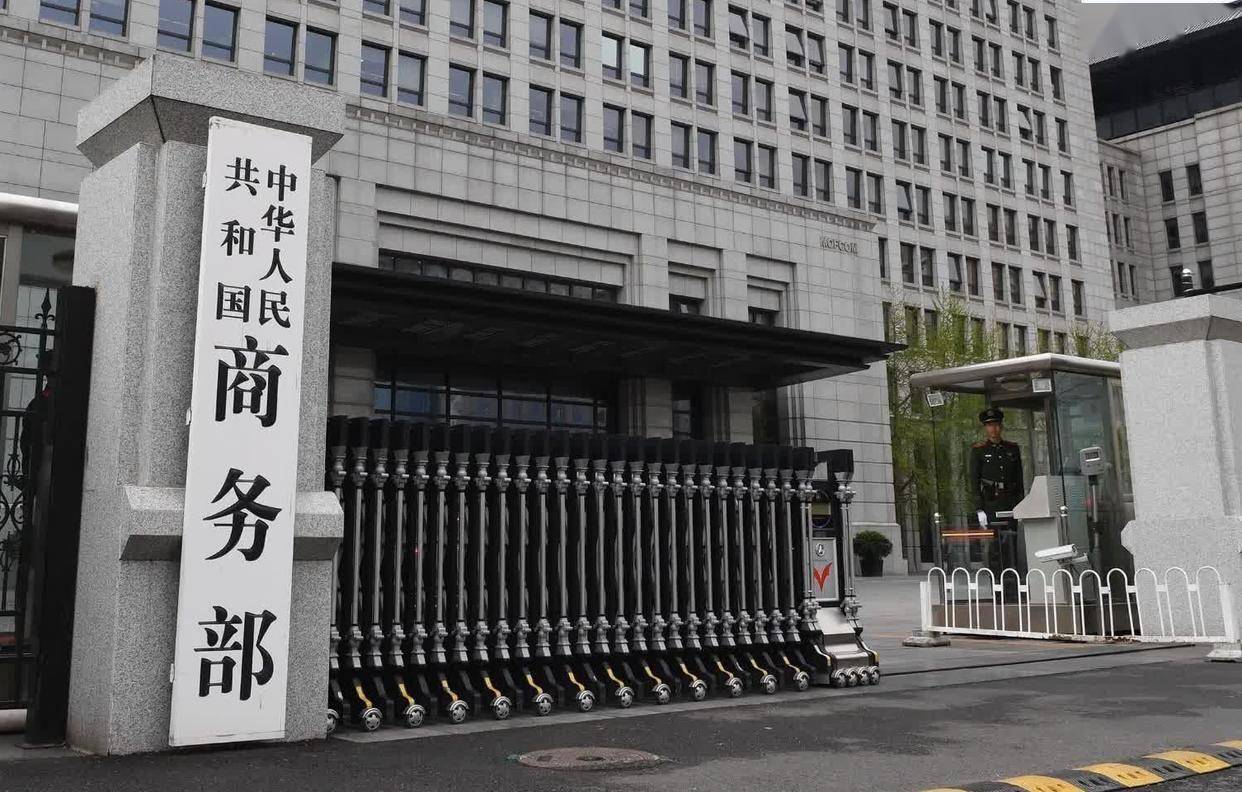
Group 1 - The core point of the article is that China's Ministry of Commerce has implemented new export control policies on rare earth elements, specifically targeting the manufacturing of chips below 14 nanometers and storage chips with over 256 layers, shifting the global focus from materials to key technological applications [1][4][8] - The new regulations require case-by-case approval for exports of rare earth items intended for the research and production of advanced chips, marking a significant expansion of control to include foreign entities [4][7] - The announcement highlights the strategic importance of rare earth elements in high-tech industries, particularly in semiconductor manufacturing and military applications, emphasizing their role as "industrial vitamins" [2][10][16] Group 2 - The new export control measures include a broad definition of "export," covering not only traditional trade but also technology transfer through various means, thereby tightening the control over the entire rare earth supply chain [12][14] - The regulations specifically prohibit Chinese citizens and organizations from providing substantial assistance to foreign rare earth activities without permission, reinforcing the technical blockade [14] - The strategic value of rare earth elements is underscored by their critical applications in semiconductors, renewable energy, and military technologies, with China holding a dominant position in the global rare earth supply chain [16][18][22] Group 3 - The timing of the new export controls reflects China's response to global supply chain restructuring and increasing technological competition, particularly from the US and Europe [18][20] - The measures may lead to bottlenecks in advanced chip manufacturing due to restricted access to essential materials, while also accelerating efforts by other countries to diversify their rare earth supply sources [20][22] - The implementation of these controls is part of China's broader strategy to enhance resource sustainability and upgrade its rare earth industry, moving towards a more regulated and high-end development model [22][23]
中国祭出稀土新规,特朗普竟又“威胁”
Guan Cha Zhe Wang· 2025-10-10 07:48
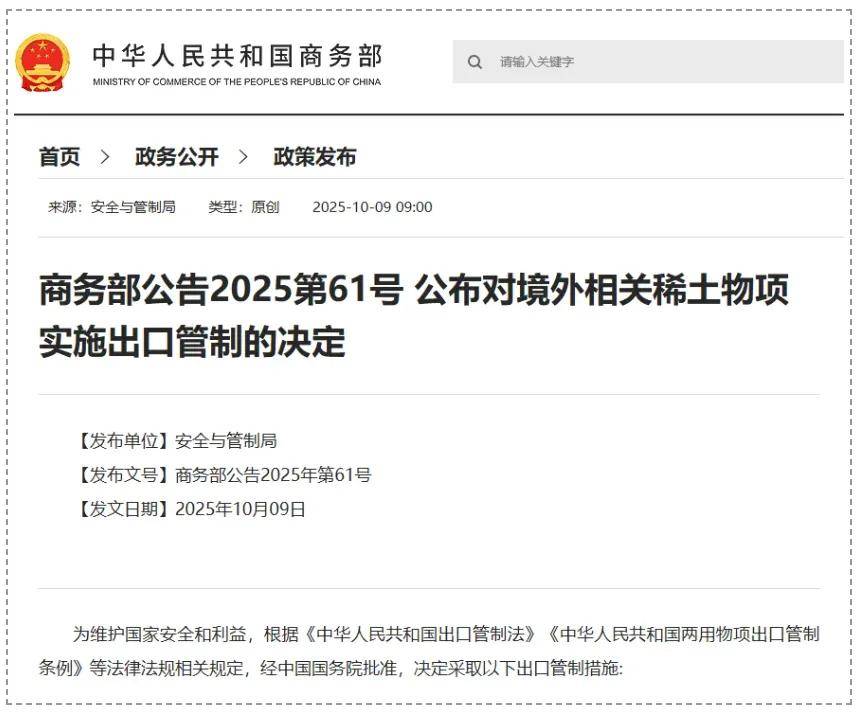
Core Viewpoint - China has announced unprecedented export controls on rare earth materials, which are critical for modern technology, potentially giving it leverage in trade negotiations with the U.S. [1][4] Group 1: Export Control Measures - On October 9, China's Ministry of Commerce issued new regulations that impose export controls on certain rare earth-related items and technologies containing Chinese components [4][9] - The new rules require foreign companies to obtain Chinese approval for exporting rare earth magnets and some semiconductor materials that contain 0.1% or more of Chinese heavy rare earth elements [4][9] - The regulations will take effect on December 1 for certain items and immediately for others, particularly those with military applications, which will generally not be permitted for export [5][9] Group 2: Impact on U.S. Economy and Technology - Experts warn that strict enforcement of these regulations could lead to a recession in the U.S. economy, particularly affecting the AI industry [1][4] - The U.S. relies heavily on Chinese rare earths for high-tech products, with China controlling approximately 70% of global rare earth mining, 90% of refining, and 93% of magnet manufacturing [4] - The new export controls are seen as a significant challenge to U.S. efforts to build domestic supply chains and reduce reliance on Chinese materials [7][9] Group 3: Strategic Timing and Negotiation Leverage - The timing of the announcement coincides with anticipated high-level talks between the U.S. and China, suggesting a strategic move to strengthen China's bargaining position [5][8] - Analysts believe that these measures are part of a broader strategy to compel the U.S. to reconsider tariffs and export controls on Chinese technology [7][8] - The U.S. may respond with increased tariffs, cutting off Chinese access to semiconductor manufacturing equipment, and accelerating domestic rare earth production [5][7]
谁帮中国堵了稀土走私后门?答案超意外——是美国公司!
Sou Hu Cai Jing· 2025-10-10 06:52
Core Insights - In April 2025, China implemented export controls on seven categories of medium and heavy rare earths, which initially raised concerns about the U.S. supply chain for rare earths, as 90% of refined rare earths in the U.S. come from China. However, three months later, U.S. companies like Lockheed Martin continued production of F-35s and Tesla maintained operations, indicating that smuggling may be occurring despite a 72% drop in Chinese exports [1][3]. Group 1 - The initial customs inspections of large containers yielded no results, but irregularities were discovered in cross-border express shipments labeled as "ceramic parts," which contained epoxy-encapsulated rare earth particles. This led to the uncovering of a smuggling network spanning China, Vietnam, and Mexico [3]. - The smuggling operations involved shipping "protein powder" to Vietnam, where it was mixed with clay and pressed into "ceramic tiles" for transport to Mexico. The extracted materials were then sent to U.S. military contractors as "scrap metal" [3]. - An anonymous tip from a U.S. molybdenum mining company revealed detailed information about the smuggling operations, including warehouses, contacts, and the flow of goods. The company reported that the smuggling of rare earths was undercutting its orders by 40% and causing issues with the purity of materials used in missile tests, prompting the report to protect the industry [3]. Group 2 - In August 2025, a joint law enforcement operation between China, Vietnam, and Mexico dismantled the smuggling network and intercepted shipments, revealing vulnerabilities in the U.S. "diversified supply chain." High-purity dysprosium and samarium are now primarily produced by China, leading to production cuts at Raytheon and Tesla [5]. - The molybdenum mining company that reported the smuggling has since signed long-term contracts with compliant companies, highlighting the importance of adhering to regulations for business sustainability [5]. - The situation illustrates a paradox where U.S. companies, in an effort to protect their interests, inadvertently assisted in closing off smuggling routes, reinforcing the notion that compliance with regulations is essential for survival in the industry [5].



西部证券晨会纪要-20251010
Western Securities· 2025-10-10 06:05
Group 1: Rare Earth Industry Policy Insights - The recent announcements from the Ministry of Commerce regarding export controls on rare earths indicate a complete management of the supply side, making significant unexpected increases in supply unlikely [6][8] - Export controls now include technologies related to rare earth extraction, refining, and recycling, aiming to prevent unauthorized foreign access to sensitive technologies [7][8] - The new regulations are expected to increase the share of secondary resource recovery in rare earth supply to 27% by 2025, marking a record high [8] Group 2: Company Dynamics - Naxin Microelectronics - Naxin Microelectronics is projected to achieve revenues of 29.76 billion, 38.44 billion, and 47.62 billion yuan from 2025 to 2027, with corresponding net profits of -0.46 billion, 1.73 billion, and 3.87 billion yuan [9][10] - The company reported a revenue of 15.24 billion yuan in the first half of 2025, a year-on-year increase of 79.49%, with a net profit of -0.78 billion yuan, reflecting a 70.59% improvement [9] - The automotive electronics sector has shown robust growth, with the company shipping 312 million automotive chips in the first half of 2025, benefiting from trends in electric and intelligent vehicles [10] Group 3: Macro Economic Insights - Economic growth momentum has slowed, prompting expectations for further macro policy easing, with GDP growth projected to fall to 4.5-5% in the third quarter [12][13] - The upcoming Central Committee meeting is anticipated to signal new policies aimed at stabilizing growth and revitalizing capital markets [13] - The U.S. export control strategies are tightening, which may impact high-tech sectors significantly, particularly in semiconductors and dual-use technologies [14] Group 4: Fixed Income Market Outlook - The convertible bond market is expected to maintain a premium rate of 30%-37% in October, with challenges in surpassing the previous high of 36.3% due to potential market volatility [20][21] - The market has shown a structural preference for technology and materials sectors, with specific recommendations for bonds related to lithium batteries and rare earths [19][20]