加密货币

Search documents
白宫重磅发布!关于加密货币、稳定币,明确提出"美国领先"……
Guo Ji Jin Rong Bao· 2025-07-31 12:38
Core Insights - The U.S. government has released a significant policy document aimed at establishing leadership in the digital financial technology sector, particularly focusing on digital assets [1][2] - The report compares cryptocurrencies to transformative inventions like railroads and the internet, advocating for a supportive innovation mindset towards digital assets [2] Policy Framework - The report outlines five key policy pillars addressing market structure, banking participation, payment systems, anti-illegal finance, and tax regulations [3] - It recommends a unified, technology-neutral regulatory framework for digital assets, granting the Commodity Futures Trading Commission (CFTC) oversight of non-securities digital asset markets [3] Banking and Payment Systems - The report opposes previous policies that restricted banking services to cryptocurrency firms, advocating for fair treatment of these businesses [4] - It emphasizes the promotion of U.S. dollar-denominated stablecoins as a tool for maintaining dollar dominance in the digital age [4] Technological Innovation - The report encourages ongoing innovation in open blockchain networks and developer communities, while opposing the issuance of central bank digital currencies (CBDCs) due to potential privacy and market intervention concerns [4] Market Dynamics - U.S. venture capital investment in blockchain and crypto startups reached $4.8 billion in Q1 2025, a 70% increase year-over-year, indicating strong market confidence [5] - The report highlights the intention to support the global expansion of U.S. dollar stablecoins, aiming to enhance the U.S. financial system's role in international monetary affairs [5] Global Context - The rise of dollar-pegged stablecoins has raised concerns in Europe about potential "dollarization" and its impact on the European Central Bank's monetary policy [6] - The International Bank for Settlements has criticized stablecoins for their lack of central bank backing and insufficient measures against illegal use [6]
美联储现分歧 + 白宫报告释疑:加密市场的突破口在哪里?
Sou Hu Cai Jing· 2025-07-31 12:31
Group 1: Economic Indicators - The Federal Reserve is experiencing internal disagreements regarding the pace of interest rate cuts, with two voting members supporting a 25 basis point reduction during the recent FOMC meeting [2][3] - The U.S. inflation data shows a mild decline, with the Consumer Price Index (CPI) rising 0.3% month-on-month in June, and the year-on-year inflation rate increasing to 2.7% [2][3] - The U.S. job market indicates a "slowdown but stability," with 147,000 new jobs added in June, slightly above market expectations, while the unemployment rate fell to 4.1% [3] Group 2: Cryptocurrency Market - Bitcoin (BTC) has been fluctuating around $118,000, while Ethereum (ETH) is trading between $3,600 and $3,800, as investors await clearer catalysts for market movement [2][4] - The White House released a 163-page cryptocurrency policy report, supporting stablecoin legislation and a regulatory framework for DeFi, which aims to enhance on-chain transparency [4][5] - The report has received positive feedback from major trading platforms and compliance institutions, indicating a potential institutional interest in the digital asset ecosystem [5] Group 3: Market Reactions and Trends - Despite the dovish signals from the Federal Reserve and the new cryptocurrency policy report, the market remains cautious, with BTC and ETH continuing to trade within key ranges [7] - Ethereum has shown strong performance in July, with prices rising over 50%, but faces significant resistance in the $3,800 to $4,000 range [6] - The altcoin market is experiencing differentiation, with the Altcoin Season Index dropping from 55 to 38, indicating that only about 38% of the top 100 altcoins are outperforming Bitcoin [6][7]


007TG产品:波场TRON上市!007TG三大工具解密Web3流量新玩法
Sou Hu Cai Jing· 2025-07-31 11:49
Group 1 - TRON has officially entered the Nasdaq capital market with a strategic reserve of 365 million TRX, highlighting the growing importance of "crypto traffic" in global business competition [1] - The rise of meme coins and the influx of sovereign funds and high-net-worth individuals into the crypto market indicate a shift in investment trends [1][3] - Companies must leverage technology marketing tools like EchoData, PromoPicasso, and CloudSeven to build a competitive edge in the crypto era [1][8] Group 2 - EchoData's global screening system enables businesses to break down information barriers and seize market opportunities before the influx of traffic [3] - The tool offers intelligent screening and precise marketing, allowing companies to convert crypto content into local languages and send it via social media platforms [3] - It aggregates user data from over 200 countries, supporting market expansion into Southeast Asia and the Middle East [3] Group 3 - PromoPicasso enhances brand visibility in the crypto market, allowing companies to capitalize on every traffic opportunity and achieve "growth without boundaries" [4][5] - The system captures high-value traffic through a restructured social media growth logic [5] Group 4 - TRON's reverse listing sets a compliance benchmark, emphasizing the importance of data security and overseas operations for businesses [7] - CloudSeven provides a cloud-based virtual desktop for remote teams, ensuring data security and management capabilities [8] - The combination of EchoData, PromoPicasso, and CloudSeven creates a comprehensive "data-marketing-team" system for businesses to prepare for future traffic surges [8] Group 5 - The lightning-fast system captures trending topics on social media, generating content matrices to engage precise global users [8] - It targets high-net-worth communities in Southeast Asia and the Middle East based on real-time market data [8] - The system includes account risk control measures, providing independent IPs for each account and 24/7 technical support [9]
微软涨超8%,市值将破四万亿美元;Q2业绩超预期,Meta涨超11%;苹果、亚马逊财报来袭【美股盘前】
Mei Ri Jing Ji Xin Wen· 2025-07-31 11:25
每经记者|岳楚鹏 每经编辑|金冥羽 兰素英 ① 【三大期指齐涨】截至发稿,道指期货涨0.38%、标普500指数期货涨0.99%、纳指期货涨1.34%。 ② 【福特称关税将使其今年损失约20亿美元】当地时间7月30日,福特表示,尽管其大部分汽车都在美国生产,但预计今年关税将使其损失约20亿美元, 这一数字高于之前的预期。2025年二季度,它已经额外缴纳了8亿美元的关税。此外,福特还因削减电动汽车项目而遭受了损失。截至发稿,福特下跌 1.38%。 ③ 【英伟达因H20漏洞后门安全风险被约谈】据国家互联网信息办公室消息,近日,英伟达算力芯片被曝出存在严重安全问题。此前,美议员呼吁要求美 出口的先进芯片必须配备"追踪定位"功能。美人工智能领域专家透露,英伟达算力芯片"追踪定位""远程关闭"技术已成熟。为维护中国用户网络安全、数 据安全,依据《网络安全法》《数据安全法》《个人信息保护法》有关规定,国家互联网信息办公室于2025年7月31日约谈了英伟达公司,要求英伟达公 司就对华销售的H20算力芯片漏洞后门安全风险问题进行说明并提交相关证明材料。 ⑨ 【摩根大通支持通过信用卡购买加密货币】 当地时间7月30日,美国银行巨 ...



手握 2.4 万枚比特币,撑起一个 IPO
Sou Hu Cai Jing· 2025-07-31 10:32
Core Insights - Bullish, a cryptocurrency exchange, has submitted an IPO application to the SEC, marking the first crypto IPO project since the passage of the "Genius Act" [2][3] - The exchange is backed by Peter Thiel and led by former NYSE president Tom Farley, generating significant market interest [2][3] - Bullish holds over 24,000 bitcoins, positioning it among the top five publicly listed companies by bitcoin holdings [3] Company Overview - Bullish has achieved a cumulative trading volume exceeding $1.25 trillion since its inception in 2021, with an average daily trading volume of $2.5 billion [3] - The projected trading volumes for 2024 are approximately $305.2 billion for bitcoin and $144.5 billion for ethereum, reflecting substantial growth [4] - The company has also expanded its media and data business by acquiring CoinDesk, enhancing its industry influence [4][5] Market Environment - The passage of the "Genius Act" and the "Clarity Act" is creating a favorable regulatory environment for cryptocurrency companies, allowing for more structured participation in the market [7][12] - Following the successful IPO of Circle, other exchanges are looking to adopt a compliance-driven approach to capitalize on market opportunities [6][12] Strategic Moves - Bullish is actively pursuing regulatory licenses in Germany and Hong Kong to expand its operations in Europe and Asia [8] - The company plans to establish its largest office in Hong Kong, employing 110 out of 260 global staff, indicating a strategic focus on the Asian market [9] Financial Performance - In Q1, Bullish reported a net loss of $348 million, attributed to a $246 million impairment from bitcoin price declines, contrasting with a net profit of $104 million in the same period last year [10] - Despite recent losses, market predictions suggest potential recovery, with bitcoin prices expected to rise significantly [10] Investment Landscape - Peter Thiel continues to invest in various cryptocurrency projects, including Paxos and Ubyx, indicating a strong belief in the sector's future [11] - Thiel's investments span across compliance infrastructure and DeFi, contributing to a comprehensive crypto financial ecosystem [11]

7月31日电,加密货币概念股盘前交易表现活跃。SharpLink Gaming涨超5%,Bit Digital涨超3%,Strategy涨超2%。
news flash· 2025-07-31 08:20
智通财经7月31日电,加密货币概念股盘前交易表现活跃。SharpLink Gaming涨超5%,Bit Digital涨超 3%,Strategy涨超2%。 ...
XBIT平台BTC今日价格行情波动背后市场情绪解析
Sou Hu Cai Jing· 2025-07-31 06:41
技术面与资金面的支撑同样值得关注。比特币闪电网络的持续扩容提升了场景实用性,链上交易活跃度 维持高位。同时,全球宏观经济的不确定性持续发酵,部分国家经济数据疲软与地缘政治紧张局势,进 一步巩固了BTC的避险资产属性。XBIT.Exchange去中心化交易平台无需 KYC,用户无需提交繁琐的身 份验证信息,可快速开启交易;且无封控、无审核,交易过程顺畅高效,不会因莫名原因被限制;更重 要的是实现了私钥自管,用户对自己的资产拥有绝对掌控权,这在当前复杂的市场环境中,极大地保障 了用户的资产安全与交易自由,让投资者能更安心地进行BTC相关操作。 BOSS Wallet 报道,近日美联储主席鲍威尔在 FOMC 会议上的表态引发市场震动 —— 明确声称利率政 策制定 "不考虑政府融资需求"。这一立场看似维护了美联储的政策独立性,却加剧了市场对经济前景 的担忧。要知道,美国政府去年利息支出已达 1.1 万亿美元,债务管理成本较疫情前翻倍,而高利率正 是这一压力的重要推手。特朗普此前提出 "降息 3% 可年省 1 万亿美元" 的主张,更凸显了政府与央行 的政策分歧,而这对稳定币市场的影响同样深远。 价格稳定性上,高利率或推 ...

XBIT加密货币市场冲刺4万亿最新动力
Sou Hu Cai Jing· 2025-07-31 06:14
Group 1 - Bitcoin's market capitalization has surpassed $1 trillion, with a total market cap of $2.38 trillion, indicating a shift of crypto assets from niche investments to mainstream financial assets [1] - The recent surge in Bitcoin's price to $123,000 reflects strong capital inflow, highlighting growing confidence in Bitcoin's long-term role as a global asset [1] - The demand for Bitcoin and Ethereum is significantly driven by the inflow of spot exchange-traded funds (ETFs) and regulatory clarity brought by the GENIUS Act [3][4] Group 2 - Ethereum has shown strong performance, with its ETH/BTC exchange rate rising 73% since May, driven by record ETF inflows and increased corporate adoption [2] - The total holdings of Bitcoin ETFs have exceeded 1.27 million BTC, representing about 6.4% of the total supply, while Ethereum's total holdings have reached 5.8 million ETH, about 4.8% of its total supply [3] - The recent growth in stablecoin supply, exceeding $255 billion, is attributed to the regulatory framework established by the GENIUS Act, enhancing public trust and lowering entry barriers for new participants [4] Group 3 - The overall cryptocurrency market cap has surged to $4 trillion, reflecting increasing confidence across the asset class, with demand for ETFs and corporate bonds outpacing new supply [5] - XBIT has integrated with major public chains like Ethereum, Solana, and Tron to support cross-chain trading, enhancing the trading experience for users [5][6] - The implementation of zk Rollup technology by XBIT aims to provide low fees and high throughput, ensuring a secure and efficient trading environment [6]

每日数字货币动态汇总(2025-07-30)
Jin Shi Shu Ju· 2025-07-31 02:24
1. 加密货币的下一个催化剂即将到来 据外媒报道,特朗普总统数字资产顾问委员会执行董事BoHines表示,白宫将于周三发布一份加密货币 政策报告,该报告是根据唐纳德·特朗普总统1月份签署的有关数字资产的行政命令而制定的。今年1 月,特朗普签署命令称,他将"在保护经济自由的同时,促进美国在数字资产和金融技术领域的领导地 位"。目前,国会正在大力规范该行业。加密货币市场的另一个催化剂将是美联储的利率决议。市场普 遍预计利率将保持不变,但美联储主席鲍威尔的意外举动或言论可能会影响市场,包括加密货币市场。 2. 香港金管局:《稳定币条例》生效后将设6个月过渡安排 据香港电台网站报道,《稳定币条例》本周五起生效,香港金管局表示将设6个月过渡安排,处理之前 在香港已有稳定币发行业务的机构,包括向有能力遵守监管规定的发行人,发出临时牌照;若发行人未 能在条例生效后3个月内符合相关要求,须在法例生效后4个月内有序结束在香港的业务;如果金融管理 专员未能信纳发行人有能力符合发牌准则及监管规定,发行人要在接获拒绝通知后一个月内有序结束香 港业务。 3. 香港金管局就8月1日起实施的稳定币发行人监管制度发布多个文件 据官方公告,香 ...
贝莱德:稳定币或将长期存在
Zhi Tong Cai Jing· 2025-07-30 23:55
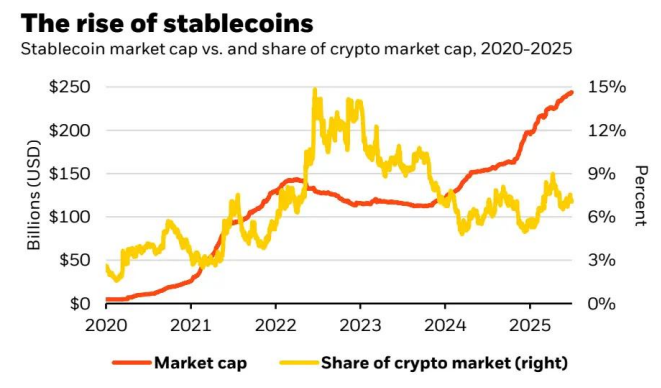
Core Viewpoint - BlackRock's Jean Boivin highlights the recent U.S. legislation solidifying the role of stablecoins in digital payments, while Bitcoin is seen as a unique investment return driver [1][6] Group 1: U.S. Legislation and Stablecoins - The recent U.S. regulations, particularly the Genius Act, are establishing a framework for stablecoins, which are pegged to fiat currencies and supported by reserve assets [3][4] - Stablecoins currently represent only 7% of the total cryptocurrency market but have seen rapid adoption, with a market cap reaching approximately $250 billion [3] - The Genius Act defines stablecoins as a payment method rather than an investment product, limiting issuance to federally regulated banks and certain registered non-bank entities [4][5] Group 2: Impact on Financial Markets - The U.S. stock market has reached historical highs, partly due to increased investments in artificial intelligence by major tech companies [1][6] - The demand for stablecoins is expected to have minimal impact on short-term U.S. Treasury yields, despite potential growth in demand for Treasury securities [5] - The U.S. Treasury's strategy of financing deficits through short-term debt issuance will continue to increase the supply of Treasury securities [5] Group 3: Global Context and Future Outlook - Other regions, such as Hong Kong and Europe, are also exploring regulatory frameworks for stablecoins and digital currencies, which could impact the U.S. dollar's dominance in trade financing [5] - BlackRock views the current wave of regulatory support as a catalyst for mainstream adoption of digital assets, reinforcing Bitcoin's role as a unique risk and return driver in investment portfolios [6]