航空航天

Search documents
霍尼韦尔(HON.US)推进航空航天业务分拆计划 2026年独立上市
智通财经网· 2025-10-23 07:09
Core Viewpoint - Honeywell (HON.US) is actively pursuing the spin-off of its aerospace technology business, which is expected to be completed in the second half of 2026, resulting in the establishment of an independent publicly traded aerospace company [1][2] Group 1: Business Restructuring - Honeywell has initiated a broader business portfolio restructuring, focusing on three core business segments: building automation, industrial automation, and process automation and technology [1] - The financial reporting structure will change on January 1, 2026, with performance disclosed across four segments: aerospace technology, building automation, industrial automation, and process automation and technology [1] Group 2: Management and Tax Implications - Post-spin-off, Honeywell's remaining business will concentrate on automation technologies in industrial, building, and process sectors, with specific management roles assigned to Billal Hammoud, Peter Lau, Jim Masso, and Ken West [2] - The spin-off of the aerospace technology business is expected to be tax-free for shareholders at the federal income tax level in the United States [2]

首颗“雄安造”卫星完成生产下线;上汽大众与Neura Robotics将在汽车制造领域开发部署认知机器人系统丨智能制造日报
创业邦· 2025-10-23 03:23
Group 1 - SAIC Volkswagen and Neura Robotics signed a strategic cooperation memorandum to develop cognitive robotic systems in automotive manufacturing, focusing on smart factory applications such as assembly tasks, quality control, and intelligent logistics [2] - Samsung's V8 NAND production line utilization increased to approximately 80% in Q3, driven by surging demand for large-capacity storage due to the expansion of data centers and a shift in focus from AI training to inference [2] - The "Taihang 7" gas turbine generator set achieved a record of 25,000 hours of operation and generated 122 million kilowatt-hours, setting a new record for domestic gas turbines [2] - The first "Xiong'an-made" satellite, "Xiong'an No. 1," has completed production, marking a significant advancement in the intelligent manufacturing capabilities of the aerospace information industry in Xiong'an New Area [2]


我国可重复使用火箭朱雀三号全箭亮相,航空航天ETF(159227)交投活跃
Xin Lang Cai Jing· 2025-10-23 02:55
Group 1 - The aerospace industry index in China shows mixed performance among constituent stocks, with Changcheng Military Industry leading at a 2.41% increase, while Guangqi Technology is the biggest loser [1] - The Aerospace ETF (159227) is currently priced at 1.11 yuan [1] Group 2 - The domestic low-orbit satellite network is entering a large-scale phase, with projections indicating that by 2028, the GW constellation will achieve the "Hundred Arrows Thousand Stars" plan, and by 2035, nearly 2,500 satellites will be launched annually, significantly increasing demand for rocket launches [2] - The commercial aerospace sector in China is entering a recovery phase, with a strong momentum expected as the industry accelerates, supported by breakthroughs from companies like StarNet and Yuanxin [2] - The Ministry of Industry and Information Technology is promoting the commercial use of satellite IoT, opening new opportunities for satellite applications [2] - The Aerospace ETF (159227) closely tracks the National Aerospace Index, with a high concentration of 98.2% in the military industry, covering key sectors such as aerospace equipment, satellite navigation, and new materials [2]



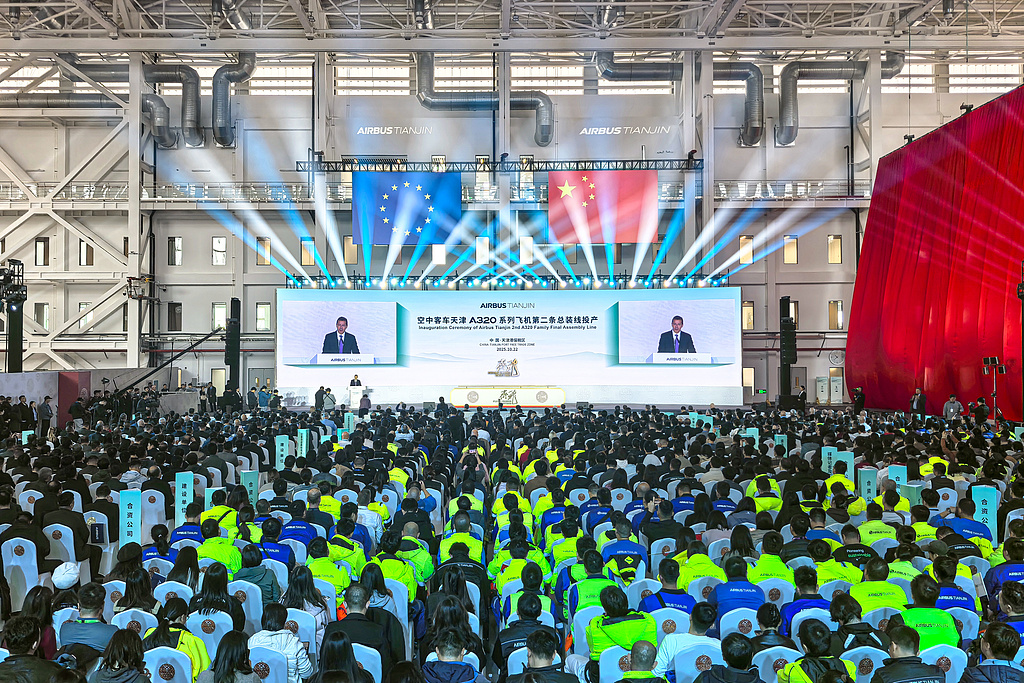
空中客车在天津启用第二条A320系列飞机总装线
Zhong Guo Xin Wen Wang· 2025-10-23 02:01
Group 1 - The article discusses the inauguration of a new final assembly line for the A320 series aircraft, indicating a significant expansion in production capacity for the company [1][3] - The new assembly line is expected to enhance the company's operational efficiency and meet the growing demand for the A320 aircraft in the global market [2][3] - The production increase is part of the company's strategy to solidify its position in the competitive aerospace industry, particularly in the passenger aircraft segment [1][2] Group 2 - The A320 series has shown strong sales performance, contributing to the company's overall profitability and market share growth [3] - The article highlights the importance of this new facility in supporting the company's long-term growth objectives and responding to customer needs [1][2] - The inauguration event signifies the company's commitment to innovation and investment in advanced manufacturing technologies [3]


解析上海经济向上曲线的“密码”
Jie Fang Ri Bao· 2025-10-23 01:31
Economic Growth - Shanghai's GDP growth rate for the first three quarters is 5.5%, exceeding the national average and market expectations, with a growth rate of 5.1% in the first half of the year [1] - The economic structure adjustment and upgrading results are being realized, reflecting the proactive layout of key industries during the "14th Five-Year Plan" [1] Industrial Development - The industrial sector in Shanghai has shown significant improvement, with the total industrial output value increasing by 5.7% year-on-year in the first three quarters, driven by the three leading industries: artificial intelligence, integrated circuits, and biomedicine, which grew by 8.5% [2] - Strategic emerging industries now account for 44.1% of Shanghai's total industrial output value, indicating a shift towards new growth engines in the industrial sector [2] Cost Reduction Initiatives - Shanghai has implemented measures to reduce costs for industrial enterprises, resulting in a reduction of over 52 billion yuan in costs through the "17 measures for cost reduction and efficiency improvement" [3] - Industrial profits in Shanghai increased by 16.3% from January to August, with a profit margin of 6.3%, indicating improved efficiency [3] Financial Sector Performance - The financial sector has seen robust growth, with the Shanghai Stock Exchange's trading volume increasing by 38.4% in the first three quarters, and the securities business turnover growing by 95.2% [4][5] - The financial industry's added value reached 696.53 billion yuan, growing by 9.8%, while the information transmission, software, and IT services sector grew by 15.5% to 527.74 billion yuan [6] Export Growth - Shanghai's exports increased by 11.3% year-on-year in the first three quarters, with the export of the three leading industries reaching 193.67 billion yuan, growing by 10.3% [8][9] - High-end manufacturing exports also showed strong growth, with industrial robots and aerospace equipment exports increasing by 41.6% and 39%, respectively [9][10] Consumer Market Recovery - The retail sales of consumer goods in Shanghai grew by 4.3% year-on-year in the first three quarters, with significant increases in July to September [11] - The tourism sector has rebounded, with 25.49 million visitors during the recent holiday period, reflecting a 19.7% increase [11] Investment Trends - Fixed asset investment in Shanghai increased by 6% year-on-year in the first three quarters, surpassing the national average, contributing to the overall economic resilience [12]

2025年4月中国飞机及其他航空器进出口数量分别为18257架和398127架
Chan Ye Xin Xi Wang· 2025-10-23 01:24
相关报告:智研咨询发布的《2025-2031年中国飞机行业市场全景调查及投资前景展望报告》 近一年中国飞机及其他航空器出口情况统计图 数据来源:中国海关,智研咨询整理 知前沿,问智研。智研咨询是中国一流产业咨询机构,十数年持续深耕产业研究领域,提供深度产业研 究报告、商业计划书、可行性研究报告及定制服务等一站式产业咨询服务。专业的角度、品质化的服 务、敏锐的市场洞察力,专注于提供完善的产业解决方案,为您的投资决策赋能。 根据中国海关数据显示:2025年4月中国飞机及其他航空器进口数量为18257架,同比增长168.6%,进 口金额为6.88亿美元,同比下降19.8%,2025年4月中国飞机及其他航空器出口数量为398127架,同比增 长79.7%,出口金额为8.54亿美元,同比增长52.7%。 近一年中国飞机及其他航空器进口情况统计图 数据来源:中国海关,智研咨询整理 ...

【机构调研记录】泉果基金调研科大讯飞、百亚股份等5只个股(附名单)
Sou Hu Cai Jing· 2025-10-23 00:05
Group 1: Company Insights - iFlytek has accumulated over 50TB of industry corpus and over 1 billion daily user interactions, enhancing its data quality and multi-modal capabilities with the upgrade of its "Xunfei Spark Model" to version 4.0, which competes with GPT-4 Turbo [1] - Baiya Co. has seen over 100% revenue growth in the first three quarters, with a significant contribution from its health product series, which accounts for over 50% of revenue, and is expanding its product scale and upgrades [2] - Tunan Co. reported a decrease in net profit due to increased production but delayed revenue recognition, with a current order backlog corresponding to approximately 1.75 billion yuan [3] - Jiao Cheng Ultrasonic is advancing in the power semiconductor field with a range of welding machines and is developing equipment for solid-state batteries, benefiting from the electric and intelligent development trends [4] - Ben Gang Steel is focusing on high-value product development and efficiency improvements, with its automotive steel recognized as a benchmark in the industry [5] Group 2: Fund Insights - Quan Guo Fund, established in 2022, has an asset management scale of 22.384 billion yuan, ranking 119th among 210 public funds, with its best-performing product showing a 35.14% growth over the past year [5]





【机构调研记录】中银基金调研科大讯飞、图南股份等3只个股(附名单)
Sou Hu Cai Jing· 2025-10-23 00:05
Group 1: Company Insights - Keda Xunfei has accumulated over 50TB of industry corpus and over 1 billion daily user interactions, enhancing its data collection and cleaning capabilities [1] - The "Xunfei Spark Model" has been upgraded to version 4.0, which significantly improves its multimodal and intelligent capabilities, comparable to GPT-4 Turbo [1] - Tunan Co. reported a decline in net profit for Q3 2025 due to increased production but delayed revenue recognition, leading to higher operational costs [2] - Tunan's inventory increased by 48% since the beginning of the year due to order-based stocking, with a backlog of orders corresponding to approximately 1.75 billion yuan [2] - Jiao Cheng Ultrasonic provides comprehensive solutions in power semiconductor fields and has begun mass shipments, focusing on advanced packaging and defect detection [3] - The company is developing ultrasonic bonding machines and has received orders for its ultrasonic solid-state bonding machines, which offer low-temperature and high-efficiency advantages [3] Group 2: Industry Trends - The semiconductor industry is seeing advancements in ultrasonic detection methods, which complement traditional X-ray detection in identifying defects [3] - The demand for automation in manufacturing, particularly in the aerospace and energy sectors, is driving growth for companies like Tunan and Jiao Cheng [2][3] - The electric vehicle and energy storage sectors are benefiting from innovations in welding equipment and battery technology, indicating a trend towards electrification and smart technology [3] Group 3: Fund Management Insights - Zhongyin Fund has an asset management scale of 676.016 billion yuan, ranking 18th among 210 firms, with a focus on public funds [4] - The fund's best-performing product in the past year is the Zhongyin Hong Kong Stock Connect Medical Mixed Fund A, which has grown by 72.27% [4] - The latest fund launched by Zhongyin is the Zhongyin CSI Robot Index C, which is an index-type stock fund with a subscription period from October 13 to October 24, 2025 [4]
深圳发布并购重组重磅政策 ;美国国债总额首次超过38万亿美元|南财早新闻
2 1 Shi Ji Jing Ji Bao Dao· 2025-10-22 23:15
今日关注 深圳市发布《深圳市推动并购重组高质量发展行动方案(2025—2027年)》,力争到2027年底,辖区上 市公司质量全面提升,境内外上市公司总市值突破20万亿元,培育形成千亿级市值企业20家。 3、港交所行政总裁陈翊庭指出,正与沪深交易所就沪深港通纳入REITs、引入大宗交易机制以及人民 币柜台纳入港股通等项目进行紧密合作,希望可以尽快落实。 4、高盛最新研报认为,中国股市的投资逻辑正在发生根本性转变,市场已进入一个更持久、波动性更 低的"慢牛"阶段。在盈利增长和估值修复的双重驱动下,到2027年底,包括A股和H股在内的中国关键 股指有约30%的上涨潜力。 5、近期,上市公司及公募基金三季报披露了多位知名基金经理的调仓路径。在结构化行情极致演绎的 三季度,这些基金经理积极出手调仓换股。部分基金经理表示,中国权益市场长期稳健向好的态势日渐 明朗,海外扰动因素出现边际改善,美元流动性有望迎来拐点,会对中国股票市场的流动性带来更大的 提升。不过,四季度宏观事件的影响仍有不确定性,成长板块将表现出较大的波动性。 宏观经济 1、据商务部官网,10月21日,商务部部长王文涛会见空客公司首席执行官傅里。双方就空客对 ...
空客在华第二条总装线正式投产,空客CEO:扎根中国、服务中国具有重要意义和价值
Huan Qiu Shi Bao· 2025-10-22 22:52
Core Points - Airbus has launched its second A320 assembly line in Tianjin, China, with full operations expected by early 2026, indicating a commitment to expanding its local supply chain despite geopolitical challenges [1][3] - The new assembly line will double Airbus's production capacity in China, contributing to the anticipated demand for 9,500 aircraft in the Chinese market over the next 20 years, which represents about 20% of global demand [3][4] - The A320 series has surpassed the Boeing 737 in total deliveries, becoming the best-selling commercial aircraft, despite being launched 20 years later [3] Summary by Sections Production Capacity - The second assembly line in Tianjin will enhance Airbus's production capacity, allowing for a total of 10 assembly lines globally, with 2 located in Tianjin [3] - The new facility will utilize the latest technology and processes, adhering to Airbus's highest global standards [3] Market Demand - The Chinese aviation market is experiencing continuous growth, with a projected demand for 9,500 aircraft over the next two decades [3] - By the end of this year, Airbus's total assembly volume in China is expected to exceed 800 aircraft [3] Geopolitical Context - Airbus acknowledges the complexities of the current global landscape, including trends of de-globalization, and emphasizes the importance of reliable partnerships [4] - The establishment of the Tianjin assembly line is seen as a strategic move to strengthen Airbus's resilience against external challenges [4]