个人电脑

Search documents
DDR已被HBM超越
是说芯语· 2025-12-03 04:12
Group 1 - Major global IT companies are continuously investing in artificial intelligence and significantly acquiring DRAM and flash memory semiconductor products, while smaller capacity PC memory and solid-state drives are facing price increases and supply shortages [1] - The primary driver of rising memory prices is the demand from AI-related enterprises, with major companies planning to double their production capacity and processing power annually over the next three years [1] - Major DRAM suppliers like Samsung, SK Hynix, and Micron have notified PC manufacturers to halt production of DDR4 products and announced price increases for existing products [3] Group 2 - The sales costs for personal computer manufacturers have significantly increased due to rising memory supply prices since October, leading to losses, and new products are expected to see price increases of at least 20% next year [3][4] - Memory price fluctuations have become more pronounced since October, with prices doubling every ten days, and even the largest companies may only receive about half of their orders next year [3][4] - The only solution to the rising costs is for major memory manufacturers to increase production of DDR5 and LPDDR5 memory, or for new suppliers to emerge [4][6] Group 3 - Major memory manufacturers are focusing on increasing the production of high-value products like HBM, which have clear demand and high prices, rather than existing memory products [6] - The reduction in memory supply may lead to a decline in personal computer production, with market research firms like IDC and Gartner already lowering their PC shipment forecasts for next year [6] - The distribution model for personal computers is expected to change, with no likelihood of discounted inventory sales until at least 2028, and it is advisable to purchase personal computers within a year if possible [6]

美国PC市场被关税“绊住”,全球其他市场双位数增长
Di Yi Cai Jing Zi Xun· 2025-10-09 09:29
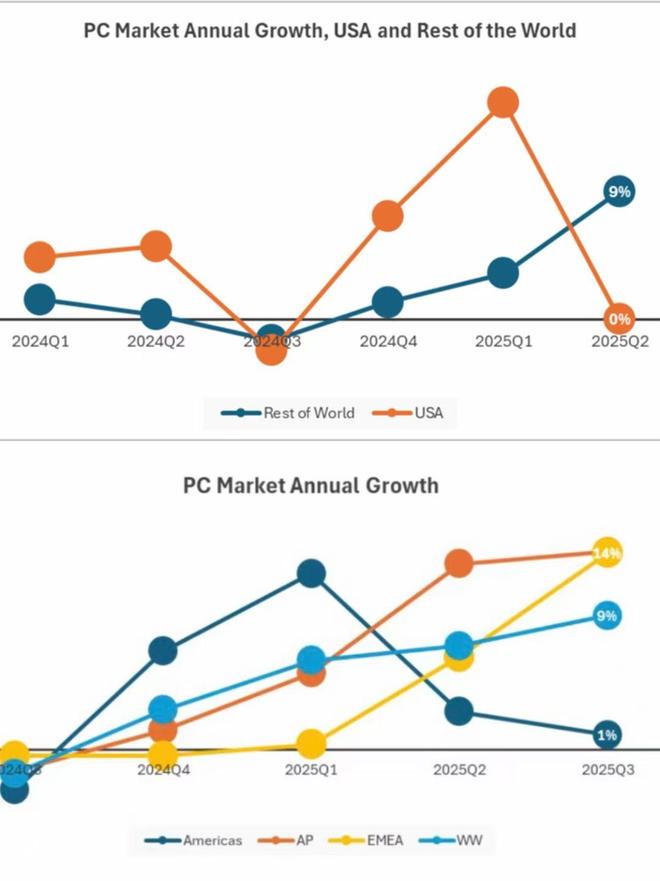
Core Insights - Global PC shipments are experiencing growth, with a year-over-year increase of 9.4% in Q3 2025, totaling 75.9 million units shipped [1][5] - The U.S. PC market is facing stagnation due to tariffs and reduced consumer spending, showing zero growth in Q2 and only 1% growth in Q3 [1][3] - Other regions, particularly Asia-Pacific and EMEA, are seeing robust demand with a 14% growth rate in Q3 [3] Market Performance - The U.S. PC market's growth is projected to be limited to approximately 2% in 2025 due to tariff impacts [3] - In contrast, the global PC market is benefiting from several factors, including the migration to Windows 11, post-pandemic device upgrades, and a surge in AI-driven demand [4] - The top five PC manufacturers by shipment volume are Lenovo, HP, Dell, Apple, and ASUS, with Lenovo leading at 19.4 million units and a market share of 25.5%, reflecting a 17.3% year-over-year growth [4][5] Competitive Landscape - The current demand cycle is favoring major manufacturers with efficient supply chains, increasing market concentration and pressure on smaller brands [5] - Companies are adapting to a complex global trade environment by shifting focus to emerging markets and enhancing supply chain flexibility [6] - AI is becoming a critical growth driver in the PC industry, with projections indicating that AI PC shipments could account for 70% of the market by 2028, growing at a compound annual growth rate of 44% from 2024 to 2028 [6]



联想引领Q3全球PC市场加速增长:市占率达25.5% 领先优势继续扩大
Ge Long Hui· 2025-10-09 03:50
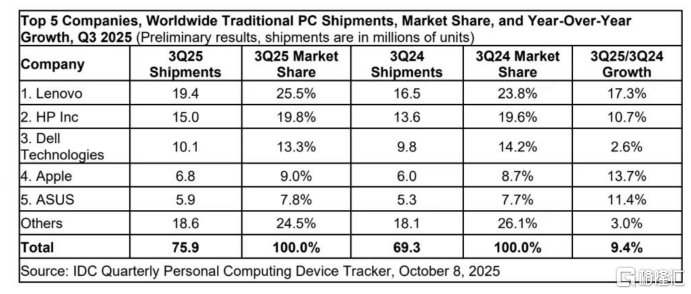
Core Insights - The global traditional PC market is showing strong growth, with shipments reaching 75.9 million units in Q3 2025, a 9.4% increase from 69.3 million units in Q3 2024 [1][2] - Lenovo has maintained its position as the leading PC manufacturer, achieving a market share of 25.5% with shipments of 19.4 million units, reflecting a year-over-year growth of 17.3%, significantly outpacing the market average [1][2] Company Performance - Lenovo's market share increased by 1.7 percentage points from 23.8% in Q3 2024, widening its lead over HP Inc., which holds a 19.8% market share [2] - HP Inc. and Dell Technologies reported year-over-year growth rates of 10.7% and 2.6%, respectively, with Dell's market share declining from 14.2% to 13.3% [2][3] - Lenovo's operational efficiency, including its ODM+ manufacturing model and flexible global/local operational strategy, has contributed to its strong performance [3] Market Trends - The PC industry is transitioning from a traditional OS-driven cycle to an innovation cycle driven by AI capabilities and new application scenarios [3] - Canalys forecasts that AI PC shipments will account for 70% of the market by 2028, with a compound annual growth rate of 44% from 2024 to 2028 [4] Strategic Initiatives - Lenovo is actively pursuing its "hybrid AI" vision, which encompasses a full-stack solution for personal and enterprise AI, aiming to provide a secure and reliable AI-driven work environment [4] - In the recent Q1 FY25/26 report, Lenovo's AI PC shipments accounted for over 30% of total PC shipments, positioning the company as a leader in the Windows AI PC market [5]
联想集团涨超3% 机构料公司上半年业绩或胜于市场预期 欧美个人电脑市场份额扩张
Zhi Tong Cai Jing· 2025-08-04 03:25
Core Viewpoint - Lenovo Group (00992) is expected to outperform market expectations for its first fiscal quarter ending June 30, primarily due to a shift in capital expenditure from AI servers to general servers, leading to strong growth in server revenue [1] Group 1: Financial Performance - Lenovo's stock rose over 3%, currently at HKD 77.5, with a trading volume of HKD 235 million [1] - Nomura's report anticipates that Lenovo's performance will exceed market expectations for the first fiscal quarter [1] Group 2: Market Position - Lenovo is gaining market share in the personal computer sector from competitors like Dell and HP, which is expected to enhance overall sales and profitability for the quarter ending June 30 [1] - Despite earlier order lead times in the upstream supply chain for personal computers, the impact on downstream brand shipment forecasts is expected to be limited, allowing Lenovo to continue increasing its market share [1]
大摩北美IT硬件数据追踪:App Store 仍跑赢市场预期,甲骨文(ORCL.US)引爆云计算资本支出
智通财经网· 2025-06-19 09:22
Group 1 - The core viewpoint indicates that the App Store's net income has increased by 12.5% year-to-date, surpassing Morgan Stanley's second-quarter forecast by 150 basis points, and reflecting a 40 basis point outperformance in the services business [1] - Morgan Stanley has raised its global cloud capital expenditure forecast for 2025 to $406 billion, representing a 43% year-on-year growth, which is an increase of 4 percentage points from the previous month [1] - The growth in cloud capital expenditure is driven by upward revisions from Oracle and Alibaba, indicating ongoing expansion in the cloud computing sector and strategic investments by industry giants [1] Group 2 - In the personal computer sector, the latest order delivery data for notebook ODMs shows a slight upward trend in second-quarter shipments, but there is high uncertainty regarding demand in the second half of 2025, leading to a cautious outlook for the third quarter [2] - Specifically, third-quarter notebook shipments are projected to be 10% lower than expected, with ODM order delivery volumes below normal seasonal levels [2] - The report also highlights a positive trend in IBM's consulting job postings, which have increased by 33% since the end of the first quarter, with a rolling 90-day average up by 36% [2]

中金降联想集团目标价12%至13.78港元 评级“跑赢行业”
news flash· 2025-05-12 03:11
Group 1 - The core viewpoint of the article is that CICC has lowered Lenovo Group's target price by 12% to HKD 13.78 while maintaining an "outperform" rating due to the release of a new super intelligent agent that marks progress towards hybrid artificial intelligence [1] - CICC believes that the launch of the super intelligent agent, which covers all application scenarios, defines its core functions for the first time [1] - The adjustment in Lenovo's target price reflects a decrease in the average valuation of the personal computer industry due to trade tensions, with the new target price corresponding to a projected price-to-earnings ratio of 13 times for the fiscal year 2026 [1]
中国4月整体出口增8%,对美出口减21%
日经中文网· 2025-05-09 08:06
Core Viewpoint - China's exports in April increased by 8.1% year-on-year, reaching $315.6 billion, marking two consecutive months of growth [1] Group 1: Export Performance - Exports in April showed a slowdown compared to March's growth of 12.4% [1] - The trade surplus reached $96.1 billion due to significant export growth [1] Group 2: Import Trends - Imports decreased by 0.2% to $219.5 billion, marking two consecutive months of negative growth [1] Group 3: Export Categories - Automotive exports grew by 4%, while exports of toys, smartphones, and personal computers fell compared to the same month last year [2] Group 4: Regional Export Analysis - Exports to the United States decreased by 21% - Exports to ASEAN, the largest export destination, increased by 21% - Exports to the European Union and Japan both grew by 8% compared to the same month last year [2]
中美关税战是危险的消耗战
日经中文网· 2025-04-11 05:00
Group 1 - The core issue of the trade war is the significant impact on high-tech industries in the U.S., particularly the reliance on rare earth elements from China, which are essential for various technologies including electric vehicles and defense applications [1][2][3] - The U.S. retail sector is heavily dependent on Chinese imports, with companies like Best Buy indicating that approximately 60% of their sales costs come from China, leading to potential price increases for consumers [4][5] - The ongoing trade tensions have resulted in a drastic reduction in U.S. exports to China, particularly in the beef sector, where exports dropped by 92% in March, highlighting the severe repercussions of the tariffs [6] Group 2 - The semiconductor industry in the U.S. faces challenges due to its 50% reliance on imports of critical materials like germanium and gallium from China, which could jeopardize domestic manufacturing efforts [3][6] - Boeing is experiencing headwinds as the trade conflict affects its sales to Chinese airlines, which are significant customers, with potential delays in aircraft deliveries due to tariffs [7] - The energy sector's impact appears limited, as U.S. LNG exports to China are minimal, allowing for a shift in export destinations without significant disruption [7]