
信息传输

Search documents
29座万亿城市新格局:东北首现万亿之城,沪京并肩5万亿
2 1 Shi Ji Jing Ji Bao Dao· 2026-02-07 01:57
Core Insights - The economic landscape of Chinese cities is undergoing a transformation as Wenzhou and Dalian join the "trillion-yuan club," with Beijing and Shanghai also surpassing the 5 trillion yuan GDP mark, indicating a reshaping of the urban economic hierarchy [1][13][15] - The competition among these trillion-yuan cities is shifting from mere economic scale to a focus on quality of life, innovation ecosystems, and sustainable development [1][14] Economic Growth and Structure - By 2025, 29 cities in China are projected to have a GDP exceeding 1 trillion yuan, with Wenzhou and Dalian being the latest additions, while Shanghai and Beijing reach the 5 trillion yuan threshold [15][20] - Among these cities, 22 are expected to have GDP growth rates exceeding 5%, with Tangshan, Hefei, Yantai, and Wenzhou achieving over 6% [15][16] - The economic structure of these cities varies, with Shanghai and Beijing's growth driven by the tertiary sector, while Wenzhou and Dalian rely on robust industrial growth [16][21] Industrial Performance - In 2025, Beijing's GDP is projected to reach 52,073.4 billion yuan, with a 5.4% year-on-year growth, primarily driven by the information technology and financial sectors [18][19] - Shanghai's GDP is expected to hit 44,958.7 billion yuan, with a 6.0% growth rate, also supported by the service sector [19] - Wenzhou's industrial output is anticipated to grow by 10.3%, with significant contributions from the automotive and electrical industries [21][22] - Dalian's industrial output is projected to increase by 11.7%, with notable growth in the equipment manufacturing sector [22] Future Industry Focus - Many of these cities are now targeting artificial intelligence as a key industry for future development, with plans to integrate AI into various sectors [23][24] - Wenzhou aims to establish itself as a leader in AI innovation, while Dalian focuses on enhancing its digital economy and AI applications in traditional industries [24][25] - The emphasis on AI is seen as a means to drive technological advancement and improve overall economic quality [25][26] Urban Development Trends - The competition among cities is expected to evolve beyond GDP figures to include factors like technological innovation, cultural strength, and livability [26] - The development model is shifting from single-center cities to collaborative urban clusters, enhancing regional synergies and economic dynamism [26]
东北首现万亿GDP之城
21世纪经济报道· 2026-02-06 14:52
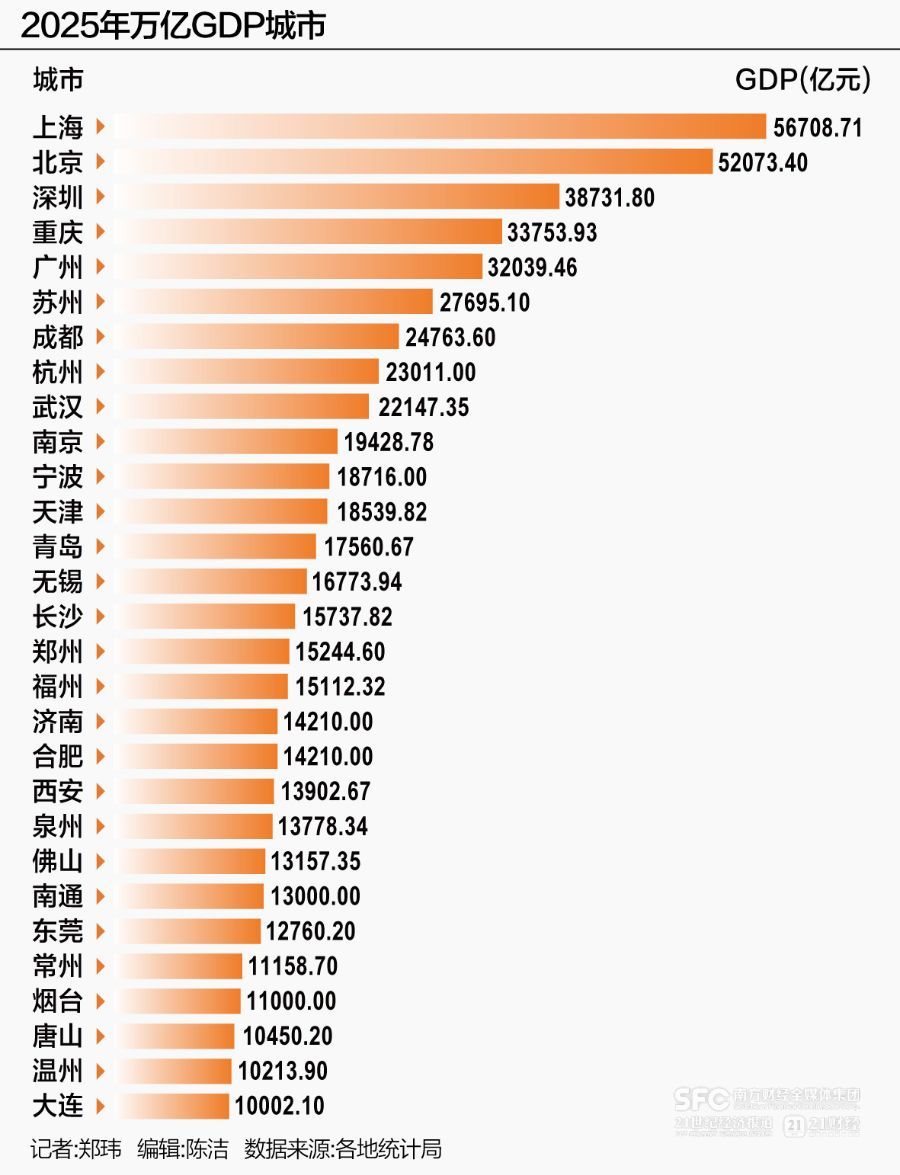
记者丨郑玮 实习生龚晨晨 编辑丨陈洁 近日,随着一批城市"尖子生"相继公布GDP数据,2025年中国万亿城市之争尘埃落定。 南方财经记者统计数据显示, 2025年全国有29座城市GDP迈入万亿级。其中,温州、大连两 市GDP首次突破万亿元, 同期上海、北京两市GDP也双双达到5万亿元区间,全国万亿GDP城 市版图再度迎来扩容。 "万亿矩阵"扩容背后,2025年,全国有22座万亿城市GDP增速超过5%(全国平均增速),其 中唐山、合肥、烟台、温州4城GDP增速超过6%。同期,14座万亿城市2025年GDP增速较 2024年持平或略有增长,其中西安、广州分别增长3.4个百分点和1.9个百分点。 进一步观察这批城市"尖子生"的经济结构,哪些产业在"破万亿"进程中提供了关键动能? 万亿城市"洗牌":两城上榜、沪京并肩 整体来看,在2025年全国29座万亿GDP城市中,GDP规模迈入5万亿元区间的城市有2座,4万 亿元区间城市出现断档,此后规模迈入3万亿元区间、2万亿元区间和1万亿元区间的城市分别 有3座、4座和20座,整体呈现正金字塔结构。 不同梯次城市的发展重心显露差异。其中,上海、北京两座"领头羊"2025年第三 ...

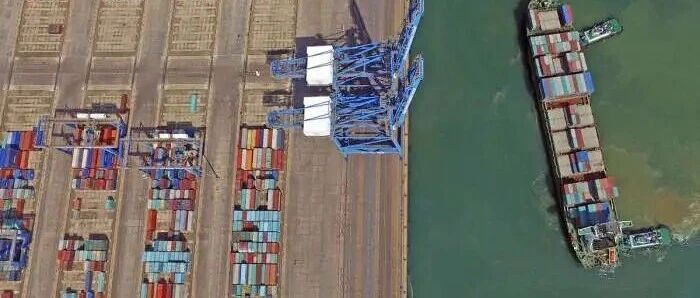
“万亿版图”重新洗牌,哪些城市要爆发
2 1 Shi Ji Jing Ji Bao Dao· 2026-02-06 13:20
南方财经记者郑玮 实习生龚晨晨 广州报道 近日,随着一批城市"尖子生"相继公布GDP数据,2025年中国万亿城市之争尘埃落定。 南方财经记者统计数据显示,2025年全国有29座城市GDP迈入万亿级。其中,温州、大连两市GDP首次突破万亿元,同期上 海、北京两市GDP也双双达到5万亿元区间,全国万亿GDP城市版图再度迎来扩容。 "万亿矩阵"扩容背后,2025年,全国有22座万亿城市GDP增速超过5%(全国平均增速),其中唐山、合肥、烟台、温州4城GDP 增速超过6%。同期,14座万亿城市2025年GDP增速较2024年持平或略有增长,其中西安、广州分别增长3.4个百分点和1.9个百 分点。 进一步观察这批城市"尖子生"的经济结构,哪些产业在"破万亿"进程中提供了关键动能? 不同梯次城市的发展重心显露差异。其中,上海、北京两座"领头羊"2025年第三产业增加值增速分别达到6.0%、5.8%,均跑赢 GDP增速。同期,温州、大连两座新晋万亿城市规上工业增加值增速均实现两位数以上正增长,依托第二产业扛起了万亿版图 的关键一角。 把时间维度拉长,2021年—2025年,全国万亿GDP城市数量已从24座逐步增长至29座。 ...
上海年用电量首破2000亿千瓦时折射经济新动能
Xin Hua Wang· 2026-02-02 11:05
记者近日从国家电网上海市电力公司获悉,2025年,上海全社会用电量首次突破2000亿千瓦时大 关,达到2088.9亿千瓦时,同比增长5.3%。其中,战略性新兴产业与第三产业用电成增长重要引擎。 上海第二产业2025年用电量同比增长3.4%,高技术及装备制造业表现格外亮眼,用电量同比增长 8.9%。其中,通信设备制造业、航空航天设备制造以及光伏设备制造等行业用电量增速均超过20%;集 成电路作为先导产业迎来快速增长,拉动计算机、通信和其他电子设备制造业2025年用电量增加 12.8%。 电力数据作为经济社会发展的"风向标",分行业用电的结构变化折射出上海经济发展的新动能。 绿色生活方式普及,城市电动汽车补能需求激增—— "上海年用电量位居全球城市领先地位,约等于两个三峡电站一年的总发电量。"国家电网上海市电 力公司经济技术研究院能源中心主任工程师、负荷预测首席专家刘盼盼说,"整体来看,用电数据勾勒 出服务业领跑、工业向新、绿色生活的清晰图景。" 上海市汽车销售行业协会发布的数据显示,截至2025年底,上海新能源汽车保有量约192万辆,占 上海全市汽车总保有量约三分之一。蓬勃的市场直接催生了旺盛的补能需求,202 ...
深圳发布2025年经济“成绩单” GDP增长5.5%
Nan Fang Ri Bao Wang Luo Ban· 2026-02-02 09:17
2025年,全市固定资产投资同比下降21.7%,其中,房地产开发投资下降31.0%,基础设施投资下降 1.9%。重点产业投资保持较快增长,工业技术改造投资增长19.2%,居民服务、修理和其他服务业投资 增长88.3%,信息传输、软件和信息技术服务业投资增长67.7%,科学研究和技术服务业投资增长 16.1%。 市场销售规模扩大 1月30日,深圳市统计局发布2025年经济数据。根据广东省地区生产总值统一核算结果,2025年深圳全 市地区生产总值38731.80亿元,按不变价格计算,同比增长5.5%。其中,第一产业增加值28.04亿元, 下降4.5%;第二产业增加值14482.54亿元,增长4.1%;第三产业增加值24221.22亿元,增长6.3%。 工业生产稳步增长 高技术产品产量快速增长 2025年,全市规模以上工业增加值同比增长5.4%。分门类看,采矿业增加值同比下降1.1%,制造业增 长5.9%,电力、热力、燃气及水生产和供应业增长3.7%。主要行业大类中,通用设备制造业增长 13.9%,计算机、通信和其他电子设备制造业增长6.2%,专用设备制造业增长5.1%。高技术产品产量持 续快速增长,其中,3D打印 ...
徐州未能晋级万亿GDP之城
2 1 Shi Ji Jing Ji Bao Dao· 2026-02-02 05:48
Core Insights - Xuzhou's GDP reached 953.7 billion yuan in 2024, nearing the trillion yuan target, generating high expectations for 2025 [2] - The government report indicated a GDP growth target of approximately 5.8% for 2025, without specifying a clear GDP figure [2][4] - Xuzhou's mayor emphasized the importance of focusing on development rather than being fixated on the trillion yuan milestone [4] Economic Performance - In 2025, Xuzhou's GDP is projected to be 995.72 billion yuan, reflecting a 5.8% increase year-on-year, which is below the 6% target but exceeds the national average growth rate of 5.0% [4][5] - The primary industry added value was 79.25 billion yuan, growing by 3.0%; the secondary industry reached 365.63 billion yuan, with a growth of 3.5%; and the tertiary industry achieved 550.85 billion yuan, growing by 8.0% [5] - Industrial production saw a 6.8% increase in the added value of large-scale industries, with significant growth in chemical fiber manufacturing (10.5%), agricultural and sideline food processing (13.1%), and electrical machinery manufacturing (18.6%) [5] Investment Trends - Fixed asset investment in Xuzhou decreased by 11.9% year-on-year, which is significantly lower than the national average decline of 3.8% [5] - Investment in the primary industry fell by 27.4%, the secondary industry by 11.5%, and the tertiary industry by 11.9% [5] - Notable growth in specific sectors included textile (36.5%), automotive manufacturing (18.4%), and furniture manufacturing (9.5%) [5] Consumer and Income Data - Retail sales of consumer goods in 2025 are expected to grow by 5.5%, with significant increases in food (18.5%), clothing (15.5%), and communication equipment (11.5%) [6] - The per capita disposable income in Xuzhou is projected to be 42,230 yuan, reflecting a 4.9% increase year-on-year, with urban residents earning 48,978 yuan (4.3% growth) and rural residents earning 30,639 yuan (5.6% growth) [6]
港媒关注:北京、上海GDP是如何突破5万亿元的?
Xin Lang Cai Jing· 2026-02-02 03:22
来源:参考消息 据香港《南华早报》网站1月29日报道,随着广东省统计局1月30日公布去年全省经济运行情况,中国排 名靠前的经济大省的"年报"已全部发布。 报道称,从结构数据看,经济大省普遍较高的增长速度已非传统动能的延续,而越来越显著地体现为新 兴动能的汇聚。 上海第三产业增加值占GDP的比重已逼近八成,信息服务业继续领跑。去年,上海第三产业增加值同比 增长6.0%,其中,信息传输、软件和信息技术服务业增加值同比增长15.3%,金融业增加值同比增长 9.7%。 河南去年的经济增速亮眼,其中制造业增加值同比增长7.6%,拉动GDP增长2.0个百分点。近年来,河 南抢抓新能源汽车、人工智能等行业发展机遇,引进比亚迪、中州时代、超聚变等龙头企业落户投产, 工业新质生产力加快形成。 四川加快建设世界级优质清洁能源基地,去年水电装机容量突破1亿千瓦,占中国全国20%以上。四川 挖掘水、风、光、气等清洁能源潜力,去年规上工业清洁能源发电量占全省规上工业发电量的81%,规 上工业天然气产量稳居全国第一。 坚持内需主导,深入实施提振消费专项行动,推动投资止跌回稳,是当前中国各地经济工作的重点任 务。 据报道,2025年,北京 ...
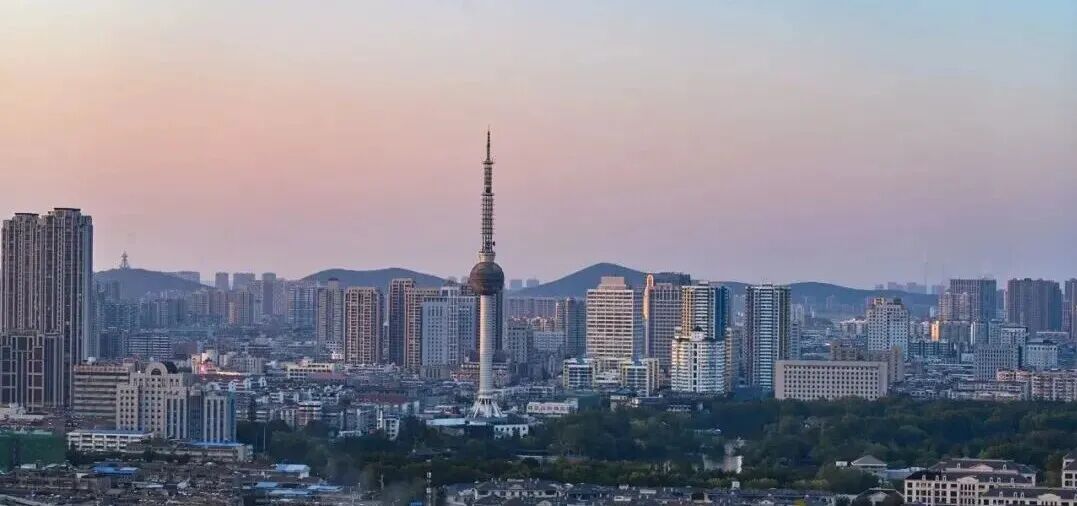
2025年南京经济运行总体平稳
Nan Jing Ri Bao· 2026-02-02 02:28
居民消费价格平稳,居民收入持续增长。2025年,全市居民消费价格同比下降0.2%。分类别看, 食品烟酒价格下降1.1%,衣着价格上涨1.9%,居住价格下降0.5%,生活用品及服务价格上涨1.3%, 交通通信价格下降3.5%,教育文化娱乐价格上涨0.8%,医疗保健价格上涨1.4%,其他用品及服务价格 上涨10.8%。12月份,居民消费价格同比上涨0.5%,涨幅较上月扩大0.1个百分点。 2025年,全市居民人均可支配收入78243元,同比增长4.1%。按常住地分,城镇居民人均可支配 收入86320元,增长3.9%;农村居民人均可支配收入40471元,增长4.6%。农村居民人均可支配收入 增速快于城镇居民0.7个百分点,城乡居民收入比由上年的2.15降至2.13。 其中,农业生产形势稳定,粮食产量实现增长。2025年,全市农林牧渔业增加值可比增长3.8%。 粮食产量稳步增长。全年粮食播种面积214.70万亩,增长0.6%;总产量100.78万吨,增长0.5%。畜牧 业产能提升。全年生猪出栏37.39万头,增长5.0%;家禽出栏1741.20万只,增长10.1%。 工业生产总体平稳,新兴动能不断积蓄。2025年,全 ...
去年上海用电量首破2000亿千瓦时
Jie Fang Ri Bao· 2026-02-02 01:35
从上海电力"大盘"中,记者发现两个显著趋势:一方面,高端制造业和战略性新兴产业加快发展, 带动工业用电由传统高耗能行业向电子信息、高端装备等领域转移,通信设备制造业、航空航天设备制 造以及光伏设备制造等行业用电量增速均超过20%;另一方面,信息传输、软件和信息技术服务业等新 兴服务业快速壮大,算力、数据中心和数字基础设施用电需求显著提升,推动第三产业用电占比持续上 升,其中,信息传输、软件和信息技术服务业用电量同比增长19.2%。 2025年,上海全社会用电量首次突破2000亿千瓦时大关,达到2088.88亿千瓦时,同比增长5.28%, 在全球主要城市中居于绝对领先地位,是纽约的3.8倍、东京的2.5倍。 记者 查睿 "电力数据是经济社会发展的'晴雨表'和'风向标'。2025年,上海市全社会用电量位居全国城市首 位,且增速较全国高出0.3%,不仅反映了上海作为中国经济第一城的增长韧性,分行业用电结构的变 化更折射出上海经济高质量发展与产业转型升级的坚实步伐。"国网上海市电力公司经济技术研究院能 源中心主任工程师、负荷预测首席专家刘盼盼说。 ...
南京2025年地区生产总值1.94万亿元 同比增长5.2%
Xin Lang Cai Jing· 2026-02-01 13:40
Economic Overview - In 2025, Nanjing's GDP reached 19,428.78 billion yuan, with a year-on-year growth of 5.2% [1][5] - The primary industry added value was 338.50 billion yuan, growing by 3.4%; the secondary industry added value was 5,873.07 billion yuan, increasing by 3.7%; and the tertiary industry added value was 13,217.21 billion yuan, rising by 6.0% [1][5] Agricultural Sector - The agricultural, forestry, animal husbandry, and fishery sector's added value grew by 3.8%, with grain production steadily increasing [1][5] - The total grain sown area was 2.147 million acres, up by 0.6%, and total grain output was 1,007,800 tons, increasing by 0.5% [1][5] - Livestock production improved, with 373,900 pigs slaughtered, a growth of 5.0%, and 17,412,000 poultry, increasing by 10.1% [1][5] Industrial Sector - The industrial added value for large-scale industries grew by 5.8%, with 28 out of 37 major industry categories experiencing growth, resulting in a growth rate of 75.7% [2][6] - Key industries such as general equipment manufacturing, pharmaceutical manufacturing, and instrument manufacturing saw increases of 8.9%, 10.8%, and 12.1% respectively [2][6] - High-tech industries' output surpassed 900 billion yuan, accounting for 55.2% of the total output of large-scale industries [2][6] - Notable growth in specific sectors included aerospace manufacturing (17.7%), instrument manufacturing (12.0%), and significant increases in production of new energy vehicles (99.0%), integrated circuits (28.2%), and industrial robots (35.4%) [2][6][7] Service Sector - The service sector's added value increased by 6.0%, with information transmission, software, and IT services growing by 7.3%, transportation and warehousing by 8.1%, and finance by 9.4% [3][7] - From January to November 2025, the revenue of large-scale service enterprises reached 8,238.82 billion yuan, a year-on-year increase of 4.8% [3][7] - The cultural, sports, and entertainment sectors benefited from events like "Su Chao," with revenues growing by 5.5%, including significant increases in sports organizations (26.4%), museums (17.3%), and leisure activities (11.4%) [3][7] Consumer Market - Nanjing's total retail sales of consumer goods reached 8,135.85 billion yuan, with a year-on-year growth of 3.5% [3][7] - Consumer policies significantly boosted retail sales of household appliances and audio-visual equipment by 9.8%, with smart appliances growing by 78.2% [3][7] - Automotive retail sales increased by 3.4%, with new energy vehicles growing by 33.1% [3][7] Investment Landscape - Fixed asset investment in Nanjing decreased by 4.9%, but investment excluding real estate development grew by 2.4% [4][8] - Industrial investment rose by 12.1%, with its share of total fixed asset investment increasing by 4.3 percentage points compared to the previous year [4][8] - Infrastructure investment grew by 3.2%, and high-tech manufacturing investment increased by 8.9%, with notable growth in aerospace (44.9%), computer and office equipment (20.1%), and medical instruments (11.8%) [4][8] Future Outlook - Nanjing's economy is expected to maintain a steady growth trajectory, focusing on quality development and addressing external environmental changes and weak domestic demand [4][8]