
农业产业

Search documents
广西学用“千万工程”经验 加快建设宜居宜业和美乡村
Guang Xi Ri Bao· 2025-11-07 02:52
Core Insights - Guangxi is focusing on the implementation of the "Ten Million Project" to enhance rural development and quality of life, with significant financial support from the central government and local initiatives [1][2] Group 1: Financial Support and Investment - Since the beginning of the 14th Five-Year Plan, Guangxi has secured 700 million yuan in central budget funds to support the construction of beautiful rural areas across 35 counties [1] - For the years 2024-2025, the autonomous region will allocate 1 billion yuan annually to implement the "Ten Million Project" and leverage social capital and community labor [1] Group 2: Infrastructure Development - The completion rate of rural infrastructure has significantly improved, with 99% of townships connected to tertiary roads and 100% of administrative villages having access to graded roads [2] - The rural water supply coverage has reached 92.4%, and over 32,000 rural houses have been renovated to eliminate safety hazards [2] - The coverage of 5G and gigabit fiber networks in administrative villages has reached 100% [2] Group 3: Improvement in Living Conditions - The penetration rate of sanitary toilets in rural areas has reached 95.29%, surpassing the national average [2] - The coverage of sewage treatment facilities in built towns has achieved 100%, making Guangxi the seventh province in the country to reach this milestone [2] - The rate of rural waste management has improved, with 95% of village groups now able to collect and process waste [2] Group 4: Public Services Enhancement - A total of 27.46 billion yuan has been allocated for the construction and expansion of 6,407 compulsory education schools, including 204 new schools [3] - The region has established 1,265 township health centers and 17,800 village clinics, significantly enhancing healthcare access [3] - The coverage of regional elderly care service centers has reached 60.9% [3] Group 5: Agricultural Development - Guangxi has implemented a three-year action plan for modern characteristic agricultural development, creating six agricultural industry clusters with annual outputs exceeding 100 billion yuan [3] - The region has established 10 national-level advantageous characteristic industry clusters and 13 national-level modern agricultural parks [3] - Innovative applications of AI in agriculture, such as "unmanned farms" and "smart pest control," are emerging [3] Group 6: Governance and Community Engagement - The proportion of star-rated village party organizations has reached 49.1%, indicating strong party leadership in rural governance [4] - New forms of village-level consultation and governance have been developed, enhancing community participation [4] - Efforts in rural spiritual civilization construction are being advanced alongside governance initiatives [4]
“十五五”规划建议全文:加强原始创新和关键核心技术攻关、全面实施“人工智能+”行动、大力提振消费
Xuan Gu Bao· 2025-10-28 09:35
Core Viewpoint - The "15th Five-Year Plan" period is crucial for achieving basic socialist modernization, building on the significant achievements of the "14th Five-Year Plan" period, and addressing complex domestic and international challenges [2][3][4]. Group 1: Achievements and Challenges - The "14th Five-Year Plan" period saw major achievements in economic stability, high-quality development, technological innovation, and social governance despite facing severe challenges such as the pandemic [2]. - The "15th Five-Year Plan" period will focus on consolidating advantages, overcoming bottlenecks, and enhancing weaknesses to secure strategic initiatives in international competition [3][4]. Group 2: Economic and Social Development Goals - The guiding principles for economic and social development during the "15th Five-Year Plan" include adhering to Marxism, promoting high-quality development, and ensuring that modernization benefits all citizens [6][7][8]. - Key goals include achieving significant results in high-quality development, enhancing self-reliance in technology, and improving social governance and public services [10][11][12]. Group 3: Modernization of Industry and Infrastructure - The establishment of a modern industrial system is essential, focusing on optimizing traditional industries and fostering emerging sectors such as new materials and aerospace [13][14]. - Infrastructure development will prioritize integrated planning and the construction of new types of infrastructure to enhance resilience and sustainability [15]. Group 4: Technological Innovation - The "15th Five-Year Plan" emphasizes the importance of technological self-reliance and innovation, aiming to strengthen the national innovation system and enhance the integration of technology and industry [16][17][18]. Group 5: Domestic Market and Consumption - Strengthening the domestic market is a strategic focus, with initiatives to boost consumption and investment while ensuring a positive interaction between supply and demand [21][22][23]. Group 6: High-Quality Development and Economic System - The plan aims to enhance the socialist market economy, stimulate various ownership enterprises, and improve the efficiency of resource allocation [24][25][26]. Group 7: Open Economy and International Cooperation - The strategy includes expanding high-level openness and cooperation, promoting trade innovation, and enhancing investment collaboration to create a win-win situation [27][28][29]. Group 8: Agricultural Modernization - Agricultural modernization is a priority, focusing on improving production capacity, quality, and efficiency while ensuring rural revitalization and integration with urban development [30][31][32]. Group 9: Regional Development - The plan aims to optimize regional economic layouts and promote coordinated development across different regions, enhancing infrastructure connectivity and collaborative growth [33][34]. Group 10: Cultural and Social Development - Cultural prosperity and social welfare are emphasized, with initiatives to enhance public services, promote cultural innovation, and ensure equitable access to resources [36][37][38][39][40].
受权发布丨中共中央关于制定国民经济和社会发展第十五个五年规划的建议
证券时报· 2025-10-28 08:54
Core Viewpoint - The "15th Five-Year Plan" period is crucial for achieving basic socialist modernization, building on the significant achievements of the "14th Five-Year Plan" period, and addressing complex domestic and international challenges to secure strategic advantages in global competition [2][3][4]. Group 1: Achievements and Challenges - The "14th Five-Year Plan" period saw major accomplishments in economic stability, high-quality development, technological innovation, and social governance, despite facing severe challenges such as the pandemic [2]. - The "15th Five-Year Plan" period is characterized by profound changes in the development environment, with both strategic opportunities and risks, including geopolitical tensions and domestic economic imbalances [4]. Group 2: Economic and Social Development Goals - The guiding principles for the "15th Five-Year Plan" include adhering to Marxist-Leninist principles, promoting high-quality development, and ensuring that modernization benefits all citizens [6][7]. - Key goals include achieving significant results in high-quality development, enhancing self-reliance in technology, and improving social governance and public services [10][11][12]. Group 3: Modern Industrial System - The plan emphasizes the importance of a modern industrial system as the foundation for Chinese-style modernization, focusing on the development of advanced manufacturing and the optimization of traditional industries [13][14]. - There is a strong push to cultivate emerging industries and enhance the quality of service sectors, ensuring they align with modern economic needs [14][15]. Group 4: Technological Innovation - The "15th Five-Year Plan" prioritizes technological self-reliance and innovation, aiming to strengthen the national innovation system and enhance the integration of technology and industry [16][17]. - Key areas of focus include original innovation, critical core technology breakthroughs, and fostering a culture of innovation within enterprises [18][19]. Group 5: Domestic Market Development - Strengthening the domestic market is seen as a strategic foundation for modernization, with initiatives aimed at boosting consumption and investment while ensuring a stable economic environment [21][22]. - The plan outlines measures to enhance consumer spending, improve investment efficiency, and eliminate barriers to market integration [23]. Group 6: High-Level Opening Up - The plan advocates for expanding high-level openness and cooperation, promoting trade and investment, and enhancing international economic collaboration [28][29]. - It emphasizes the importance of aligning with international trade rules and fostering a favorable environment for foreign investment [30]. Group 7: Agricultural Modernization - Agricultural modernization is highlighted as essential for overall modernization, with a focus on improving production capacity, quality, and rural living conditions [31][32]. - The plan aims to ensure sustainable agricultural practices and enhance the integration of various agricultural sectors [33]. Group 8: Cultural Development - Cultural prosperity is identified as a key indicator of modernization, with efforts to promote socialist core values and enhance cultural confidence [38][39]. - The plan encourages the development of a robust cultural industry and the preservation of cultural heritage [40]. Group 9: Social Welfare and Employment - The plan emphasizes improving social welfare systems and ensuring high-quality employment opportunities, with a focus on equitable income distribution and enhancing living standards [41][42]. - It aims to strengthen the social safety net and promote inclusive growth to achieve common prosperity [43].

推动乡村发展“一直兴”(专家点评)
Ren Min Ri Bao· 2025-10-23 21:55
Core Viewpoint - The 20th Central Committee's Fourth Plenary Session has systematically deployed the promotion of comprehensive rural revitalization during the "14th Five-Year Plan" period, emphasizing the development of rural characteristic industries and the deep integration of rural culture and tourism [1][2]. Group 1: Policy and Strategic Direction - The 2025 Central Document No. 1 calls for the implementation of rural industry integration development projects and the promotion of deep integration between rural culture and tourism, providing a clear direction for rural revitalization [1]. - The rise of "village sports" events, such as "Village BA" and "Village Super," exemplifies the development of new rural industries and practices, transforming spectator engagement into economic benefits through tourism, dining, and agricultural product sales [1]. Group 2: Community Engagement and Economic Impact - In these events, villagers serve as athletes, organizers, spectators, and beneficiaries, enhancing community identity and cohesion, while digital media expands participation beyond geographical limits [1]. - The integration model of "sports + culture + tourism + industry" extends the value chain of events, strengthens rural economic resilience, and explores sustainable development paths [1]. Group 3: Future Development Strategies - Future efforts should focus on systematic planning, including product innovation, data platforms, talent services, and collaborative development to promote high-quality rural cultural tourism [1]. - Key strategies include enhancing the branding and regularization of "village sports," avoiding homogenization, and empowering rural revitalization through cultural industry initiatives [1]. - The digital transformation of rural culture and tourism is essential, utilizing new media to expand communication channels and improve service experiences [1]. - Infrastructure and public service improvements are necessary to attract young entrepreneurs back to rural areas, fostering a new generation of agricultural professionals [1]. - Establishing benefit-sharing mechanisms is crucial to ensure that farmers become the main participants and beneficiaries of cultural tourism development [1].
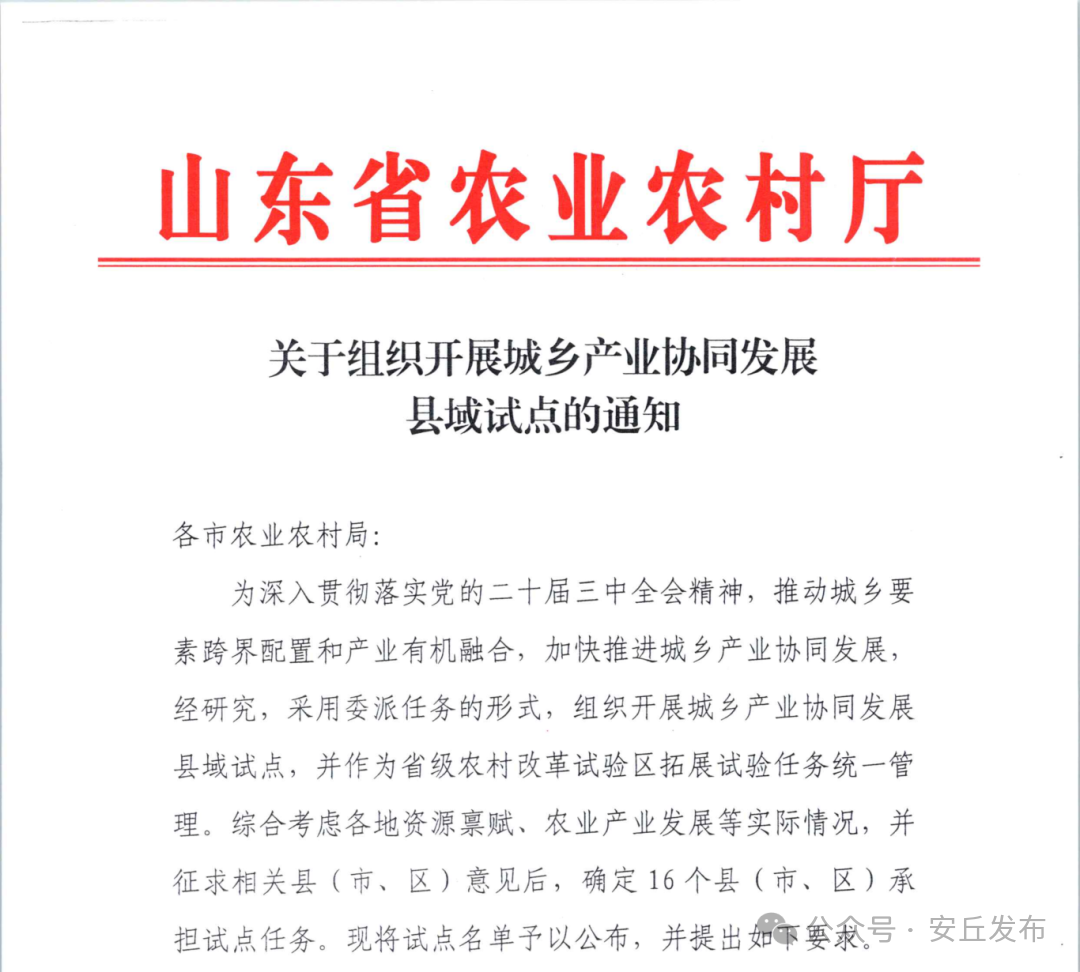
潍坊安丘入选全省城乡产业协同试点
Qi Lu Wan Bao Wang· 2025-10-19 08:04
Core Points - The provincial agricultural and rural affairs department has announced the list of pilot counties for urban-rural industrial coordinated development, with Anqiu City being the only selected county-level city in Weifang, tasked with the provincial pilot project [1] - The pilot aims to implement the spirit of the 20th National Congress of the Communist Party, promoting cross-border allocation of urban and rural factors and organic integration of industries, accelerating urban-rural industrial coordinated development [1] Summary by Sections - The pilot work period is approximately three years, with the goal of forming replicable models and mechanisms for urban-rural industrial coordinated development, cultivating and strengthening the main bodies of urban-rural industrial coordination, and significantly enhancing the level of industrial integration [4] - Anqiu City will approach this task with a strong sense of responsibility and mission, seizing opportunities, boldly exploring, and actively innovating. The city will base its efforts on local resource endowments and agricultural industry characteristics, scientifically preparing the pilot plan, and clarifying objectives, tasks, measures, and guarantees [4] - As a provincial rural reform experimental zone, Anqiu City will establish a robust promotion mechanism, clarify departmental responsibilities, and gather collaborative efforts, aiming to achieve significant results during the pilot period, contributing Anqiu's wisdom and strength to the provincial and national promotion of urban-rural industrial coordinated development and the advancement of common prosperity [4]
我省成立“头雁”联合会
Liao Ning Ri Bao· 2025-09-16 01:23
Core Viewpoint - The establishment of the Liaoning Rural Industry Revitalization Leading Goose Development Association aims to bridge the gap between the government and leading enterprises, focusing on serving the "three rural issues" and promoting work through policy support, information sharing, and cooperation [1] Group 1: Objectives and Functions - The association will unite the province's "leading goose" forces to support agricultural industry development and ensure the effective implementation of rural revitalization [1] - It aims to protect the legitimate rights and interests of its members and promote the sustainable development of leading enterprises [1] - The association will create a comprehensive service platform for innovation, vitality, cooperation, and win-win outcomes among its members [1] Group 2: Talent Development and Impact - Since the launch of the "leading goose" cultivation project in 2022, a total of 1,900 leading goose trainees have been trained, with a goal of reaching 3,000 by next year [1] - Currently, 84 leading geese have been appointed as agricultural technicians, and over 430 trainees have helped surrounding farmers increase their income [1] - The expansion of the leading goose industry has created 15,600 new jobs for farmers [1] Group 3: Strategic Importance - The establishment of the association is a significant measure for the province's agricultural and rural system to implement the new era talent strategy and rural revitalization strategy [1] - It will enhance the integration of policies, resources, elements, and platforms to support the development of the association and its leading geese [1]
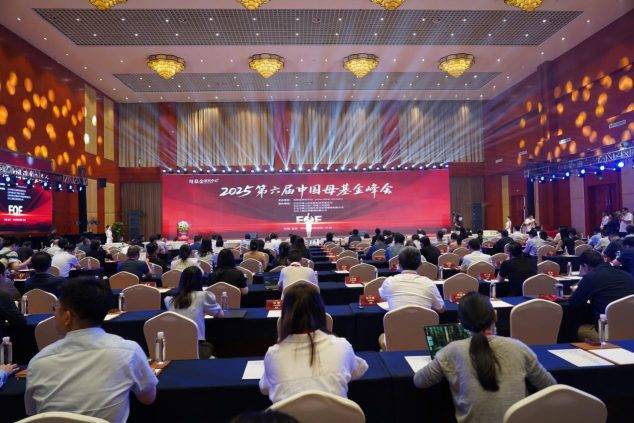
共话发展之道!北京农业产业投资基金正式发布!将为顺义新增产值6亿元、创造税收1.5亿元……
Sou Hu Cai Jing· 2025-08-31 08:04
Core Insights - The 2025 Sixth China Mother Fund Summit was held on August 30, focusing on the development of mother funds and private equity investments, with over 300 representatives from major domestic mother funds and top investment institutions in attendance [1][5]. Fund Overview - The Beijing Agricultural Industry Investment Fund, totaling 500 million yuan, is the first agricultural industry fund in Shunyi District, designed to promote investment at the municipal, district, and town levels [1][3]. - The fund is expected to drive fixed asset investment of 375 million yuan, generate new output value of 600 million yuan, and create tax revenue of 150 million yuan over the next five years, along with creating 700 to 1500 high-tech jobs directly and 300 to 500 indirect jobs in supporting services [1][3]. Fund Structure and Management - Established in 2009, the Agricultural Industry Fund is the first private equity investment fund focused on the agricultural sector in China, with its first phase successfully exiting all invested projects [3]. - The second phase of the fund, a collaboration between Shunyi District, Beijing Agricultural Investment Company, and Gongshun Investment, aims to support high-quality agricultural enterprises through equity investments, focusing on technology agriculture and integrated industries [3][5]. - A CO-GP joint management mechanism has been introduced, enhancing the governance structure and ensuring Shunyi District's influence in fund decision-making [5]. Strategic Goals - The second phase of the Agricultural Industry Fund emphasizes the integration of agriculture and technology, aiming to leverage capital to enhance agricultural productivity and contribute to rural revitalization [5]. - The summit served as a platform for discussing the future of the mother fund industry, with participation from government departments, industry associations, and leading investment institutions [5].
神农集团: 云南神农农业产业集团股份有限公司关于财务总监变更的公告
Zheng Quan Zhi Xing· 2025-08-26 16:19
Group 1 - The company announced the resignation of Mr. Shu Meng as the Chief Financial Officer (CFO) due to personal reasons, effective from August 26, 2025 [1][2] - The board expressed gratitude for Mr. Shu Meng's contributions during his tenure [2] - The company appointed Mr. Yan Jin as the new CFO, with his term starting from the board's approval date until the end of the current board's term [2] Group 2 - Mr. Yan Jin, born in 1985, holds a master's degree and is a certified public accountant with experience in auditing and investment banking [2][3] - Mr. Yan Jin does not hold any shares in the company and has no relationships with major shareholders or other executives [3] - He meets all legal and regulatory requirements to serve as CFO, with no penalties or disciplinary actions from regulatory bodies [3]

神农集团拟回购注销27.46万股限制性股票 ,涉及金额约376.74万元
Xin Lang Cai Jing· 2025-08-25 10:01
Core Viewpoint - Yunnan Shennong Agricultural Industry Group Co., Ltd. is proceeding with the repurchase and cancellation of certain restricted stock options as part of its 2022 incentive plan, following necessary approvals and legal opinions [1][2]. Summary by Relevant Sections Authorization and Approval - The repurchase and cancellation of restricted stocks have received the necessary authorizations through multiple board meetings and shareholder meetings from April 2022 to July 2025 [2]. Reasons for Repurchase and Cancellation - The reasons for the repurchase include: - Personnel changes: 8 individuals lost eligibility due to resignation, involving 37,050 shares; 23 individuals also resigned, involving 51,500 shares; and 1 individual passed away, involving 1,500 shares [3]. - Performance issues: 48 individuals did not meet performance standards, involving 136,344 shares; 57 individuals from the reserved grant also did not meet standards, involving 48,200 shares [3]. Total Shares and Financial Details - A total of 274,594 shares will be repurchased and canceled, which includes: - 173,394 shares from the initial grant, representing 4.3275% of the total initial grant and 0.0330% of the total share capital before cancellation. - 101,200 shares from the reserved grant, representing 10.8467% of the total reserved grant and 0.0193% of the total share capital before cancellation [4]. - The repurchase price is set at 13.72 yuan per share, totaling approximately 3.7674 million yuan, funded entirely from the company's own resources [4]. - After the repurchase, there will be no remaining restricted stocks under the incentive plan [4].
如何扩大农村有效投资和市场消费?北京市政协委员建言献策
Zhong Guo Jing Ji Wang· 2025-08-22 06:24
Group 1: Urban-Rural Integration and Resilience - The Beijing Municipal Political Consultative Conference emphasizes the importance of integrating urban-rural development with resilience in rural areas to enhance disaster prevention and recovery capabilities [2][3] - Recent extreme weather events highlight the need for a comprehensive approach to rural development and safety, which is crucial for maintaining investor confidence and supporting rural economic growth [2][3] Group 2: Infrastructure and Emergency Preparedness - The construction of dual-use public facilities that can serve both regular and emergency purposes is a focal point, with examples of successful conversions during emergencies [4] - Recommendations include enhancing the functionality of public spaces for emergency use and improving the overall emergency response capabilities in rural areas [4] Group 3: Rural Consumption and Tourism Development - There is significant untapped potential in the rural consumption market, with urban residents showing a strong interest in rural tourism and experiences [5][6] - Suggestions include creating diverse consumption scenarios and integrating cultural and ecological resources to enhance the attractiveness of rural tourism [6][7] Group 4: Agricultural Industry and Financial Support - The report stresses the importance of developing agricultural industry clusters and enhancing financial support for rural investments and consumption [8][9] - Recommendations include leveraging technology and brand empowerment to improve agricultural productivity and marketability, as well as fostering financial innovation to support rural development initiatives [8][9]