
民营经济

Search documents
市政府就《政府工作报告》和政府工作征求党外人士意见建议
Nan Jing Ri Bao· 2026-01-08 02:23
Group 1 - The meeting was chaired by Deputy Mayor Li Zhongjun to gather opinions and suggestions from various democratic parties, the Federation of Industry and Commerce, and representatives of non-party individuals regarding the drafting of the "Government Work Report" and government work [1] - Participants expressed that the "Government Work Report" is comprehensive, focused, and practical, serving as a confidence booster and morale enhancer [1] - Constructive suggestions were made on enhancing the smart grid industry, developing the biopharmaceutical sector, exploring digital economy potential, supporting low-altitude economy development, upgrading key business districts, enriching nighttime economy offerings, promoting the integration of culture, commerce, tourism, and sports, invigorating the private economy, and strengthening talent retention [1] Group 2 - Li Zhongjun acknowledged the contributions of various democratic parties, the Federation of Industry and Commerce, and non-party individuals in providing timely advice on key issues in the city's economic and social development over the past year [2] - The government aims to support these groups in fulfilling their roles and contributing to high-quality development by creating favorable conditions [2]
从经济热词看影响四川的“变量”
Xin Lang Cai Jing· 2025-12-28 20:28
Core Viewpoint - The article emphasizes the importance of expanding domestic demand and enhancing the role of the private economy in driving China's economic growth, particularly in the context of the upcoming "15th Five-Year Plan" and the challenges posed by external economic environments [2][11]. Group 1: Domestic Demand Growth - The current economic environment shows a significant contradiction between strong supply and weak demand, necessitating a focus on expanding effective domestic demand [2][3]. - The central economic work meeting has prioritized the construction of a strong domestic market, indicating a strategic shift towards internal circulation [2][3]. - In 2024, China's consumer rate was reported at 39.9%, which is significantly lower than that of developed countries by 10 to 30 percentage points, highlighting the potential for growth in domestic consumption [2]. Group 2: Investment in Human Capital - The concept of "investing in people" is highlighted as a crucial strategy for economic development, emphasizing the need to allocate more resources to education, healthcare, and social security [5][6]. - This approach aims to enhance human capital and improve living standards, which are essential for driving sustainable economic growth [6][7]. - The integration of "investment in people" with "investment in material" is seen as a necessary step to address supply-demand imbalances and promote high-quality development [7]. Group 3: Private Economy Development - The private economy is recognized as a vital force for modernization and high-quality development, with significant contributions to job creation and GDP [11][12]. - In 2024, the private economy in Sichuan achieved a value-added of 36,461.1 billion yuan, accounting for 56.4% of the province's GDP [11]. - There is a need for targeted policies to address the challenges faced by the private sector, including improving the business environment and supporting innovation [12][13]. Group 4: Regional Coordination - The article discusses the importance of regional coordination and urban-rural integration as key tasks for economic development in 2026 [14][15]. - Sichuan aims to enhance inter-provincial cooperation, particularly with Chongqing, to foster balanced development and optimize resource allocation [14][15]. - The focus on building a modern urban system and improving infrastructure is essential for supporting regional economic growth [15][16]. Group 5: Cultural and Tourism Integration - The integration of culture and tourism is identified as a strategic priority for Sichuan, aiming to leverage its rich cultural resources to enhance economic development [24][25]. - The shift from resource-driven to value-creation in the tourism sector is necessary to address existing challenges and improve the overall quality of tourism offerings [25][26]. - The article emphasizes the need for innovative approaches to enhance the cultural tourism experience and drive economic growth [26][27]. Group 6: Water Resource Management - The "Yin Da Ji Min" project is a significant cross-basin water diversion initiative aimed at addressing water resource distribution issues in Sichuan [28][29]. - This project is expected to provide essential water supply for industrial and agricultural needs, supporting sustainable development in the region [29][30]. - The initiative aligns with national strategies for water security and ecological protection, contributing to the overall resilience of the region's water management system [30][31]. Group 7: Public Service Mapping - The development of a public service "population map" is proposed to enhance the precision of service delivery in response to demographic changes [32][33]. - This innovative approach aims to improve the allocation of public resources and ensure that services are tailored to the needs of the population [33][34]. - The initiative represents a shift towards data-driven governance, enhancing the efficiency and effectiveness of public service provision [34].
以高质量法学研究 撑起民营经济发展“晴空”
Sou Hu Cai Jing· 2025-12-13 21:27
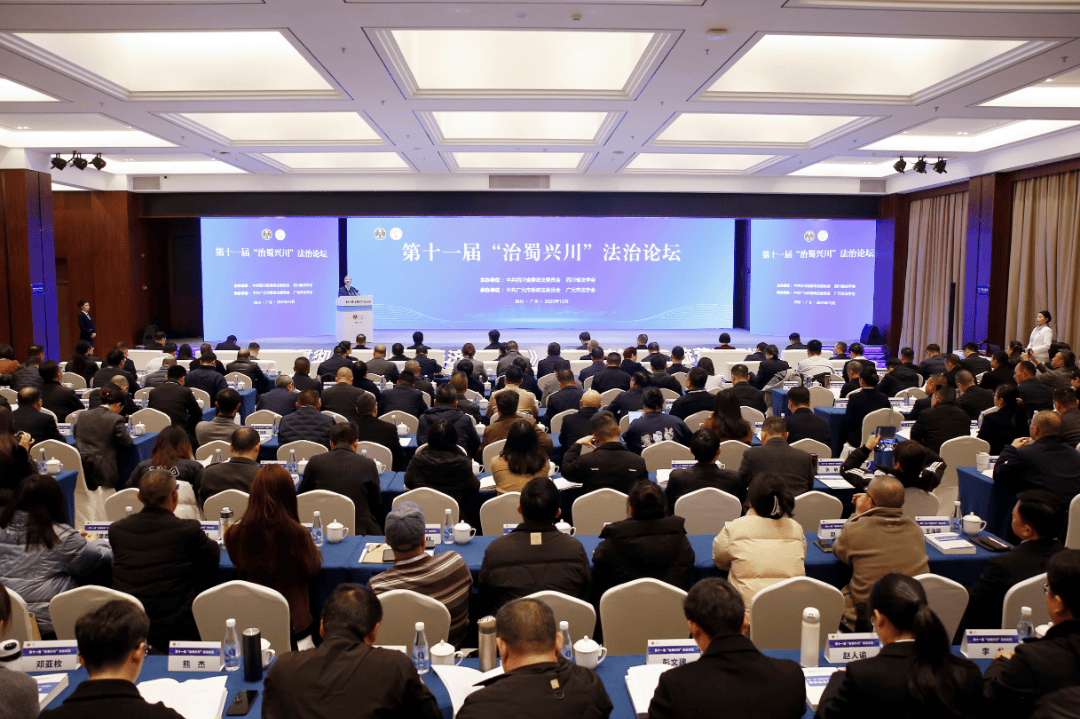
Group 1 - The forum emphasized the importance of the rule of law as a guarantee for China's modernization, focusing on the political responsibility to promote the development of the private economy and create a first-class legal business environment [3][5] - The implementation of the "Private Economy Promotion Law" on May 20 this year provides a strong basis for promoting the healthy development of the private economy through legal means, addressing issues such as fair competition and investment financing [3][5] - Keynote speeches highlighted the relationship between law and economy, with a focus on judicial protection, maintaining fair competition, and enhancing intellectual property protection to support the sustainable and high-quality development of the private economy [3][5][9] Group 2 - The forum discussed the "five pillar systems" of legal support for the private economy in Sichuan, emphasizing the need for collaboration among government, private enterprises, and society to build a better legal business environment [7][9] - The need for a stable, transparent, and predictable legal environment for private enterprises was underscored, with legal research evolving to become a source of wisdom for legal construction and economic development [11] - The forum collected 1,478 papers on various legal topics, showcasing significant research outcomes and facilitating discussions on the role of law in supporting the high-quality development of the private economy [11][21]

征求对市委“十五五”规划《建议》的意见
Nan Jing Ri Bao· 2025-12-13 05:11
Core Viewpoint - The Nanjing Municipal Committee of the Communist Party of China held a meeting to gather opinions from various democratic parties and non-party representatives regarding the formulation of the 15th Five-Year Plan for economic and social development, emphasizing the importance of collective effort and collaboration in achieving the plan's goals [1][2]. Group 1: Meeting Outcomes - The meeting was chaired by Secretary Zhou Hongbo, who highlighted the significance of democratic participation and collective wisdom in addressing major issues and formulating important documents [2]. - Representatives from various democratic parties and the Federation of Industry and Commerce expressed high praise for the achievements during the 14th Five-Year period and supported the suggestions for the 15th Five-Year Plan [1]. Group 2: Suggestions and Focus Areas - Specific suggestions were made regarding the development of a new power system, acceleration of the biopharmaceutical industry, promotion of digital economy to enhance consumer upgrades, and strengthening the development of the private economy [1]. - Additional focus areas included urban innovation, enhancing financial support, optimizing the business environment for Taiwanese enterprises, exploring modern agricultural development, and tapping into the consumption potential of cultural and tourism industries [1].
粤沪浙用好土地“调色盘”
Zhong Guo Zi Ran Zi Yuan Bao· 2025-12-10 01:22
Group 1: Economic Development in Guangdong, Shanghai, and Zhejiang - Guangdong is positioned as a leading economic province, with a focus on advanced manufacturing and high-tech industries, expecting a growth of 6.6% in advanced manufacturing and 10.2% in high-tech manufacturing value added in 2024 [2][3] - The province has allocated at least 20,000 acres of new construction land for emerging industries such as low-altitude economy, artificial intelligence, and chip manufacturing, ensuring land supply aligns with investment intensity [3] - Shanghai is accelerating its urban development under the "Shanghai 2035" plan, focusing on optimizing urban space and enhancing resource supply, with a strategy to manage land resources effectively [4][5] Group 2: Land Use and Management Strategies - Shanghai has implemented a new land reserve mechanism that integrates planning and resource management, ensuring that land supply meets project needs and enhances urban governance [4][6] - The city has achieved a 50% allocation of land resources to key development areas since 2021, with significant projects like Huawei's R&D center and Lexus's new energy project receiving prioritized land use [5][6] - Zhejiang's Taizhou has developed a proactive approach to support private enterprises, with a focus on land allocation and project facilitation, contributing to the local economy [8][9] Group 3: Support for Private Enterprises in Taizhou - Taizhou's private sector, comprising 97.9% of market entities, significantly contributes to the local GDP, prompting government initiatives to support land needs for these businesses [8][9] - The local government has established a demand ledger to track land requirements for enterprises, ensuring timely and efficient service delivery [9][10] - Taizhou's strategy includes improving land selection, expediting approval processes, and providing ongoing support to enhance project implementation for private enterprises [10]
兵团民营经济“生力军”作用持续增强
Sou Hu Cai Jing· 2025-11-19 05:45
Core Insights - The private sector in the Xinjiang Production and Construction Corps (XPCC) has seen significant growth, with the number of private enterprises increasing by over 2.5 times since the start of the 14th Five-Year Plan, and the share of private enterprises in the overall business landscape rising from approximately 75% in 2020 to 93.77% currently [1] - The private economy contributes about 40% of the XPCC's gross domestic product (GDP) and approximately 60% of its tax revenue, while also absorbing over 80% of urban labor employment, highlighting its crucial role in economic development [1] Group 1 - The XPCC has implemented initiatives such as "I Serve Private Enterprises" to enhance support for private businesses, resulting in the issuance of over 70 policy briefings to help enterprises utilize various policies effectively [1] - The XPCC has organized over 90 promotional activities for private enterprises to explore opportunities outside the region and has facilitated 128 cooperation intentions with a total signed amount of 29.269 billion yuan [1] Group 2 - The XPCC has strengthened element guarantees by signing strategic cooperation agreements with multiple financial institutions to increase the availability of first loans, renewal loans, and credit loans for private enterprises [2] - The XPCC has optimized the legal business environment by conducting "Legal Three Advances" and "Legal Health Check" activities, leading to the establishment of commercial mediation rooms in 15 chambers of commerce and successfully mediating over a thousand disputes [2] - The XPCC has recognized over 30 private enterprises and more than 10 entrepreneurs at the national level to promote exemplary practices, while also implementing the "Ten Thousand Enterprises Revitalize Ten Thousand Villages" initiative to support rural revitalization through various means [2]
加强知识产权保护促进民营经济高质量发展
2 1 Shi Ji Jing Ji Bao Dao· 2025-11-05 01:44
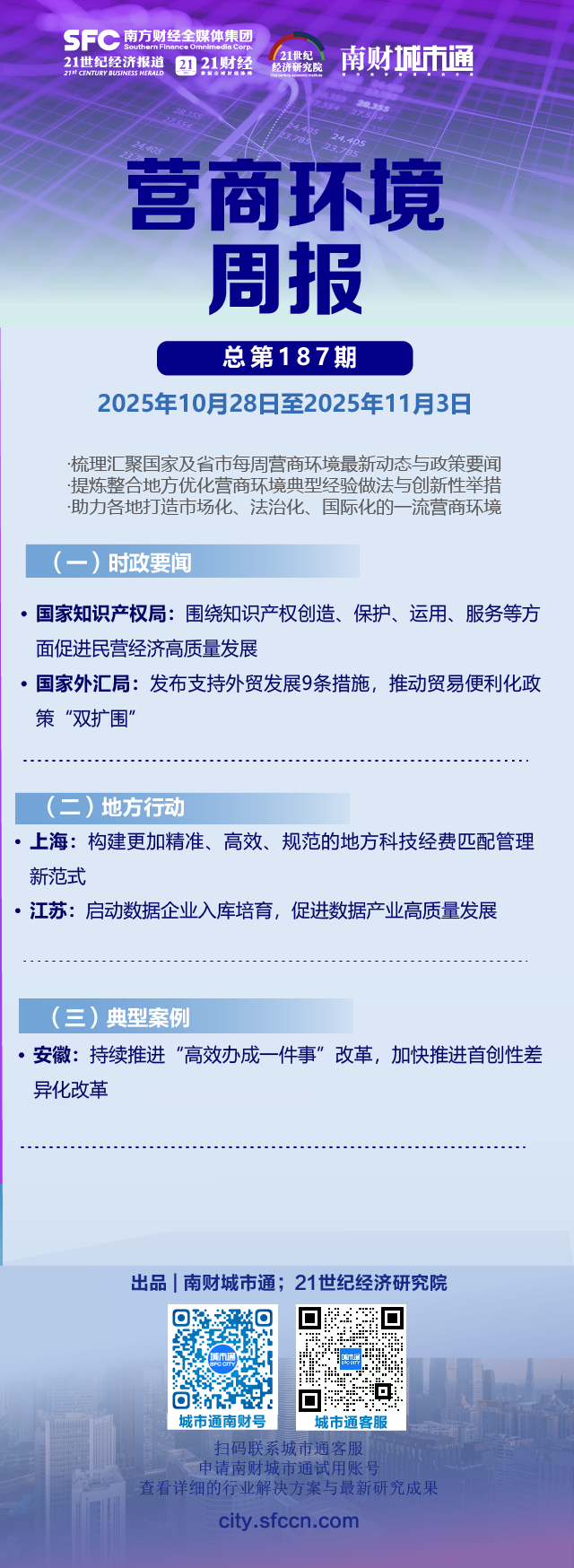
Group 1: Intellectual Property and Private Economy - The National Intellectual Property Administration has issued the "Implementation Measures for Promoting the Development of the Private Economy through Intellectual Property" to enhance patent protection and support high-quality development of the private economy [4][5] - The measures encourage private enterprises to strengthen independent innovation and improve the quality and efficiency of intellectual property examination [4][5] - The implementation includes providing rapid patent pre-examination and resolution solutions for intellectual property disputes, as well as enhancing foreign-related intellectual property protection [5] Group 2: Foreign Trade Development - The State Administration of Foreign Exchange has released nine measures to facilitate foreign trade development and promote cross-border trade payment convenience [6][7] - The measures include expanding the regions for high-level cross-border trade pilot programs and simplifying the settlement procedures for cross-border payments [6][7] - Support is provided for construction companies to open centralized management accounts abroad, allowing for flexible use of funds across different projects [7] Group 3: Local Government Initiatives - Shanghai has introduced a new management approach for local matching of technology funding, aiming to support national major science and technology projects [8][9] - The matching funds will be allocated from the municipal budget, with specific percentages set for different types of national projects [8][9] - Jiangsu Province has initiated a program to cultivate data enterprises, focusing on establishing a database of data-related companies to promote high-quality development in the data industry [10] Group 4: Administrative Reforms in Anhui - Anhui Province is advancing the "Efficient Completion of One Matter" reform, with a significant number of key initiatives already implemented [11] - The province is enhancing the "One Table Pass" platform to streamline data sharing and improve administrative efficiency [11][12] - Future plans include further integration of applications and the use of new technologies to innovate administrative processes [12]
把改革动能转化为高质量发展效能
Jing Ji Ri Bao· 2025-08-30 01:01
Group 1 - The core viewpoint emphasizes the continuous advancement of Chinese-style modernization through reform and opening up, which will create broad prospects for the future [1] - Recent reforms in various fields have led to significant achievements, including the optimization of the private economy environment, with the number of private economic organizations reaching 185 million, accounting for 96.76% of total operating entities by May 2025 [2] - The core competitiveness of state-owned enterprises has significantly improved, playing a crucial role as a "ballast" and "pillar" in the national economy [2] - The construction of a unified national market is progressing steadily, with increasingly unified market basic institutional rules and more efficient market supervision [2] - The reform of the pricing mechanism has yielded fruitful results, and the market-oriented allocation of factors is deepening, enhancing resource allocation efficiency [2] Group 2 - The innovation system is becoming more refined, with strengthened cooperation between industry, academia, and research, leading to a significant leap in technological innovation capabilities [2] - China's global innovation index ranking has risen from 34th in 2012 to 11th in 2024, with notable achievements in cutting-edge fields such as quantum information and stem cells [2] - Social reforms are making breakthroughs, with improvements in education, healthcare, and social security, contributing to enhanced public welfare [2] - The largest social security system in the world has been established, with continuous expansion and improvement in coverage and standards [2] Group 3 - Future reforms will focus on transforming reform momentum into strong driving forces for high-quality development, addressing deep-seated institutional barriers [3] - Key reform measures will be implemented to enhance the national unified market and improve the quality of state-owned enterprise reforms [3] - The government aims to lower logistics costs and expand autonomous and unilateral openings, promoting the effective implementation of free trade zone policies [3] - There will be an emphasis on problem-oriented approaches, promoting effective policy measures from pilot reform areas nationwide [3] - The participation of the public in reforms will be enhanced through various channels, ensuring that reform plans align more closely with public needs [3]

福建发布“十四五”改革成绩单:活力迸发,多项改革成果全国领先
Zhong Guo Fa Zhan Wang· 2025-08-20 09:59
Core Viewpoint - Fujian Province is focusing on high-quality development and comprehensive reform during the "14th Five-Year Plan" period, aiming to enhance its role in China's modernization efforts [1][2]. Group 1: Reform and Innovation - Fujian is implementing bold reforms to address prominent development issues, enhancing new growth drivers and creating new competitive advantages [2]. - The province is deepening state-owned enterprise reforms and improving the environment for private enterprises, with a focus on creating a first-class business ecosystem [2][3]. - Fujian is promoting the integration of technological and industrial innovation, establishing a Provincial Science and Technology Committee, and launching policies to foster innovation [2]. Group 2: Business Environment - The province has developed its first business environment construction plan and introduced various regulations to optimize the business climate, achieving high satisfaction rates [3]. - Fujian is enhancing regional coordination and urban-rural integration, with significant progress in urbanization, achieving a projected urbanization rate of 71.8% by 2024, which is 4.8 percentage points higher than the national average [3]. Group 3: Unique Reforms - Fujian is conducting pilot reforms at the city and county levels, promoting a culture of innovation and experimentation that contributes to both local and national development [4]. - The province is advancing cross-strait integration with significant policy support, leading to a high number of new Taiwanese enterprises and investment [4]. Group 4: Environmental Initiatives - Fujian is committed to ecological development, maintaining high environmental quality and leading in forest coverage rates for 46 consecutive years [5]. - The province's ecological initiatives have gained international recognition, with successful cases in ecological restoration and sustainable practices showcased globally [5]. Group 5: Social Welfare and Quality of Life - Fujian prioritizes reforms in the social sector, focusing on employment, education, healthcare, and social security, with over 70% of provincial fiscal spending directed towards these areas [6]. - The province aims to improve public services and quality of life, with projected per capita disposable income reaching 47,857 yuan in 2024, ranking seventh nationally [6]. Group 6: Governance and Community Engagement - Fujian is enhancing governance effectiveness through innovative community engagement strategies, maintaining a high public safety perception rate of over 98% [7]. - The province's commitment to reform and openness is expected to drive further development and modernization efforts in the future [7].
数说全国统一大市场 高质量发展动能十足
Zheng Quan Shi Bao· 2025-08-18 18:29
Market Potential - The structural advantages of China's super-large market are accelerating, with the number of registered business entities reaching 189 million by the end of 2024, a 3.1% increase from the end of 2023, indicating strong economic resilience and potential [3] - The number of private enterprises has grown from 10.857 million in 2012 to 56.707 million by January 2025, a 5.2-fold increase, with private enterprises now accounting for over 92% of national high-tech enterprises [3][4] - The index for the development of small and medium-sized enterprises reached 89.5 in Q1 2025, the highest since 2020, driven by further relaxation of market access restrictions [4] Consumption Data - In the first half of 2025, China's GDP grew by 5.3% year-on-year, with domestic demand contributing 68.8% to economic growth [6] - The total retail sales of consumer goods reached 24.5458 trillion yuan in the first half of 2025, a 5.0% increase year-on-year, with 19 provinces exceeding the national average growth rate [6] - Online retail sales have maintained the world's highest position for 12 consecutive years, with a total of 15.5 trillion yuan in 2024, a 31% increase from the end of the 13th Five-Year Plan [6] Logistics and Supply Chain - The total social logistics volume reached 360.6 trillion yuan in 2024, a 5.8% increase year-on-year, with logistics costs as a percentage of GDP decreasing from 18% in 2012 to 14.4% in 2023 [7][8] - The government aims to reduce the logistics cost-to-GDP ratio to around 13.5% by 2027, indicating ongoing efforts to enhance logistics efficiency [8] Energy Market - The volume of market-based electricity transactions increased from 1.1 trillion kWh in 2016 to 6.2 trillion kWh in 2024, with the proportion of market transactions in total electricity consumption rising from 17% to 63% [9] Fair Competition - The implementation of the Fair Competition Review Regulations in August 2024 has led to a decrease in identified issues by 2.78 percentage points year-on-year, enhancing the competitive market environment [11] - In the first half of the year, market regulators investigated 11 cases of monopoly agreements and abuse of market dominance, imposing fines totaling 632 million yuan [11] Consumer Environment - In 2024, market regulators handled 39.239 million consumer complaints, with 18.625 million being complaints, resulting in economic losses of 5.16 billion yuan being recovered for consumers [12]
