水产品

Search documents
商务预报:12月8日至14日食用农产品和生产资料价格略有上涨
Shang Wu Bu Wang Zhan· 2025-12-18 02:56
Agricultural Products Market - The national market price of edible agricultural products increased by 0.7% from the previous week, while production material prices rose by 0.1% [1] - The average wholesale price of 30 types of vegetables reached 6.03 yuan per kilogram, up by 1.3%, with notable increases in eggplant (8.4%), tomato (7.5%), and winter melon (5.8%) [1] - The average wholesale price of six types of fruits saw a slight increase, with watermelon, banana, and grape rising by 4.3%, 3.1%, and 0.8% respectively [1] - Poultry product prices experienced minor increases, with white-feathered chicken and eggs rising by 0.2% and 0.1% respectively [1] - Wholesale prices of aquatic products remained stable, with slight increases in certain fish types, while others saw minor declines [1] - Grain and oil wholesale prices showed slight fluctuations, with rice, rapeseed oil, and soybean oil increasing by 0.2%, 0.1%, and 0.1% respectively, while peanut oil decreased by 0.2% [1] - Meat wholesale prices saw a slight decline, with pork priced at 18.00 yuan per kilogram, down by 0.2%, and lamb and beef decreasing by 0.3% and 0.1% respectively [1] Production Material Market - Basic chemical raw material prices experienced a slight increase, with sulfuric acid rising by 1.7%, while methanol, soda ash, and polypropylene saw declines of 0.5%, 0.3%, and 0.3% respectively [2] - Prices of non-ferrous metals predominantly increased, with copper and zinc rising by 1.4% and 0.8%, while aluminum decreased by 0.3% [2] - Rubber prices showed slight increases, with natural rubber and synthetic rubber rising by 0.9% and 0.1% respectively [2] - Fertilizer prices experienced minor fluctuations, with compound fertilizer increasing by 0.3% and urea decreasing by 0.1% [2] - Coal prices saw slight declines, with coking coal, thermal coal, and anthracite priced at 1061 yuan, 783 yuan, and 1164 yuan per ton, down by 0.7%, 0.3%, and 0.2% respectively [2] - Steel prices generally decreased, with rebar, high-speed wire rod, and hot-rolled strip priced at 3354 yuan, 3545 yuan, and 3505 yuan per ton, down by 0.5%, 0.4%, and 0.3% respectively [2] - Wholesale prices of refined oil showed slight declines, with 0 diesel, 92 gasoline, and 95 gasoline decreasing by 0.6%, 0.2%, and 0.2% respectively [2]

蒸发1000亿,高市慌了,歼15百公里外死死锁定,稀土断供倒计时!
Sou Hu Cai Jing· 2025-12-13 07:12
Economic Impact - China's travel advisory against Japan has led to a significant decline in Japanese tourism, with Chinese tourists accounting for 21.3% to 35% of total foreign tourist spending in Japan in 2024 [2] - From November 15 to 18, Chinese airlines canceled approximately 500,000 tickets to Japan, representing 32% of the booking volume, potentially costing Japan around 2.2 trillion yen, equivalent to over 100 billion RMB [2] - Japan's cultural and seafood industries are also suffering, with many scheduled events being postponed or canceled, leading to losses in the film industry estimated in the tens of billions of RMB [4] Military Pressure - As of December 4, the number of Chinese vessels in the East Asia sea exceeded 100, creating a significant military presence [5] - Chinese J-15 fighter jets successfully locked onto Japanese F-15s at distances of 50 km and 150 km, indicating a substantial advancement in China's military capabilities [5] Legal and Diplomatic Response - China's Foreign Minister Wang Yi utilized international law to counter Japan's claims regarding Taiwan, referencing historical documents and international resolutions that affirm Taiwan as part of China [7] - This legal argument effectively undermines Japan's position on Taiwan, framing any Japanese intervention as a violation of post-World War II international order [8]


百洋股份高管减持透 业绩高增长背后现金流与利润背离
Xin Lang Cai Jing· 2025-12-11 05:34
Core Insights - The company Baiyang Co., Ltd. announced a share reduction plan by Vice President Yang Sihua, intending to sell up to 246,000 shares, representing 0.07% of the total share capital after excluding the repurchase account, with an estimated cash-out of approximately 1.717 million yuan based on the closing price of 6.98 yuan per share on December 10 [1] Industry Background - The reduction occurs as the seafood industry transitions from rapid expansion to a new phase characterized by low growth, low investment, and a focus on stability [1] Financial Performance - Baiyang Co., Ltd. reported a revenue of 2.952 billion yuan for the first three quarters of 2025, marking a year-on-year increase of 38.77%, while the net profit attributable to shareholders surged by 218.12% to 36.128 million yuan [1] - The company anticipates strategic adjustments and operational optimizations starting in the second half of 2024, with positive outcomes already visible in the food processing export business and a recovery in feed sales [1] Government Support - The company received substantial government subsidies during the reporting period, further supporting its performance improvement [1] Operational Challenges - There is a notable divergence between cash flow and profit, with a net cash flow from operating activities of -406 million yuan contrasting sharply with the net profit of 36.128 million yuan, influenced by long export settlement cycles and prepayments for raw materials [2] - The company faces overseas policy risks, including a tax policy adjustment in Mauritania that resulted in a tax payment and late fees of 3.2132 million yuan, impacting net profit by approximately 1.86 million yuan [2] - The company's diversification efforts have not yet yielded results, and it remains disconnected from industry trends towards high-value areas such as prepared foods and functional proteins [2]

百洋股份高管减持 业绩高增长背后现金流与利润背离
Xin Lang Cai Jing· 2025-12-11 05:34
Core Viewpoint - The company Baiyang Co., Ltd. is undergoing a significant transition in the seafood industry, moving from a phase of rapid expansion to one characterized by low growth and stability, as evidenced by the recent share reduction plan by Vice President Yang Sihua [1][3]. Company Performance - Baiyang Co., Ltd. reported a revenue of 2.952 billion yuan for the first three quarters of 2025, marking a year-on-year increase of 38.77% [1][3]. - The net profit attributable to shareholders reached 36.128 million yuan, a remarkable year-on-year surge of 218.12% [1][3]. Strategic Adjustments - The company plans to adjust its strategic direction and optimize its operational strategies starting in the second half of 2024, with positive results already beginning to show [1][3]. - The food processing export business continues to grow, with a steady increase in export volume and a corresponding rise in net profit [1][3]. Industry Context - The seafood industry is transitioning from high-speed expansion to a phase focused on low growth, low investment, and stability [1][3]. Financial Concerns - There is a notable divergence between cash flow and profit, with a net cash flow from operating activities of -406 million yuan for the first three quarters of 2025, contrasting sharply with the net profit of 36.128 million yuan [2][4]. - This cash flow issue is attributed to the long export settlement cycles typical in the seafood processing industry and the company's advance payments for raw material procurement [2][4]. Policy Risks - Recent changes in agricultural tax policies in countries like Mauritania and Ecuador have posed risks, with the company’s subsidiary needing to pay back taxes and penalties amounting to 3.2132 million yuan, impacting net profit by approximately 1.86 million yuan [2][4]. Business Structure - The company’s diversification efforts have not yet yielded results, and it remains disconnected from industry trends where leading firms are moving towards high-value areas such as prepared foods and functional proteins [2][4].
2025年10月中国水产品进出口数量分别为44万吨和39万吨
Chan Ye Xin Xi Wang· 2025-12-04 03:19
Core Insights - The report by Zhiyan Consulting highlights the trends in China's aquatic product industry from 2026 to 2032, focusing on market monitoring and investment prospects [1] Import and Export Data - In October 2025, China's aquatic product imports totaled 440,000 tons, showing a year-on-year decrease of 0.4%, while the import value reached $190.3 million, reflecting a year-on-year increase of 20.8% [1] - In the same month, China's aquatic product exports amounted to 390,000 tons, with a year-on-year decrease of 0.2%, and the export value was $164.7 million, indicating a year-on-year decline of 9.9% [1] Industry Analysis - Zhiyan Consulting is recognized as a leading industry consulting firm in China, specializing in in-depth industry research, business plans, feasibility studies, and customized services [1] - The firm emphasizes its commitment to providing comprehensive industry solutions to empower investment decisions through professional insights and market acumen [1]

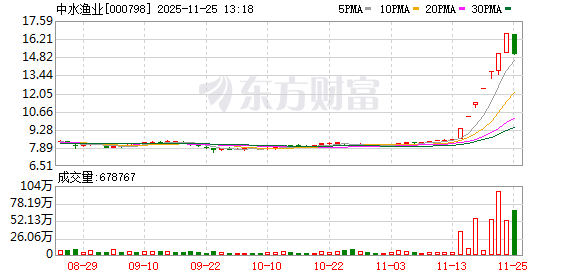
000798,1分钟内股价跳水跌停!
Zheng Quan Shi Bao Wang· 2025-11-25 05:18
Group 1 - The stock price of Zhongshui Fisheries (000798) hit the limit down within one minute of trading on November 25, following a period of seven consecutive trading days of limit up [2][3] - The company experienced a significant drop of 9.7% by midday, closing at 14.99, down from a previous high [2][3] - The company issued a risk warning on November 24, stating that there had been no significant changes in its operational situation or external environment, but noted the high volatility of its stock price [3] Group 2 - The market capitalization of Zhongshui Fisheries is reported at 5.48 billion, with a rolling price-to-earnings (P/E) ratio of 85.29 and a price-to-book (P/B) ratio of 14.83, indicating a substantial difference from industry averages [3] - The stock's trading volume ratio was noted at 2.36, suggesting increased trading activity [3] - The company highlighted the potential for irrational trading behavior and the risk of significant price corrections following previous price increases [3]

“抛售日本”开始了?高市早苗执意“玩火”引发市场冲击波!
Sou Hu Cai Jing· 2025-11-22 17:18
Group 1 - Japan's Prime Minister, Taro Kono, made erroneous statements leading to heightened tensions in Sino-Japanese relations, prompting China to implement countermeasures such as suspending multiple exchanges and restricting Japanese seafood imports, which indirectly affects Japan's manufacturing supply chain [1] - Market risk aversion has surged, with investors concerned about regional stability, resulting in accelerated capital withdrawal from the Japanese market. Invesco strategist Kinoshita noted that the deterioration of Sino-Japanese relations is a significant driver of the "sell Japan" trend [1] Group 2 - On November 21, Kono's cabinet announced a 21.3 trillion yen (approximately 140 billion USD) economic stimulus plan aimed at revitalizing the sluggish economy, which has raised fears of worsening Japan's fiscal situation [3] - Japanese government bonds have faced sell-offs, with bond yields rising for several consecutive days, and the 30-year bond yield reaching a historic high, indicating a potential collapse risk for the world's third-largest bond market [3] - The yen is under devaluation pressure, nearing the 160 mark, which approaches the intervention threshold set by the Bank of Japan [3] - The Nikkei 225 index experienced a significant drop of over 2,500 points in a single week, erasing all gains since Kono took office [3] Group 3 - Investors are worried that Japan may repeat the "mini-budget crisis" seen during former UK Prime Minister Liz Truss's tenure, where aggressive fiscal policies led to a collapse in market confidence [4] Group 4 - Japan's GDP contracted at an annualized rate of 1.8% in the third quarter, marking a return to negative growth after the first quarter of 2024, primarily due to weak domestic demand and export challenges from U.S. tariffs [6] - High valuations in technology stocks have led to correction pressures, compounded by fiscal risks, creating a vicious cycle of "sell-off in stocks, bonds, and currency" [6] - Analysts warn that if Kono loses policy credibility, the sell-off could extend to all Japanese assets, indicating that the current "sell Japan" trend is still in its early stages [6] - There is a critical need for the Kono administration to balance fiscal expansion with debt management; otherwise, prolonged diplomatic stalemates could lead to systemic crises [6] - Bloomberg analysis suggests Japan must find a balance between policy credibility and market stability to avoid a repeat of the "lost decade" [6]

失去中国市场后,日本水产品找不到替补
第一财经· 2025-11-20 06:48
Core Viewpoint - The article discusses the significant decline in Japan's agricultural and fishery product exports to China, primarily due to the suspension of Japanese seafood imports by China following the Fukushima nuclear wastewater discharge, which has led to a loss of the largest export market for Japan's seafood products [3][4]. Group 1: Export Data and Trends - In 2022, Japan's agricultural and fishery product export value reached 1.4 trillion yen (approximately 73.5 billion yuan), with China contributing significantly, showing a growth of 25.2% to 278.3 billion yen [4]. - The export value of Japanese seafood to China was approximately 87.1 billion yen (around 4.3 billion yuan) in 2022, accounting for about 22% of Japan's total seafood exports [4]. - Following the Fukushima incident on August 24, 2023, Japan's seafood exports to China plummeted from 87.1 billion yen to 32 billion yen, marking the largest decline since 1998, with a year-on-year drop of 57% in agricultural and fishery exports [4][5]. Group 2: Market Challenges and Responses - In 2024, Japan's agricultural and fishery product exports to China decreased by 29% to 168.1 billion yen, continuing the downward trend for the second consecutive year, with seafood exports dropping over 90% to approximately 6.1 billion yen [5]. - Japanese producers are seeking new markets in the U.S., Mexico, and other regions to compensate for the loss of the Chinese market, but the overall export decline persists [6]. - The Japanese government had set ambitious export targets of 2 trillion yen by 2025 and 5 trillion yen by 2030, but these goals are increasingly challenged by the inability to find alternative markets for seafood [7]. Group 3: Competitive Landscape - The seafood sector is the only category experiencing a decline in Japan's agricultural and fishery exports, despite overall growth in other categories [6]. - The imposition of a 15% tariff by the Trump administration on Japanese products has further complicated the situation, leading potential international buyers to reconsider their procurement strategies [7].
收评:沪指和创业板指小幅上涨 水产品、船舶、军贸概念等多板块大涨
Xin Hua Cai Jing· 2025-11-19 07:28
Market Overview - The Shanghai and Shenzhen stock indices opened lower on November 19, with the Shanghai Composite Index closing at 3946.74 points, up 0.18%, and the Shenzhen Component Index at 13080.09 points, down 0.00% [1] - The ChiNext Index rose 0.25% to close at 3076.85 points, while the STAR Market Index fell 1.13% to 1578.39 points [1] - The total trading volume for the Shanghai market was approximately 720.9 billion yuan, and for the Shenzhen market, it was about 1005 billion yuan [1] Sector Performance - A surge in water product stocks was noted, with Guolian Aquatic Products hitting a 20% limit up, and several other stocks like Zangzi Island and Dahu Co. reaching around 10% limit up [1] - Significant gains were observed in sectors such as shipbuilding, military trade concepts, and precious metals, while sectors like oil, insurance, non-ferrous metals, and daily chemicals also saw notable increases [1] - The Hainan Free Trade Zone, composite copper foil, and media entertainment sectors experienced the largest declines [1] Institutional Insights - Jifeng Investment Advisory noted that the overall market trend remains upward, with a focus on high-performing sectors like semiconductors, consumer electronics, AI, robotics, and low-altitude economy for mid-term investment opportunities [2] - Huatai Securities highlighted a turning point in capital expenditure growth in the chemical raw materials sector, predicting a new round of recovery driven by domestic demand and export support [2] - Dongwu Securities reported a surge in demand for AI data centers and a shift in energy storage policies, indicating a focus on leading equipment manufacturers in the battery sector [2] Regulatory Developments - The National Standard for the use of recycled materials in household appliances was approved, set to take effect on May 1, 2026, promoting green and low-carbon development in the industry [3] Electric Vehicle Infrastructure - As of October 2023, China has 18.645 million electric vehicle charging facilities, marking a 54% year-on-year increase, with public charging facilities reaching 4.533 million [4] - The total rated power of public charging stations is 203 million kilowatts, with an average power of approximately 44.69 kilowatts [4]

威海市环翠区水产品消费行为专项调查展开
Sou Hu Cai Jing· 2025-11-17 11:46
Core Viewpoint - The investigation aims to understand the consumption behavior of aquatic products among residents with different dietary patterns, providing data support for microbial risk assessment at national and provincial levels [1][3]. Group 1: Investigation Overview - The investigation is conducted by the Huancui District Disease Control Center in collaboration with local streets, focusing on the consumption behavior of aquatic products among residents [1][3]. - A total of 100 representative households were selected from six communities across three streets, considering factors like population structure, economic level, and consumption habits [3]. - The data collection involved systematic and standardized methods, including home visits and face-to-face interviews, ensuring broad representativeness and in-depth analysis [3]. Group 2: Data Quality and Management - The Huancui District Disease Control Center emphasizes data quality, regularly organizing experienced quality control personnel for field visits and reviews [3]. - Weekly meetings are held to discuss common issues and develop practical solutions and standardized operating procedures [3]. - This mechanism effectively addresses challenges encountered during the investigation and establishes a sustainable and efficient working system for reliable data quality [3][4]. Group 3: Progress and Goals - The investigation is progressing steadily and has successfully achieved its established phase goals [4].