
电视机制造

Search documents
2025年6月中国电视机进出口数量分别为2万台和786万台
Chan Ye Xin Xi Wang· 2025-08-28 03:27
Core Insights - The report by Zhiyan Consulting highlights a significant decline in China's television import and export figures for June 2025, indicating a challenging market environment for the industry [1] Import Data - In June 2025, China imported 20,000 television sets, representing a year-on-year decrease of 12.2% [1] - The import value for the same period was $0.18 million, which is a year-on-year decline of 21.3% [1] Export Data - In June 2025, China exported 7.86 million television sets, showing a year-on-year decrease of 14.7% [1] - The export value for this period was $1.12 billion, reflecting a year-on-year decline of 17.3% [1] Industry Context - Zhiyan Consulting is recognized as a leading industry consulting firm in China, specializing in in-depth industry research and providing comprehensive consulting services to support investment decisions [1]


海信视像:2025年上半年净利润10.56亿元,同比增长26.63%
Xin Lang Cai Jing· 2025-08-25 08:25
Core Insights - The company reported a revenue of 27.231 billion yuan for the first half of 2025, representing a year-on-year growth of 6.95% [1] - The net profit for the same period was 1.056 billion yuan, showing a year-on-year increase of 26.63% [1] Financial Performance - Revenue for H1 2025: 27.231 billion yuan, up 6.95% year-on-year [1] - Net profit for H1 2025: 1.056 billion yuan, up 26.63% year-on-year [1]

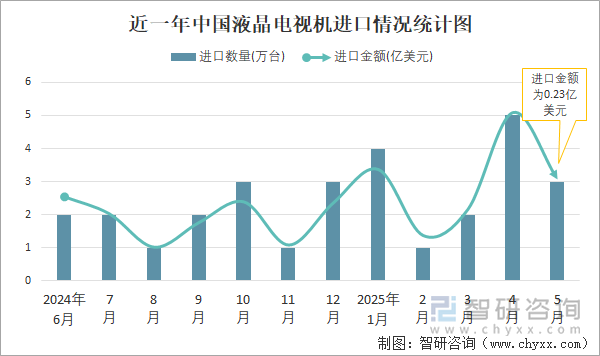
2025年5月中国液晶电视机进出口数量分别为3万台和863万台
Chan Ye Xin Xi Wang· 2025-08-05 03:51
Group 1 - In May 2025, China's import of LCD televisions reached 30,000 units, representing a year-on-year increase of 12.7%, with an import value of $0.23 million, up 5.1% year-on-year [1] - In the same month, China's export of LCD televisions totaled 8.63 million units, showing a year-on-year decline of 3.2%, with an export value of $11.79 million, down 5.8% year-on-year [1]
6月中国PPI环比下降 部分行业价格企稳回升
Zhong Guo Xin Wen Wang· 2025-07-09 08:20
Group 1 - In June, China's Producer Price Index (PPI) decreased by 0.4% month-on-month, with some industries showing signs of price stabilization and recovery [1] - The main reason for the month-on-month decline in PPI was the seasonal decrease in prices of certain raw material manufacturing industries, influenced by high temperatures and increased rainfall affecting construction progress in real estate and infrastructure projects [1] - The increase in green energy production contributed to a decrease in energy prices, with the electricity and heat production and supply industry seeing a month-on-month price drop of 0.9% [1] Group 2 - The year-on-year decline in PPI expanded by 0.3 percentage points to 3.6% in June, influenced by both month-on-month declines and changes in comparison bases [1] - The construction of a unified national market has led to a narrowing of year-on-year price declines in certain industries, with prices for gasoline and diesel vehicle manufacturing and new energy vehicle manufacturing increasing by 0.5% and 0.3% respectively [2] - Policies aimed at boosting consumption have led to a year-on-year increase in prices of daily necessities, with general daily goods and clothing prices rising by 0.8% and 0.1% respectively in June [2]
重磅公布:由降转涨!
中国基金报· 2025-07-09 05:59
Group 1: CPI Analysis - In June 2025, the Consumer Price Index (CPI) increased by 0.1% year-on-year, marking a shift from a decline that lasted for four consecutive months [3][9] - The rise in CPI was primarily influenced by the recovery in industrial consumer goods prices, with the year-on-year decline narrowing from 1.0% to 0.5% [3][4] - Core CPI, excluding food and energy, rose by 0.7% year-on-year, the highest increase in nearly 14 months [3][4] Group 2: PPI Analysis - The Producer Price Index (PPI) decreased by 0.4% month-on-month, with the decline remaining consistent with the previous month [6][7] - The year-on-year decline in PPI expanded by 0.3 percentage points, influenced by seasonal price decreases in raw material manufacturing and pressures in export-oriented industries [6][7] - Some industries showed signs of price stabilization and recovery, particularly in sectors benefiting from domestic market improvements and consumption policies [7][6] Group 3: Price Changes by Category - Food prices decreased by 0.3% year-on-year, with notable declines in pork prices by 8.5% and egg prices by 7.7% [9][17] - Non-food prices increased by 0.1% year-on-year, with service prices rising by 0.5% [9][10] - Among various categories, prices for durable goods and entertainment-related items showed increases, reflecting ongoing consumer demand [7][12]

14个月新高!重要经济数据发布
证券时报· 2025-07-09 05:28
Core Viewpoint - The Consumer Price Index (CPI) has turned from a decline to an increase of 0.1% year-on-year in June, ending a four-month downward trend, influenced by the recovery in industrial consumer goods prices [2][3]. CPI Analysis - In June, the CPI increased by 0.1% year-on-year, with food prices decreasing by 0.3% and non-food prices rising by 0.1% [3]. - The decline in industrial consumer goods prices narrowed from 1.0% to 0.5% year-on-year, reducing its downward impact on CPI by approximately 0.18 percentage points [3]. - International commodity price fluctuations led to significant increases in gold and platinum jewelry prices, which rose by 39.2% and 15.9% respectively, contributing about 0.21 percentage points to the CPI increase [3]. - The core CPI rose by 0.7%, marking a new high in nearly 14 months [3]. PPI and Industrial Prices - The Producer Price Index (PPI) showed a consistent decline in June, but some industries are experiencing price stabilization and recovery due to improved supply-demand relationships [8]. - The construction of a unified national market and increased efforts to combat disorderly low-price competition are contributing to price stabilization in certain sectors [8]. - Prices in the automotive sector, including both traditional and new energy vehicles, have shown signs of recovery, with respective year-on-year declines narrowing [8]. Consumer Demand and Living Costs - The demand for housing rentals has increased during the graduation season, leading to a 0.1% rise in rental prices [6]. - Policies aimed at boosting consumption have led to a rise in prices for daily necessities and clothing, with general daily goods and clothing prices increasing by 0.8% and 0.1% respectively [9]. - High-tech industries are also seeing price increases, with integrated circuit packaging and testing prices rising by 3.1% year-on-year [9].

中非产业链合作共筑发展之路
Xin Hua She· 2025-06-15 06:09
Group 1: Trade and Economic Cooperation - In 2024, China-Africa trade is expected to exceed 295.56 billion USD, marking a 4.8% increase and setting a new historical record, with China maintaining its position as Africa's largest trading partner for 16 consecutive years [1] - The "Ten Major Cooperation Actions" initiative is driving deep cooperation across the entire industrial chain between Chinese and African enterprises, contributing to sustainable economic development in Africa [1] Group 2: Agricultural Development and Local Production - A modern cocoa processing plant in Côte d'Ivoire, built by a Chinese company, has a processing capacity of 50,000 tons per year and a storage capacity of 140,000 tons, marking a significant step in the local cocoa industry's upgrade [2] - Chinese agricultural development experience is seen as a vital reference for African countries, with Chinese enterprises not only constructing factories but also providing solutions for industrial chain upgrades [2] Group 3: Talent Development and Training - The development of the industrial chain is heavily reliant on a skilled workforce, with Chinese companies emphasizing vocational education and technical training to cultivate local talent capable of independent production [3] - Over 20,000 textile professionals have been trained by a Chinese company in Madagascar, enhancing local skills and contributing to the textile industry's growth [3][4] Group 4: Market Expansion for African Products - Various platforms and mechanisms are facilitating the entry of African products into global markets, with the establishment of e-commerce platforms like Qili Mall in Kenya, which has become a leading platform in East Africa [5] - Chinese companies are increasingly investing in local production, with a significant portion of components for products being sourced locally, thus enhancing the local economy [5] Group 5: Strategic Initiatives and Trade Policies - China has implemented zero-tariff policies for 100% of products from 33 African countries, promoting trade and economic cooperation [5] - The China-Africa Economic and Trade Expo and other platforms are being utilized to help African enterprises access the Chinese market and connect with global resources [5][6]
核心CPI企稳的三个特征?——5月通胀数据点评(25.05)(申万宏观·赵伟团队)
赵伟宏观探索· 2025-06-11 23:28
Core Viewpoints - The improvement in consumer demand stabilizes the core CPI, but supply-side factors significantly suppress inflation readings [3][72] - The core commodity PPI shows a notable rebound primarily due to demand improvement, with tariff impacts on prices not intensifying [3][72] - The overall CPI aligns with market expectations, with food supply showing a mixed performance leading to a slight decline in food CPI [28][74] Group 1: Core CPI Characteristics - Characteristic 1: The core commodity PPI rebounded by 0.3 percentage points to -1.4% YoY, driven by sustained effects of consumption policies and a moderation in tariff impacts [3][72][8] - Characteristic 2: The core commodity CPI increased by 0.1 percentage points to 0.2% YoY, supported by consumption policies and rising gold prices, with gold jewelry prices up 40.1% YoY [19][73] - Characteristic 3: The service CPI rose by 0.2 percentage points to 0.5% YoY, aided by an increase in holiday days, which enhanced service demand [22][61] Group 2: Future Outlook - The combination of policy reinforcement and recovery in domestic demand is expected to alleviate inflationary pressures, although supply-side changes may still impose constraints on price readings [5][74] - Continued emphasis on policies to boost service consumption may further improve core service CPI, while the "old-for-new" policy could support core commodity CPI and PPI [5][74] - Despite these positive factors, low capacity utilization in downstream sectors and uncertainties regarding tariffs may still limit price recovery [5][74] Group 3: Regular Tracking - The CPI remained flat YoY, with improvements in both core commodity and core service CPI [38][74] - The PPI continued to decline, with a YoY drop of 0.6 percentage points to -3.3%, particularly in production materials [38][74] - Food CPI showed a slight decline due to mixed supply conditions, with fresh fruits and fish prices rising while seasonal vegetables saw price drops [28][74]
核心CPI企稳的三个特征?——5月通胀数据点评(25.05)(申万宏观·赵伟团队)
申万宏源宏观· 2025-06-10 03:59
Core Viewpoints - The improvement in consumer demand stabilizes the core CPI, but supply-side factors significantly suppress inflation readings [3][68] Group 1: Key Features of Core CPI Stabilization - Feature 1: The core commodity PPI shows a significant rebound, primarily due to improved demand and a lack of further tariff impacts. In May, the core commodity PPI increased by 0.3 percentage points to -1.4% [3][68] - Feature 2: Consumption promotion policies combined with rising gold prices lead to an increase in core commodity CPI. In May, the core commodity CPI rose by 0.1 percentage points to 0.2% [4][19] - Feature 3: The increase in holiday days in May allows for a more substantial release of service demand, pushing the core service CPI higher. The service CPI rose by 0.2 percentage points to 0.5% in May [4][22] Group 2: Outlook and Regular Tracking - The combination of policy reinforcement and recovery in domestic demand is expected to alleviate inflationary pressures, but supply-side changes must be monitored for their impact on price readings [5][33] - The overall CPI in May was -0.1%, slightly better than market expectations, with food supply showing a mixed performance [5][27] - The non-food CPI saw improvements in transportation and communication, while fuel prices for transportation significantly declined [51][71]
5月核心CPI涨幅扩大 居民消费需求正逐步回暖
Zheng Quan Shi Bao· 2025-06-09 17:53
Group 1 - The Consumer Price Index (CPI) decreased by 0.2% month-on-month and 0.1% year-on-year in May, while the Producer Price Index (PPI) fell by 0.4% month-on-month and 3.3% year-on-year, indicating a continued impact of consumption-boosting policies [1][2] - Energy prices were the main factor dragging down both the CPI and PPI, with energy prices decreasing by 6.1% year-on-year and 1.7% month-on-month, significantly affecting the overall CPI decline [1] - Core CPI, excluding food and energy, increased by 0.6% year-on-year, with hotel accommodation and tourism prices rising by 4.6% and 0.8% respectively, indicating a recovery in certain sectors [1] Group 2 - PPI data showed marginal improvement in terminal consumer demand, with life goods prices stabilizing and some manufacturing prices narrowing their year-on-year decline [2] - High-tech product demand is expanding, with prices in sectors like integrated circuit packaging and testing, aircraft manufacturing, and wearable smart devices increasing by 3.6%, 3.0%, and 2.1% respectively [2] - Economic analysts predict a likely upward trend in the price index, with CPI expected to gradually recover and PPI showing signs of marginal improvement due to previous consumption-boosting policies [2]