
粮食生产

Search documents
1.43万亿斤,粮食产量再创历史新高 今年将“五路并进”提升产能
2 1 Shi Ji Jing Ji Bao Dao· 2026-01-22 23:15
Core Viewpoint - The Chinese government is accelerating agricultural modernization and promoting rural revitalization, with significant achievements in grain production and poverty alleviation by 2025 [1][10][12]. Group 1: Agricultural Production - In 2025, China's grain production reached 14,298 billion jin, an increase of 1.68 billion jin, marking a historical high and maintaining over 14 trillion jin for two consecutive years [1][3][10]. - The increase in grain production is primarily attributed to autumn grain, which contributed 1.636 billion jin, accounting for over 90% of the total increase [3][12]. - The main contributors to the increase were the northeastern provinces, Inner Mongolia, and Xinjiang, which together accounted for nearly 70% of the national increase [3][12]. Group 2: Poverty Alleviation and Support Policies - By the end of 2025, over 7 million monitoring subjects were identified for assistance, effectively eliminating the risk of returning to poverty [1][15]. - The employment scale of the poverty alleviation labor force exceeded 32 million, ensuring stable income sources for more than two-thirds of the poverty-stricken families [1][15]. - The government has invested 161.11 billion yuan in assistance funds and facilitated the sale of agricultural products from poverty-stricken areas amounting to 754.54 billion yuan [15]. Group 3: Future Agricultural Strategies - In 2026, the focus will be on stabilizing grain production areas, enhancing single yield, optimizing production structure, increasing efficiency, and disaster reduction [4][13][14]. - The government aims to implement a new round of grain production capacity enhancement actions, emphasizing the importance of maintaining grain planting areas and improving yield through advanced agricultural practices [4][12][13]. - Continuous support for rural revitalization will be integrated into the strategy to prevent large-scale poverty [16][17].


1.43万亿斤!产量再创历史新高,今年粮食生产将“五路并进”
2 1 Shi Ji Jing Ji Bao Dao· 2026-01-22 13:00
Core Viewpoint - The Chinese government is accelerating agricultural modernization and rural revitalization, with a focus on stabilizing grain production and ensuring food security, while also enhancing the living conditions of farmers and promoting sustainable development in rural areas [1][2][6]. Group 1: Agricultural Production - In 2025, China's grain production reached a historical high of 14,298 billion jin, an increase of 1.68 billion jin, maintaining stability above 14 trillion jin for two consecutive years [1][2]. - The increase in grain production in 2025 was primarily driven by autumn grain, which contributed 16.36 billion jin, accounting for over 90% of the total increase [2]. - The main regions contributing to the grain increase were Northeast China, Inner Mongolia, and Xinjiang, which together accounted for nearly 70% of the national increase [2]. - Corn was the leading crop in terms of production increase, contributing 12.64 billion jin, which represented 75% of the total grain increase [2]. Group 2: Poverty Alleviation and Support Policies - The government has identified and supported over 7 million monitoring objects to eliminate the risk of returning to poverty, with over 85% of impoverished households benefiting from at least one form of industrial support [6][7]. - Employment for the impoverished population has remained stable, with over 32 million people engaged in work, ensuring that more than two-thirds of the income for impoverished families is maintained [6]. - The transition period for poverty alleviation policies will end in 2026, with a focus on maintaining stability in support measures and integrating them into rural revitalization strategies [6][7]. Group 3: Future Agricultural Strategies - In 2026, the government plans to implement a new round of actions to enhance grain production capacity, aiming for a significant increase in grain output [3][4]. - Key strategies include stabilizing planting areas, improving yield per unit area, optimizing production structures, enhancing efficiency, and disaster reduction measures [3][4][5]. - The government emphasizes the importance of technology and collaboration among agricultural cooperatives to improve production efficiency and resilience against adverse weather conditions [3][4].
事关粮食生产与“菜篮子”产品供应
Jing Ji Guan Cha Wang· 2026-01-22 08:19
Core Viewpoint - The press conference held by the State Council Information Office focuses on accelerating agricultural modernization and promoting rural revitalization, addressing key issues such as grain production stability, poverty alleviation, and supply of essential food products amid recent weather challenges [1] Group 1: Grain Production Stability - China's grain production has remained stable at over 1.4 trillion jin (approximately 933 million tons) for two consecutive years, with a focus on enhancing production through integrated efforts in land, seeds, machinery, and methods [1] - The Central Rural Work Conference emphasized the need for a new round of actions to increase grain production capacity by 100 billion jin (approximately 66 million tons), highlighting the importance of solidifying the foundation for national food security [1] Group 2: Poverty Alleviation - The transition period for consolidating and expanding poverty alleviation achievements has ended, marking the beginning of a new phase of normalized assistance, ensuring that previous support policies will not be abruptly halted [1] - The approach to ongoing assistance will involve adjustments based on new circumstances, with a focus on identifying and supporting households at risk of falling back into poverty due to health issues, accidents, or natural disasters [1] Group 3: Supply of Essential Food Products - With the Spring Festival approaching, there is a focus on the production status of essential food items such as meat, eggs, milk, fruits, and vegetables, assessing the impact of recent cold weather on production and market supply [1] Group 4: Rural Revitalization Policies - As the first year of the 14th Five-Year Plan begins, there is a commitment to advancing agricultural modernization and rural revitalization, with new policies aimed at fostering county-level industries, ensuring stable income for farmers, and promoting the development of livable and workable rural areas [1]
全国人大代表尚金锁:毫不放松抓好粮食生产
Ren Min Ri Bao· 2026-01-15 09:58
Core Viewpoint - The article emphasizes the importance of maintaining food production in China, highlighting that food security should never be taken lightly despite recent years of abundant harvests [1] Group 1: Agricultural Production - China's grain production has been consistently high, ensuring stable food supply, but the country must remain vigilant due to its unique challenges of having a large population and limited arable land [1] - It is crucial to protect arable land as the foundation of food production, focusing on both the quantity and quality of farmland [1] Group 2: Technological Advancements - The development of new agricultural production capabilities tailored to local conditions is essential, integrating advanced technologies such as artificial intelligence and biotechnology to enhance food production efficiency [1] Group 3: Farmer Support - Policies must be strengthened to encourage farmers' participation in grain production, including price support, subsidies, and insurance, to ensure reasonable prices for key agricultural products and promote stable income for farmers [1] Group 4: Food Security - Food security is deemed a national priority, necessitating unwavering efforts to ensure stable and safe supply of food and important agricultural products at a higher level [1]
守质量安全 护三餐四季(人民时评)
Ren Min Ri Bao· 2026-01-14 23:48
Group 1 - The core viewpoint emphasizes the importance of food security and safety in China, highlighting significant progress in grain production and food safety measures [1][2] - By 2025, China's grain production is projected to reach 14,298 billion jin, maintaining stability above 14 trillion jin despite adverse natural conditions [1] - As of November 2025, the national market supervision system completed 6.1769 million batches of food inspections, with 24 out of 39 food categories showing a non-compliance rate below 1% [1] Group 2 - The governance approach is shifting from end-point inspections to full-chain traceability, enhancing consumer confidence in food safety through rigorous standards and accountability [2] - Daily food supply statistics indicate that 700,000 tons of grain, 98,000 tons of oil, 1.92 million tons of vegetables, and 230,000 tons of meat flow through complex supply chains to reach consumers [2] - The focus is on balancing quantity and quality in food safety, emphasizing that without safety, all agricultural achievements could be undermined [2] Group 3 - Technology plays a crucial role in improving food quality and safety, with the non-compliance rate for edible vegetable oil dropping from 2.08% in 2020 to 0.08% in 2025 due to strict regulation [3] - Collective societal participation is essential in combating food waste, with initiatives like offline "food stations" and online platforms for selling near-expiry products contributing to food security [3] - Strengthening the food supply chain and ensuring food safety is a systemic project that requires collaboration across various sectors [3]
今年农业生产支持政策多
Xin Lang Cai Jing· 2026-01-09 18:43
Group 1 - The city will provide a reward of 50,000 yuan for each enterprise that obtains national plant variety rights, promoting a commercial breeding system led by enterprises [1] - Financial subsidies for large-scale grain production will be implemented, including 100 yuan per mu for oilseed planting over 50 mu, 200 yuan per mu for wheat, rice, and corn planting over 50 mu, and 400 yuan per mu for hybrid rice and corn seed production over 100 mu [1] Group 2 - The city will continue to support agricultural managers with financial support policies and pension insurance subsidies, with a contribution rate of 20% based on 60% of the previous year's average provincial salary [2] - Financial assistance for facility agriculture includes a maximum of 40% subsidy for vegetable production facility upgrades, capped at 2 million yuan per project, and 30% for new cold storage facilities, capped at 1 million yuan [2] - For the renovation of cold storage facilities, a subsidy of 40% of the total cost will be provided, with a maximum of 200,000 yuan per entity [2]
“三农”新蓝图已绘就!——河南省专家结合河南实际解读中央农村工作会议精神
He Nan Ri Bao· 2025-12-30 23:31
Core Insights - The Central Rural Work Conference emphasizes the importance of ensuring stable and safe supply of grain and key agricultural products as a top priority for building a strong agricultural nation [2] - The conference outlines key agricultural and rural development tasks, focusing on enhancing grain production capacity and promoting agricultural modernization through technology and innovation [5] Group 1: Grain Security - The conference highlights the need to stabilize grain and oil production and implement a new round of actions to increase grain production capacity by a billion jin [2] - Experts stress that Henan, as a major grain-producing province, plays a crucial role in national food security and must actively implement the central government's directives [2] - The focus is on improving grain yield through the integration of quality land, seeds, machinery, and methods, while also promoting technological, green, quality, and brand agriculture [2] Group 2: Agricultural Technology - The conference calls for strengthening key agricultural technology research and efficient application of scientific achievements to develop new agricultural productivity [5] - Experts emphasize the importance of addressing industry challenges through targeted technological advancements, particularly in the sesame industry, where Henan leads in production [5] - Successful transformation of scientific research into practical applications is deemed essential for agricultural innovation [5] Group 3: Rural Income and Employment - The conference stresses the need to promote stable income growth for farmers and establish a mechanism to ensure the profitability of grain farmers [4] - A comprehensive approach is advocated to enhance farmers' income beyond traditional farming, focusing on the entire agricultural value chain [4] - Support for returning entrepreneurs and enhancing employment opportunities for migrant workers is highlighted as vital for rural revitalization [6][7] Group 4: Disaster Prevention and Climate Resilience - The conference underscores the importance of enhancing meteorological monitoring and disaster prevention capabilities in agriculture [3] - Measures will be taken to improve early warning systems and integrate meteorological data into agricultural practices to shift from passive to proactive disaster management [3] - The goal is to protect over 88 million acres of high-standard farmland and ensure food security in the face of climate change [3]
颗粒归仓 筑牢饭碗里的安全感
Zhong Guo Jing Ji Wang· 2025-12-22 02:01
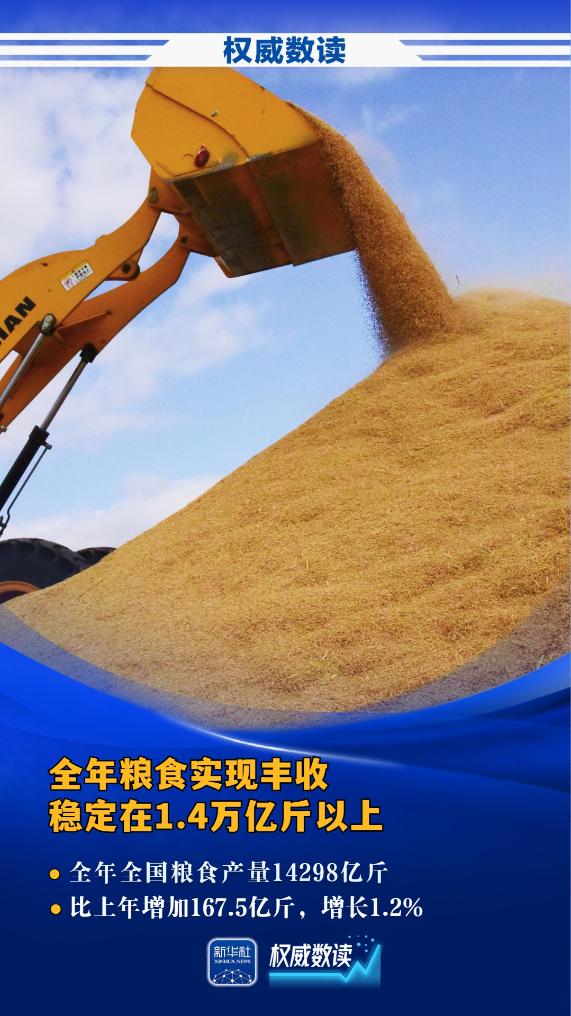
Core Insights - The national grain production is projected to reach 14,297.5 billion jin in 2025, an increase of 167.5 billion jin or 1.2% from the previous year, marking a new high [1] - The abundance of grain serves as a "ballast" for economic and social development, emphasizing the importance of cherishing every grain and saving food [1] - The phrase "颗粒归仓" reflects the need to reduce losses and improve efficiency throughout the agricultural production chain, highlighting the importance of modern agricultural technology and logistics [2] Group 1 - The grain production achievement is a result of hard work and dedication from researchers and farmers, and it is crucial to respect labor by valuing food [1] - Current challenges in grain production include climate change and extreme weather events, which create uncertainties for future yields [1] - The concept of "颗粒归仓" should be integrated into daily life as a collective responsibility, emphasizing that individual efforts can lead to significant savings on a national scale [2] Group 2 - The promotion of agricultural modernization and scientific storage techniques is essential for minimizing losses during harvesting, transportation, storage, and processing [2] - The cultural value of frugality is a traditional virtue in Chinese society and is seen as a modern civic responsibility, reinforcing the idea that saving food contributes to national food security [2][3] - The celebration of grain harvests should not lead to wastefulness; instead, it should inspire a renewed commitment to frugality and awareness of potential future challenges [3]
权威数读丨11月国民经济:延续总体平稳、稳中有进态势
Xin Hua Wang· 2025-12-15 04:40
Core Insights - The national economy is showing overall stability and gradual improvement, with production supply remaining stable and market prices continuing to improve [1] Agricultural Sector - The total grain production for the year reached 14.298 billion jin, an increase of 1.2% or 167.5 million jin compared to the previous year [3] Industrial Sector - In November, the industrial added value for large-scale enterprises grew by 4.8% year-on-year and 0.44% month-on-month [6] - The equipment manufacturing sector saw a year-on-year increase of 7.7%, while high-tech manufacturing increased by 8.4% [6] Service Sector - The service production index increased by 4.2% year-on-year in November [9] - Specific sectors such as information transmission, software and IT services, leasing and business services, and finance saw production index growth of 12.9%, 8.4%, and 5.1% respectively [9] Retail Sector - The total retail sales of consumer goods reached 43.898 billion yuan in November, marking a year-on-year growth of 1.3% [14] - From January to November, service retail sales grew by 5.4%, with an acceleration of 0.1 percentage points compared to the previous ten months [14] Investment Sector - From January to November, fixed asset investment excluding real estate development increased by 0.8%, while manufacturing investment rose by 1.9% [16] Trade Sector - In November, the total value of goods imports and exports reached 38.987 billion yuan, reflecting a year-on-year increase of 4.1%, which is an acceleration of 4.0 percentage points compared to the previous month [19] - Exports and imports with countries involved in the "Belt and Road" initiative grew by 6.0%, and private enterprises' imports and exports increased by 7.1% [21]
中央经济工作会议:加强重点城市群协调联动 深化跨行政区合作
Xin Lang Cai Jing· 2025-12-11 09:46
Core Viewpoint - The meeting emphasizes the importance of coordinated development, promoting urban-rural integration and regional collaboration [1] Group 1: Urbanization and Rural Revitalization - The focus is on advancing urbanization with counties as key carriers and comprehensively revitalizing rural areas to drive high-quality county economic development [1] - Strict adherence to the farmland red line is highlighted, ensuring food production is prioritized and maintaining reasonable prices for essential agricultural products [1] Group 2: Poverty Alleviation and Economic Support - Continuous consolidation and expansion of poverty alleviation achievements are essential, with regular assistance integrated into the rural revitalization strategy to prevent large-scale return to poverty [1] - Support for major economic provinces to take on significant roles is encouraged [1] Group 3: Regional Cooperation and Marine Economy - Strengthening coordination among key urban agglomerations and deepening inter-administrative cooperation is a priority [1] - Emphasis on overall planning for major bays to promote high-quality development of the marine economy is noted [1]