锡行业

Search documents
长江有色:宏观鹰风及供需承压锡市全线遭抛 2日锡价或大跌
Xin Lang Cai Jing· 2026-02-02 03:32
Core Viewpoint - The recent decline in tin prices is driven by a combination of macroeconomic pressures, weak demand recovery, and rising inventory levels, leading to a bearish sentiment in the market [2][3][4]. Group 1: Macroeconomic Factors - The US dollar index has seen significant gains, creating a strong currency environment that diminishes the attractiveness of dollar-denominated commodities like tin [2]. - The US stock market is experiencing heightened risk aversion, particularly affecting technology stocks, which has negatively impacted market confidence in downstream demand for tin in electronics and AI hardware [2]. - Hawkish signals from the Federal Reserve and unexpected inflation data have reversed optimistic expectations for interest rate cuts, leading to a tightening of liquidity support [2]. Group 2: Supply Dynamics - There is a clear expectation of a shift from tight to loose global supply conditions, primarily driven by steady recovery in Myanmar's Wa region and ongoing releases of legal production capacity in Indonesia [3]. - Global visible tin inventories have surged significantly from their lows, raising concerns about oversupply and putting downward pressure on prices [3]. Group 3: Demand Challenges - The traditional consumption sectors, which constitute the majority of tin demand, remain sluggish, with no strong signs of recovery in electronic solder, home appliances, and real estate-related tin chemical demand [4]. - Although emerging sectors like photovoltaics and AI servers show long-term resilience, their current share of total demand is still small, making it difficult to offset declines in traditional sectors [4]. - High historical tin prices have suppressed actual purchasing intentions among downstream users, leading to low inventory levels and weak support in the spot market [4]. Group 4: Industry Profitability - The profit distribution within the tin industry is increasingly skewed towards upstream resource providers, who are benefiting from their scarcity [5]. - As expectations for increased tin supply rise, the scarcity premium for upstream resources is likely to face downward pressure [5]. - Midstream smelting operations, primarily dominated by China, are stable but face rising environmental costs, while downstream processing enterprises are struggling with weak orders and high raw material costs [5]. Group 5: Market Sentiment - The sharp decline in futures prices has led to a collapse in trading sentiment in the spot market, with traders opting for aggressive selling to avoid further losses [6]. - Downstream processing companies are maintaining minimal purchasing levels due to weak end-user demand and a strong wait-and-see attitude, resulting in a lack of buying interest [7]. - The market is characterized by a "strong selling but weak buying" dynamic, indicating a challenging short-term trading atmosphere [7]. Group 6: Short-term Outlook - Tin prices are expected to continue fluctuating as they seek a bottom, with investors advised to monitor developments in Myanmar's production recovery, the Federal Reserve's March meeting, domestic consumption trends, and global inventory depletion rates [8].


受市场恐慌情绪影响本周多数金属价格下跌,后续仍看好关键金属全面行情
HUAXI Securities· 2026-02-01 11:10
Investment Rating - The industry rating is "Recommended" [3] Core Views - The report expresses optimism for key metals in the future despite recent price declines due to market panic [1] - Supply tightening expectations remain for nickel, cobalt, antimony, lithium, rare earths, tin, tungsten, and uranium, which may support prices in the coming months [1][2][8][11][13][14][22] Nickel and Cobalt Industry Summary - As of January 30, LME nickel settled at $17,540 per ton, down 5.85% from January 23, with total LME nickel inventory increasing by 0.90% to 286,284 tons [1] - Supply constraints are expected due to increased rainfall in Indonesia affecting mining and shipping operations, alongside regulatory pressures leading to conservative sales strategies [1] - The Indonesian government plans to reduce nickel mining quotas to 250-260 million tons, which is anticipated to support nickel prices [1][16] - Cobalt prices are expected to rise due to supply tightness, with electrolytic cobalt priced at 446,000 yuan per ton as of January 30, up 1.83% [2][17] Antimony Industry Summary - Antimony prices have increased, with antimony ingot averaging 162,500 yuan per ton as of January 29, up 1.25% [6] - Supply constraints are expected to persist due to production halts at Hunan Zhenqiang Antimony Industry, which may reduce output by over 2,000 tons [6][19] Lithium Industry Summary - Lithium carbonate prices fell to 160,400 yuan per ton as of January 30, down 6.22% [8] - Supply disruptions are anticipated due to environmental assessments delaying mining operations in Jiangxi, impacting future supply [8] - Demand is expected to remain strong, potentially stabilizing prices despite recent declines [8][19] Rare Earth Industry Summary - The report highlights tightening supply expectations for rare earths, particularly due to new regulations in Vietnam and ongoing geopolitical tensions [20] - The global rare earth supply chain remains heavily reliant on China, which continues to dominate production capabilities [20] Tin Industry Summary - Tin prices are supported by uncertainties in overseas supply, with LME tin settling at $54,000 per ton as of January 30, down 0.37% [11] - Supply concerns persist due to slow recovery in Myanmar and ongoing regulatory actions in Indonesia [11][12] Tungsten Industry Summary - Tungsten prices have seen significant increases, with white tungsten concentrate priced at 597,500 yuan per ton as of January 30, up 11.58% [13] - Supply constraints are expected to continue due to strict mining quotas and environmental regulations [13][21] Uranium Industry Summary - Uranium prices remain high, with global market prices at $63.51 per pound, supported by ongoing supply tightness and geopolitical factors [14][22] - The report indicates a persistent supply-demand gap in the uranium market, with expectations for continued price support [14][22]

长江有色:28日锡价大涨 价涨量稳商家畏高观望
Xin Lang Cai Jing· 2026-01-28 08:30
午间现货市场呈现"价涨量稳、结构分化"的特征。锡价跳涨至高位,但成交主要依赖大型电子、半导体 企业的节前刚性备货支撑。中小厂商普遍畏高观望,贸易商操作谨慎,以短线交易为主,市场未出现囤 货惜售现象。这种"大型企业刚需采购、中小散单冷清"的分化格局,表明高价传导至终端仍需时间,市 场博弈加剧。 后市展望:高位震荡,长期逻辑不改 锡价高涨的本质是"供应刚性"与"需求爆发"的结构性失衡。供应端,资源稀缺、地缘冲突(刚果 (金)、缅甸、印尼)及低库存形成三重约束,叠加我国超60%的原料进口依存度,导致缺口难补。需 求端,传统领域需求稳健,而AI服务器与先进封装引爆"算力金属"新需求,单机耗锡量激增,叠加节前 备货,共同支撑"淡季不淡"的强势格局。此供需矛盾是价格上涨的根本动力,并重塑了产业链利润分 配,形成"冰火两重天"局面:上游资源端掌握定价权,利润丰厚;中游冶炼端受成本挤压,开工承压; 下游加工端则显著分化,资金雄厚的大型企业尚可备货生产,而众多中小企业已陷入"原料采购难、订 单不敢接"的经营困境。 龙头动向:业绩高增,加码算力赛道 行业龙头在资源与高端化布局上双向发力,业绩表现亮眼。以锡业股份为例,2025年前 ...
锡业股份:公司目前的锡产品为锡锭,涉及的锡的深加工产品主体主要为公司参股公司云锡新材料
Mei Ri Jing Ji Xin Wen· 2026-01-28 07:15
Core Viewpoint - The company currently produces tin ingots and is primarily involved in deep processing products through its affiliated company, Yunxi New Materials [2] Group 1 - An investor inquired about the possibility of the company producing collectible tin bars and whether there are plans to develop such a business in the future [2] - The company confirmed that its current tin products are limited to tin ingots [2] - The main deep processing products related to tin are handled by the company's affiliated entity, Yunxi New Materials [2]

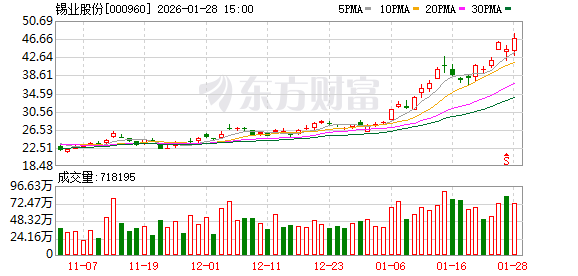
长江有色:27日锡价下跌 刚需为主交投热度有所降温
Xin Lang Cai Jing· 2026-01-27 09:34
今日午盘后沪锡走势:今日沪锡合约2603上涨,开盘价报424790元/吨,盘中最高报452500元/吨,最低 报421800元/吨,结算价报434650元/吨,收盘报451160元/吨,上涨8560元,涨幅1.93%;沪锡主力月 2603合约成交量351975手,持仓量55071手,较前一日减少162手。 今日现货锡价走势:据长江有色金属网获悉,1月27日ccmn长江综合市场1#锡价报424800元/吨-427800 元/吨,均价报426300元/吨,较前一日价格下跌10500元;今日长江现货市场1#锡价报425500元/吨-427500 元/吨,均价426500元/吨,较上一交易日价格下跌10500元/吨。 ccmn锡市分析:宏观面,今日锡价大幅回调,成当日有色板块波动最显著品种,这是短期利空共振导 致,并非锡市供需紧平衡基本面反转,锡的长期资源稀缺与新兴需求支撑逻辑未变。内外宏观利空集中 释放是此次下跌核心,海外虽处弱美元周期,但美国经济数据超预期降温美联储降息预期,美债收益率 上行压制大宗商品价格,中资工业品板块也现资金流出;国内上期所收紧锡期货交易限额引发投机资金 离场,节前资金面偏紧进一步放大跌幅, ...
今日锡价急跌:短期情绪还是长期拐点?
Xin Lang Cai Jing· 2026-01-27 04:20
据长江有色金属网获悉,2026 年 1 月 27 日长江现货 1# 锡市场报 425500-427500 元 / 吨,均价 426500 元 / 吨,单日重挫 10500 元 / 吨,成为当日有色板块情绪扰动最显著品种。此番急跌并非全球锡市供需 紧平衡基本面反转,而是海外宏观政策不确定性、国内资金面调整、地缘局势扰动及春节节前效应的多 重短期利空共振,全球锡资源稀缺、新兴需求驱动的中长期核心支撑逻辑未发生根本改变。 内外宏观双压 周期品配置意愿骤降 锡价下跌的核心宏观诱因是内外利空集中释放,海外货币政策预期转向与国内资金面收缩形成双重压 制,直接导致机构短期配置周期品的意愿降温。 海外层面,美国 11 月耐用品订单月率 5.3% 大幅超预期,凸显经济韧性的同时重挫降息预期;叠加美 联储 1 月 27-28 日议息会议临近,市场 95.6% 预期维持利率不变,鲍威尔继任者悬念持续发酵,进一步 加剧政策不确定性。美债长端收益率上行、纳斯达克中国金龙指数跌 0.63%,全球资产分化背景下有色 金属板块承压明显。国内层面,上期所当日起将锡期货合约日内开仓限额调整至 200 手,引发部分投机 资金离场;临近春节假期,杠 ...
研报掘金丨长江证券:予锡业股份“买入”评级 高纯度、长久期的龙头,高光有望来临
Ge Long Hui A P P· 2026-01-20 07:23
Core Viewpoint - The report from Changjiang Securities highlights that Xiyu Co. has grown to become the largest integrated tin enterprise globally, with a domestic market share of 48% and a global market share of 25% in refined tin for 2024 [1] Company Overview - Xiyu Co. has a static tin resource that can be developed for 20 years, and with exploration and mining efforts, the dynamic development period may extend to 62 years [1] - The company has a potential resource-to-reserve ratio that could reach 82 years by utilizing tailings [1] - The integration of group-managed mines and potential external acquisitions may ensure that Xiyu Co.'s tin resources can last for another century, emphasizing the value of tin [1] Industry Context - Tin is recognized as a crucial material in the semiconductor sector, often referred to as the "metal of the future" [1] - The supply-demand dynamics of metals indicate that tin stands out among other metals [1] - As a leading provider of high-purity and long-duration tin, Xiyu Co. is expected to experience significant growth and recognition in the market [1]

云南锡业股份有限公司2026年第一次临时股东会决议公告
Shang Hai Zheng Quan Bao· 2026-01-16 20:46
Meeting Overview - The first temporary shareholders' meeting of Yunnan Tin Company Limited for 2026 was held on January 16, 2026, at 15:00 [4][5] - The meeting combined on-site voting and online voting [6] - The meeting was convened by the company's board of directors and presided over by Chairman Liu Lukai [7] Attendance - A total of 1,144 shareholders and their proxies attended the meeting, representing 1,057,713,738 shares, which is 64.2818% of the total voting shares [8] - Of these, 5 shareholders attended the meeting in person, representing 726,453,866 shares (44.1497% of total voting shares) [9] - 1,139 shareholders participated via online voting, representing 331,259,872 shares (20.1321% of total voting shares) [9] Resolutions Passed - The following resolutions were approved by a simple majority of the votes cast: 1. Profit distribution plan for the first three quarters of 2025 [11] 2. Proposed guarantee limit for subsidiaries for 2026 [12] 3. Proposal to conduct forward foreign exchange trading [12] 4. Application for comprehensive credit from several commercial banks for 2026 [12] 5. Hedging plan for 2026 and adjustments to the 2025 hedging plan [13] 6. Expected related party transactions for 2026, with certain shareholders abstaining from voting due to conflicts of interest [14] Legal Opinion - The legal opinion provided by Beijing Deheng (Kunming) Law Firm confirmed that the meeting's convening, attendance, and voting procedures complied with legal and regulatory requirements [14]
资金获利减仓,锡锭领跌基本金属
Zhong Xin Qi Huo· 2026-01-16 00:47
1. Report's Industry Investment Rating No specific industry investment rating is provided in the report. 2. Core Viewpoints of the Report - In the short - and medium - term, the supply - demand of tin ingots is expected to improve, and nickel and zinc have supply - related speculations. After a rapid price increase, profit - taking by funds led to an adjustment. However, the logic of a weak US dollar expectation and supply - disruption concerns remains unchanged. Opportunities to buy copper, aluminum, tin, and nickel at low prices should be watched for, and downstream industrial customers should pay attention to restocking opportunities during the adjustment. In the long - term, there are still expectations of potential incremental stimulus policies in China, and supply - disruption issues for copper, aluminum, and tin persist, leading to an expected tightening of supply - demand and a positive outlook for their prices [2]. - For each metal: - Copper: Supply disruptions continue to increase, and the copper price is expected to remain high and fluctuate strongly [3][7]. - Alumina: The fundamentals are weak, and the alumina price is under pressure and expected to fluctuate [3][8]. - Aluminum: Inventory continues to accumulate, the aluminum price has declined, but in the short - term, it is expected to remain strong with fluctuations due to positive macro - expectations and a tight supply - demand outlook [3][12]. - Aluminum alloy: Cost support persists, and the price is expected to fluctuate strongly at a high level [3][14]. - Zinc: The LME has suspended the delivery of KZ and YP zinc, and the SHFE zinc price has broken through 25,000 yuan/ton. It is expected to fluctuate in the short - term and may decline in the long - term [3][17]. - Lead: Social inventory has significantly increased, limiting the upside potential of the lead price, and it is expected to fluctuate [3][22]. - Nickel: Policy expectations are in a game with the weak reality, and the nickel price is expected to fluctuate [3][23]. - Stainless steel: The nickel - iron price continues to rise, and the stainless - steel price is expected to fluctuate [3][26]. - Tin: Supply remains in short - supply, and the tin price is expected to fluctuate strongly at a high level [3][27]. 3. Summary by Relevant Catalogs Copper - **Information analysis**: The US December CPI data was in line with expectations. The 2026 copper concentrate long - term processing fee was set at 0 dollars/ton. December SMM China's electrolytic copper production increased both month - on - month and year - on - year. The spot price of 1 electrolytic copper on January 15 had a higher average premium than the previous trading day. A Chilean copper mine's union will start a strike, and the production of a mine in Ecuador has been postponed [7]. - **Main logic**: Macroscopically, the Fed may continue to be loose, supporting the copper price. On the supply - demand side, copper - mine supply disruptions are increasing, and the supply of refined copper is expected to shrink. Although the terminal demand is weak and inventory is accumulating, the long - term supply - demand is expected to be tight [8]. - **Outlook**: The copper price is expected to fluctuate strongly due to supply constraints and increasing disruptions [8]. Alumina - **Information analysis**: On January 15, the spot prices of alumina in various regions declined, and the alumina warehouse receipts remained unchanged [8]. - **Main logic**: Macroeconomic sentiment amplifies price fluctuations. Fundamentally, high - cost capacity has some fluctuations, but the supply contraction is insufficient, and the cost support is weak. However, as the valuation is in a low range, price fluctuations may increase [9]. - **Outlook**: The alumina price is expected to fluctuate due to an oversupply in reality and a low - range valuation [9]. Aluminum - **Information analysis**: On January 15, the SMM AOO average price and the premium/discount of aluminum decreased. The inventory of aluminum ingots and aluminum bars in major domestic consumption areas increased, and the SHFE electrolytic aluminum warehouse receipts also increased. The Q1 2026 aluminum - ingot premium in Japanese ports increased significantly, and the December 2025 export of unforged aluminum and aluminum products decreased month - on - month but increased year - on - year [12]. - **Main logic**: Macroscopically, the US interest - rate cut expectation and China's new - infrastructure policies are positive. On the supply side, domestic production capacity is high, and overseas new - project progress is uncertain. On the demand side, high prices have suppressed demand, and inventory has accumulated. Overall, the short - term price is expected to remain strong with fluctuations [12]. - **Outlook**: In the short - term, the aluminum price is expected to remain strong with fluctuations. In the medium - term, the supply is expected to be tight, and the price center is expected to rise [13]. Aluminum Alloy - **Information analysis**: On January 15, the prices of some aluminum - alloy products decreased, and the warehouse receipts increased. An Indonesian electrolytic - aluminum project has started production [14]. - **Main logic**: The cost is supported by a tight supply of scrap aluminum. The supply is restricted by raw - material shortages and profit issues, and policies may also affect supply. The demand is mainly for刚需 in the short - term and is expected to improve marginally in the medium - term. The social inventory has decreased slightly, but the warehouse - receipt inventory has increased. Overall, the price is expected to fluctuate strongly [16]. - **Outlook**: In the short - and medium - term, the aluminum - alloy price is expected to fluctuate strongly due to cost support and a tight supply - demand balance [16]. Zinc - **Information analysis**: On January 15, the spot premiums of 0 zinc in different regions varied. The SMM seven - region zinc - ingot inventory decreased slightly. The LME has suspended the further delivery of certain zinc brands since January 14, 2026 [19]. - **Main logic**: The macro - outlook is relatively stable. The zinc - ore supply is tight, and the smelter's profit has declined. The domestic zinc - ingot supply pressure is not significant in the short - term. The demand is in the off - season, and the overall demand expectation is average. In the short - term, the zinc price may remain high and fluctuate, and in the long - term, it may decline [20]. - **Outlook**: In January, the zinc price is expected to fluctuate as the production has increased slightly, the demand is in the off - season, but exports and the overall strength of the non - ferrous sector support the price [21]. Lead - **Information analysis**: On January 15, the price of waste electric - vehicle batteries remained unchanged, and the price of SMM1 lead ingots increased. The social inventory of lead ingots and the SHFE lead warehouse receipts increased. The LME has suspended the further delivery of a certain lead brand since January 14, 2026 [22]. - **Main logic**: The spot premium and the original - recycled lead price difference have increased, and the futures warehouse receipts have increased. The supply has increased as some smelters have resumed production, and the demand is mixed, with a decline in electric - bicycle orders but an improvement in automobile - battery orders. Overall, the lead price is expected to fluctuate [23]. - **Outlook**: As the lead - ingot production recovers and the demand weakens marginally, but the waste - battery cost remains high, the lead price is expected to fluctuate [23]. Nickel - **Information analysis**: On January 15, the SHFE nickel warehouse receipts and the LME nickel inventory increased. An Indonesian nickel - mining company has fully resumed operations, and Indonesia may approve a certain amount of nickel - ore production quota in 2026. The SMM expects a significant increase in the Indonesian domestic - trade nickel - ore price in the second half of January 2026 [24]. - **Main logic**: The supply of nickel is under pressure as domestic and Indonesian production remains high. The demand is in the off - season, and the overall fundamentals are in surplus. The Indonesian nickel - ore quota is uncertain, and its actual implementation needs to be monitored [25]. - **Outlook**: In January, the nickel price is expected to fluctuate as the fundamentals are not significantly improved, but the Indonesian policy may affect the supply - demand balance [25]. Stainless Steel - **Information analysis**: The stainless - steel futures warehouse receipts decreased. On January 15, the spot price of stainless steel in Foshan had a certain discount compared to the futures contract. The average price of high - nickel pig iron increased, and the SMM expects a significant increase in the Indonesian domestic - trade nickel - ore price in the second half of January 2026 [26]. - **Main logic**: The cost of stainless steel is supported by the increase in nickel - iron price. The production in December decreased, and there may be a slight increase in January. The terminal demand is cautious. The inventory may accumulate in the off - season, and the warehouse receipts are at a low level [26]. - **Outlook**: In January, the stainless - steel price is expected to fluctuate as the production may increase slightly, the demand is weak in the off - season, but the cost is supported [26]. Tin - **Information analysis**: On January 15, the LME tin warehouse receipts remained unchanged, the SHFE tin warehouse receipts increased, and the SHFE tin positions decreased. The average price of 1 tin ingots increased [27]. - **Main logic**: The supply of tin is a major concern. Supply disruptions in Myanmar, Indonesia, and Africa are expected to limit production. The demand is expected to increase due to the global economic situation and the growth of industries such as semiconductors, photovoltaics, and new - energy vehicles. Overall, the tin price is expected to be strong [28]. - **Outlook**: The tin price is expected to fluctuate strongly due to high supply risks and low inventory in the industry chain [28]. Market Monitoring - **Commodity Index**: On January 15, 2026, the comprehensive index, the commodity 20 index, and the industrial - product index of CITIC Futures all decreased. The non - ferrous metal index increased by 0.09% on the day, 2.13% in the past 5 days, 12.72% in the past month, and 6.27% since the beginning of the year [156][158].
三箭齐发!上期所:调整锡期货交易保证金比例、涨跌停板幅度及交易限额
券商中国· 2026-01-15 14:27
Core Viewpoint - The Shanghai Futures Exchange has announced adjustments to the margin ratio, price fluctuation limits, and trading limits for tin futures, aiming to guide market participants towards rational and cautious participation, ensuring stable market operations [4]. Group 1: Market Adjustments - Starting from January 15, 2026, the price fluctuation limit for tin futures contracts will be adjusted to 11%, with the margin ratio for hedging transactions set at 12% and for general positions at 13% [3]. - From January 16, 2026, the maximum number of contracts for day trading by non-futures company members and special overseas non-broker participants will be limited to 800 contracts, while hedging and market-making transactions will not be subject to this restriction [3]. Group 2: Price Trends and Influencing Factors - Tin prices have recently surged, breaking historical highs and surpassing the 2022 peak, reaching above 400,000 yuan/ton, with a cumulative increase of 33% within just half a month [5]. - Factors influencing the rise in tin prices include tight supply due to delayed production recovery in Myanmar, export issues in Indonesia, and production reduction expectations in regions like the Democratic Republic of the Congo due to conflicts [3]. - Domestic inventory levels are at a historical mid-range, with recent accumulation in futures inventory, while the market remains optimistic about long-term consumption driven by electronic products and solder materials [3]. Group 3: Analyst Insights - Analysts suggest that 2026 is likely to be a turning point for tin concentrate supply, with expectations of a gradual easing of supply by the second quarter [4]. - Despite the ongoing demand growth for semiconductor solder, the rapid price increase may be overextending long-term expectations, leading to potential volatility in the market [4]. - The recent price surge has positively impacted related company stock prices, with Huaxi Nonferrous rising by 2.2% and Yunnan Tin Company increasing by 1.5% as of January 15, 2026 [5].