军工制造

Search documents
大消费、国产软件板块表现活跃
财联社· 2025-10-15 04:00
下载财联社APP获取更多资讯 准确 快速 权威 专业 今日A股早间冲高回落,随后再度翻红。沪深两市半日成交额1.27万亿,较上个交易日缩量3985亿,量能大幅萎缩。盘面上热点较为杂乱,整体高低 切换,主要集中在医药、国产软件、消费等方向。 大消费板块反复活跃, 国光连锁3连板。 利好刺激下国产软件概念股反弹, 久其软件、榕基软件双双涨停。创新药板块表现活跃,昂利康涨停,亚 太药业2连板,广生堂20cm涨停。下跌方面,军工板块集体走弱,北方长龙跌超10%。半导体板块出现明显分歧,至纯科技跌停。 板块方面, 医药、零售等板块涨幅居前, 军工、半导体、港口航运等板块跌幅居前。截至收盘,沪指涨0.1%,深成指几乎平盘,创业板指 涨0.22%。 7x24h电报 头条新闻 VIP资讯 实时盯盘 ...


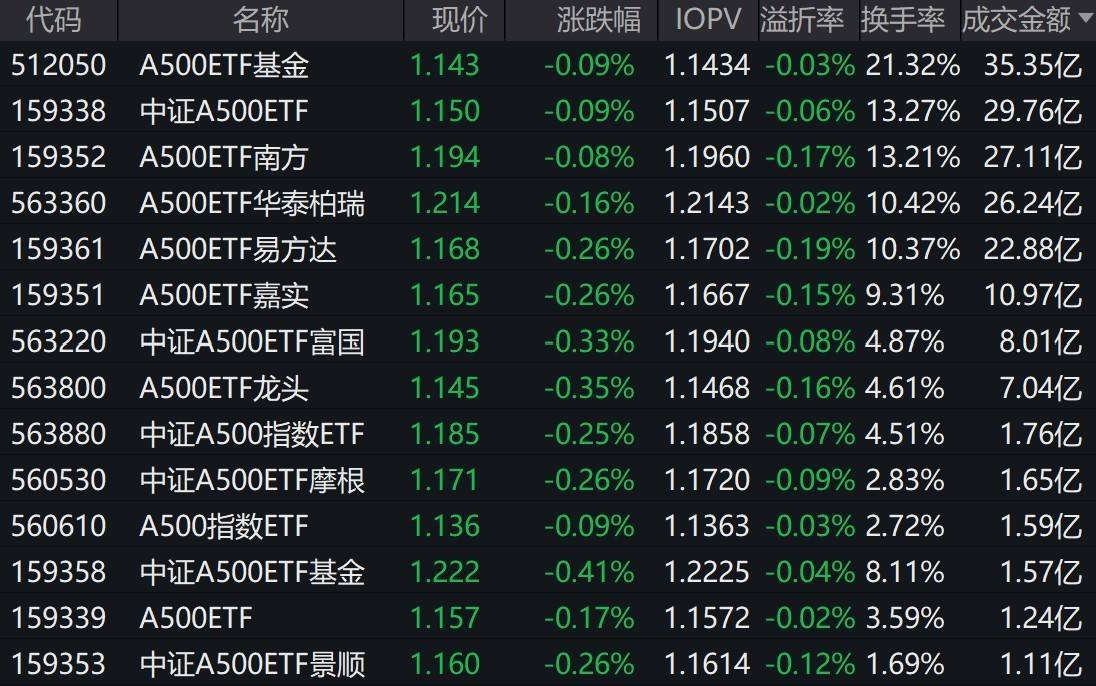
市场早间冲高回落,中证A500指数下跌0.04%。3只中证A500相关ETF成交额超27亿元
Sou Hu Cai Jing· 2025-10-15 03:54
Market Overview - The market experienced a morning surge followed by a slight decline, with the CSI A500 Index down by 0.04% [1] - The consumer sector showed repeated activity, while domestic software stocks rebounded and the innovative drug sector performed actively; however, the military industry sector weakened collectively [1] ETF Performance - As of the morning close, ETFs tracking the CSI A500 Index saw a slight decline, with 14 related ETFs having transaction volumes exceeding 100 million yuan, and 3 exceeding 2.7 billion yuan [1] - Specific transaction amounts for A500 ETFs included 3.535 billion yuan for A500 ETF Fund, 2.976 billion yuan for CSI A500 ETF, and 2.711 billion yuan for A500 ETF Southern [1][2] Investment Sentiment - Analysts noted that the current "bull market" is supported by the ongoing global AI wave, which has heightened technology investment enthusiasm, along with domestic "anti-involution" leading to improved performance expectations and increased liquidity from household savings entering the market [1] - The expectation of a Federal Reserve interest rate cut is seen as beneficial for the price appreciation of risk assets, reinforcing the foundation of the current market trend [1]
四川三线军工厂探访,占地650亩楼房林立,荒凉破败如空城
Sou Hu Cai Jing· 2025-10-14 16:33
Core Insights - The "Third Front" construction was a significant project in China from 1964 to 1978 aimed at relocating key industrial, technological, and defense capabilities to the southwestern and inland mountainous areas to enhance national security [1][11] - The project involved the establishment of numerous military factories, including the 348 Factory, which was built in the Huaying Mountains and became a symbol of this industrial effort [3][5] Group 1: Historical Context - The Third Front construction was the largest and longest industrial system construction in New China, with its major secrets only being disclosed in the late 1980s [1] - The goal was to create a defense system that would protect the core national capabilities from external attacks [1] Group 2: 348 Factory Overview - The 348 Factory, also known as the State-owned Hongguang Instrument Factory, was established in 1966 and initially focused on producing aiming devices for fighter jets [5] - Over time, the factory diversified its production to include civilian products such as movie cameras and carburetors, reflecting changes in military and civilian demand [5] Group 3: Factory Infrastructure and Community - The 348 Factory covered approximately 650 acres and employed around 2,400 workers, functioning as a self-contained community with various facilities including dormitories, schools, and recreational areas [7] - The factory was designed to support both production and the daily lives of its employees, creating a small society within its premises [7] Group 4: Current State and Legacy - The factory has deteriorated over time, with remnants of its past glory now hidden in the forest, symbolizing the passage of time and the decline of the once-thriving industrial site [9][11] - The current state of the 348 Factory serves as a reminder of the historical significance of the Third Front construction and the importance of national security and self-sufficiency [11]

中国式长臂管辖:这场稀土战争,我们赢定了
Sou Hu Cai Jing· 2025-10-14 13:27
Core Viewpoint - China has escalated its rare earth export controls, invoking national security reasons and implementing a "long-arm jurisdiction" over the global rare earth supply chain, which significantly impacts U.S. military capabilities [1][3][16] Group 1: China's Rare Earth Strategy - China is using advanced technologies such as blockchain tracking and nano-level electronic tagging to monitor the entire rare earth supply chain, ensuring transparency while controlling military exports [11] - The dual-track control system allows for civilian use while restricting military applications, effectively targeting U.S. military needs without disrupting normal trade [11][16] - China's rare earth processing capabilities are unmatched, with the ability to achieve a purity level of 99.999%, creating a monopoly in the market [6] Group 2: Impact on U.S. Military - The U.S. is heavily reliant on China for rare earth processing, with 90% of its rare earth elements processed in China, making it vulnerable to supply chain disruptions [6] - The F-35 fighter jet, for example, requires 417 kilograms of rare earth materials, and the U.S. military's rare earth inventory can only last for six months under current export controls [8] - The production of F-35s has drastically decreased from 143 units in 2022 to an expected 36 units in 2024 due to rare earth supply constraints [8] Group 3: Long-term Strategic Implications - The ongoing U.S.-China competition over rare earths is not just a resource battle but also a technological and strategic one, with China actively controlling standards and technology across the supply chain [16][18] - The U.S. faces significant barriers in establishing its own rare earth production capabilities, which could take 5 to 10 years, leaving China in a position of leverage [13] - China's strategy aims to ensure that the U.S. remains dependent on its rare earth market, thereby maximizing the strategic value of these resources [16][18]
三线军工记忆:是谁留下的那一抹红,四川广元120厂的前世今生
Sou Hu Cai Jing· 2025-10-14 09:20
冬日的阳光温暖而柔和,把人影拉得很长,走在熟悉的道路上,阳光洒在身上,温度渐渐升高,让我不禁有种想脱下厚重棉服的冲动,正如茅盾小说中描写 的"直想把那棉服脱了去"。 与那些搬迁或已废弃的三线工厂相比,120厂依旧保存着相当规模。从一组航拍照片中可以看到,厂区沿公路两侧密集分布,但真正属于职工宿舍的区域, 只有几个集中地。其它单独的小楼,基本是本地原住民所建。 从沟口步行到中区的灯光球场,这段路对我小时候来说显得漫长无比。这里曾是4131厂,信箱号113,官名大明仪器厂,而我所在的厂则是4170厂,保密代 号为111信箱,广平机械厂。一个小溪把这片名为小孙家沟的地方自然分为东、西两个区域,两个厂被溪流分隔,坐落在南北两边,直到1983年两厂合并为 广明无线电厂,也就是今天的120厂。 厂区很大,分为南区和北区,南区以球场为中心,而北区则一直延伸到两公里外的黑石坡脚下。合并后的南区变成了中区,而以南大院为核心的区域则被称 为南区。 沿着球场右边的小路上行,便是厂区的办公楼,这是我曾在这里工作多年之地。推开门,室内一片沉寂,开门的吱吱声在这静默的环境中显得格外刺耳,似 乎在召唤那些曾经在这里工作的老员工。阳光透过门 ...

中国稀土管制令打响“时间争夺战”,能否重塑全球格局?
Sou Hu Cai Jing· 2025-10-13 19:43
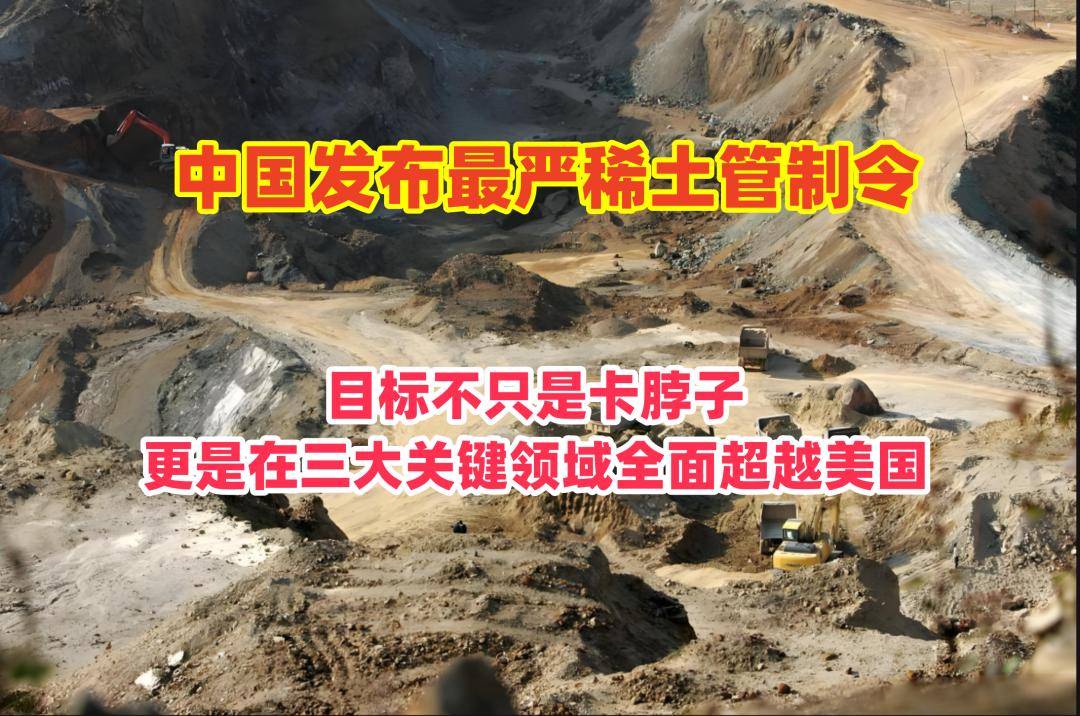
Core Insights - The recent announcement of China's strict rare earth regulations is viewed as a strategic move in a "race against time" that impacts global markets and technology sectors [1][3][8] - The competition between China and the U.S. in key areas such as AI, semiconductors, and military technology will shape the future global landscape [3][5] Industry Analysis - China's rare earth control is not merely a trade tactic but a strategic maneuver to secure a buffer period for industrial upgrades and technological breakthroughs [1][3] - The U.S. faces significant challenges in establishing a self-sufficient rare earth supply chain, with estimates suggesting it could take 5 to 10 years to reduce dependence on Chinese supplies [3][5] - China's rare earth regulations are creating opportunities in AI, where U.S. data center expansions are hindered by shortages, while Chinese AI chip performance is rapidly improving [3][5] - In the semiconductor sector, while U.S. companies struggle with supply issues, Chinese firms like SMIC and Yangtze Memory Technologies are making significant advancements in production capabilities [5] - The military sector is also affected, with U.S. defense production facing rare earth supply constraints, while China accelerates the development of advanced military technologies [5][7] Strategic Implications - The interplay between rare earth resources and advancements in AI, semiconductors, and military technology is creating a virtuous cycle that enhances China's competitive edge [5][7] - The strategic foresight of China's rare earth policy may lead to a significant shift in global industrial dynamics, positioning China as a leader in critical technology sectors [7][8]

特朗普千字怒文引美股崩盘!中国三拳出击反杀关税战?
Sou Hu Cai Jing· 2025-10-13 07:53
Group 1 - The U.S. stock market experienced a significant drop, with the S&P 500 index falling by 820 points, resulting in a loss of $700 billion in market value due to Trump's announcement of a 100% tariff [1][8] - China's implementation of rare earth material controls is seen as a critical blow to the U.S. military and technology sectors, particularly affecting companies like Lockheed Martin and Tesla [3][5] - Qualcomm faces a potential fine in the billions due to antitrust investigations, while Huawei's upcoming 5nm chips could disrupt the market, particularly impacting Apple's iPhone sales [5][6] Group 2 - New port fees imposed on U.S. ships entering Chinese ports could significantly increase operational costs, leading to concerns among American manufacturers about relocating production [6][8] - The rapid capital flight from U.S. markets to places like Singapore and Dubai indicates a strategic move by hedge funds to mitigate risks associated with the current trade tensions [8][10] - The political implications of these trade policies are evident, with companies like General Motors halting new factory plans in the U.S. and shifting focus to partnerships in China [8][10]
美国田纳西州一军用炸药厂爆炸
Xin Hua She· 2025-10-10 22:40
Group 1 - A significant explosion occurred at a military explosives factory in Humphreys County, Tennessee, resulting in 19 people reported missing, likely deceased [1][2] - The explosion took place around 7:45 AM, with the factory located approximately 100 kilometers southwest of Nashville [1] - The factory is owned by "American Precision Energy Systems," established in 1980, which manufactures various high explosives and specialty products for the U.S. Department of Defense and the industrial market [1] Group 2 - The cause of the explosion is currently unknown, and the Bureau of Alcohol, Tobacco, Firearms and Explosives has joined the investigation [2] - The Department of Defense has been informed of the incident and will conduct its own investigation [2]
谁帮中国堵了稀土走私后门?答案超意外——是美国公司!
Sou Hu Cai Jing· 2025-10-10 06:52
Core Insights - In April 2025, China implemented export controls on seven categories of medium and heavy rare earths, which initially raised concerns about the U.S. supply chain for rare earths, as 90% of refined rare earths in the U.S. come from China. However, three months later, U.S. companies like Lockheed Martin continued production of F-35s and Tesla maintained operations, indicating that smuggling may be occurring despite a 72% drop in Chinese exports [1][3]. Group 1 - The initial customs inspections of large containers yielded no results, but irregularities were discovered in cross-border express shipments labeled as "ceramic parts," which contained epoxy-encapsulated rare earth particles. This led to the uncovering of a smuggling network spanning China, Vietnam, and Mexico [3]. - The smuggling operations involved shipping "protein powder" to Vietnam, where it was mixed with clay and pressed into "ceramic tiles" for transport to Mexico. The extracted materials were then sent to U.S. military contractors as "scrap metal" [3]. - An anonymous tip from a U.S. molybdenum mining company revealed detailed information about the smuggling operations, including warehouses, contacts, and the flow of goods. The company reported that the smuggling of rare earths was undercutting its orders by 40% and causing issues with the purity of materials used in missile tests, prompting the report to protect the industry [3]. Group 2 - In August 2025, a joint law enforcement operation between China, Vietnam, and Mexico dismantled the smuggling network and intercepted shipments, revealing vulnerabilities in the U.S. "diversified supply chain." High-purity dysprosium and samarium are now primarily produced by China, leading to production cuts at Raytheon and Tesla [5]. - The molybdenum mining company that reported the smuggling has since signed long-term contracts with compliant companies, highlighting the importance of adhering to regulations for business sustainability [5]. - The situation illustrates a paradox where U.S. companies, in an effort to protect their interests, inadvertently assisted in closing off smuggling routes, reinforcing the notion that compliance with regulations is essential for survival in the industry [5].



多地能源设施遭袭后,乌克兰收到坏消息,欧洲又1国拒无条件援乌
Sou Hu Cai Jing· 2025-10-08 07:46
Core Viewpoint - The recent election results in the Czech Republic pose a significant challenge for Ukraine, as the newly elected leader, Babis, has indicated intentions to halt military support, particularly the artillery supply plan crucial for Ukraine's frontline needs [3][5][15]. Group 1: Election Results and Implications - The Czech parliamentary elections resulted in the "Action of Dissatisfied Citizens" party, led by former Prime Minister Babis, winning 34.7% of the votes, making it the largest party [3]. - The current government, which supports unconditional aid to Ukraine, received only 23% of the votes, indicating a shift in public sentiment towards prioritizing domestic issues over foreign aid [3][14]. - Babis's victory reflects a growing public desire to address domestic economic challenges rather than continue extensive support for Ukraine [3][12]. Group 2: Military Support and Supply Chain - The Czech Republic has been a key supplier of artillery to Ukraine, providing over 1.5 million shells since February 2024, which has been critical given the ongoing ammunition shortages faced by Ukraine [5][8][6]. - The cessation of the artillery supply plan, which Babis aims to implement, would exacerbate the ammunition crisis on the Ukrainian frontline, where daily consumption exceeds 10,000 shells [5][6]. - The Czech artillery supply plan was supported by nearly 20 countries, including significant contributions from Germany (540 million euros), the Netherlands (250 million euros), and Belgium (200 million euros) [8]. Group 3: Domestic Economic Concerns - Babis's campaign focused on addressing domestic economic issues, promising tax cuts and increased support for low-income households, which resonated with voters facing rising inflation and living costs [11][12]. - The Czech Republic has experienced inflation rates between 6% and 8%, leading many households to cut back on expenses, further influencing the electorate's preference for prioritizing national issues over foreign aid [12][13]. Group 4: Future of Czech Foreign Policy - The potential shift in Czech foreign policy towards reduced military support for Ukraine could lead to a broader trend among EU countries, raising concerns about the overall commitment to Ukraine amidst domestic pressures [15][16]. - If Babis successfully forms a coalition government, the Czech Republic may pivot from military assistance to humanitarian aid, impacting Ukraine's ability to sustain its defense efforts [16][18].