
工业

Search documents
252只港股获南向资金大比例持有
Zheng Quan Shi Bao Wang· 2026-01-09 01:43
Core Insights - The overall shareholding ratio of southbound funds in Hong Kong Stock Connect stocks is 19.38%, with 252 stocks having a shareholding ratio exceeding 20% [1] - Southbound funds hold a total of 4,931.19 million shares, accounting for 19.38% of the total share capital of the stocks, with a market value of 62,848.28 billion HKD, representing 14.76% of the total market value [1] - The stocks with the highest shareholding ratios by southbound funds are China Telecom (71.61%), Gree Power (69.82%), and Kaisa New Energy (67.97%) [1] Group 1: Shareholding Distribution - 252 stocks have a shareholding ratio of over 20%, 131 stocks have a ratio between 10% and 20%, 99 stocks between 5% and 10%, 79 stocks between 1% and 5%, and 22 stocks below 1% [1] - Among the stocks with over 20% shareholding by southbound funds, 131 are AH concept stocks, making up 51.98% of that group [1] Group 2: Industry Concentration - The stocks with over 20% shareholding by southbound funds are primarily concentrated in the healthcare, industrial, and financial sectors, with 57, 38, and 34 stocks respectively [2] - Notable stocks with high southbound fund holdings include: - China Telecom: 99,384.85 million shares, 71.61% of issued shares, closing price 5.340 HKD, daily change -0.74% [2] - Gree Power: 28,236.60 million shares, 69.82%, closing price 5.360 HKD, daily change 0.75% [2] - Kaisa New Energy: 16,996.20 million shares, 67.97%, closing price 3.920 HKD, daily change 1.55% [2]

在扩大对外开放上开辟新空间新路径
Xin Lang Cai Jing· 2026-01-08 23:07
《报告》明确了"十五五"时期的奋斗目标和主要任务:我们要一张蓝图绘到底,锚定"三大目标"不动 摇。更加凸显沈阳对外开放桥头堡的地位和作用,不断夯实沈阳城乡融合发展示范区的内涵和支撑,让 沈阳城市副中心的功能和品位更加鲜明。我们要加快高质量发展,聚焦"四大战略"求突破。实施开放带 动战略,实施特色产业崛起战略,实施乡村振兴战略,实施城市更新战略。 一区三园厚积薄发,乡村振兴持续稳定,工业产业转型提质,城市品质持续提升。2025年12月30日,沈 阳市辽中区第三届人民代表大会第五次会议在近海文体中心开幕。 辽中区政府区长杨晓波代表沈阳市辽中区人民政府作《政府工作报告》。《报告》对2025年政府工作进 行总结:全力以赴稳增长,区域发展更具特色。经济运行稳中向好,项目建设全面提速,一区三园厚积 薄发,对外开放纵深推进,发展活力全面激发;聚力攻坚强产业,发展根基更加坚实。乡村振兴持续稳 固,工业产业转型提质,消费潜力充分释放,央地合作持续深化;标本兼治优环境,绿色发展更富内 涵。粪污治理科学规范,水体环境全面改善,空气质量明显好转;统筹建管提品质,城乡功能更趋完 善。城市品质持续提升,城乡设施不断完善。农村面貌焕然一新 ...
德国走上“去工业化”不归路:资本外流、绿色政策重创制造业
Hua Er Jie Jian Wen· 2026-01-08 13:16
尽管商界领袖呼吁改革,但并未触及绿色转型政策这一核心问题,这使得工业衰退的风险在2026年进一 步加剧。 据德国工商总会(DIHK)针对2.3万家会员企业的最新调查显示,德国经济危机已延续至2026年,仅有六 分之一的企业预计经济会出现好转,而四分之一的企业正计划进一步裁员。DIHK的数据指出,自2019 年以来,德国工业部门已流失约40万个就业岗位。DIHK主席Helena Melnikov警告称,如果政策制定者 不能采取果断行动,德国面临价值创造和就业机会进一步大规模流失的风险,形势已十分严峻。 这种衰退正在对德国经济结构造成连锁反应,从工业相关服务业到区域贸易,甚至公共财政均受波及。 斯图加特、埃尔朗根和沃尔夫斯堡等传统工业中心的市政财政正面临赤字挑战,营业税收入显著萎缩。 与此同时,资本外流趋势并未减缓,虽然2025年的具体流出规模尚不完全明朗,但2024年的净直接投资 流出额为645亿欧元,2023年更是超过1000亿欧元。 市场的深层担忧在于,持续的经济衰退和明显的去工业化迹象表明,德国经济可能已经跨过了一个关键 的"临界点"。投资者和企业正在逃离高昂的监管成本和财政负担,而政府通过大量举债和补贴 ...
中衡设计(603017):中标杭州市教育发展服务中 (杭州市电化教育馆)采购项目,中标金额为1353.83万元
Xin Lang Cai Jing· 2026-01-08 11:36
Group 1 - Company Zhongheng Design Group Co., Ltd. won a bid for the Hangzhou Education Development Service Center project with a bid amount of 13.5383 million yuan [1][2] - In 2024, the company's operating revenue was 1.335 billion yuan, with a revenue growth rate of -22.84% [1][2] - The net profit attributable to the parent company for 2024 was 51 million yuan, with a net profit growth rate of -51.86% [1][2] Group 2 - In the first half of 2025, the company's operating revenue was 521 million yuan, with a revenue growth rate of -21.93% [2] - The net profit attributable to the parent company for the first half of 2025 was 57 million yuan, with a net profit growth rate of -19.35% [2] - The company operates in the industrial sector, with main product types including industrial construction and professional consulting services [2]

正在直播丨易方达基金杨正旺:红利可以“+”成长,不同风格并非一定“零和博弈”,或可实现在持有体验上1+1>2的效果
Xin Lang Cai Jing· 2026-01-08 08:42
Group 1 - The core viewpoint emphasizes that dividend assets can provide independent allocation value and complement growth-style assets, optimizing the overall risk-return structure of investment portfolios [1] - Dividend assets serve as a balancing tool in portfolios, particularly effective in a moderate credit cycle recovery and neutral market sentiment, highlighting their cost-effectiveness due to low valuations and stable dividends [1][2] - The combination of "dividend + growth" can significantly reduce portfolio volatility and maximum drawdown while maintaining return elasticity, potentially achieving a performance effect greater than the sum of its parts [1] Group 2 - New regulations on insurance funds have lowered the risk factors associated with dividend assets, guiding long-term capital allocation and providing structural support for dividend assets [2] - The dividend index is characterized as both a defensive allocation tool and a crucial component for enhancing long-term resilience in investment portfolios [3]
“十五五”期间,雅安围绕“三区两地一枢纽”谋篇布局 绿色发展,雅安如何“先行”
Si Chuan Ri Bao· 2026-01-08 00:24
Core Viewpoint - The article discusses the strategic development plan of Ya'an City, emphasizing its goal to become a leading green development city in the province and a new highland for opening up towards the west of Chengdu and Chongqing. The plan includes a focus on ecological, industrial, and open market development strategies to enhance the city's economic capabilities and quality of life for its residents [9][10]. Group 1: Development Strategy - The development strategy is centered around "ecological city, industrial city, and open city," with a clear path defined as "three zones, two areas, and one hub" [9][10]. - The strategy aims to establish a green industrial innovation development zone, a collaborative economic pilot zone with Tibet, and a significant functional area in the Chengdu metropolitan area [9][10]. Group 2: Economic and Social Goals - The city aims to significantly enhance its economic development capabilities, reform and opening-up levels, green transformation quality, social civilization standards, living quality, and safety development capabilities [10]. - Eight key measures have been proposed, including improving the modern industrial system, strengthening technological innovation, deepening reform and opening up, and enhancing urban-rural integration [10]. Group 3: Ecological and Industrial Focus - The article highlights the importance of ecological priorities in Ya'an's development, with a focus on creating a modern industrial system that supports green innovation and sustainable practices [11][12]. - Specific initiatives include promoting green industrialization and establishing a green industrial system supported by modern agriculture, services, and manufacturing [12][13]. Group 4: Open Market Development - The article emphasizes the role of openness in driving Ya'an's economic growth, with plans to build a comprehensive transportation hub and expand cooperation with surrounding regions [15][16]. - Key initiatives include enhancing transportation infrastructure, expanding international market access for local products, and developing a logistics center to support exports of unique products like caviar and lithium battery materials [15][16].


今年将实施重点产业项目和技改项目3000个左右 在新起点上高质量建设制造强省
He Nan Ri Bao· 2026-01-07 23:20
1月6日至7日,全省工业和信息化工作会议在郑州召开。会议全面落实中央经济工作会议和省委经济工 作会议、全国工业和信息化工作会议部署,总结2025年工作,部署2026年任务,动员全省工信战线聚 焦"1+2+4+N"目标任务体系,把握新形势,勇担新使命,保持竞进姿态,增强拼抢意识,在新起点上高 质量建设制造强省。 "2025年1至11月,全省规上工业增加值、工业投资分别同比增长8.4%、15.7%,双双居10个工业大省首 位,坚决扛起稳定工业经济大盘的政治责任。"省工业和信息化厅党组书记、厅长严琛在会上介绍, 2025年全省工信系统全力以赴稳增长、调结构、提质效、优治理,推动新型工业化迈出坚实步伐,实现 工业经济稳中向好、趋新向优,为全省"十四五"规划顺利收官交上出彩答卷。 "十五五"是河南由制造大省迈向制造强省的关键期,也是为基本实现新型工业化夯实基础、全面发力的 关键期。会上明确,"十五五"期间将做好改造升级"老字号"、深度开发"原字号"、培育壮大"新字号"、 精准拓展"外字号"四篇文章;实施产业创新、链群提质、"三化"转型、雁阵培育、场景拓展、开放带 动"六大工程";夯实稳比重、拓消费、化产能、降成本、强金 ...
地缘政治靠边站,美股2026年的真正驱动力还是“盈利为王”
Hua Er Jie Jian Wen· 2026-01-07 18:32
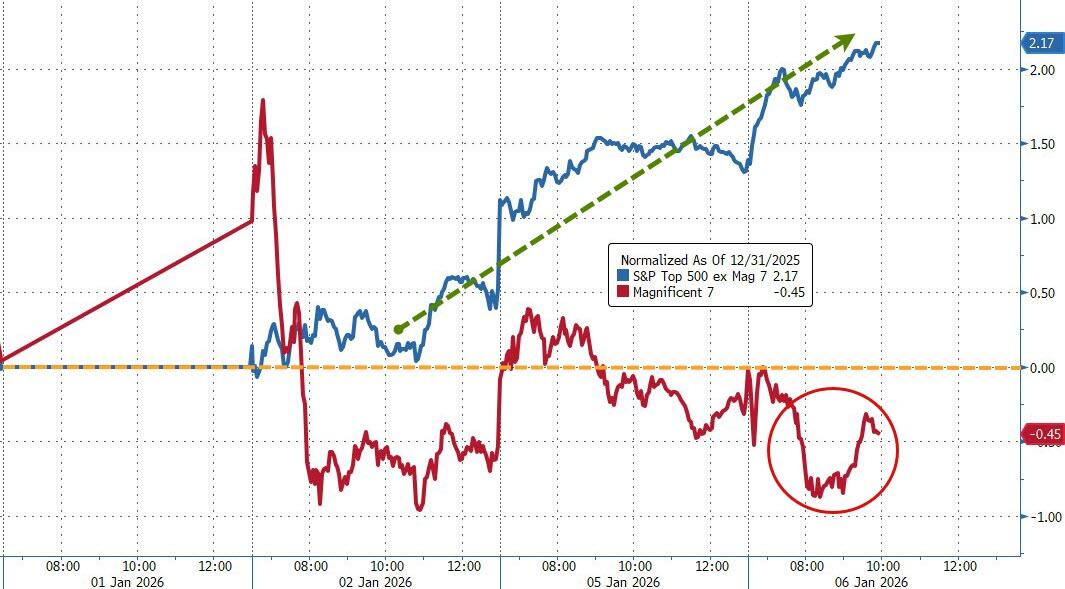
Core Viewpoint - The U.S. stock market is experiencing a trend of concentration dispersion at the beginning of 2026, with earnings growth becoming the core driver of market increases. Goldman Sachs predicts the S&P 500 index will rise to 7600 points in 2026, primarily driven by a 12% growth in earnings [1]. Market Structure Changes - Since the start of 2026, the "Magnificent Seven" tech giants, including Nvidia, Apple, Microsoft, Alphabet, Amazon, Tesla, and Meta, have collectively declined by approximately 0.5%, while the remaining 493 stocks in the S&P 500 have increased by 2.5%. This shift indicates a reallocation of assets by investors, with industrial, healthcare, and technology sectors performing notably well in the first three trading days of the year [1]. Economic Growth and Earnings Projections - Goldman Sachs' Managing Director Chris Hussey notes that accelerated U.S. economic growth combined with loose monetary policy will drive the rise of cyclical sectors in early 2026, including small-cap stocks and companies related to non-residential construction. The firm expects S&P 500 constituent earnings per share (EPS) to grow by 12% in 2026 and by 10% in 2027 [2][3]. Key Investment Themes - Five key investment themes for the U.S. stock market in 2026 have been identified: 1. Mid-cycle acceleration, recommending an increase in cyclical stocks, including industrial and HVAC-related stocks [4]. 2. "Massive Re-leveraging," where financial stocks will benefit as companies increase borrowing for future investments [5]. 3. Focus on the application of artificial intelligence (AI), with investment opportunities in companies deploying AI solutions to reduce costs [5]. 4. "Revival of the Arts," where private equity is expected to see a resurgence in exits, distributions, and fundraising due to a rebound in IPOs and M&A activity [5]. 5. Value investment opportunities, particularly in the healthcare sector, as favorable macroeconomic conditions suggest continued strong performance of value factors [5]. Risks to Monitor - Goldman Sachs highlights three key risks: the potential for economic recession due to worsening employment, the possibility of slowing AI growth impacting the overall economy, and interest rate risks. While the firm predicts moderate fluctuations in the yield of 10-year U.S. Treasuries, accelerated GDP growth typically accompanies rising yields, which could pose challenges for the stock market [6].

京东工业(07618):部分行使超额配股权、稳定价格行动及稳定价格期间结束
智通财经网· 2026-01-07 13:14
Core Viewpoint - JD Industrial (07618) announced the partial exercise of the over-allotment option involving 3.9574 million shares, representing approximately 1.87% of the total shares initially available for subscription before any over-allotment options are exercised [1] Group 1 - The overall coordinator representing international underwriters will partially exercise the over-allotment option on January 7, 2026, after trading hours [1] - Merrill Lynch International has borrowed 31.6812 million shares from JD Industrial Technology Limited to cover the excess allocation for the international offering [1] - The over-allotment shares will be issued at a final offering price of HKD 14.10 per share [1] Group 2 - The Hong Kong Stock Exchange has approved the listing and trading of the over-allotment shares [1] - The over-allotment shares are expected to commence trading on the main board of the Hong Kong Stock Exchange on January 12, 2026, at 9:00 AM [1]
中信重工(601608):中标包头华美稀土高科有限公司采购项目,中标金额为2800.00万元
Xin Lang Cai Jing· 2026-01-07 10:51
Group 1 - The core point of the news is that China Northern Rare Earth Group's smelting subsidiary has awarded a procurement project to CITIC Heavy Industries, with a contract value of 28 million yuan, for the upgrade of green smelting facilities [1][2] Group 2 - CITIC Heavy Industries (601608.SH) reported a revenue of 8.034 billion yuan in 2024, with a revenue growth rate of -15.93% and a net profit attributable to the parent company of 375 million yuan, reflecting a net profit growth rate of -2.36% [2][3] - In the first half of 2025, the company achieved a revenue of 3.981 billion yuan, with a revenue growth rate of 2.35% and a net profit attributable to the parent company of 203 million yuan, showing a net profit growth rate of 6.39% [3] - The company operates in the industrial sector, with its main product types including generators and auxiliary equipment, environmental machinery, metallurgical machinery, heavy construction machinery, and specialized equipment and components [2][3] - The main business composition for 2024 is as follows: heavy equipment segment 69.48%, special materials 16.66%, power industry 11.26%, and new energy equipment 2.61% [2][3]
