本地生活服务

Search documents
天津沧州吴桥商会与天津市消费流通促进会开展交流座谈 共探消费流通领域合作新路径
Sou Hu Cai Jing· 2025-10-18 05:27
Core Insights - The meeting between Tianjin Cangzhou Wuqiao Chamber of Commerce and Tianjin Consumer Circulation Promotion Association focused on resource integration and innovative development in the consumption circulation sector [1][4][6] - The discussion highlighted the importance of digital transformation in the consumption circulation field, with emphasis on the role of technology in enhancing operational efficiency [6] Group 1: Meeting Overview - The meeting was initiated with a warm welcome from the Secretary-General of Tianjin Consumer Circulation Promotion Association, who introduced the association's development history and core functions [4] - The "Zhangshang Tianjin" platform was presented as a key player in local life services, showcasing its operational model and user scale [4] Group 2: Chamber of Commerce Insights - Wu Shengheng, Secretary-General of Cangzhou Wuqiao Chamber of Commerce, provided an overview of the chamber's development, member composition, and recent work priorities [4] - The focus was on the strategic consulting services offered by Tianjin Daote Think Tank, led by the chamber's president, Han Liansheng [4] Group 3: Digital Transformation Discussion - The meeting included a presentation by the head of Tianjin Mengkai Network Technology Co., detailing their digital payment and membership SaaS systems [6] - The discussion sparked interest in the application scenarios and cooperation models for digital solutions in various industries [6] Group 4: Future Collaboration - The cross-chamber and cross-sector dialogue was seen as a platform for resource integration and mutual development [6] - The meeting established a solid foundation for future cooperation in consumption circulation and enterprise services, aiming to enhance the prosperity of Tianjin's consumer market [6]


围绕开店和外卖,美团一口气发布三个智能助手,AI投入已达百亿
3 6 Ke· 2025-10-17 00:24
Core Insights - Meituan's CEO Wang Puzhong showcased the company's AI products for the restaurant industry at the 8th Restaurant Industry Conference, emphasizing a comprehensive approach to integrating AI into various operational aspects of restaurants [2][4]. AI Product Offerings - Meituan introduced three AI assistants for merchants: "Kangaroo Advisor," "Kangaroo Manager," and "Smart Steward," all built on the self-developed LongCat-Flash-Chat model, aimed at enhancing decision-making and operational efficiency in restaurant management [4][11]. - "Kangaroo Advisor" is an independent app designed to assist restaurant owners with high-uncertainty decisions such as location selection, menu pricing, and product offerings, utilizing various analytical metrics to reduce the failure rate of new stores [5][7]. - "Kangaroo Manager" and "Smart Steward" are integrated into Meituan's merchant operational backend, focusing on streamlining daily operations and providing real-time data analysis to improve efficiency [7][9]. Technical Foundation - The LongCat-Flash-Chat model employs a MoE architecture, optimizing for reasoning speed and cost while being adaptable for complex tasks in the restaurant sector [11][12]. - The AI solutions are designed to be auditable and reviewable, ensuring that business owners understand the rationale behind AI recommendations and can assess their effectiveness [12]. Integration and Future Prospects - There is potential for synergy between Meituan's consumer-facing AI assistant "Xiao Mei" and the B2B AI tools, allowing for improved operational efficiency and customer service through shared data and capabilities [13][14]. - The company aims to create an AI ecosystem where these assistants collaborate effectively, presenting both opportunities and challenges for future development [14].


商家和消费者,不再“独宠”大众点评
Sou Hu Cai Jing· 2025-10-16 16:35
Core Insights - The restaurant industry is shifting its marketing focus from traditional platforms like Dianping to newer social media platforms such as Douyin and Xiaohongshu, reflecting a broader trend in consumer engagement and marketing strategies [3][19]. Group 1: Market Trends - The online penetration rate of dine-in services is approximately 10%, indicating significant market potential for growth [3]. - The competitive landscape has evolved, with platforms like Douyin and Kuaishou entering the dine-in service market, leading to diversified platform choices for restaurants [3][19]. - Restaurants are increasingly recognizing the importance of online marketing, moving from a singular focus on Dianping to exploring various social media platforms [4][19]. Group 2: Marketing Strategies - Many small restaurants are leveraging Xiaohongshu for its community-driven content, creating a closed-loop of user engagement from content viewing to in-store consumption [4][6]. - In smaller cities, restaurants often rely on local word-of-mouth and social media platforms rather than Dianping, which is less utilized [6][9]. - Marketing budgets are tightening, prompting restaurants to be more strategic in their platform choices and marketing expenditures [9][10]. Group 3: Platform Dynamics - Dianping is facing challenges in maintaining its credibility and trust among consumers, necessitating improvements in its rating system and exposure strategies [17][19]. - Xiaohongshu must address issues related to the authenticity of its content to retain user trust and engagement [17]. - Douyin's challenge lies in converting views into actual sales and repeat customers, highlighting the need for effective marketing strategies [17][19]. Group 4: Future Outlook - The trend indicates that restaurants will need to adopt a multi-platform marketing approach, akin to investment strategies, to optimize their marketing effectiveness [19]. - The competition among platforms is intensifying, and restaurants are likely to diversify their marketing efforts across multiple channels to enhance customer retention and conversion rates [19].
美团追加28亿元帮餐饮商家稳经营 外卖、堂食商家均可获得现金支持
Di Yi Cai Jing· 2025-10-16 14:02
Core Insights - Meituan announced an additional investment of 2 billion yuan to support not only takeaway merchants but also dine-in businesses [2] - The company will invest an additional 300 million yuan to encourage restaurants to explore new store formats, products, and services [2] - Meituan will also provide 500 million yuan in subsidies for the "Bright Kitchen, Bright Stove" initiative, aiming to create transparent kitchen infrastructure in collaboration with merchants [2] Investment and Support Initiatives - The total additional funding includes 2 billion yuan for expanding support to dine-in merchants [2] - A dedicated fund of 300 million yuan will be allocated for innovative restaurant models and services [2] - The "Bright Kitchen, Bright Stove" initiative will receive 500 million yuan to enhance kitchen transparency [2] Business Model Innovations - Meituan encourages merchants to adopt new revenue models such as satellite stores, takeaway self-pickup, and group meal services [2]
到店风云录:美抖阿「三国杀」,一场没有退路的战争
雷峰网· 2025-10-13 13:18
Core Viewpoint - The competition in the local service market is intensifying, with Meituan facing challenges from Douyin and Alibaba, as they both seek to capture market share in the restaurant and local service sectors [2][5][42]. Group 1: Douyin's Entry and Impact - Douyin's entry into the local service market has significantly disrupted Meituan's growth, with Douyin's order volume surpassing Meituan's during promotional events [4][5]. - Douyin's aggressive marketing strategies, including live streaming and heavy subsidies, have attracted merchants and consumers alike, leading to rapid user growth [4][9]. - The competitive landscape has shifted, with Douyin's user base expanding quickly, putting pressure on Meituan to respond effectively [3][13]. Group 2: Meituan's Response Strategies - In response to Douyin's rise, Meituan has initiated several defensive strategies, including launching live streaming features and shifting to a direct sales model in lower-tier cities [25][27]. - Meituan's efforts to support merchants through subsidies and reduced commissions have helped maintain its market position, although this has come at a significant financial cost [30][31]. - The internal restructuring within Meituan aims to enhance operational efficiency and adapt to the changing market dynamics, with a focus on integrating its delivery and local service businesses [31][34]. Group 3: Alibaba's Involvement - Alibaba's recent entry into the local service market through Taobao and Gaode has introduced a new competitive element, potentially reshaping the market dynamics further [42][43]. - Gaode's "Street Ranking" feature aims to leverage user behavior data to provide a unique evaluation system, challenging the existing dominance of platforms like Dazhongdianping [48][50]. - The competition is evolving into a three-way battle, with Meituan, Douyin, and Alibaba all vying for market share, which could lead to increased pressure on Meituan's profitability [54][56]. Group 4: Market Dynamics and Future Outlook - The local service market remains attractive due to its higher profit margins compared to food delivery, prompting ongoing interest from various players [66][68]. - The competition is expected to continue intensifying, with new entrants and existing players exploring innovative strategies to capture consumer attention and market share [67][68]. - The evolving landscape suggests that the battle for dominance in the local service sector is far from over, with potential for further disruptions and shifts in market leadership [65][68].


美团试点:骑手可“拉黑”顾客
Guan Cha Zhe Wang· 2025-10-13 10:11
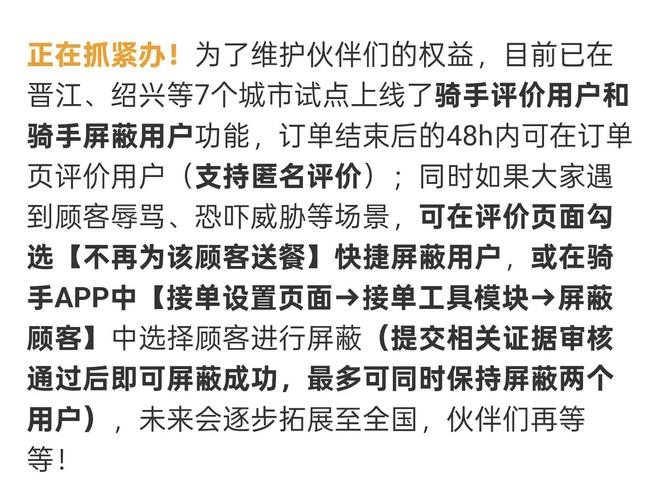
Core Viewpoint - Meituan has launched a pilot feature in seven cities that allows delivery riders to evaluate and block users, enhancing rider protection and promoting a more balanced interaction between users and riders [1][2]. Group 1: New Features and User Interaction - The new feature enables riders to anonymously evaluate users within 48 hours after order completion and block users who threaten or insult them [1][2]. - Riders can only block a maximum of two users at a time, with a blocking period of 365 days, after which the block is automatically lifted [2]. - The introduction of this feature is seen as a significant step towards establishing a two-way evaluation and trust mechanism, enhancing riders' dignity and voice [2]. Group 2: Industry Impact and Service Optimization - If widely adopted, this feature could lead to further optimization of service rules in the local life service sector, balancing interests among various stakeholders and fostering a healthier platform ecosystem [2]. - Meituan has implemented several protective policies for riders this year, including the cancellation of penalty fees for late deliveries and the introduction of a pension insurance subsidy [3][4]. - The company aims to create a more equitable and humane incentive mechanism, shifting from negative penalties to positive incentives for riders [3][4]. Group 3: Financial Insights - In May, Meituan disclosed that the average monthly income for high-frequency riders ranged from 7,230 to 10,100 yuan, with skilled riders in major cities earning up to 12,593 yuan [3].
高德扫街掀起榜单暗战,百度、抖音入局“三国杀”
Sou Hu Cai Jing· 2025-10-13 01:17
Core Insights - The article discusses the recent surge in daily active users for Gaode Map during the National Day holiday, attributed to the launch of the "Street Ranking" feature, which aims to penetrate the local lifestyle service market dominated by Meituan [2][3] - Despite the initial success, there are concerns regarding the fairness of the algorithm used for recommendations, as it may favor easily accessible locations over quality establishments [4][5] - The competitive landscape is evolving, with Baidu Map and Douyin Life Services introducing their own ranking systems shortly after Gaode's launch, indicating a fierce battle for market share in the local lifestyle sector [7][8] Gaode Map's Strategy - Gaode Map has undergone significant organizational changes within Alibaba, being categorized under "other businesses" following a restructuring aimed at focusing on e-commerce and cloud services [3] - The introduction of "Amap 2025" marks Gaode's transition from a navigation tool to an AI-driven application, leveraging Alibaba's AI capabilities to enhance user experience [3][4] - The "Street Ranking" feature aims to create a trustworthy ranking system by utilizing user behavior data and a credit system, covering over 1.6 million offline merchants across more than 300 cities [4] Challenges and Concerns - Users have raised issues regarding the complexity of the new features, leading to complaints about the application becoming cumbersome [4] - The reliance on sensitive user data for the "Street Ranking" raises privacy concerns, especially in a tightening regulatory environment [5] - Gaode's commitment to not commercialize the "Street Ranking" feature poses questions about its long-term sustainability, especially given the significant financial investments made to attract users [5][9] Competitive Landscape - Baidu Map's "AI Ranking" adopts a collaborative approach by integrating existing third-party rankings, allowing for a more efficient content ecosystem [7] - Douyin's "Heartbeat Ranking" focuses on user engagement metrics rather than geographical data, reflecting a shift towards content-driven consumer behavior [8][9] - The competition highlights different strategies: Gaode emphasizes authentic user behavior, Baidu leverages partnerships for content aggregation, and Douyin capitalizes on emotional engagement to drive consumer decisions [9]
美团闪购异地订单量同比增长47%
Xin Lang Cai Jing· 2025-10-11 14:28
Core Insights - Meituan Flash Purchase has reported a significant increase in consumption trends for the upcoming Mid-Autumn Festival and National Day, with intercity orders growing by 47% year-on-year, reaching a new high in overall consumption scale [1] Sales Performance - The sales of mobile digital products have doubled compared to last year, while the sales of liquor have tripled and tea has seen over a twofold increase [1] - Orders and transaction volumes for gift flowers have shown steady growth [1] Consumer Spending Trends - The average spending amount for categories such as 3C home appliances and beauty skincare has significantly increased compared to the same period last year [1]
深度| 扫街榜给线下小店引流破亿,高德和美团进入新基建之战
Guan Cha Zhe Wang· 2025-10-11 11:40
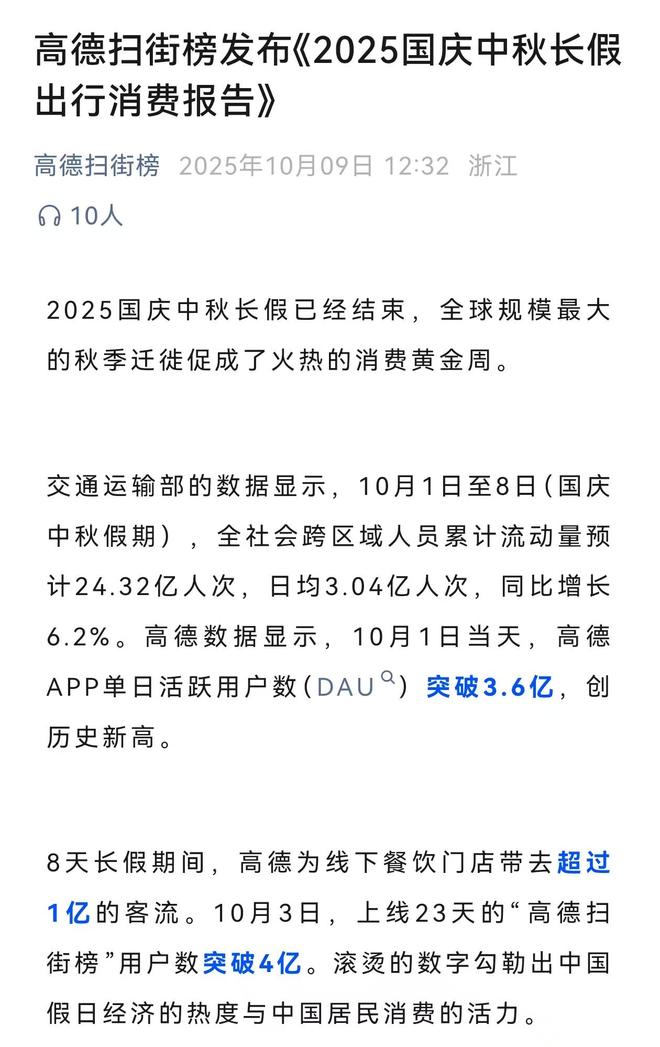
Core Insights - Offline dining merchants have unexpectedly become the focal point in this year's local lifestyle battle, with the launch of Gaode's "Street Scanning List" injecting new vitality into the market [1][3][10] - The "Street Scanning List" has achieved over 400 million users within 23 days of its launch, indicating strong acceptance from both merchants and consumers [7][10] - The competition in the local lifestyle market is evolving into a battle for new infrastructure, focusing on building a credible offline service credit system [6][10][11] Summary by Sections Market Dynamics - During the recent National Day and Mid-Autumn Festival holidays, Gaode's initiatives drove over 100 million customer visits to offline dining establishments [3][8] - Over 70% of the "must-eat" restaurants saw a more than 200% increase in traffic compared to the pre-holiday period, with many being long-established local eateries [3][11] Competitive Landscape - Gaode's "Street Scanning List" is positioned as a new type of infrastructure, akin to logistics networks and payment systems, enhancing its commercial and social value [5][6] - The competition between Gaode and Meituan is not just about market entry but also about establishing a new service credit system that can serve various industries [6][10] User Engagement and Growth - The "Street Scanning List" has rapidly gained traction, with a user base exceeding 400 million shortly after launch, reflecting a shift in consumer habits and preferences [10][11] - Gaode's promotional strategies, including a support plan for merchants and waiving annual fees for restaurant listings, have led to a 631% increase in new merchant registrations within 24 hours of announcement [8][10] Future Outlook - The local lifestyle market still holds significant untapped potential, as evidenced by the growth in dining consumption in cities like Hangzhou, which saw a 17.1% increase in spending during the holiday period [11] - The competition in the local lifestyle sector is expected to intensify, focusing on AI-driven recommendations and governance to filter out low-quality information [10][11]

深度| 扫街榜小店引流破亿,高德美团进入新基建之战
Guan Cha Zhe Wang· 2025-10-11 11:35
Core Insights - Offline dining merchants have unexpectedly become the focal point in this year's local lifestyle competition, with the launch of Gaode's "Street Scanning List" injecting new vitality into the market [1][3][6] Group 1: Market Dynamics - Gaode's "Street Scanning List" has attracted over 400 million users within 23 days of its launch, indicating strong market acceptance and user engagement [6][7][9] - During the recent National Day and Mid-Autumn Festival holidays, Gaode drove over 100 million customer visits to offline dining establishments, showcasing its impact on consumer behavior [3][6] - The competition between Gaode and Meituan is not just about market share but represents a broader battle for establishing a new infrastructure for local services [5][11] Group 2: Consumer Behavior and Trends - The "Street Scanning List" and similar recommendation systems are evolving into essential infrastructure, akin to logistics and payment systems, enhancing the commercial and social value of local dining experiences [5][10][11] - The rise of small local eateries during the holidays reflects a shift in consumer preferences towards authentic dining experiences, with over 70% of popular dining spots seeing a more than 200% increase in traffic compared to pre-holiday levels [3][10] Group 3: Competitive Landscape - The competition in the local lifestyle market is characterized by a focus on building a reliable credit system for offline services, with both Gaode and Meituan striving to differentiate themselves through technology and algorithmic capabilities [9][12][14] - The ongoing battle for consumer trust and credibility in the evaluation of local dining options is central to the competition, as establishing a trustworthy credit system is crucial for market leadership [12][13][14]