
航运业

Search documents
10月制造业PMI为49.0%,高技术制造业仍处于扩张区间 | 高频看宏观
Sou Hu Cai Jing· 2025-11-07 03:58
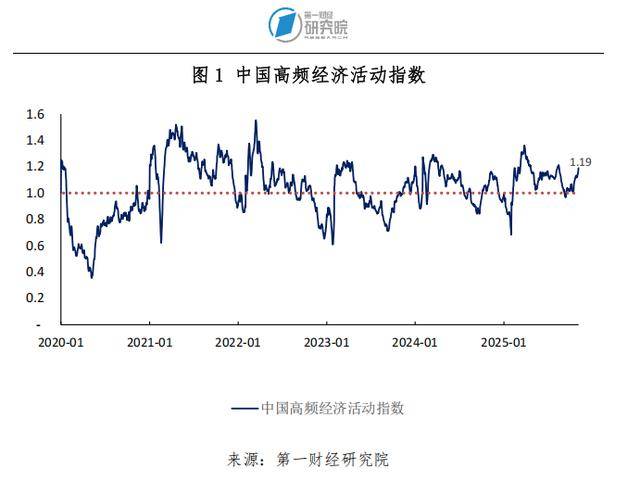
Group 1: Economic Activity Index - The China High-Frequency Economic Activity Index (YHEI) reached 1.19 on November 4, 2025, an increase of 0.07 from October 28 [1][3] - Key contributors to the YHEI increase include the Coastal Coal Freight Index and the Imported Dry Bulk Freight Index, which rose to 1.22 and 1.12, respectively [1][3] - The 30-City Commodity Housing Sales Index fell by 0.06 during the same week [1][3] Group 2: Manufacturing and PMI - The Manufacturing Purchasing Managers' Index (PMI) for October was 49.0%, down 0.8 percentage points from the previous month, indicating a contraction in manufacturing activity [23][24] - High-tech manufacturing, equipment manufacturing, and consumer goods sectors maintained expansion with PMIs of 50.5%, 50.2%, and 50.1%, respectively [23][24] - Large manufacturing enterprises saw a PMI drop to 49.9%, while medium and small enterprises' PMIs decreased to 48.7% and 47.1% [23][24] Group 3: Supply and Demand Indicators - The production index fell to 49.7% in October, influenced by the National Day holiday [24] - New orders and new export orders indices decreased to 48.8% and 45.9%, respectively [24] - The purchasing index dropped to 49.0%, indicating reduced procurement activity amid slowing production [24] Group 4: Non-Manufacturing Sector - The Non-Manufacturing Business Activity Index was 50.1%, slightly up by 0.1 percentage points from the previous month [24] - The construction sector's index fell to 49.1%, while the services sector's index rose to 50.2% [24] Group 5: Monetary Policy and Interest Rates - The central bank's net fund injection was 119.9 billion yuan for the week ending November 4, 2025 [5][6] - The overnight interbank rate decreased by 17 basis points to 1.36%, while the seven-day repo rate fell by 16 basis points to 1.47% [10][11] - One-year and ten-year government bond yields decreased by 3.85 and 1.95 basis points to 1.39% and 1.80%, respectively [10][16] Group 6: Commodity Prices - Steel billet prices decreased by 1.68% over the past week and 6.39% year-on-year [25] - Cement prices increased by 0.12% week-on-week but fell by 22.28% year-on-year [25] - Power coal prices rose by 1.18% month-on-month but decreased by 4.20% year-on-year [25] Group 7: Real Estate Market - New housing transaction areas in first and third-tier cities fell by 20.39% and 26.08%, respectively, while second-tier cities saw a 1.59% increase [35][36] - Second-hand housing transaction areas decreased by 5.24%, 1.75%, and 17.04% in first, second, and third-tier cities, respectively [39] Group 8: Global Economic Indicators - The US Dollar Index rose by 1.49 points to 100.21, while the RMB/USD exchange rate fell by 227 basis points to 7.1233 [45][46] - The Chicago Board Options Exchange VIX Index increased by 2.58 points to 19 [49]

航运日报:下半月实际揽货价格逐步报出,运价中枢或能再度小幅抬升-20251107
Hua Tai Qi Huo· 2025-11-07 03:14
1. Report Industry Investment Rating - Unilateral: The 12 - contract is expected to be oscillating upward [7] - Arbitrage: None at present [7] 2. Core Viewpoints of the Report - The actual freight - booking prices in the second half of the month are gradually being reported, and the freight rate center may rise slightly again [1] - The 12 - month contract trading focuses on the rhythm, and the overall valuation support is constantly rising. Shipping companies will adjust the supply to keep freight rates at a relatively high level for the next - year long - term agreement negotiation [4] - The 2026 February contract may have a large expectation gap, but it is currently suppressed by the resumption of navigation expectations [5] - The reduction of the 10% "fentanyl tariff" is conducive to promoting the recovery of Sino - US trade, which will drive the demand on the US route to pick up and support the European route prices to some extent [3] 3. Summary According to the Directory 3.1 Futures Prices - As of November 6, 2025, the total open interest of all container shipping index European line futures contracts was 69,438.00 lots, and the daily trading volume was 47,681.00 lots. The closing prices of EC2602, EC2604, EC2606, EC2608, EC2610, and EC2512 contracts were 1601.00, 1178.00, 1414.20, 1484.00, 1140.00, and 1848.20 respectively [5] 3.2 Spot Prices - Online quotes of different shipping companies show price increases in the second half of November and December. For example, HPL's 11 - month second - half - month shipping schedule quote increased from 1185/1935 in the first half of November to 1935/3135, and the December first - half - month shipping schedule quote is 1935/3135 [1] - The SCFI (Shanghai - Europe route) price announced on October 31 was 1344 US dollars/TEU, the SCFI (Shanghai - US West route) price was 2647 US dollars/FEU, and the SCFI (Shanghai - US East) price was 3438 US dollars/FEU. The SCFIS (Shanghai - Europe) on November 3 was 1208.71 points, and the SCFIS (Shanghai - US West) was 1267.15 points [5] 3.3 Container Ship Capacity Supply - In November, the monthly average weekly capacity from China to European base ports was 286,000 TEU, and in December, it was 322,900 TEU. There were 10 blank sailings and 1 TBN in November and 6 TBNs in December [3] - As of October 31, 2025, 218 container ships with a total capacity of 1.784 million TEU had been delivered in 2025. Among them, 67 ships with a capacity of 12,000 - 16,999 TEU (total 1.008 million TEU) and 11 ships with a capacity of over 17,000 TEU (total 236,320 TEU) were delivered [6] 3.4 Supply Chain - Geopolitical factors: The Israeli Defense Minister instructed the Israeli army to divide the area near the Israeli - Egyptian border into a closed military zone and adjust the rules of engagement [2] - The US will cancel the 10% so - called "fentanyl tariff" on Chinese goods, and the 24% reciprocal tariff on Chinese goods will continue to be suspended for one year. The US will also suspend the implementation of its 301 investigation measures on China's maritime, logistics, and shipbuilding industries for one year. In response, China will also suspend its counter - measures against the US for one year [3] 3.5 Demand and European Economy - The reduction of the 10% fentanyl tariff is helpful for the recovery of Sino - US trade, which will drive the demand on the US route to pick up and support the European route prices to some extent [3] - The shipping companies will adjust the supply to keep the freight rates at a relatively high level in the fourth quarter to prepare for the next - year long - term agreement negotiation [4]

银河期货每日早盘观察-20251106
Yin He Qi Huo· 2025-11-06 03:08
1. Report Industry Investment Ratings The report does not provide industry investment ratings. 2. Core Views of the Report - The A - share market showed resilience despite external shocks. The stock index futures market is expected to remain in a high - level shock in the short term, while the bond market has limited upward space. - In the agricultural products market, the prices of different varieties vary. For example, the price of soybean meal is affected by trade relations and supply - demand, and the international sugar price is in a downward trend. - The black metal market is in a state of shock. Steel prices are in a range - bound state, and the double - coke market is expected to be strong after a callback. - The non - ferrous metal market has different trends for each variety. Precious metals are in a range - bound arrangement, and the prices of some metals are affected by factors such as supply - demand and cost. - The energy and chemical market also shows different trends. For example, the price of crude oil has support, while the price of asphalt is under pressure. 3. Summary by Relevant Catalogs Financial Derivatives - **Stock Index Futures**: The market was affected by the overnight decline of US stocks but quickly rebounded. The short - term market will maintain a high - level shock. It is recommended to buy at low levels near 3930 points of the Shanghai Composite Index and reduce positions at high levels above 4000 points. Also, consider IM\IC long 2512 + short ETF cash - and - carry arbitrage and bull spread options at low levels [18][19]. - **Treasury Futures**: The treasury futures closed mostly lower on Wednesday. It is recommended to take appropriate profit - taking. In the future, short - term long positions can be tried on the TL contract, and pay attention to short - term spread and term spread arbitrage opportunities [22][23]. Agricultural Products - **Soybean Meal**: Trade relations are beneficial to US soybeans, but the international soybean supply is abundant. The price of domestic soybean meal is supported in the near - term but under pressure in the long - term. It is recommended to short the far - month contracts [25][26]. - **Sugar**: The international sugar price is in a downward trend due to increased production in major producing areas. The domestic sugar price is expected to be in a range - bound state. It is recommended to operate in the range and short the international sugar while going long on Zhengzhou sugar [29][30][31]. - **Oilseeds and Oils**: The palm oil inventory in Malaysia is expected to gradually decrease after accumulating in October, and the domestic palm oil inventory is increasing. It is recommended to wait for the market to stabilize and then consider going long at low levels [33][34][35]. - **Corn/Corn Starch**: The US corn is expected to be in a narrow - range shock. The domestic corn price has a short - term decline space. It is recommended to go long on the 12 - month US corn on dips, wait and see for the 01 - month contract, and wait for a callback for the 05 and 07 - month contracts [37][38]. - **Pigs**: The pressure of pig slaughter continues, and the price remains low. It is recommended to short a small amount [39][40][41]. - **Peanuts**: The peanut spot price is rebounding, and the 01 - month contract is in a short - term bottom shock. It is recommended to go long lightly on the 01 and 05 - month contracts [42][43][44]. - **Eggs**: The number of culled chickens has increased, and the egg price has stabilized. It is recommended to close out previous short positions and wait and see [45][46][47]. - **Apples**: The market is expected to fluctuate greatly with the release of warehousing data. It is recommended to wait and see [50][51][52]. - **Cotton - Cotton Yarn**: The cotton harvest is at its peak. The supply is expected to increase, and the demand is in the off - season. The price is expected to be slightly stronger in a shock. It is recommended to wait and see [55][56][57]. Black Metals - **Steel**: The iron - making output is shrinking, and the steel price is in a range - bound state. It is recommended to go long on dips and continue to hold the long position of the coil - screw spread [60][61]. - **Double - Coke**: The market is in a high - level shock. It is recommended to wait for a callback and then go long [62][63][64]. - **Iron Ore**: It is recommended to take a bearish view. The price is expected to be in a high - level bearish operation [65][66]. - **Ferroalloys**: The valuation is at a low level, and previous short positions can be reduced. It is recommended to sell out - of - the - money straddle option combinations [68]. Non - Ferrous Metals - **Precious Metals**: Multiple factors are intertwined, and the precious metals market is in a range - bound arrangement. It is recommended to operate in a band [71][72][74]. - **Copper**: The downstream purchasing sentiment has improved. It is recommended to wait and see and continue to hold the inter - market cash - and - carry arbitrage [75][76][77]. - **Alumina**: The supply - side production reduction has not been implemented, and the price is in a bottom - grinding state. It is recommended to wait and see [78][80][81]. - **Electrolytic Aluminum**: The demand is resilient, and the price is expected to rise on dips. It is recommended to go long on dips and consider long Shanghai aluminum and short LME aluminum arbitrage [82][84][85]. - **Cast Aluminum Alloy**: The seasonal peak season is coming, and the price is expected to rise on dips. It is recommended to go long on dips [86][87][89]. - **Zinc**: It is recommended to wait and see. The price is expected to be strong in the short - term, and previous long positions can take partial profit [90][91][92]. - **Lead**: It is recommended to hold short positions. The price may have a downward space. Be vigilant about the impact of funds on the price [94][95]. - **Nickel**: The supply - demand is loose, the cost support is weakening, and the price is expected to decline in a shock [96].
海航科技:11月5日融资净买入78.18万元,连续3日累计净买入5269.46万元
Sou Hu Cai Jing· 2025-11-06 02:40
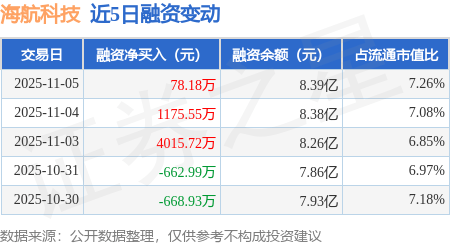
Core Insights - HNA Technology (600751) reported a net financing purchase of 781,800 yuan on November 5, 2025, with a total financing balance of 839 million yuan, indicating a continuous net purchase trend over the past three trading days totaling 52.69 million yuan [1][4]. Financing Activity - On November 5, 2025, the net financing purchase was 781,800 yuan, with a financing balance of 839 million yuan, representing 7.26% of the circulating market value [2]. - The previous trading days showed a net financing purchase of 11.76 million yuan on November 4 and 40.16 million yuan on November 3, while there were net financing repayments on October 30 and 31 [2]. - The total financing balance increased by 0.09% from the previous day, reaching 841 million yuan [4]. Margin Trading - On November 5, 2025, there were 9,700 shares sold short, with a margin balance of 2.09 million yuan and a remaining short position of 466,200 shares [3]. - The margin trading activity showed fluctuations, with a net short sale of 14,100 shares on November 3 and a net buy of 6,200 shares on October 31 [3]. Overall Margin Balance - The total margin balance reached 841 million yuan on November 5, 2025, reflecting a slight increase of 77,520 yuan from the previous day [4]. - The margin balance had previously increased by 11.71 million yuan on November 4 and 40.25 million yuan on November 3, indicating a generally positive trend in margin trading [4].

福建海通发展股份有限公司关于2025年股票期权与限制性股票激励计划股票期权预留授予结果公告
Shang Hai Zheng Quan Bao· 2025-11-05 20:25
Core Viewpoint - The announcement details the stock option and restricted stock incentive plan for 2025 by Fujian Haitong Development Co., Ltd, including the reserved grant of stock options and their terms [2][3][8] Summary by Sections Reserved Grant Details - The reserved grant registration date for stock options is November 5, 2025 [2] - A total of 1.015 million stock options are reserved for 33 eligible participants, with an exercise price set at 7.05 yuan per option [2][3] Plan Approval and Authorization - The board of directors approved the grant of reserved stock options during the 30th meeting of the fourth board on September 22, 2025 [2][3] - The plan excludes independent directors and shareholders holding more than 5% of the company's shares [3] Validity and Exercise Terms - The validity period for the stock options is up to 66 months from the initial authorization date [6] - The waiting period for the stock options varies, with specific waiting periods of 12, 24, 36, and 48 months before options can be exercised [6] Registration and Accounting Impact - The stock options were registered with the China Securities Depository and Clearing Corporation on November 5, 2025 [6] - The company will adjust the expected number of exercisable stock options based on performance metrics and will account for the related costs in accordance with accounting standards [7]

中远海控(01919.HK)11月5日回购1679.22万港元,已连续4日回购
Zheng Quan Shi Bao Wang· 2025-11-05 15:05
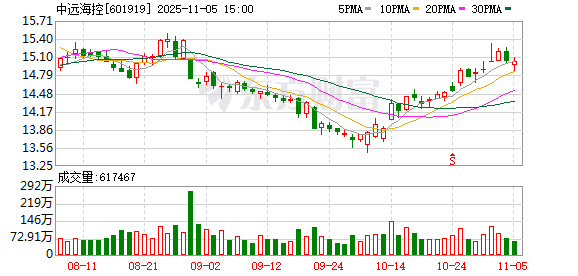
Core Points - China COSCO Shipping Holdings Co., Ltd. has been actively repurchasing its shares, with a total of 1,025,000 shares repurchased over four consecutive days starting from October 31, 2025, amounting to HKD 14 million [2] - The stock price on November 5, 2025, ranged from HKD 13.320 to HKD 13.590, with a closing price of HKD 13.590, reflecting a decrease of 0.59% for the day [2] - Year-to-date, the company has conducted 92 repurchase transactions, totaling 356 million shares and an aggregate repurchase amount of HKD 4.637 billion [2] Repurchase Details - On November 5, 2025, the company repurchased 125,000 shares at a maximum price of HKD 13.590 and a minimum price of HKD 13.320, with a total expenditure of HKD 16.79 million [2] - The repurchase activity included significant transactions on previous days, such as 450,000 shares on November 4, 2025, for HKD 61.70 million, and 300,000 shares on October 31, 2025, for HKD 40.71 million [2][3] - The highest repurchase price recorded this year was HKD 15.040 on May 26, 2025, while the lowest was HKD 11.440 on February 4, 2025 [3]

洲际船务附属拟2270万美元出售一艘散货船
Zhi Tong Cai Jing· 2025-11-05 14:43
Core Viewpoint - The company has entered into an agreement to sell a bulk carrier for a maximum price of $22.7 million, aligning with its strategy to optimize its fleet composition and improve liquidity [1] Group 1: Transaction Details - The seller, an indirect wholly-owned subsidiary of the company, has agreed to sell a bulk carrier built in 2006 with a total tonnage of 104,700 tons [1] - The vessel is currently leased to the seller under a bareboat charter, and the seller intends to exercise a purchase option before the delivery date [1] - The sale is expected to enhance the company's working capital position and provide funds for acquiring new vessels [1] Group 2: Strategic Implications - The transaction aligns with the group's ongoing strategy to maintain a balanced fleet composition [1] - The board believes that this sale represents an opportunity to sell the vessel at a reasonable price [1] - The company will continue to monitor the current market conditions in the shipping industry and adjust its fleet composition as necessary [1]
洲际船务(02409)附属拟2270万美元出售一艘散货船
智通财经网· 2025-11-05 14:39
Core Viewpoint - The company, Intercontinental Shipping (02409), has announced the sale of a bulk carrier for a maximum price of $22.7 million, aligning with its strategy to optimize its fleet composition and improve liquidity [1] Group 1: Transaction Details - The transaction involves the sale of a bulk carrier built in 2006 with a total tonnage of 104,700 tons [1] - The seller plans to exercise a purchase option to buy the vessel before the delivery date, which is currently leased to the seller under a bareboat charter [1] Group 2: Strategic Implications - The sale is seen as an opportunity to sell the vessel at a reasonable price, which will enhance the company's working capital and liquidity [1] - The funds from this transaction will be used to acquire new vessels, further optimizing the company's fleet composition [1] - The company will continue to monitor the current market conditions in the shipping industry and adjust its fleet composition as necessary [1]
中远海控:首次回购A股股份6059095股
Zheng Quan Ri Bao· 2025-11-05 13:38
Core Points - Company announced the repurchase of A-shares on November 5, 2025, through the Shanghai Stock Exchange [2] - A total of 6,059,095 shares were repurchased, representing 0.0391% of the company's total share capital as of October 31, 2025 [2]
海通发展:关于2025年股票期权与限制性股票激励计划股票期权预留授予结果公告
Zheng Quan Ri Bao Zhi Sheng· 2025-11-05 11:39
Group 1 - The company has completed the registration work for the stock option reserve grant under the "Incentive Plan (Draft) for 2025 Stock Options and Restricted Stock of Fujian Haitong Development Co., Ltd." [1] - The registration date for the stock option reserve grant is November 5, 2025 [1] - The number of stock options reserved for grant is 1.015 million [1]